You’ve finalised the brand name, registered the company and ordered the logo. Then you type the name into a browser and find someone else sitting on the .com. Or the .in shows a “this domain is for sale” page asking for ₹5 lakh. Or, worse, there’s an Instagram account using your name, your logo and your product photos, taking orders and money from your customers.
This is one of the most common, and most stressful, problems founders and brand owners face online. The good news is that Indian law and international domain dispute systems give brand owners real tools. Depending on the facts, you may be able to get the domain name transferred to you within about two months, have a fake social media handle taken down within days, or get a court injunction that reaches future copycats too.
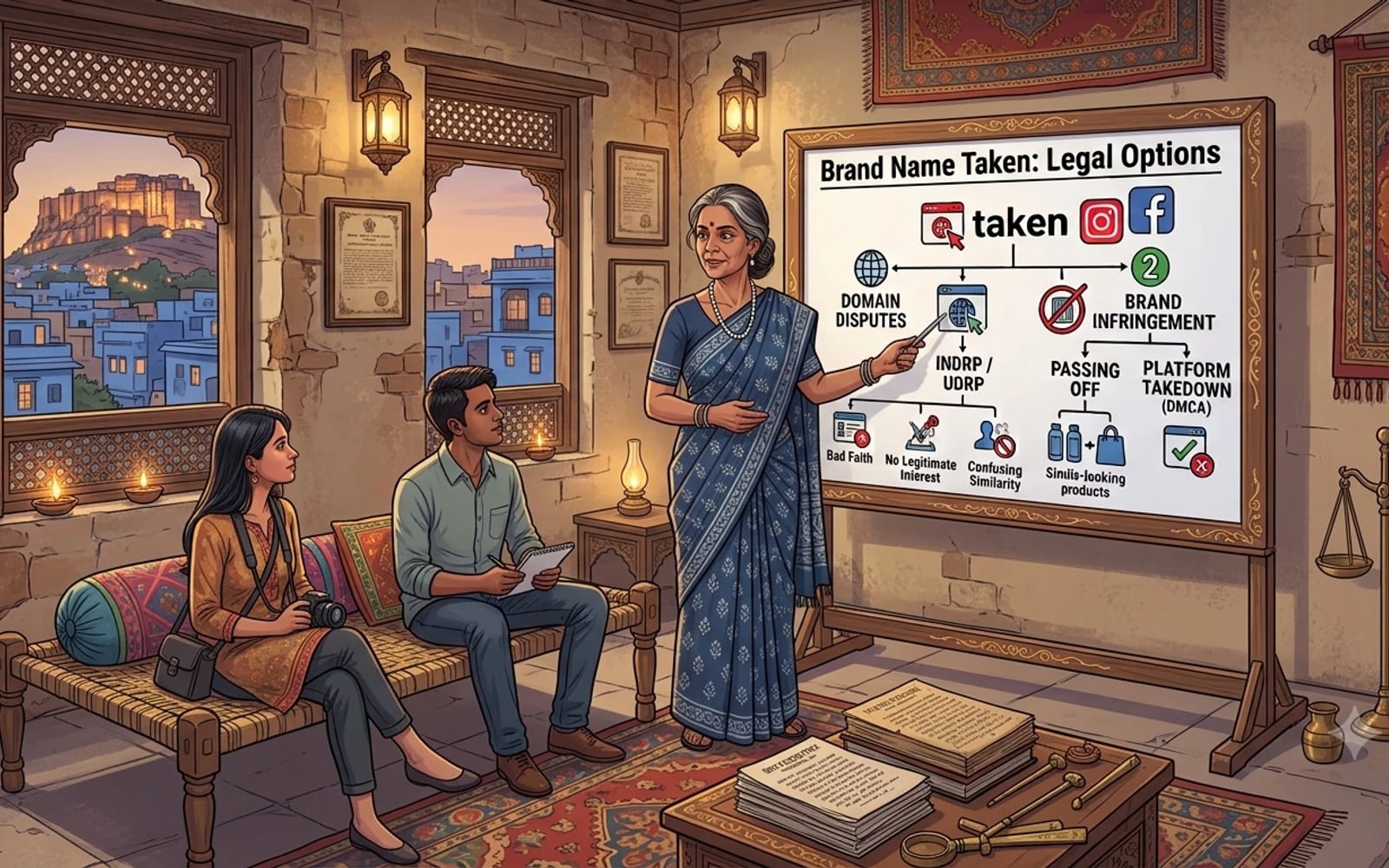
This guide walks you through every legal option when your brand name is taken as a domain or social handle: INDRP for .in domains, UDRP for .com and other global domains, court action for passing off and trademark infringement, and platform takedowns for social media accounts.
Before you act: how Indian law treats domain names and social handles
India has no separate “domain name law”. Domain name disputes and fake social handles are dealt with through trademark law, the law of passing off, dispute resolution policies built into the domain system, and the IT Rules that govern platforms.
The foundation is the Supreme Court’s decision in Satyam Infoway Ltd. v. Sifynet Solutions (2004). The Court recognised that a domain name is not just an internet address. It works as a business identifier, much like a trademark, so the law of passing off applies to it. That principle now extends naturally to social media handles, which do the same job on Instagram, X, YouTube and LinkedIn.
Before you send a single legal notice, work through four questions. Your answers decide which legal option fits.
- What rights do you have in the brand name? A registered trademark is your strongest asset. It makes an INDRP or UDRP complaint far simpler and lets you sue for trademark infringement. If your mark isn’t registered, you can still rely on passing off, but you’ll need evidence of prior use, reputation and goodwill, such as sales, advertising and press coverage.
- Who got there first? If someone registered the domain name years before your brand existed, it’s very hard to show they took it in bad faith. Filing a domain dispute in that situation can backfire. UDRP panels can make a finding of “reverse domain name hijacking” against a brand owner who abuses the process.
- Is this a cybersquatter or a genuine user? A cybersquatter registers a domain name or handle to sell it back to you, to divert your customers, to sell counterfeits or to run a scam. A genuine user might simply share your name for an unrelated business, such as a bakery in Pune with the same name as your fintech app. The law treats these very differently.
- What is the domain or handle being used for? A parked page with a “for sale” banner, a site that redirects to your competitor, pay-per-click ads in your industry, fake franchise or job offers, or a phishing page each point strongly to bad faith.
Collect evidence straight away
Take dated screenshots of the website or social handle, save WHOIS records (often masked by privacy services), archived versions of the site, any messages offering to sell the domain, and any customer complaints or confusion. Avoid making a high offer to buy the domain before you’ve taken legal advice: an offer of sale from the other side can later be evidence of bad faith, but an inflated offer from you won’t help your case.
Getting a .in domain back: the INDRP domain dispute process
If someone has registered your brand name as a .in domain, or a .bharat domain in an Indian language, the fastest legal option is usually a complaint under the .IN Domain Name Dispute Resolution Policy (INDRP). It is administered by NIXI, the National Internet Exchange of India, and decided by a sole arbitrator from NIXI’s panel under the Arbitration and Conciliation Act, 1996 (Lexology; HK India).
What you must prove
An INDRP complaint is built on three elements:
- the disputed domain name is identical or confusingly similar to a name, trademark or service mark in which you have rights;
- the registrant has no rights or legitimate interests in the domain name; and
- the domain name was registered, or is being used, in bad faith.
The policy gives examples of bad faith: registering the domain primarily to sell it to the brand owner, blocking the brand owner from using its own name online, disrupting a competitor’s business, or using the domain to attract users for commercial gain by creating confusion with your brand. The registrant can defend itself by showing a genuine business under the name before the dispute, that it is commonly known by that name, or a legitimate non-commercial use.
How the INDRP process works
- You file the complaint with NIXI, with evidence of your trademark rights and the respondent’s bad faith, and pay the fee. A separate complaint is needed for each domain name.
- NIXI checks the complaint and, once it complies, appoints an arbitrator within five working days (.IN Registry). The domain is locked so it can’t be transferred during the dispute (Global Law Experts).
- The arbitrator serves notice on the registrant, who gets a chance to respond.
- The arbitrator must deliver the award within 60 days of the proceedings starting, extendable by up to 30 days in exceptional cases (LDOTR).
What it costs
The INDRP schedule of fees is ₹10,000 for the Registry’s administration fee and ₹20,000 for the arbitrator, about ₹35,400 per domain name once GST is added (.IN Registry). Professional fees for drafting the complaint come on top.
The remedy
The arbitrator can order the domain name to be transferred to you or cancelled. Costs can also be awarded, though in practice the main prize is getting the domain back. INDRP doesn’t award damages, so for those you’ll need a civil suit. Because an INDRP award is an arbitral award, the losing party can challenge it in court under Section 34 of the Arbitration and Conciliation Act, but only on the limited grounds that section allows.
For straightforward cybersquatting of a .in domain, especially where the registrant doesn’t respond, INDRP is quick, relatively cheap and effective. It’s the route we’d usually try first.
.com and global domains: the UDRP domain dispute process
If your brand name has been taken as a .com, .net, .org or one of the newer generic domains (.shop, .app, .online and so on), the equivalent route is the Uniform Domain-Name Dispute-Resolution Policy (UDRP). Every ICANN-accredited registrar has to follow it. Indian brand owners file UDRP complaints all the time, most often with the WIPO Arbitration and Mediation Center, and you don’t need to go abroad to do it. The whole process happens online and in English.
What you must prove
The three UDRP elements look like INDRP’s, with one important difference:
- the domain name is identical or confusingly similar to a trademark or service mark in which you have rights;
- the registrant has no rights or legitimate interests in it; and
- the domain name has been registered and is being used in bad faith.
Under UDRP, bad faith must be shown both at registration and in use. INDRP’s wording is “registered or used”. That makes UDRP harder where a domain was registered innocently years ago and only later misused, or where your brand didn’t exist when the domain was registered. An unregistered trademark can still qualify if you can prove it has acquired distinctiveness through use.
Cost and timeline
WIPO’s fee for a single-member panel starts at about US$1,500 for one to five domain names, and a typical UDRP case takes around six to eight weeks (LDOTR). A three-member panel costs more, and the respondent can insist on one. Domain names under newer gTLDs can also be targeted under the Uniform Rapid Suspension (URS) system. It is cheaper and faster, but the standard of proof is higher (“clear and convincing evidence”), and the only remedy is suspending the domain, not transferring it to you.
The remedy
A UDRP panel can order transfer or cancellation of the domain name, but it can’t award damages or legal costs. Once a transfer is ordered, the registrar waits ten business days before implementing it. If the losing registrant files a court case within that window, the transfer is put on hold.
| Point of comparison | INDRP | UDRP |
|---|---|---|
| Domains covered | .in and .bharat | .com, .net, .org and other generic domains |
| Administered by | NIXI, sole arbitrator | WIPO and other approved providers, 1 or 3 panellists |
| Bad faith test | Registered or used in bad faith | Registered and used in bad faith |
| Official fees (approx.) | ₹35,400 per domain | From about US$1,500 for 1 to 5 domains |
| Typical timeline | Award within 60 days of commencement (extendable) | Around 6 to 8 weeks |
| Remedies | Transfer or cancellation; costs possible | Transfer or cancellation only |
The lesson for brands: if your name is taken across several domain extensions, you’ll often need both an INDRP complaint and a UDRP complaint, and possibly a court case for the rest.
Going to court: passing off, trademark infringement and dynamic injunctions
INDRP and UDRP are designed for one job: getting a domain name back. Sometimes you need more. Go to court when many domains or handles are involved, the registrants are hidden or keep changing, customers are being defrauded, you want damages, or you need orders against platforms, registrars and banks all at once.
Your causes of action
- Trademark infringement. If your trademark is registered, using an identical or deceptively similar mark in a domain name, website or social handle for related goods or services can be infringement under Section 29 of the Trade Marks Act, 1999. For well-known marks, the protection extends even to unrelated goods and services.
- Passing off. Even without registration, you can sue for passing off, which Section 27(2) preserves, by proving goodwill, misrepresentation and damage. Satyam Infoway confirms that passing off applies to domain names.
What the court can order
Under Section 135, the court can grant an injunction, including an urgent ex parte interim injunction, plus damages or an account of profits, and delivery up of infringing material. In domain name and impersonation cases, Indian courts now routinely go further. They direct registrars to suspend, lock or transfer domains and to disclose who registered them, order platforms to take down accounts, order banks to freeze accounts used in scams, and ask government agencies to block websites. You can sue where your business is based (Section 134), and urgent cases are exempt from pre-institution mediation under the Commercial Courts Act, 2015.
The Dabur judgment: a turning point
On 24 December 2025, in Dabur India Ltd. v. Ashok Kumar, Justice Prathiba M. Singh of the Delhi High Court delivered a landmark judgment on fraudulent domain names (LawFinder). Scammers had been registering domains using “DABUR” to run fake distributorship schemes. The court:
- granted a “dynamic+” injunction covering not just the domains identified but future mirror, redirect and alphanumeric variations of the DABUR mark (LawFinder);
- required domain name registrars to verify registrants through KYC and to disclose full registrant details within 72 hours of a valid request from law enforcement agencies or courts (Managing IP);
- directed that privacy protection be offered only as a paid add-on, not by default, that registrars appoint grievance officers in India, that domains found to be used illegitimately be permanently blocked, and that infringing domains be transferred to the trademark owner on a court order (Law.asia); and
- held that registrars’ safe harbour under Section 79 of the IT Act is not absolute, and that registrars that suggest infringing domain names for profit can’t claim to be neutral intermediaries (Suns Legal).
For brand owners, Dabur means a single well-drafted suit can now shut down a whole network of fake domains, including ones that haven’t been registered yet. One caution: GoDaddy has challenged the directions ending default domain privacy in appeal (MediaNama), so check the current position before relying on every direction in the judgment.
Criminal remedies for scams
Where fake domains or handles are used to cheat people with fake franchise offers, job scams or counterfeit sales, file a cybercrime complaint at cybercrime.gov.in or call 1930, and lodge an FIR. Relevant offences include cheating by personation using a computer resource (Section 66D, IT Act), cheating and cheating by personation under the Bharatiya Nyaya Sanhita, 2023, and falsely applying a trademark (Section 103, Trade Marks Act), punishable with six months to three years’ imprisonment and a fine of ₹50,000 to ₹2 lakh.
A word of caution: under Section 142 of the Trade Marks Act, someone you threaten with infringement proceedings without justification can sue you. Make sure your legal notice is based on solid rights.
Fake social media handles: platform takedowns, legal remedies and prevention
Social media handles don’t have an INDRP or UDRP. There’s no arbitration that orders Instagram to give you @yourbrand. But you do have three strong levers: the platform’s own policies, the IT Rules, and the courts.
Lever 1: Report it through the platform’s trademark or impersonation process
Meta (Instagram and Facebook), X, YouTube and LinkedIn all have dedicated forms for trademark infringement and impersonation, separate from the ordinary “report” button. Use the right form. A trademark complaint works best when you attach your trademark registration certificate, while an impersonation report fits accounts pretending to be your business. Include links, screenshots and evidence of customer confusion. Platforms usually remove or suspend the infringing handle. Releasing the username to you is much rarer, so act quickly and reserve variants of your name in the meantime.
Lever 2: Use the IT Rules grievance process
Every platform operating in India must have a Grievance Officer under the IT (Intermediary Guidelines and Digital Media Ethics Code) Rules, 2021. The Grievance Officer must acknowledge a complaint within 24 hours, and the February 2026 amendment cut the time to resolve it from 15 days to seven (MediaNama). Complaints about impersonation sit on a faster track, and the 2026 amendment tightened those windows further, especially where the impersonation uses AI-generated content. If the Grievance Officer refuses or doesn’t respond, you can appeal to the Grievance Appellate Committee within 30 days. A platform that ignores lawful complaints risks losing its safe harbour protection under Section 79 of the IT Act. (For impersonation using AI-generated faces or voices, see our guide on deepfakes and personality rights in India.)
Lever 3: Get a court order
Where fake handles keep coming back, or scammers are taking money from your customers, a suit for trademark infringement and passing off lets you seek an urgent injunction against the people behind the accounts (including unnamed “John Doe” defendants), directions to platforms to take down the handles and disclose the operators’ subscriber details, and a dynamic injunction covering new handles that appear later. For scams, combine this with a cybercrime complaint under Section 66D of the IT Act.
Prevention: your brand name protection checklist
Prevention is far cheaper than any domain dispute or takedown. Before you announce a new brand:
- Register the trademark in every relevant class, including classes 9 and 42 for apps and software and class 35 for online retail. A trademark registration is the backbone of every remedy in this article. Our guide to trademark registration for startups walks through the whole process.
- Buy the key domains: .com, .in, your industry’s extension, and the obvious typos. Register them in the company’s name, not a founder’s (see our guide to founders’ agreements in India).
- Reserve your handle on every major platform, even the ones you don’t plan to use yet.
- Get verified where platforms allow it, and list your official domains and handles on your website so customers can check.
- Monitor: set up alerts for new domains and handles using your brand name, and act on the first copycat instead of waiting for the tenth.
Quick answers
Can I get a domain back if I don’t have a registered trademark?
Possibly, if you can prove common law rights through use and reputation, but a registered trademark makes INDRP, UDRP and court action much easier.
How long does an INDRP domain dispute take?
The arbitrator must deliver the award within 60 days of the proceedings starting, extendable by up to 30 days in exceptional cases.
Can I force Instagram to give me my brand’s handle?
Not as of right. Platforms usually remove infringing handles. A court order or the platform’s trademark policy may help in clear cases.
Related reading: trademark squatting in India; also trade mark squatting in India.
Final word
Losing your brand name to a cybersquatter or impersonator isn’t the end of the story. For .in domains, INDRP is fast and affordable. For .com and other global domains, UDRP does the job. For networks of fake domains, fraud and repeat offenders, the Delhi High Court’s Dabur judgment has given brand owners some of the strongest court remedies anywhere. For fake social handles, platform policies, the IT Rules and the courts together can shut impersonators down. What decides your case is acting quickly, keeping good evidence and choosing the right legal route.
At Halverton & Co., we help startups, creators and businesses protect their brand name online, through trademark registration, INDRP and UDRP domain disputes, social media takedowns and passing off and trademark infringement actions. We practise in Jharkhand, Maharashtra and before the Supreme Court of India. Halverton & Co.: Where tech needs law!
If your brand name has been taken as a domain or social handle, write to us at office@halvertonandco.com or get in touch.
This article reflects the INDRP, UDRP, Indian case law and the IT Rules as reported up to early October 2026. Fees and procedures can change; check the current NIXI and WIPO schedules before filing. Sources: INDRP Rules of Procedure (.IN Registry) · S.S. Rana & Co. on the Dabur judgment
Related practice area
Intellectual Property
Trade marks, copyright, patents and designs. Searched, filed, licensed and enforced under Indian law.
View the practice area