Key takeaways
- Squatters register foreign brands in India to block the owner or sell the mark back; UK brands are common targets.
- A Delhi High Court order of 13 October 2026 and an IP India notice of 16 October 2026 started a consultation on squatting and AI misuse; the next hearing is reported for 14 December 2026.
- Watch the register and the Trade Marks Journal, check filers’ patterns and act within the four-month opposition window.
- File in India early, record your first use and keep distributors under written agreements.
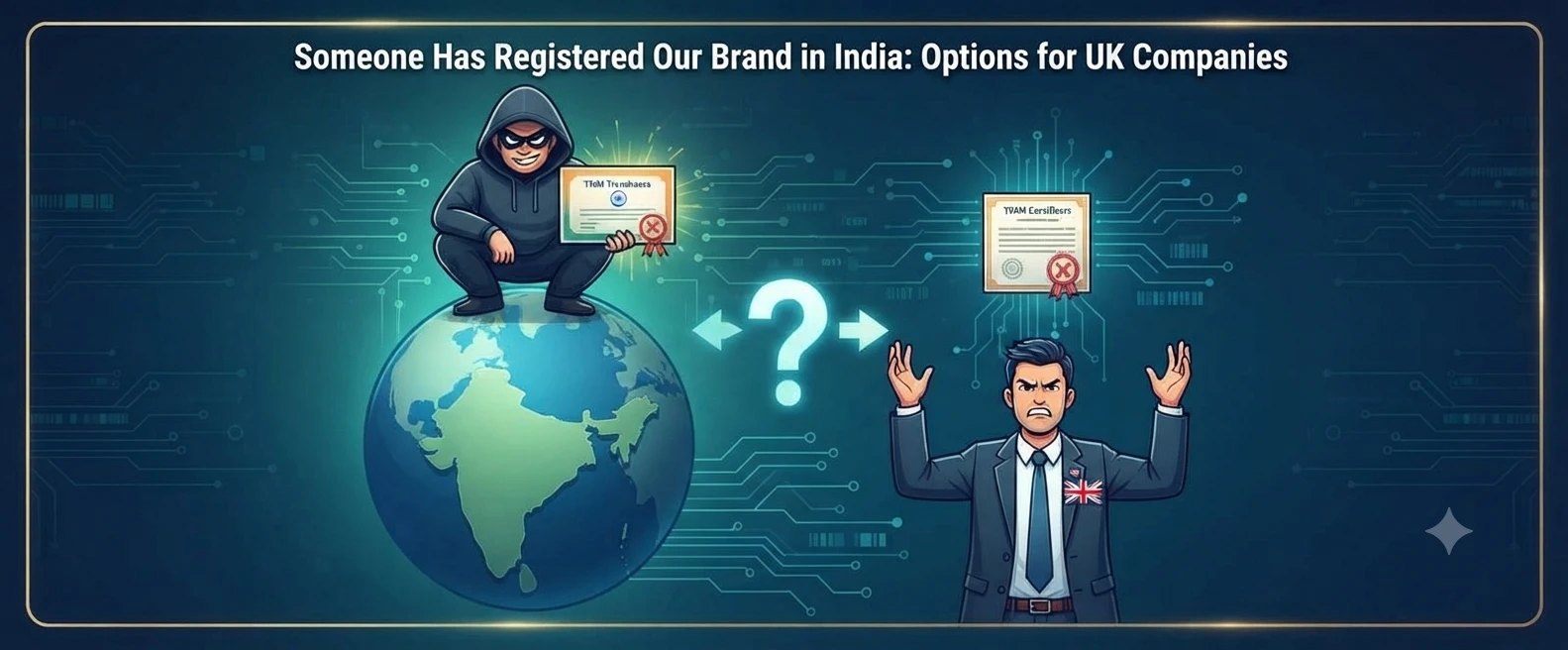
Trademark squatting India UK brand owners face is a real and common risk. A local filer registers or applies for a UK brand’s name in India before the owner arrives, hoping to block the brand or to sell the mark back. In October 2026, a Delhi High Court order pushed IP India to frame guidelines on squatting and on AI misuse, and a public notice dated 16 October invited comments within three weeks. The next court hearing is reported for 14 December 2026.
This guide explains how to spot squatters early, what the draft guidelines mean for UK brands, what legal tools exist, and a practical protection plan. It is written by an Indian law firm for UK readers. The draft is not final, so read the notice and the draft before relying on this summary, and take advice on your own marks.
What squatting looks like
Squatting means registering or applying for a mark that belongs in substance to someone else, usually a foreign brand that is not yet in India, in order to block that owner, to extract payment or to trade on its reputation. The squatter may file the exact name, a slight variation, a Hindi version or the logo. It may also register a matching domain and social handles, and then offer the brand for sale or demand a licence fee. Trademark squatting India UK brand cases follow this pattern.
UK brands are targets because many are known in India through media, the diaspora, tourism or online sales, but may not have filed there. Squatters watch for signs of market entry, such as news of a funding round, a trade deal or a partnership, and file soon afterwards. They also copy brands from the UK register. The harm is delay, legal cost and sometimes the loss of the name in India.
Squatting is different from a genuine dispute. A local business that has used a similar name in good faith for years is not a squatter, and the right response may be coexistence. Squatting involves bad faith: no intention to use, knowledge of the foreign brand and an aim to block or sell. Evidence of that intent is what changes the legal outcome, so spotting a pattern early matters.
What the 2026 draft rules mean for UK brands
According to reports, a Delhi High Court order of 13 October 2026 asked the Registrar to frame guidelines on malicious squatting of trade marks and on the misuse of AI. A public notice from the Controller General dated 16 October 2026 invited suggestions within three weeks, and reports of the next hearing give 14 December 2026. Check the notice for the exact closing date, since commentators read it differently.
The reported draft on AI would ask parties and agents to declare AI use in filings and to check any citations independently. For squatting, the guidelines are expected to deal with how the Registry treats bad faith filings, but the details are not final. The IP India draft is procedural guidance, not a new statute, and the law on squatting will continue to rest on the Trade Marks Act, 1999.
For UK brands, the main effects are practical. The Registry may become more alert to bad faith filings, and brand owners may get clearer routes to raise them. But the draft does not remove the need to file in India. If you have not filed, you remain exposed. Use the consultation as a reminder to audit your Indian rights, and consider submitting comments if you have experience of squatting. Trademark squatting India UK brand risk does not fall until you have filed.
How to spot squatters early
Run regular searches of the Trade Marks Registry and the Trade Marks Journal for your name and variants, including Hindi script and phonetic versions. Use a watch service that alerts you to new filings. Look at the filer: does it have many unrelated foreign brand filings, does it have no business in the field, and does the address or the agent match other suspicious filings? These are signs of a squatter. Early detection is the heart of managing trademark squatting India UK brand risk.
| Sign | What to check | Action |
|---|---|---|
| Many foreign brand filings | The filer’s other applications | Collect the list as evidence |
| No real business in the field | Website, address, products | Prepare a bad faith case |
| Filing soon after your news | Dates against your announcement or funding | Show knowledge of your brand |
| Offer to sell or demand for a fee | Messages and emails | Keep every message |
| Matching domain or handles | Registrations of your name | Note the pattern |
Monitor the market around your brand. Check domain registrations, social handles, marketplaces and app stores for names matching yours, and for sellers claiming to be your distributor. Watch for approaches: an unsolicited offer to sell the mark, or a demand for a fee to stop opposing. Keep every message. Also check your own distributors and agents, since a partner who files your mark in its own name creates a different, but related, problem.
Act on the signs quickly. The opposition period is four months from advertisement of the application in the Journal, and it cannot be extended. A pending application can also be challenged by a letter of objection to the Registrar. Collect evidence of your reputation, the date of your first use, your UK and international registrations and any proof that the filer knew of you. Early evidence is the best weapon.
Legal tools and a protection plan
The Trade Marks Act gives several tools. Section 11 and Section 11(10) deal with conflicts with earlier and well-known marks and bad faith, Section 18 allows only the proprietor to apply, Section 21 allows opposition to an application, and Section 57 allows rectification of a registered mark. Where a squatter is using the mark, a civil action for passing off and infringement is possible, with an application for an interim injunction. The Delhi High Court has dealt with squatting as bad faith in several cases.
A protection plan starts with filing. File your word mark and logo in India, directly or through the Madrid Protocol, in the right classes, before you announce an Indian launch. Record your first use in India. Consider an application for well-known mark status if your brand is widely known. Keep your distributors under written agreements that say who owns the mark and require them to assign anything they file.
Build a response process. Decide who monitors, who instructs Indian counsel, what evidence you keep and what settlement limits you are willing to consider. Where a squatter’s price is lower than the cost of a fight, a negotiated assignment may be sensible, but be careful about paying someone who may repeat the tactic. Review your portfolio yearly. For a UK brand, trademark squatting India UK brand risk is manageable with early action.
Next steps and quick answers
In the next month, search the Indian register for your names, file or review your Indian applications, set up a watch, collect evidence of reputation and read the IP India notice and draft. If you find a squatter, take advice immediately because the opposition deadline is fixed. This is general information, not legal advice. Treat trademark squatting India UK brand protection as a standing task.
Related reading: IP India’s draft rules on AI and trade mark squatting, trade mark squatting in India for UK companies, UK trade marks in India: Madrid or national filing, defending a UK brand against an Indian opposition, how to check a UK brand in India for free, getting a well-known trade mark declared in India and recovering a .in domain from squatters; also trademark opposition in India and trademark renewal in India.
Quick answers
What is trademark squatting in India?
It is registering or applying for another party’s brand, usually a foreign one, in bad faith to block the owner or to sell the mark back. Indian law gives tools such as opposition, rectification and passing off actions.
What do IP India’s 2026 draft rules mean for UK brands?
They signal a stronger focus on bad faith filings and on AI misuse, following a Delhi High Court order of 13 October 2026. The draft is not final, and UK brands still need to file in India to be protected.
How long do I have to oppose a squatter’s application?
Four months from the date the application is advertised in the Trade Marks Journal, and the period cannot be extended. Monitor the Journal and act quickly.
What do I do if a squatter has already registered my mark?
Take advice quickly. Options include rectification, evidence of bad faith and prior rights, negotiation and a passing off action, depending on the facts.
Is the draft final?
No. Reports say IP India invited comments within three weeks of a 16 October 2026 notice, and the court hearing is reported for 14 December 2026. Read the notice and check for updates.
Final word
Halverton & Co. is an Indian law firm advising UK companies, founders, investors and law firms on Indian law, including trade mark filing, watch and opposition in India, brand protection for UK companies, and enforcement against squatters. We practise in Jharkhand, Maharashtra and before the Supreme Court of India, and work alongside your UK solicitors, who advise on English law. Halverton & Co.: Where tech needs law! If you have a question about Indian law, write to us at office@halvertonandco.com, or get in touch.
This article reflects developments reported up to 31 October 2026. It is for general information only, is not legal advice, and does not create a solicitor-client relationship. Halverton & Co. is an Indian law firm, is not authorised or regulated by the Solicitors Regulation Authority, and does not advise on English law; UK-law points should be confirmed with UK advisers.
Sources
Related practice area
Intellectual Property
Trade marks, copyright, patents and designs. Searched, filed, licensed and enforced under Indian law.
View the practice areaComments
No account needed. Comments are reviewed before they appear, so yours will show here once approved. Please do not share confidential details or describe your own legal matter: replies are general discussion, not legal advice, and do not create an advocate-client relationship. For your own situation, write to office@halvertonandco.com.