Key takeaways
- A trademark registration in India lasts ten years from the date of application, not from the certificate date.
- Renewal is filed on Form TM-R, and a six-month grace period with surcharge is available after expiry.
- After removal, restoration is possible within a limited time, but sources differ on the anchor date and fees.
- Diarise expiry dates and keep the proprietor’s address current.
Trademark renewal India is a boring deadline with expensive consequences. A registered mark lasts ten years from the date of application, and then it has to be renewed. Miss the renewal window and the Registrar can remove the mark from the register. Brands that built value for a decade have found out the hard way that a reminder email was sent to an old address.
The good news is that there’s a grace period and, after that, a route to restoration. The bad news is that the exact fees and the way sources count the windows aren’t consistent, and a few details matter. Below is how renewal works, what the late-fee period is, what happens after removal, and a short plan for keeping your marks safe. Fees and timelines come from commercial guides, so check IP India’s current fee schedule. Trademark renewal India is a boring deadline with expensive consequences.
How long a registration lasts
Under Section 25 of the Trade Marks Act, 1999, a registration is valid for ten years from the date of the application, not from the date the certificate is issued. That is a common mistake. A mark applied for in March 2016 that took two years to register still expires in March 2026, so the trademark validity ten years India rule works from the filing date. Trademark renewal India works from the date of application.
Renewal gives another ten years, counted from the expiry of the previous term, and can be repeated without limit as long as the mark is renewed on time. Each renewal is a fresh payment per class. A registration covering three classes means three renewal fees.
The Registry used to send reminders, but you shouldn’t rely on them. Keep your own calendar of expiry dates for every registration, and make sure the address and email on the register are current. Many missed renewals trace back to a founder’s former address or an attorney who left the firm.
The renewal window and Form TM-R
Renewal is filed on Form TM-R, with the prescribed fee for each class. Sources differ on how early you can file. Some say up to six months before expiry, others say up to twelve, so check the current Rules and the Registry’s portal. A safe plan is to file well before expiry and not at the last minute. Form TM-R renewal is the form for trademark renewal India applicants use.
Form TM-R renewal covers three situations: timely renewal, renewal during the grace period and restoration after removal, with different fees and conditions. When you file, give the registration number, the class, the proprietor’s details and any changes in ownership or address that should be recorded. If the mark has been assigned, record the assignment first, so the correct owner renews.
Government fees are commonly quoted at around ₹10,000 per class for e-filing by a company or other general applicant, and ₹5,000 for an individual, small enterprise or startup, but figures vary between sources. Attorney charges are on top. Check the current fee table before you budget, particularly if you hold many marks. Budget for trademark renewal India per class.
What a missed deadline costs
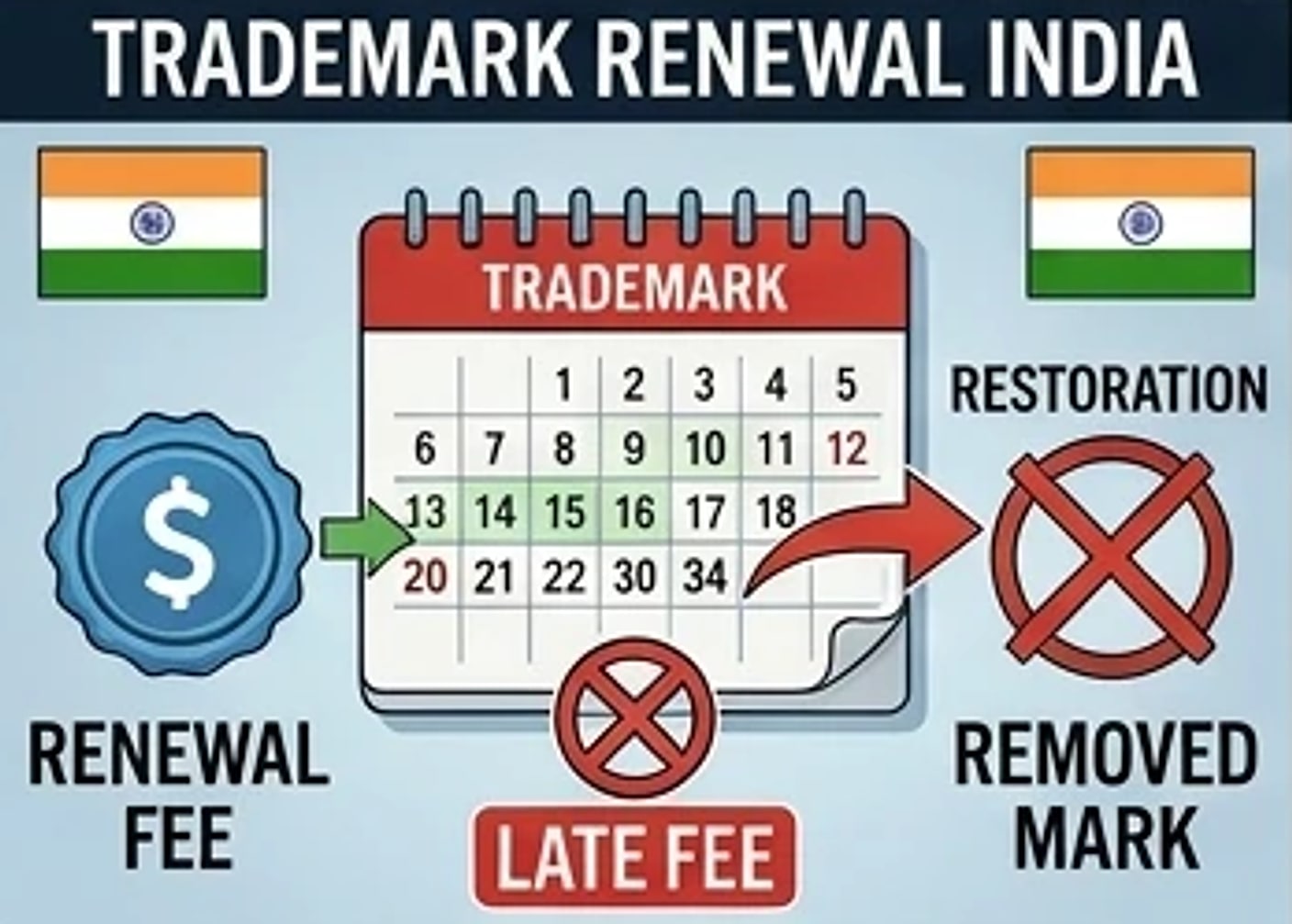
If you miss expiry, you have a trademark renewal grace period surcharge window. Under the proviso to Section 25(3), the Registrar will not remove the mark if the renewal application, the fee and a surcharge are filed within six months after expiry. During that time the mark stays on the register, so there is no gap in protection on paper. A late trademark renewal India filing costs a surcharge.
| Stage | Position | Note |
|---|---|---|
| Validity | Ten years from the application date | Section 25 |
| Renewal on Form TM-R | Before expiry | Earliest date differs by source |
| Grace period | Six months after expiry with surcharge | Mark stays on register |
| Restoration | After removal, time-limited | Check anchor date |
The surcharge is extra. Sources quote different figures, from about ₹3,000 to ₹5,000 per class, so confirm the amount. Even so, a late filing costs more and is riskier. Third parties checking the register may see the mark as expired, and some marketplaces and customs systems check status.
If you miss the grace period too, the Registrar can remove the mark after notice. Removal means the registration lapses and the mark is treated as not on the register. That exposes the brand to copycats, who can file for the same mark, and weakens your ability to enforce, though common law rights from use may survive. Missed trademark renewal what to do is a question to ask quickly, because restoration has time limits.
Restoring a removed mark
A removed mark can be restored on application, with a fee, under the provisions for restoration in the Act and Rules. Sources describe a window of about one year from the date of removal, or from the date of expiry, depending on who you read, with an additional fee for restoration. The anchor date matters, because a month’s difference can decide whether you are in time. Check Section 25(4) and the Rules. If you must restore removed trademark India rules give you a limited window. Trademark renewal India restoration is time-limited.
To restore a removed trademark India applicants file Form TM-R in the restoration category, with the renewal fee and the restoration fee, and the Registrar decides whether to restore. The Registrar may impose conditions to protect third parties who applied for similar marks in the meantime. If someone has filed for your mark in the gap, restoration may be contested.
A practical approach: don’t wait. If you discover a lapse, file restoration immediately, and check the register for conflicting applications. If a squatter has applied, plan an opposition or a prior-user claim at the same time. A watch service on your own mark catches those filings, and a good docket prevents the problem altogether. Our posts on trademark opposition and on squatting cover the next steps. Prevent the issue with a watch on your own trademark renewal India dates.
Questions people ask
Put it in the calendar three times: twelve months out, six months out and ninety days out. Boring, and effective. Put trademark renewal India dates in the calendar three times.
Related reading: trademark renewal in India: deadlines and fees, trademark status meanings in India, trademark opposition in India, spotting trademark squatters in India, trademark registration for startups and how to check a trade mark in India for free.
Quick answers
When must trademark renewal India filings be made?
A registration lasts ten years from the date of application. File Form TM-R before expiry, with a grace period of six months after expiry on payment of a surcharge. Confirm the earliest filing date in the current Rules.
What happens if I miss trademark renewal in India?
You can still renew within six months after expiry with a surcharge. After that the Registrar can remove the mark, and you must apply for restoration, which is time-limited and may be contested.
How much does trademark renewal in India cost?
Government fees are commonly quoted at about ₹10,000 per class for e-filing (less for individuals and startups), plus a surcharge if late and attorney fees. Check IP India’s fee schedule.
What if I miss trademark renewal?
You can renew within six months with a surcharge. After that the mark can be removed and must be restored.
Final word
Halverton & Co. is an Indian law firm advising founders, startups, technology companies and investors on Indian law, including trade mark docketing, renewal and restoration in India for startups and foreign brand owners. We practise in Jharkhand, Maharashtra and before the Supreme Court of India, and act as fractional legal counsel for technology-driven businesses. Halverton & Co.: Where tech needs law! If you have a question about Indian law, write to us at office@halvertonandco.com, or get in touch.
This article reflects developments reported up to 31 October 2026. It is for general information only, is not legal advice, and does not create an advocate-client relationship. Halverton & Co. is an Indian law firm.
Sources
Related practice area
Intellectual Property
Trade marks, copyright, patents and designs. Searched, filed, licensed and enforced under Indian law.
View the practice areaComments
No account needed. Comments are reviewed before they appear, so yours will show here once approved. Please do not share confidential details or describe your own legal matter: replies are general discussion, not legal advice, and do not create an advocate-client relationship. For your own situation, write to office@halvertonandco.com.