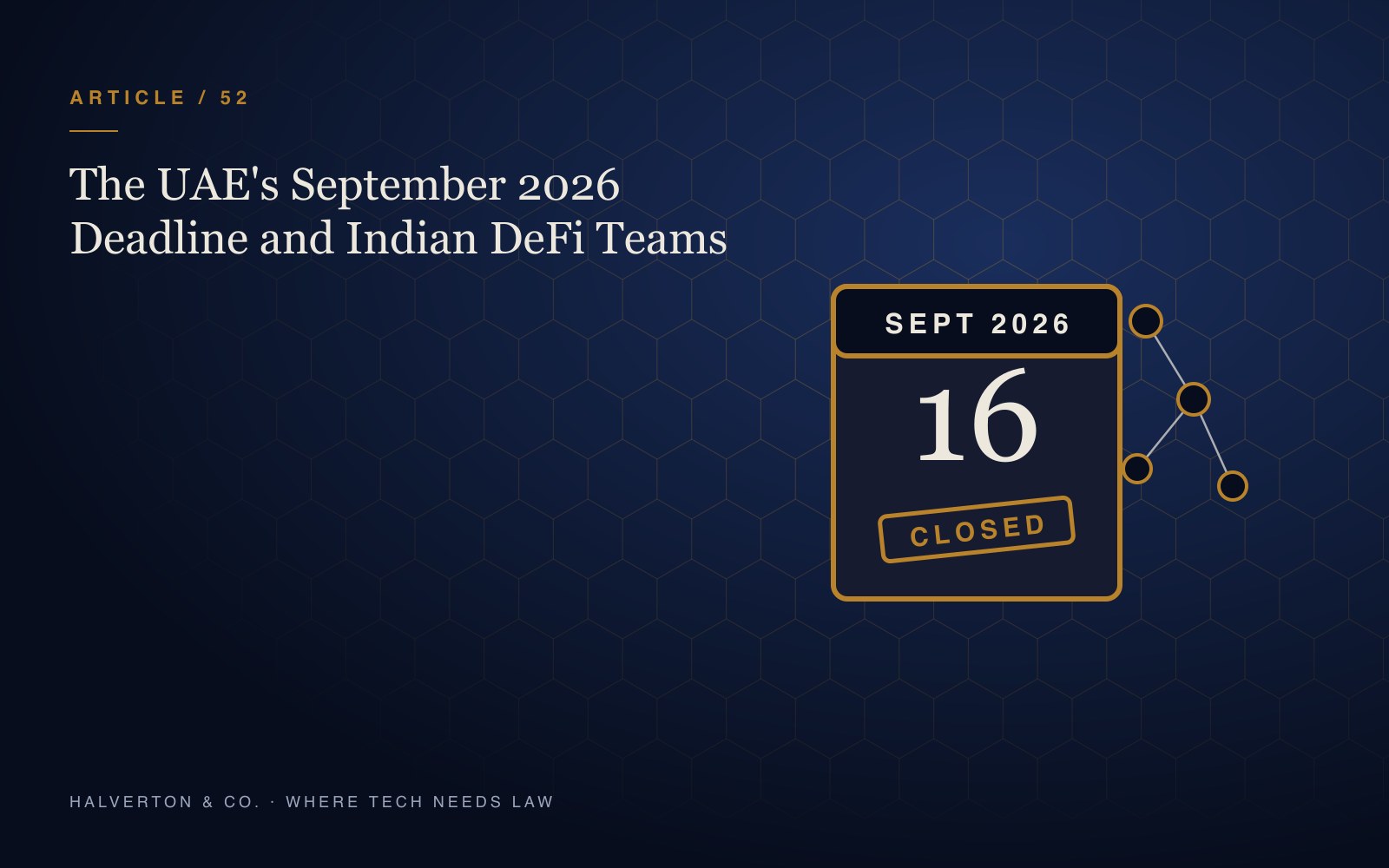
For years, many DeFi founders treated the UAE as a place where you could build first and think about licensing later, as long as your protocol was “just code”. That era ended on 16 September 2026, when the transition window under the UAE’s new Central Bank law closed.
A large share of the developers, founders and operators behind UAE-facing protocols are Indian, working from Dubai, from India, or both. This guide explains what the September 2026 deadline was, who it applies to, how the UAE’s other regulators fit in, and what it means for Indian DeFi teams and the Indian entities behind them. It’s written from the Indian-law perspective and should be read alongside advice from UAE counsel.
What Federal Decree-Law No. 6 of 2025 changed
On 16 September 2025, the UAE enacted Federal Decree-Law No. 6 of 2025, with administrative penalties of up to AED 1 billion and criminal sanctions for unlicensed activities (Databird Journal). The law brings the Central Bank of the UAE’s licensing perimeter over a wide range of activities, and Article 62 sets a technology-neutral licensing trigger: authorisation is required regardless of the “medium, technology or form” of service delivery (UpperSetup).
In practice, commentators read Article 62 as capturing DeFi protocols, dApps, decentralised exchanges, cross-chain bridges, stablecoins and their supporting infrastructure (Bex). The law gave crypto companies a one-year transition period until September 2026 to obtain licensing, partner with licensed entities, or stop targeting UAE users (Databird Journal). That transition window closed on 16 September 2026 (UpperSetup).
Dubai sits at the centre of this change. Many Web3 teams chose Dubai precisely because VARA offered a clear framework for centralised services, while DeFi protocols often assumed they were outside it. The new federal law narrows that gap across the UAE, including in Dubai. The UAE’s wider framework also changed in 2026. The federal securities regulator was rebuilt as a Capital Market Authority, and a new federal virtual-asset licensing decision, Decision No. 4/R.M/2026, replaced the previous federal VASP framework with a three-module rulebook (TradingView / Coinpedia). In Dubai, VARA continues to regulate virtual assets outside the DIFC.
| Regulator or instrument | Scope | Point to note |
|---|---|---|
| Central Bank of the UAE (Federal Decree-Law No. 6 of 2025) | Licensing perimeter reaching DeFi protocols, dApps, DEXs, bridges, stablecoins and supporting infrastructure, on a technology-neutral basis (Article 62) | Transition window closed on 16 September 2026; administrative penalties up to AED 1 billion and criminal sanctions |
| VARA (Dubai) | Virtual assets in Dubai outside the DIFC | Continues to regulate centralised services and marketing in Dubai |
| Capital Market Authority (CMA) | Rebuilt federal securities regulator; Decision No. 4/R.M/2026 replaced the previous federal VASP framework with a three-module rulebook | A single exchange or protocol may face several regulators at once |
Who the September 2026 deadline affects
The CBUAE’s September 2026 deadline applies to virtual assets, DeFi protocols, stablecoins, tokenised real-world assets, decentralised exchanges, wallets, bridges and supporting blockchain infrastructure within its regulatory perimeter (TradingView / Coinpedia). The key question for any team is whether its protocol “touches” UAE users or operates from UAE territory.
That has direct consequences for Indian DeFi teams. Many protocols are built by Indian developers, governed by foundations or companies in other jurisdictions, and operated or marketed from Dubai. If a protocol serves UAE users, is run by people in the UAE, or markets in the UAE, it may be within scope, whatever its structure on paper. UAE counsel should assess each project’s position; this article focuses on the Indian side.
For teams based in Dubai, the practical question is how VARA licensing, CBUAE licensing and the federal Capital Market Authority framework fit together for a given protocol. An exchange licensed by VARA in Dubai that also serves mainland clients or processes payment tokens may be subject to several regulators at once (Pnyx Hill). Teams that missed the deadline face a choice: seek licensing, partner with a licensed entity, or cease UAE-facing activities. Continuing as before risks significant penalties.
The Indian side: people, entities and money
For Indian DeFi teams, the UAE deadline raises Indian legal questions too. First, Indian entities. Many protocols have an Indian development company providing services to a foreign foundation or Dubai entity. That Indian company should make sure its role is clearly limited to software development under a services contract, priced at arm’s length, and doesn’t extend to operating or controlling a protocol that requires licensing elsewhere.
Second, Indian anti-money laundering law. If the protocol or its front-end serves users in India, India’s rules on virtual digital asset service providers may apply, requiring registration with FIU-IND under the Prevention of Money-laundering Act. FIU-IND has actively enforced these rules against offshore platforms.
Third, Indian founders’ personal positions. Indian-resident founders holding tokens or equity in Dubai or other offshore entities must comply with India’s overseas investment rules and disclose foreign assets in their Indian tax returns. Tokens received for work are taxable in India for Indian residents, and gains on transfer are taxed at 30%.
Practical steps for Indian DeFi teams after the deadline
Start with a regulatory map. For each protocol, set out where it is governed, where the team works, who the users are, where it markets, and which entities perform which functions. That map will show which UAE regulator, if any, applies, and which Indian rules apply to the Indian entities and individuals.
Next, decide on a path in the UAE with local counsel: licensing, partnership with a licensed entity, or exit from UAE-facing activities. In parallel, tidy up the Indian side: intercompany agreements between Indian development companies and offshore entities, FEMA filings for Indian founders’ overseas holdings, tax positions on token compensation, and data protection for user data processed in India.
Also review where your people are. Developers, community managers and treasury signers living in Dubai create a stronger UAE connection than a team working entirely from India, which affects both UAE licensing analysis and Indian tax residence for the individuals. Finally, review marketing. In Dubai, VARA’s rulebooks prohibit activities involving anonymity-enhanced cryptocurrencies and strictly limit marketing of virtual assets to licensed providers (Databird Journal). Influencer campaigns aimed at UAE or Indian audiences should be paused until the regulatory position is clear in both countries.
Risks and remedies
After the September 2026 deadline, the main risks are enforcement in the UAE, which can include penalties up to AED 1 billion and criminal sanctions for unlicensed activities, and parallel action in India if Indian users are served without FIU-IND registration. Individual developers are generally less exposed than operators and controllers, but the line can blur in small teams where developers also run infrastructure, communities and treasuries. If you receive a regulatory inquiry in either country, respond promptly with advice, document the protocol’s structure and your role, and don’t make public statements before taking advice. For Indian DeFi teams, the September 2026 deadline is a prompt to put structure, contracts and compliance in order on both sides of the Arabian Sea.
Related reading: why Dubai exchanges also need FIU-IND registration, Dubai vs GIFT City for crypto and Web3 businesses, setting up a Dubai holding company as an Indian founder, stablecoins in India, building a Web3 startup with an Indian team and CERT-In’s 6-hour incident rule; also launching a token from Dubai with Indian investors.
Quick answers
What was the UAE’s September 2026 crypto deadline?
The end of the one-year transition period under Federal Decree-Law No. 6 of 2025, which brought DeFi protocols, DEXs, Web3 platforms and bridges within the Central Bank’s licensing perimeter.
Does the UAE deadline affect Indian developers?
It can, if their protocol serves UAE users or operates from the UAE. Indian entities and founders also face Indian rules on anti-money laundering, foreign investment and tax.
What should DeFi teams do now?
Map the protocol’s structure, choose a UAE path with local counsel (licensing, partnership or exit), and tidy up Indian contracts, filings and tax positions.
Which law created the UAE deadline?
Federal Decree-Law No. 6 of 2025, enacted on 16 September 2025, gave crypto companies a one-year transition period that closed on 16 September 2026.
What are the penalties for unlicensed activity?
Administrative penalties of up to AED 1 billion and criminal sanctions.
Final word
Halverton & Co. is an Indian law firm advising Indian founders, investors, NRIs and crypto businesses in Dubai and across the UAE on Indian law, including structuring Indian development entities, FIU-IND and FEMA compliance, and tax for DeFi and Web3 founders. We practise in Jharkhand, Maharashtra and before the Supreme Court of India, and work alongside UAE-licensed counsel, who advise on UAE law. Halverton & Co.: Where tech needs law! If you have a question about Indian law, write to us at office@halvertonandco.com, or get in touch.
This article reflects developments reported up to early October 2026. It is for general information only, is not legal advice, and does not create an advocate-client relationship. Halverton & Co. is an Indian law firm and does not advise on UAE law; UAE-law points should be confirmed with UAE-licensed counsel.
Related practice area
Crypto, Web3 & Digital Assets
Advice for virtual digital asset businesses on registration, reporting and structure.
View the practice area