Indian founders building in crypto and Web3 often face the same choice: Dubai or GIFT City? Dubai offers a dedicated crypto regulator and a mature ecosystem. GIFT City, India’s International Financial Services Centre in Gujarat, offers proximity to India, an Indian talent base and a regulator eager to attract global finance.
For crypto businesses, though, the two aren’t really competing on the same terms. This guide compares Dubai vs GIFT City for crypto and Web3 businesses: what each regulator allows, tokenisation, tax, banking, talent, and the Indian regulatory exposure that follows founders wherever they go.
Dubai: a dedicated crypto regulator
Dubai’s Virtual Assets Regulatory Authority regulates virtual asset activities in the Emirate of Dubai, including mainland and free zones, except within the DIFC (Sumsub). VARA’s Rulebook Version 2.0, published in May 2025, governs virtual asset activities in Dubai (Neos Legal), and in 2026 VARA clarified when tokenised real-world assets fall under federal securities rules and launched a framework for exchange-traded derivatives (Sumsub).
Dubai’s model offers clear licence categories for exchanges, brokers, custodians, issuers and other virtual asset services. VARA had licensed over 85 companies by March 2026 (Bex). But it’s also an enforcing regulator: in 2026, VARA fined unlicensed operators, including KuCoin’s operating entity in June (VARA).
The UAE’s federal framework adds layers. Federal Decree-Law No. 6 of 2025 brought DeFi protocols, DEXs and Web3 platforms within the Central Bank’s licensing perimeter, with a transition window that ended in September 2026 (Pnyx Hill). Founders choosing Dubai need to understand which UAE regulator applies to their activity.
GIFT City: tokenisation yes, crypto no
GIFT City’s regulator, the International Financial Services Centres Authority (IFSCA), has taken a very different line on crypto. In its consultation paper on tokenisation, IFSCA stated that it does not intend to regulate, permit trading in or otherwise endorse any cryptocurrencies or crypto assets (IFSCA). It has publicly denied media reports that it was preparing to regulate crypto exchanges, cryptocurrencies or allied virtual assets (Cafemutual).
Where GIFT City is active is tokenisation of real-world assets and blockchain technology services. IFSCA published a consultation paper on 26 February 2025 on tokenising real-world assets, and its TechFin regulations list blockchain, DLT, Web 3.0 and tokenisation among permitted services (PKM Advisory). A new FinTech Sandbox Framework issued on 16 March 2026 provides a route for tokenisation projects, with graduation to full authorisation once IFSCA notifies a final framework (PKM Advisory).
So, for Dubai vs GIFT City, the answer depends on what you’re building. A crypto exchange, broker or token issuer can be licensed in Dubai but not in GIFT City. A blockchain infrastructure provider or a real-world asset tokenisation project may find a home in either.
Tax, banking and talent
Tax is a major factor. The UAE has no personal income tax, and companies may benefit from free zone regimes subject to conditions, alongside the federal corporate tax. GIFT City offers its own incentives, including tax holidays for eligible IFSC units. But for Indian founders, personal tax depends on residence: Indian residents are taxed in India on worldwide income, including income from a Dubai company, and India’s deemed resident rule can catch Indians in Dubai with significant Indian income.
Banking access is often decisive for crypto businesses. Dubai’s banks, while selective, are more familiar with licensed crypto businesses. Indian banking for crypto remains difficult, and internal RBI documents reported in 2026 suggest the central bank favours restricting banks’ crypto exposure. GIFT City’s banking units operate under IFSC rules but follow IFSCA’s stance against crypto.
Lifestyle and mobility also play a part for founders: Dubai offers long-term residence options for entrepreneurs and investors, while GIFT City keeps founders close to family and the Indian market. Talent cuts the other way. India’s engineering talent is a key advantage, and many Dubai crypto businesses rely on Indian development teams. GIFT City keeps teams in India with simpler employment arrangements, while Dubai requires visas and relocation, or a split structure with an Indian development company.
| Factor | Dubai | GIFT City |
|---|---|---|
| Regulator | VARA outside the DIFC, with federal Central Bank and CMA layers on top | IFSCA |
| Exchange, broker or token issuer | Licensable under VARA’s categories | Not available: IFSCA has said it does not intend to regulate or permit trading in crypto |
| Tokenisation of real-world assets | Within VARA and federal frameworks | Active: consultation paper of 26 February 2025 and the FinTech Sandbox Framework of 16 March 2026 |
| Blockchain and technology services | Possible, depending on activity | Listed as permitted in the TechFin regulations |
| Personal tax | No personal income tax, but Indian residents stay taxable in India on worldwide income | Inside India’s tax system, with incentives for eligible IFSC units |
| Banking | Selective, but more familiar with licensed crypto businesses | Follows IFSCA’s stance against crypto |
| Talent | Visas and relocation, or a split structure with an Indian development company | Keeps teams in India with simpler employment arrangements |
The Indian regulatory exposure that follows you
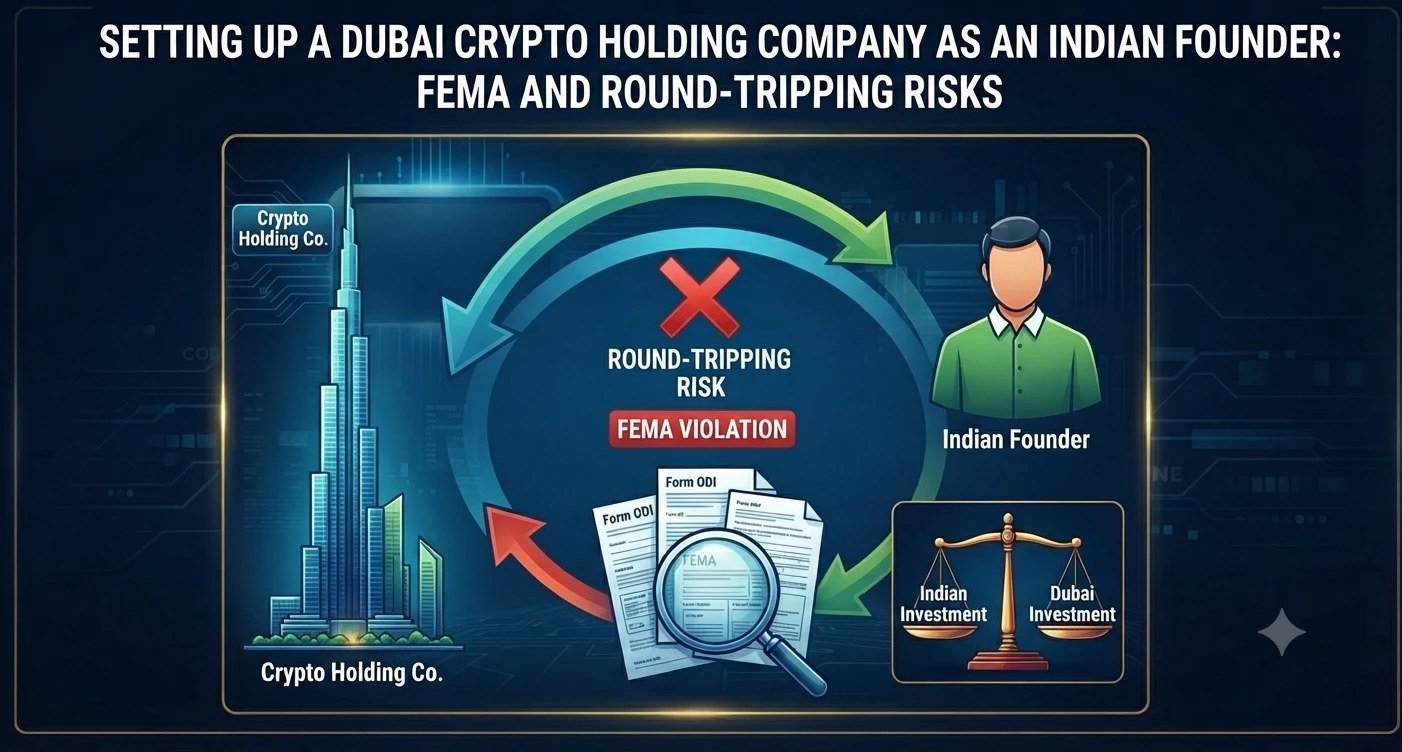
Whichever you choose, Indian law follows Indian founders and users. A Dubai platform serving users in India must register with FIU-IND under India’s anti-money laundering law. Indian-resident founders investing in a Dubai entity must follow India’s overseas investment rules, including restrictions on round-tripping structures. Tokens and gains received by Indian residents are taxed at 30% under India’s virtual digital asset regime, and foreign holdings must be disclosed in Schedule FA.
GIFT City has its own advantages here: it sits within India’s legal system, which can make Indian regulatory relationships smoother for permitted activities. But it can’t host crypto exchange or trading activity, and Indian crypto policy itself remains unsettled, with a long-delayed discussion paper and an RBI that has signalled support for restrictions.
Time to launch differs as well, since licensing timelines, sandbox processes and bank onboarding all vary between the two hubs. Investors and future acquirers will also look at the choice. A Dubai entity with a VARA licence offers regulatory clarity for crypto activities, while a GIFT City entity offers a familiar route for Indian institutional investors in permitted sectors. Choosing a structure that fits your likely investors can save a costly restructuring later. Many Indian founders therefore end up with a hybrid: a licensed operating entity in Dubai for crypto activities, and an Indian or GIFT City entity for technology development, tokenisation or other permitted services. The structure must be designed so that each entity stays within its own regulatory perimeter.
Choosing between them and remedies
As a rule of thumb, choose Dubai for regulated crypto services such as exchanges, brokers, custody and token issuance, and consider GIFT City for tokenisation of real-world assets, blockchain technology services and India-centred fintech that doesn’t involve crypto trading. In every case, build the Indian side properly: FEMA compliance for founders’ investments, intercompany agreements for Indian teams, FIU-IND registration if Indian users are served, and accurate tax reporting. If problems arise, Indian FEMA defaults can often be regularised, tax positions corrected, and regulatory notices answered, but the cost rises with time. The Dubai vs GIFT City decision is ultimately about what you’re building, and where Indian law will meet you.
Related reading: why Dubai exchanges also need FIU-IND registration, setting up a Dubai crypto holding company, paying Indian developers from a Dubai Web3 company, tokenized real estate in Dubai, FIU-IND registration for crypto exchanges and stablecoins in India; also launching a token from Dubai with Indian investors.
Quick answers
Can a crypto exchange be set up in GIFT City?
No. IFSCA has said it does not intend to regulate or permit trading in cryptocurrencies, although it supports tokenisation of real-world assets.
Is Dubai better than GIFT City for crypto?
For licensed crypto services, yes, because VARA provides a dedicated licensing framework. GIFT City suits tokenisation and blockchain technology services.
Do Indian rules still apply if I set up in Dubai?
Yes. FIU-IND registration applies if you serve Indian users, and Indian-resident founders face FEMA and Indian tax rules.
What is the difference between VARA and IFSCA?
VARA licenses virtual asset activity in Dubai outside the DIFC. IFSCA, GIFT City’s regulator, has said it does not intend to regulate, permit trading in or endorse crypto assets, but it supports tokenisation of real-world assets and blockchain technology services.
Can a founder use both Dubai and GIFT City?
Yes. Many founders use a hybrid: a licensed operating entity in Dubai for crypto activities and an Indian or GIFT City entity for technology development, tokenisation or other permitted services, with each entity staying inside its own regulatory perimeter.
Final word
Halverton & Co. is an Indian law firm advising Indian founders, investors, NRIs and crypto businesses in Dubai and across the UAE on Indian law, including Dubai and GIFT City structuring, FEMA, FIU-IND compliance and tax for crypto and Web3 founders. We practise in Jharkhand, Maharashtra and before the Supreme Court of India, and work alongside UAE-licensed counsel, who advise on UAE law. Halverton & Co.: Where tech needs law! If you have a question about Indian law, write to us at office@halvertonandco.com, or get in touch.
This article reflects developments reported up to early October 2026. It is for general information only, is not legal advice, and does not create an advocate-client relationship. Halverton & Co. is an Indian law firm and does not advise on UAE law; UAE-law points should be confirmed with UAE-licensed counsel.
Related practice area
Crypto, Web3 & Digital Assets
Advice for virtual digital asset businesses on registration, reporting and structure.
View the practice area