Key takeaways
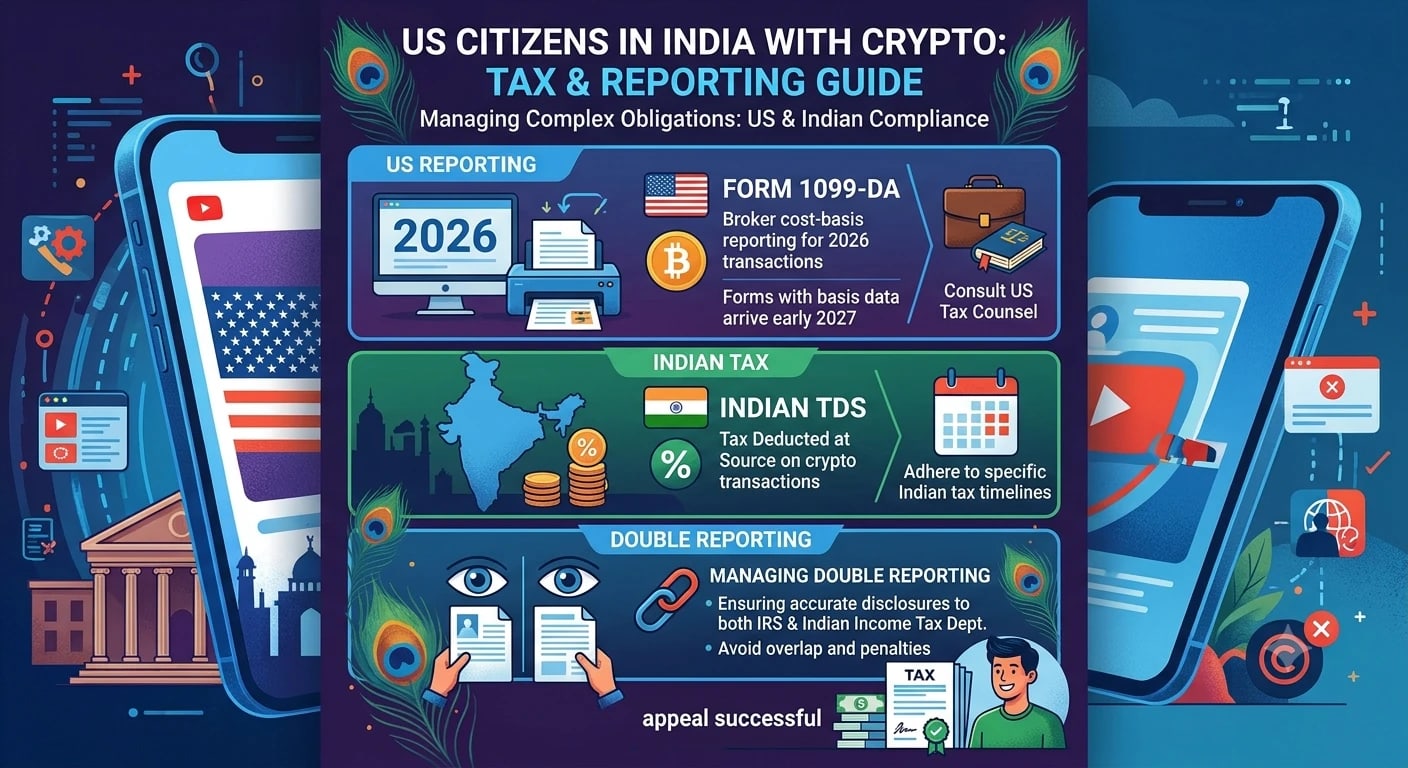
- Form 1099-DA reports gross proceeds for 2025 and, from 2026 transactions, cost basis for covered assets, with the first basis forms arriving in early 2027.
- An Indian exchange is not a US broker and issues no Form 1099-DA, so US citizens must report every disposal themselves.
- India taxes crypto gains at 30% with a 1% TDS, and a foreign tax credit on Form 1116 may reduce double tax.
- Keep both sets of numbers, because India allows no loss set-off and the US does; take US and Indian advice.
If you are a US citizen living in India and you trade crypto, you face two tax systems at once. The United States taxes citizens on worldwide income, and India taxes residents on worldwide income at 30% on crypto gains with a 1% TDS on transfers. The 1099-DA India crypto question is simple on one point: an Indian exchange does not issue Form 1099-DA, so the burden of reporting falls on you.
This guide explains what Form 1099-DA covers, why it will not arrive from an Indian exchange, how cost basis reporting changes from 2026, how Indian TDS and tax credits interact, and what US expats should report. It is written by an Indian law firm. US tax points, including forms and thresholds, must be confirmed with a US tax adviser.
What form 1099-DA covers
Form 1099-DA is the new information return for digital asset sales, filed by brokers with the IRS and sent to customers. For 2025 transactions, it reports gross proceeds. Under the broker reporting rules, cost basis reporting starts with transactions in 2026, and the first forms that show basis arrive in early 2027. Basis reporting applies to covered assets, generally those acquired on or after 1 January 2026 and held with the same custodial broker.
For assets that are not covered, brokers may report basis voluntarily, but you remain responsible for working out your gain on Form 8949 and Schedule D. A broker’s form is therefore a helpful record, not the end of your duty. US citizens must report every disposal, whether or not they receive a form, and the IRS asks every taxpayer on the return whether they received or sold digital assets. Trades on a foreign exchange still go on Form 8949, and Form 8949 foreign exchange crypto entries need your own cost records. Keep this in mind for every 1099-DA India crypto filing.
The broker rules apply to brokers that meet the US definition, mainly US platforms and some non-US platforms serving US persons that fall within the rules. Brokers have also received penalty relief for good-faith efforts in the transition. Check the IRS instructions for Form 1099-DA for the current definitions and dates. For expats, the key point is that the form is only as complete as the platforms you use.
Why Indian exchanges do not issue it
An exchange registered in India does not file Form 1099-DA, because it is not a US broker under the rules. It reports to Indian authorities instead. It deducts 1% TDS under Section 194S of the Income-tax Act, 1961, now carried into the Income-tax Act, 2025, and it files statements of crypto transactions that reach the tax department and appear in your tax credit statement. India’s own crypto reporting began domestically from 1 April 2026. Many readers ask why an Indian exchange 1099-DA never arrives; the answer is that it is not a US broker.
That creates a gap for US expats. You will not receive a 1099-DA from an Indian platform, yet the US still expects you to report each sale. Many US citizens in India assume no form means no reporting, which is a mistake. The IRS can receive information from other sources, and the penalty for omitting income is the same whether or not a form was issued. This gap is the heart of the 1099-DA India crypto problem.
Use the Indian data as your source. Download the full transaction history and the tax statements from the Indian exchange, convert values to US dollars on the date of each transaction, and compute gain and loss under US rules, which differ from Indian rules. India allows no loss set-off, while the US allows capital losses to offset gains. Keep both versions of the numbers. US expats crypto taxes India often differ by thousands of dollars between the two systems.
Double taxation and credits
The same gain can be taxed twice. India taxes the gain at 30% for residents, and the US taxes it as a capital gain at its own rates. The usual relief is a foreign tax credit. On the US side, you claim it on Form 1116 for foreign taxes paid or accrued. The credit is limited to the US tax on that income, so it may not remove the whole Indian tax if India’s rate is higher. Claiming a foreign tax credit Indian crypto tax can support depends on proof of payment. Double taxation is the second half of the 1099-DA India crypto issue.
The India-US tax treaty also provides relief for double taxation, but it was written long before crypto, and its capital gains article does not clearly cover digital assets. Take advice on which article applies and on whether you should rely on the treaty or the domestic credit. On the Indian side, you may claim a credit for US tax paid by filing Form 67 with your return, subject to conditions, so keep proof of the US tax.
The 1% TDS is not the final tax. It is an advance that you claim as a credit against your Indian liability. For the US, TDS is not a separate foreign tax, because it is a withholding on account of the Indian tax. The foreign tax credit rules focus on the tax actually paid, so track the Indian tax after all credits. A US tax adviser can model the credit limits and any carryovers.
Reporting checklist for US expats in India
Report every disposal on Form 8949 and Schedule D, including trades on Indian and foreign exchanges. If you hold foreign financial assets above the thresholds, which are higher for taxpayers living abroad, you may need to file Form 8938 with your return. Check whether crypto held on a foreign exchange counts as a specified foreign financial asset, which depends on current IRS guidance, and confirm any thresholds that apply to you. Ask your adviser about Form 8938 crypto held in India before you file. A checklist is the safest way to handle 1099-DA India crypto reporting.
| Item | What to do | Note |
|---|---|---|
| Form 8949 and Schedule D | Report every disposal, in US dollars | Even without a 1099-DA |
| Form 1116 | Claim a foreign tax credit for Indian tax paid | Subject to limits |
| Form 8938 and FBAR | Check whether foreign crypto accounts count | Confirm with a US adviser |
| Indian return | Schedule for virtual digital assets and TDS credits | 30% tax, no loss set-off |
| Form 67 | Claim credit in India for US tax paid | Keep proof of payment |
Check FBAR as well. FinCEN Form 114 applies to foreign financial accounts above a threshold, and the treatment of crypto held on foreign platforms has been the subject of proposed rules and guidance. Confirm the current position with a US adviser before you decide not to file. Also keep your Indian filings in order: the schedule for virtual digital assets, your Indian return as a resident and any required disclosure of foreign assets.
Make a simple annual routine. Download exchange statements in January, reconcile Indian and US records, calculate gains under both systems, claim credits and file on time. If you have missed earlier reporting, ask a US adviser about streamlined procedures before the IRS contacts you. Do this with the Indian return in mind, because mistakes in one country can surface in the other through information exchange.
Next steps and quick answers
Gather your 2025 and 2026 crypto records now, check each exchange’s reporting, decide which US forms apply to you and speak to both a US tax adviser and an Indian one before you file. Do not rely on a missing form as a reason to skip reporting. This is general information, not tax advice. Do not treat a missing form as the end of your 1099-DA India crypto duties.
Related reading: crypto tax in India and the US compared, crypto tax in India: 30% and 1% TDS, what Budget 2026 changed for crypto tax, CARF and crypto data sharing for Indian expats, whether crypto is legal in India in 2026, FIU-IND registration for crypto businesses and GENIUS Act explained; also US tax on staking rewards.
Quick answers
Will my Indian crypto exchange send me a Form 1099-DA?
No. Indian exchanges are not US brokers and do not issue Form 1099-DA. They report to Indian authorities and deduct 1% TDS, so you must report your US disposals yourself.
Can I claim a foreign tax credit for Indian crypto tax?
Often yes, on Form 1116, for Indian tax actually paid, subject to limits and documentation. A US tax adviser should confirm how the credit applies to your gains.
Do I need to file Form 8938 for crypto held in India?
It depends on whether the crypto is a specified foreign financial asset under current IRS guidance and on your thresholds, which are higher if you live abroad. Check with a US adviser.
Does the broker reporting rule apply to non-US exchanges?
It applies to brokers that meet the US definition. Indian exchanges are not US brokers, so you must self-report. Check the IRS instructions for the current definitions.
Can I claim Indian TDS as a US foreign tax credit?
TDS is an advance on the Indian tax, so the credit depends on the Indian tax finally paid. A US tax adviser should model it.
Final word
Halverton & Co. is an Indian law firm advising US companies, founders, investors and law firms on Indian law, including cross-border tax and compliance for US persons in India, virtual digital asset regulation, and Indian filings for expats. We practise in Jharkhand, Maharashtra and before the Supreme Court of India, and work alongside US counsel, who advise on US law. Halverton & Co.: Where tech needs law! If you have a question about Indian law, write to us at office@halvertonandco.com, or get in touch.
This article reflects developments reported up to 31 October 2026. It is for general information only, is not legal advice, and does not create an attorney-client relationship. Halverton & Co. is an Indian law firm and does not advise on US law; US-law points should be confirmed with US counsel.
Sources
Related practice area
Crypto, Web3 & Digital Assets
Advice for virtual digital asset businesses on registration, reporting and structure.
View the practice areaComments
No account needed. Comments are reviewed before they appear, so yours will show here once approved. Please do not share confidential details or describe your own legal matter: replies are general discussion, not legal advice, and do not create an advocate-client relationship. For your own situation, write to office@halvertonandco.com.