Some of the best Web3 engineers in the world are in India. Many US crypto founders have built their protocols, exchanges and wallets with Indian developers, and India consistently ranks among the countries with the most crypto users and blockchain developers. But India’s approach to crypto is unusual: heavily taxed, regulated for money laundering, yet never fully legalized or banned.
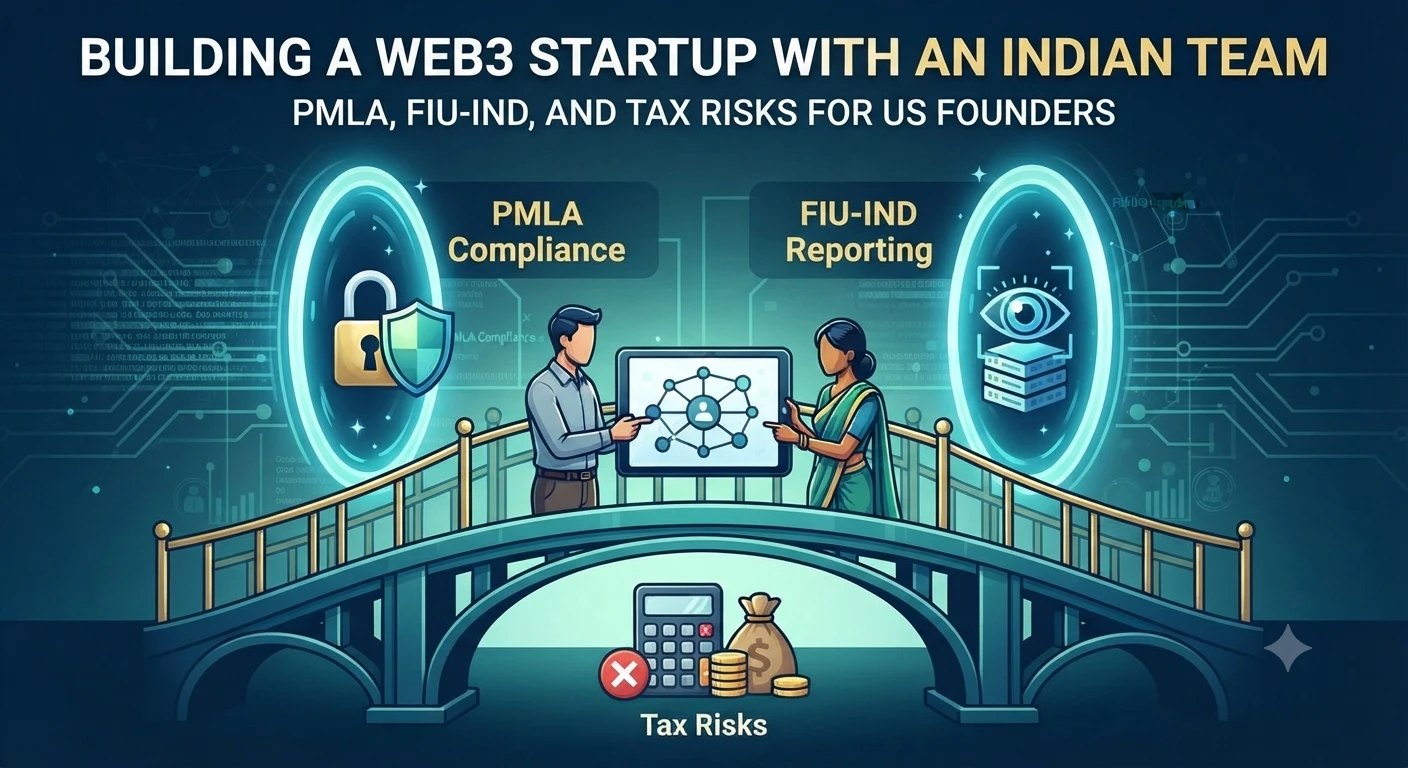
If you’re building a Web3 startup with an Indian team, those rules can affect your team, your users and your token. This guide explains when Indian anti-money laundering registration applies, how crypto is taxed in India, the risks of paying Indian contributors in tokens, and how to structure an Indian team safely.
Does your Web3 startup need FIU-IND registration?
Since March 2023, India has treated “virtual digital asset service providers” (VDA SPs) as reporting entities under the Prevention of Money-laundering Act, 2002. A business is a VDA SP if it carries out activities such as exchanging VDAs and fiat, exchanging one VDA for another, transferring VDAs, safekeeping or administering them, or providing financial services for token offerings, on behalf of others. VDA SPs must register with the Financial Intelligence Unit-India (FIU-IND). See our guide to FIU-IND registration for crypto businesses.
Registration obligations apply to offshore platforms serving Indian users, not just Indian companies. FIU-IND has enforced this actively: it has blocked and fined offshore exchanges and, according to press reports, issued non-compliance notices to further offshore platforms in 2025 and 2026. Check the latest enforcement position before you launch to Indian users.
The key distinction for a US Web3 startup with an Indian team is between where your team sits and whom you serve. A protocol that only uses Indian developers to build software, and doesn’t offer custodial or exchange services to Indian users, may not be a VDA SP in India. A custodial wallet, exchange, OTC desk or launchpad that serves Indian users likely is, wherever it’s incorporated.
PMLA compliance if you do serve Indian users
FIU-IND’s AML and counter-terrorist financing guidelines for VDA SPs were updated on January 8, 2026. Registered VDA SPs must appoint a Principal Officer and Designated Director, carry out KYC and customer due diligence, screen against sanctions lists, file suspicious transaction reports, comply with the travel rule, and keep records.
FIU-IND registration is an anti-money laundering registration, not a license. It doesn’t mean the platform is authorized by SEBI or the RBI. US founders should never describe it to users or investors as a “license to operate”.
Other Indian rules also apply to VDA SPs: CERT-In’s cyber security directions, which require KYC and record-keeping for virtual asset service providers and six-hour incident reporting (see our guide to the CERT-In 6-hour rule), and, since April 2026, crypto transaction reporting to the tax department under Section 509 of the Income-tax Act, 2025.
| Activity | Likely Indian status |
|---|---|
| Indian developers build open-source software; no custody or exchange for Indian users | Probably not a VDA SP; tax and FEMA issues still apply to the team |
| Custodial wallet, exchange, OTC desk or launchpad serving Indian users | VDA SP: FIU-IND registration and PMLA duties |
| Indian subsidiary providing development services to the US parent | Not a VDA SP while it stays in its development role |
| Indian subsidiary starts offering crypto services to Indian users | Becomes a VDA SP with PMLA obligations |
Crypto tax for your Indian team and users
India taxes gains from transferring virtual digital assets at a flat 30%, plus cess, with no deductions other than cost of acquisition and no set-off of losses. A 1% TDS (tax deducted at source) applies to payments for transfers above specified thresholds. These rules continue under the Income-tax Act, 2025, which took effect on April 1, 2026, and the VDA definition now expressly includes crypto-assets. See our guide to crypto tax in India and our comparison of crypto tax in India vs the US.
For a US Web3 startup with an Indian team, this matters most for compensation. Paying Indian developers in tokens is common, but tokens received for services are generally treated as taxable income in the developer’s hands, and any later sale is taxed again at 30% on the gain. The exact timing and characterization should be confirmed by an Indian tax adviser. If the developer is an employee of an Indian entity or employer of record, the employer may need to withhold tax on token compensation.
Equity and token grants should also be documented clearly, including vesting, lockups and what happens if the developer leaves, because disputes over unvested tokens are common in Web3 teams; see our guides to founders’ agreements and stock options for Indian employees. Many Indian Web3 developers aren’t aware of these rules, and India’s tax department now actively contacts taxpayers who don’t report crypto; see our guide to the crypto nudge email. Helping your team understand its obligations protects them and your company’s reputation.
FEMA, banking and structuring your Indian team
India’s foreign exchange law adds a further layer. Indian residents who hold shares or tokens in a foreign entity, or receive foreign-currency payments, must follow FEMA rules. Indian founders or employees holding equity in a US or offshore Web3 company may have overseas investment reporting obligations. Paying Indian contributors through proper banking channels, with invoices and contracts, avoids most FEMA problems.
Banking access is a practical risk. Internal RBI documents reported in July 2026 suggest the central bank favors restricting banks’ exposure to crypto; see our guide to the RBI’s push towards a crypto ban. Indian banks already scrutinize crypto-related transactions closely, and team members paid in crypto who convert to rupees through P2P markets can also face account freezes if tainted funds pass through their accounts; see frozen bank accounts over crypto or UPI.
The right structure for a Web3 startup with an Indian team depends on what the team does, how large it is, and whether the business has Indian users. Most US Web3 startups structure their Indian team in one of three ways: independent contractors paid in fiat, an employer of record, or an Indian subsidiary providing development services to the US parent at cost plus a markup. A subsidiary offers the most control, but it must stay within its development role. If it starts offering crypto services to Indian users, it becomes a VDA SP with PMLA obligations. See our guides to hiring contractors in India and setting up an Indian subsidiary.
Risks, remedies and quick answers
India’s crypto policy remains unsettled. A long-promised discussion paper has been repeatedly shelved, and the RBI favors restriction, so build for a stricter future; see our guide to India’s shelved crypto policy paper. If FIU-IND issues a notice, respond fully, register if required, and seek a hearing before any penalty, with appeals available under the PMLA. If team members face tax notices, they can file updated returns and appeal assessments. Where bank accounts are frozen, some Indian High Courts have limited police to a lien on the disputed amount. If a platform is hacked, see our guide to what to do when a crypto exchange is hacked. The safest approach for a Web3 startup with an Indian team is a clear legal map of what the Indian entity and team do, and don’t do, before launch.
Related reading: paying Indian developers from a Dubai Web3 company, setting up a Dubai crypto holding company and Dubai vs GIFT City for crypto and Web3 businesses; also launching a token from Dubai with Indian investors; also smart contract liability for Indian developers.
Quick answers
Does a US Web3 startup need FIU-IND registration because it has Indian developers?
Not just for having Indian developers. Registration is triggered by providing VDA services, such as exchange or custody, to Indian users.
How are tokens paid to Indian developers taxed?
Generally as income when received, and again at 30% on any gain when the tokens are sold, with 1% TDS on transfers above thresholds. Confirm the timing with an Indian tax adviser.
Is crypto legal in India?
Yes, it isn’t banned. It’s taxed at 30%, and service providers must register with FIU-IND, but policy remains uncertain.
Final word
Halverton & Co. is an Indian law firm that advises on Indian law, including Web3 structuring, FIU-IND registration, PMLA compliance and crypto taxation in India. We practice in Jharkhand, Maharashtra and before the Supreme Court of India, and we work alongside US counsel, who advise on US law. Halverton & Co.: Where tech needs law! If you have a question about Indian law, write to us at office@halvertonandco.com, or get in touch.
This article reflects developments reported up to early October 2026. It is for general information only, is not legal advice, and does not create an attorney-client relationship. Halverton & Co. is an Indian law firm and does not advise on US law.
Related practice area
Crypto, Web3 & Digital Assets
Advice for virtual digital asset businesses on registration, reporting and structure.
View the practice areaComments
No account needed. Comments are reviewed before they appear, so yours will show here once approved. Please do not share confidential details or describe your own legal matter: replies are general discussion, not legal advice, and do not create an advocate-client relationship. For your own situation, write to office@halvertonandco.com.