Key takeaways
- DIFC and ADGM offer common law courts and their own data protection laws, and suit regulated or enterprise-facing AI businesses.
- Other Dubai free zones are cheaper and suit pure software firms, but follow the federal data law.
- A qualifying free zone person may get a 0% corporate tax rate on qualifying income if conditions are met, so ask a UAE tax adviser.
- An Indian founder still faces FEMA, tax residence and transfer pricing rules in India.
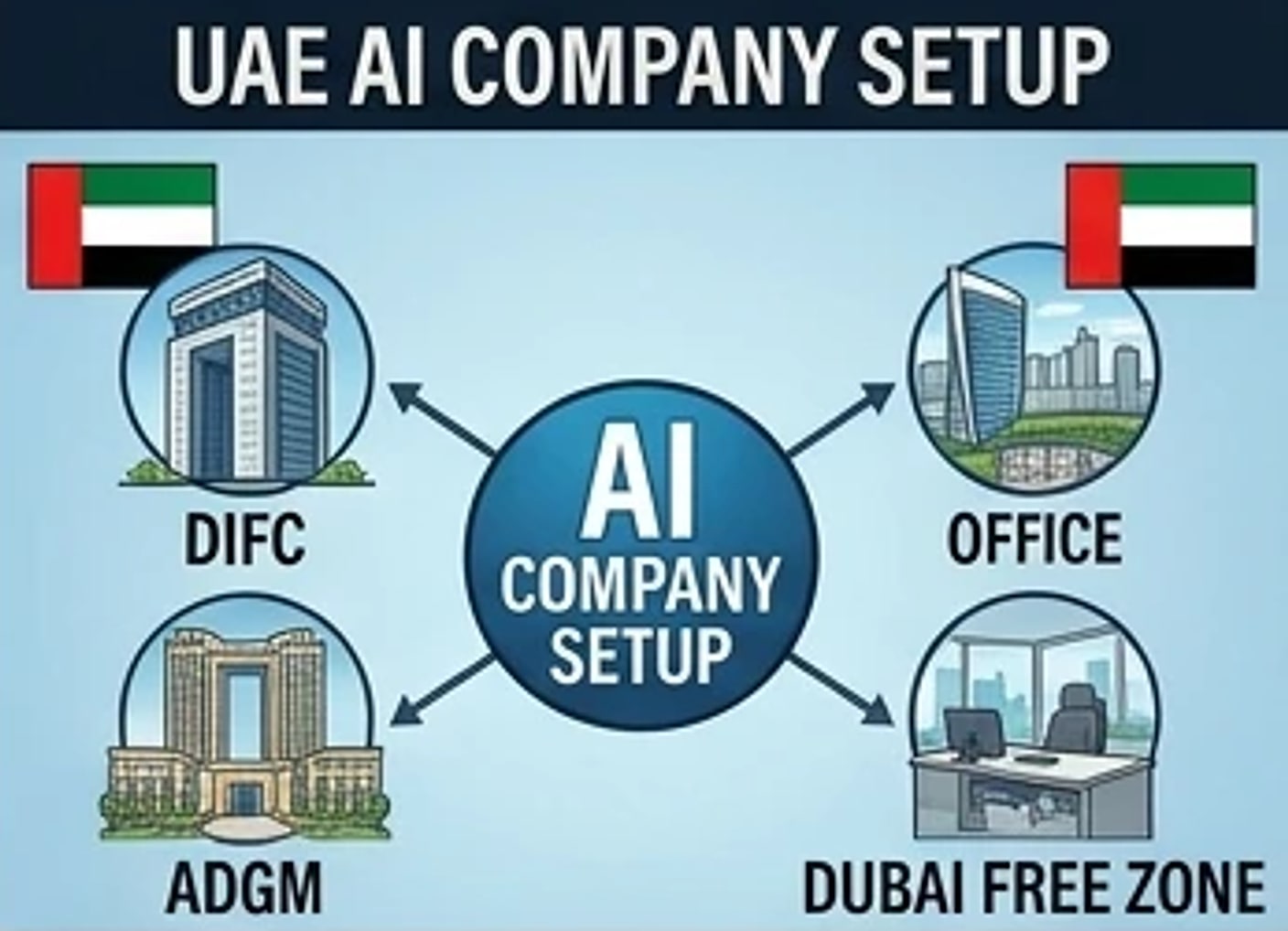
AI company setup Dubai is a popular plan for Indian founders, and for good reason: fast incorporation, talent visas, a supportive government and a customer base across the Gulf. The tricky part is choosing where. DIFC, ADGM, Dubai Internet City, Dubai Silicon Oasis, DMCC and the mainland all offer licences to tech companies, and the differences are in the rules that apply to you after you incorporate, not in the brochure.
Here is how to think about the choice for an AI startup: regulation and data, licence type, tax, visas, cost and the Indian side. Fees and conditions change often, so we describe the structure and leave numbers to the free zone’s own pages. For UAE law and licensing questions, take advice from a UAE-licensed adviser; our firm advises on Indian law. AI company setup Dubai needs a decision on zone before anything else.
Why the location matters more for AI
For many software companies, the licence is a formality. For AI companies it is more than that, for three reasons. Data protection rules differ by zone and affect how you can train and deploy models on personal data. Some AI products touch regulated activities, such as financial services, health or crypto, which need separate licences. And the legal system that governs your contracts and disputes varies. AI company setup Dubai matters more for AI firms because of data rules.
A good first step is to describe what your AI company does in a sentence for a regulator. Do you sell software to businesses? Process consumer data? Provide advice? Handle money? If any of those touch a regulated sector, the zone must be one where the regulator can license you or at least won’t object.
AI company setup Dubai plans also depend on who your customers are. Government and large corporate clients in Dubai may prefer mainland or DIFC counterparties. Startups selling to other startups may not care. Choose based on customers as well as cost. AI company setup Dubai also depends on who your customers are.
DIFC and ADGM: the common law zones
DIFC in Dubai and ADGM in Abu Dhabi are financial free zones with their own common law legal systems, English-language courts and their own data protection laws. A DIFC innovation licence AI companies use is designed for early-stage tech firms, with lower cost than a full licence and access to the innovation community. DIFC’s data law includes a regulation on autonomous and semi-autonomous systems that affects AI products using personal data. For AI company setup Dubai in a financial free zone, DIFC and ADGM are the choices.
ADGM offers a technology startup licence and a regulatory sandbox for fintech and related ventures, with its own data protection regulations and a strong focus on digital assets and AI. ADGM technology startup licence applicants get access to common law courts and a supportive regulator. If your AI business is in financial services, healthcare or crypto, ADGM and DIFC are the places where the relevant regulators sit.
Both are more expensive and more regulated than other free zones. Expect compliance expectations similar to those of a financial centre, including annual filings, office requirements and bank onboarding. For a pure software startup, the benefits are mostly the legal system and credibility.
Dubai free zones and the mainland
Dubai Internet City, Dubai Silicon Oasis, DMCC, Dubai South and others offer lower-cost licences, flexible desks and communities of tech firms. They are generally subject to the federal data protection law, not DIFC’s. They are well suited to software companies that do not need to be in a financial centre. Dubai free zone vs mainland licence AI decisions turn on whether you need to trade directly with mainland customers. In AI company setup Dubai on a budget, the other free zones are cheaper.
| Option | Legal system and data law | Best for |
|---|---|---|
| DIFC | Common law courts, DIFC data law with AI regulation | Regulated or enterprise-facing AI |
| ADGM | Common law courts, ADGM data regulations | Fintech and digital assets |
| Dubai free zones | Federal law and federal data law | Pure software firms on a budget |
| Mainland | Federal law, trade directly with mainland clients | Local and government customers |
A mainland licence from the Department of Economy and Tourism lets you trade across the emirate and contract directly with local clients, with fewer restrictions than before on foreign ownership for most activities. It can be better for companies selling to local businesses and government. Free zone companies often need a distributor or a mainland branch to reach mainland customers, depending on the zone.
Whatever you choose, check the permitted activities on the licence. An AI company providing software and data services needs the right activity code. A licence for “IT consulting” may not cover everything you plan to do. The wrong code can cause trouble at the bank or in a dispute.
Tax, visas and the Indian side
The UAE introduced a 9% corporate tax on profits above a threshold, and a 0% rate on qualifying income of a qualifying free zone person that meets conditions about substance and the type of income. Whether a qualifying free zone person corporate tax 0% status is available to an AI software business depends on the activity and where customers are. Don’t assume. Ask a UAE tax adviser to model it. AI company setup Dubai tax depends on the qualifying free zone rules.
Visas help. Founders and key staff can get residence visas through the company, and the UAE has golden visa categories aimed at skilled people. Golden visa AI founders UAE programmes have been promoted by the government, with eligibility depending on qualifications, investment or recognition. Check the current criteria with the authorities.
From the Indian side, a founder who moves to Dubai but keeps an Indian company, or whose Indian company funds the Dubai one, still faces Indian law. FEMA rules on overseas investment, place of effective management, transfer pricing and Indian tax residence all matter. Our posts on Dubai holding companies and on Indian laws that still apply to Indian founders in Dubai cover those points. Plan the structure with both advisers at the same table. Plan AI company setup Dubai with Indian and UAE advisers together.
Questions people ask
A sensible approach: shortlist two zones, ask each for a written confirmation of your activity and data obligations, and choose on that, not on the headline fee. For AI company setup Dubai, shortlist two zones.
Related reading: a Dubai holding company for an Indian founder: FEMA, Indian laws that still apply to Indian founders in Dubai, AI startups in Dubai using Indian data, DMCC licence vs VARA licence, UAE corporate tax and free zones and UAE PDPL compliance for Indian SaaS firms.
Quick answers
Which is best for AI company setup Dubai: DIFC, ADGM or a free zone?
It depends on your activity, data and customers. DIFC and ADGM offer common law courts and their own data laws and suit regulated or enterprise-facing AI businesses. Other Dubai free zones are cheaper and suit pure software firms.
Do I need a mainland licence for an AI startup in Dubai?
Only if you need to trade directly with mainland customers or the activity requires it. Free zone companies can often serve mainland clients through distributors or a branch, subject to the zone’s rules.
Does the UAE tax AI startups?
The UAE has a 9% corporate tax with a 0% rate on qualifying income of qualifying free zone persons that meet conditions. Whether your business qualifies depends on its activities and structure, so take UAE tax advice.
Do I need a mainland licence for an AI startup?
Only if you need to trade directly with mainland customers or your activity requires it.
Final word
Halverton & Co. is an Indian law firm advising NRIs, founders, investors and businesses in Dubai and across the UAE on Indian law, including Indian-law structuring for Indian founders setting up AI and technology companies in the UAE, alongside UAE-licensed counsel. We practise in Jharkhand, Maharashtra and before the Supreme Court of India, and work alongside UAE-licensed counsel, who advise on UAE law. Halverton & Co.: Where tech needs law! If you have a question about Indian law, write to us at office@halvertonandco.com, or get in touch.
This article reflects developments reported up to 31 October 2026. It is for general information only, is not legal advice, and does not create an advocate-client relationship. Halverton & Co. is an Indian law firm and does not advise on UAE law; UAE-law points should be confirmed with UAE-licensed counsel.
Sources
Related practice area
Startups & Venture
From incorporation to term sheet. The documents a company needs to be fundable.
View the practice areaComments
No account needed. Comments are reviewed before they appear, so yours will show here once approved. Please do not share confidential details or describe your own legal matter: replies are general discussion, not legal advice, and do not create an advocate-client relationship. For your own situation, write to office@halvertonandco.com.