Key takeaways
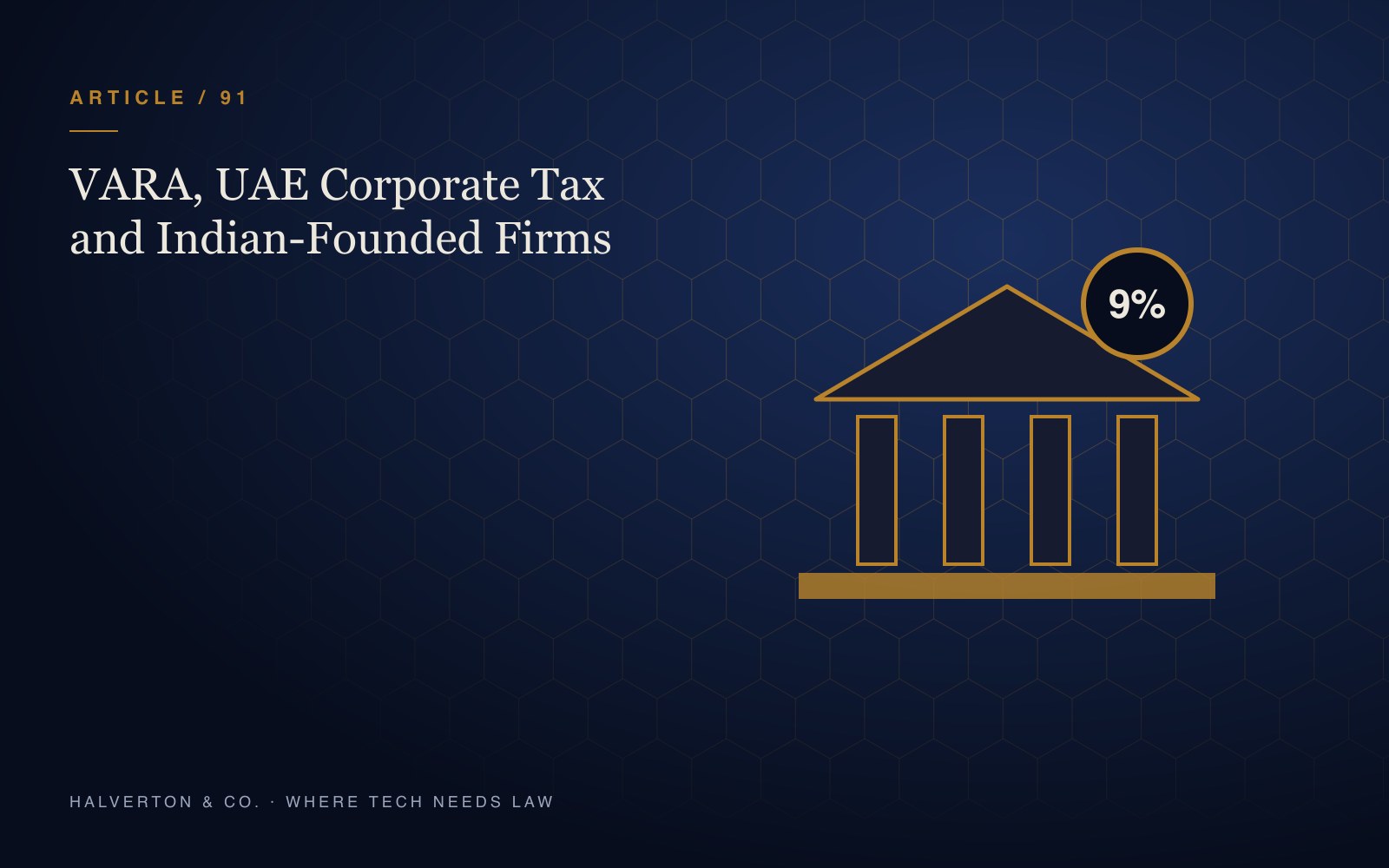
- The UAE standard corporate tax rate is 9% above AED 375,000, and the 0% rate for Qualifying Free Zone Persons applies only to qualifying income.
- Ministerial Decision No. 336 of 2025 reportedly added VARA to the competent authorities relevant to certain qualifying activities, such as fund and wealth management.
- VARA supervision may help meet one condition but does not make crypto income tax-free.
- Indian-resident founders face Indian tax on worldwide income, a flat 30% rate on virtual digital asset gains and place-of-effective-management risk.
A headline that VARA has been named a UAE corporate tax authority is easy to misread. VARA does not collect tax and has not become a tax regulator. What reportedly changed is narrower and still important: under a ministerial decision announced in February 2026, VARA was added to the list of competent authorities whose supervision counts for certain activities under the UAE’s free zone corporate tax rules.
For Indian-founded crypto firms in Dubai, the practical effect is on the tax rate. This guide explains the UAE corporate tax basics, what the reported decision does, how it may help a VARA-licensed firm qualify for the free zone regime, why it does not decide the position by itself, and what Indian founders must also consider at home. We worked from secondary reports and did not see the primary text of the operative article, so tax points must be confirmed with a UAE tax adviser.
UAE corporate tax and free zone basics
The UAE introduced federal corporate tax for financial years starting on or after 1 June 2023. The standard rate is 9% on taxable income above AED 375,000, with 0% below that threshold. A Qualifying Free Zone Person can benefit from a 0% rate on qualifying income, but must meet conditions: it must maintain adequate substance, derive qualifying income, comply with transfer pricing rules, and not elect to be taxed under the standard rules. Income that is not qualifying is taxed at 9%.
| Income | Rate | Condition |
|---|---|---|
| Taxable income up to AED 375,000 | 0% | Applies to all taxable persons |
| Taxable income above AED 375,000 | 9% | Standard rate |
| Qualifying income of a Qualifying Free Zone Person | 0% | Substance, qualifying activities, transfer pricing and other conditions must all be met |
| Non-qualifying income of a Qualifying Free Zone Person | 9% | Taxed at the standard rate |
Qualifying income is defined by cabinet and ministerial decisions. Ministerial Decision No. 229 of 2025 sets out the qualifying and excluded activities. Some qualifying activities are conditioned on the person being supervised or regulated by a competent authority, which is why the identity of the competent authority matters to financial and fund-related businesses.
This is the background to the VARA news. Whether a firm’s income is qualifying is a question of what it does, where it is licensed and how it is supervised, not just where its office is.
What the ministerial decision reportedly does
According to reports from February 2026, Ministerial Decision No. 336 of 2025 adds VARA to the definition of competent authority for the purposes of Decision No. 229 of 2025. In practice, that means supervision by VARA can satisfy the requirement that certain activities be conducted under a competent authority’s supervision. Reported coverage describes the relevant activities as fund management and wealth and investment management services.
The decision is reported not to expand VARA’s own powers. VARA remains the regulator of virtual asset activity in and from Dubai, with the DIFC excluded because it has its own regulator, the DFSA. It also does not make crypto income tax-free or create a special rate for virtual assets.
We could not locate the primary text of the operative article, and reports differ in detail. For that reason, this article describes the change in general terms and recommends reading the decision before relying on it.
The competent authority condition is one of several. A firm must also meet the substance requirements, which usually mean adequate staff, assets and premises in the free zone, with the core income-generating activities carried out there. It must keep audited financial statements, follow transfer pricing rules for related-party transactions, and avoid dealing with certain excluded activities beyond a small de minimis allowance. Failure on any condition can mean losing qualifying status, with the 9% rate applying to all income for a period. Treat the competent authority point as one box among several, not as the whole test.
Does it help a VARA-licensed crypto firm
Possibly, for some businesses and some income. A firm that is a Qualifying Free Zone Person and carries on a qualifying activity under VARA supervision, such as managing a virtual asset fund, may find the competent authority condition easier to satisfy. That could support the 0% rate on qualifying income, subject to all other conditions.
It will not help every crypto business. A centralised exchange, a broker or a token issuer is not automatically doing fund or wealth management, and its income may fall outside the qualifying list or inside the excluded list. Income from transactions with non-free-zone persons is also treated differently. A firm that mixes activities may have a split: some income qualifying and some taxed at 9%.
Location matters too. A VARA licence is for activity in and from Dubai. Whether the entity is on the mainland or in a free zone, and whether that free zone meets the definition for tax, are separate questions. A VARA licence does not itself make a company a Qualifying Free Zone Person. Substance, such as staff, premises and decision-making in the UAE, is tested.
What Indian founders must also consider
UAE tax is only one layer. If the founder is a tax resident of India, India taxes residents on their worldwide income, and gains from virtual digital assets are taxed at a flat 30% with no set-off of losses. Salary or dividends received from the UAE company can be taxable in India, and disclosure of foreign assets is required. The India-UAE double tax avoidance agreement can provide relief in some cases.
A UAE company can also be treated as an Indian tax resident if its place of effective management is in India. If key decisions are taken by Indian-resident directors from India, the company may face Indian tax on global income, whatever its UAE licence says. Founders who split time between the two countries should review the residency tests, keep travel records and document where board decisions are made.
There are also corporate-law and exchange-control questions if an Indian company invests overseas: FEMA overseas direct investment rules apply, and a UAE subsidiary of an Indian company will have transfer pricing and reporting duties. We cover these structures in our guides to setting up in Dubai.
Founders who run both an Indian company and a UAE company should also think about intra-group dealings. Service fees, licence fees and cost-sharing between the two must be at arm’s length, and each tax authority may look at them. Dividends flowing from the UAE to an Indian parent, and loans between entities, raise further questions under Indian company law and FEMA. A short written group structure paper, updated each year, makes later audits and fundraising much easier.
Next steps, remedies and quick answers
Have a tax adviser map each revenue stream to the qualifying and excluded lists, in light of the competent authority change. Check that your entity is in a free zone that can qualify and that you meet substance requirements. Review the VARA licence category and conditions to make sure you are supervised for the activity that produces the income. Keep contemporaneous records, including transfer pricing documents. Register for corporate tax and file on time, because penalties apply for late registration and filing. For Indian-resident founders, check residency and place of effective management and Indian disclosure. If the tax authority challenges the classification of your income, the UAE system provides for reconsideration and appeal, and early engagement with an adviser is better than waiting for an assessment. Do not market a structure as tax-free on the strength of this decision: it is narrow, and the facts decide the outcome.
Timing matters. Corporate tax registration and filing deadlines run from the start of the financial year, and late registration carries penalties. A company that was formed before the competent authority change should review whether its past treatment, and its licence conditions, need to be revisited rather than assuming the change helps retrospectively. A short written tax position memo, updated when the law or the business changes, is cheap insurance.
Related reading: DMCC and VARA licences compared, the VARA and Securitize tokenisation MoU, the UAE FIU and VARA agreement, crypto tax in Dubai for Indian residents, a Dubai holding company for Indian founders and FEMA, Dubai vs GIFT City for crypto and Web3 and paying Indian developers from a Dubai Web3 company; also VARA token issuance guidance 2026 and an intercompany IP licence from Dubai to an Indian subsidiary; also crypto corporate tax in the UAE.
Quick answers
Is VARA now a tax authority in the UAE?
No. Reports say VARA was added to the list of competent authorities for the purposes of the UAE’s free zone corporate tax rules, so its supervision can count for certain qualifying activities. It does not collect tax.
Does this mean VARA-licensed crypto firms pay no corporate tax?
No. The standard rate is 9% above AED 375,000, and the 0% rate applies only to qualifying income of a Qualifying Free Zone Person that meets all conditions. Many crypto activities will not qualify.
Does an Indian founder in Dubai still pay tax in India?
Possibly. A founder who is an Indian tax resident is taxed on worldwide income, virtual digital asset gains are taxed at 30%, and a UAE company managed from India can face Indian tax, so residency and management should be reviewed.
Does VARA collect tax?
No. VARA regulates virtual asset activity. Reports say it was added as a competent authority under the corporate tax rules for qualifying free zone activities, which is a different thing from collecting tax.
Does a VARA licence make my company a Qualifying Free Zone Person?
No. Qualifying status depends on being in a qualifying free zone, meeting substance and income conditions and carrying on qualifying activities. A VARA licence is relevant only to the supervision condition for some activities.
Final word
Halverton & Co. is an Indian law firm advising NRIs, founders, investors and businesses in Dubai and across the UAE on Indian law, including cross-border structuring, FEMA, Indian tax residency and place-of-effective-management risk for Indian-founded companies in Dubai. We practise in Jharkhand, Maharashtra and before the Supreme Court of India, and work alongside UAE-licensed counsel, who advise on UAE law. Halverton & Co.: Where tech needs law! If you have a question about Indian law, write to us at office@halvertonandco.com, or get in touch.
This article reflects developments reported up to late October 2026. It is for general information only, is not legal advice, and does not create an advocate-client relationship. Halverton & Co. is an Indian law firm and does not advise on UAE law; UAE-law points should be confirmed with UAE-licensed counsel.
Sources
Related practice area
Crypto, Web3 & Digital Assets
Advice for virtual digital asset businesses on registration, reporting and structure.
View the practice areaComments
No account needed. Comments are reviewed before they appear, so yours will show here once approved. Please do not share confidential details or describe your own legal matter: replies are general discussion, not legal advice, and do not create an advocate-client relationship. For your own situation, write to office@halvertonandco.com.