
Key takeaways
- For an Indian resident employee, the gain at exercise of a foreign company’s options is generally taxed in India as a perquisite.
- A later sale is taxed as a capital gain with the taxed value as cost, and foreign shares must be reported in the foreign assets schedule.
- The UAE does not tax the individual, so the main liability sits in India.
- Moving countries changes residence status, so plan exercise dates with a tax adviser.
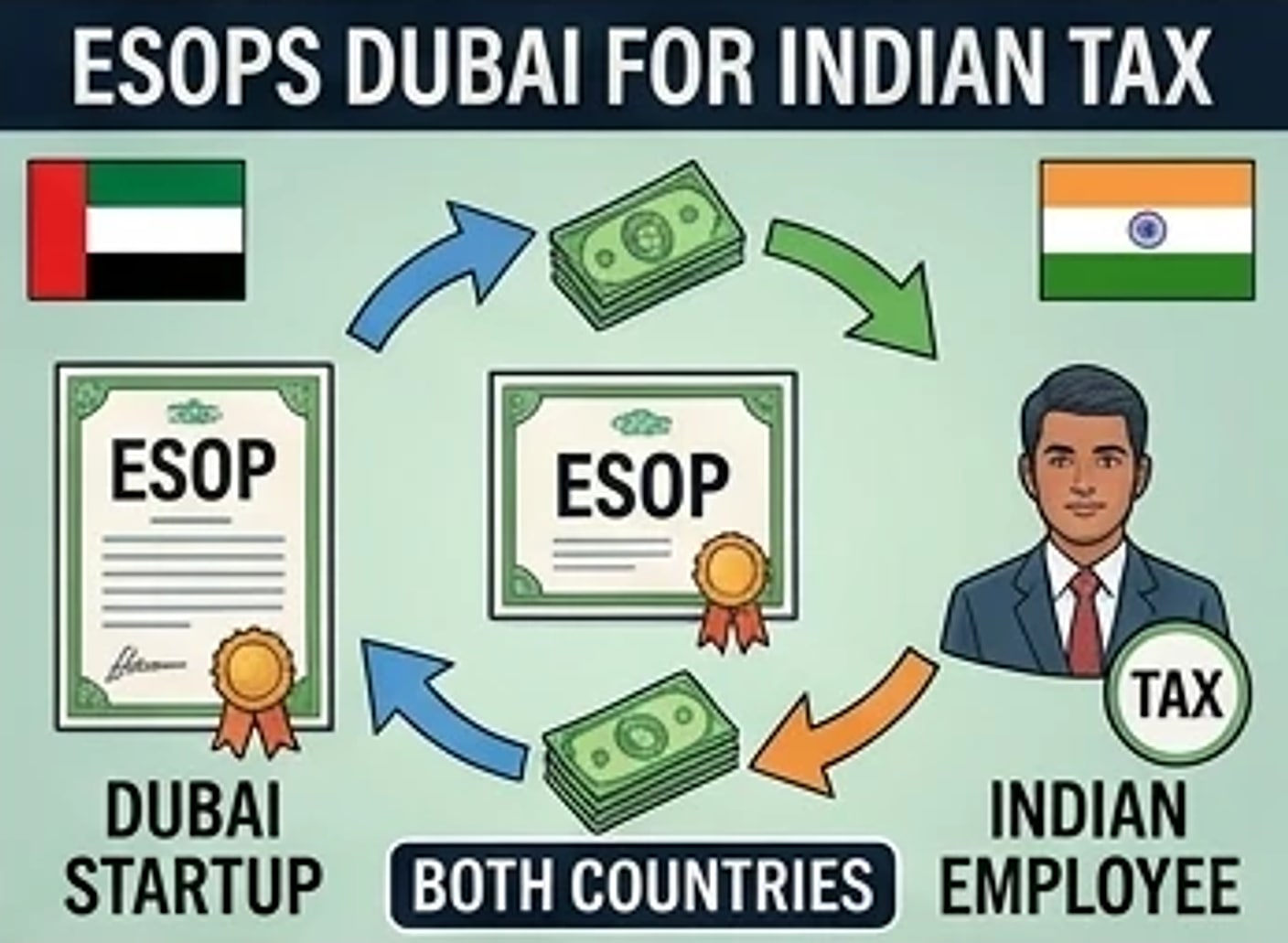
ESOP Dubai startup Indian employee tax looks simple on the surface: the UAE has no personal income tax, so where is the problem? The problem is that the employee is usually an Indian tax resident, and India taxes worldwide income. Options granted by a Dubai company to an engineer in Bengaluru are an Indian tax matter at exercise and again at sale, whatever the UAE says.
Founders often discover this when an employee asks, a week before exercise, who pays the tax and how. Here is a walk-through for a Dubai startup granting options to employees who live in India, and for employees who are moving. We cover India’s treatment at each step, reporting duties, how money for the exercise price can be sent, and what changes on moving to Dubai. Treat it as a map and ask a tax adviser to confirm the numbers for a given case. ESOP Dubai startup Indian employee tax is mostly an Indian issue, since the UAE has no personal income tax.
The UAE side
The UAE has no personal income tax on salary or capital gains, and its corporate tax regime is aimed at companies. A Dubai startup granting options doesn’t withhold income tax on exercise for employees who are not UAE residents, and there is no UAE tax on the employee’s gain in the ordinary case. That is why founders think the position is simple. ESOP Dubai startup Indian employee tax looks simple on the UAE side.
The legal form of the plan still matters. A company in DIFC or ADGM can use the free zone’s rules on share schemes, while a mainland or other free zone company follows its own company law. The plan rules should cover vesting, exercise, cashless or net settlement, leaver provisions and valuation. Our post on good leaver and bad leaver clauses shows how these work.
Check securities law on the Indian side too. Offering shares of a foreign company to employees in India is possible, but the Indian employee may need to comply with exchange control and reporting, and the company should avoid marketing the plan as a public offer. A short written plan and clear communication help.
Tax in India at exercise
For an employee who is a resident of India, the benefit from an ESOP is generally taxed as a perquisite under salary income when the option is exercised. The taxable value is, in general terms, the fair market value of the share on the exercise date less the exercise price paid. Perquisite tax on exercise India rules apply to shares of foreign companies, including unlisted ones, and the valuation is done under Indian rules, often by a merchant banker. Perquisite tax on exercise India foreign ESOP rules mean the employee pays at exercise. ESOP Dubai startup Indian employee tax bites there.
The employee’s employer in India, if any, withholds tax on perquisites. If the Dubai company is the employer and has no Indian presence, nobody deducts tax and the employee must pay advance tax and report the perquisite in the return. That catches people out, since tax is due at exercise even if the shares can’t be sold. An exercise with no sale can create a bill with no cash.
Valuation is an issue for an unlisted startup. Indian rules require a determination of fair market value for the perquisite, and a startup’s own valuation may not match. Agree a method with advisers in advance. An early plan to share valuation reports with Indian employees saves arguments later. Valuation is the hard part of ESOP Dubai startup Indian employee tax.
Tax in India on sale, and reporting
When the employee later sells the shares, the gain is a capital gain. The cost of acquisition is the fair market value that was taxed as a perquisite. Capital gains on sale of foreign unlisted shares India taxes as long term if held for more than 24 months, at a flat rate under recent changes, and short term otherwise at slab rates. Check the current rates and holding periods, which have changed. On sale, ESOP Dubai startup Indian employee tax becomes a capital gains matter.
| Moment | India | UAE |
|---|---|---|
| Grant and vesting | Generally no tax | No personal income tax |
| Exercise | Perquisite taxed as salary | No tax |
| Sale | Capital gains tax | No tax |
| Reporting | Schedule FA and foreign income schedules | None for the employee |
Reporting is an obligation separate from tax. A resident Indian holding foreign shares must disclose them in the foreign assets schedule of the return, and foreign income in the related schedules. Schedule FA ESOP foreign shares must be reported even if they produced no income that year, and non-disclosure can attract penalties under the Black Money Act. File accurately each year.
If the sale proceeds are taxed in another country, a foreign tax credit may be claimed in India on Form 67. Since the UAE doesn’t tax the gain, there is usually nothing to credit. If the employee later moves to a country that does tax, credit rules matter. A foreign tax credit Form 67 ESOP claim is rarely needed for the UAE.
Moving between countries and plan design
Residence changes matter. An Indian employee who moves to Dubai and becomes a non-resident for Indian tax purposes may be taxed differently on options exercised after the move, and the allocation of gain between the periods of Indian residence and non-residence may be an issue. Residency status depends on days in India and other tests, and a returning NRI may be in a transitional category. Plan exercise dates with a tax adviser. Moving residence changes ESOP Dubai startup Indian employee tax.
On the funding side, a resident individual who pays an exercise price to a foreign company is making an overseas remittance. Commentary on the exchange control rules says remittance for an ESOP counts towards the LRS limit, even though the limit does not apply to some other forms of overseas investment. LRS ESOP exercise remittance is therefore usually through the annual USD 250,000 limit, with the bank’s declaration. Cashless exercise structures may avoid the remittance but have their own tax effects.
Founders can make life easier for employees. Offer a net exercise or cashless option if the plan allows, share valuation reports in time, explain tax at exercise in plain terms, and consider Indian-law advice before launching a plan for India-based staff. Provide a short FAQ. A plan that employees understand is more motivating than a generous one they fear. Founders can ease ESOP Dubai startup Indian employee tax by explaining it early.
Questions people ask
In short, the UAE side is quiet and the Indian side is the one to plan. Get the valuation method and the cash plan agreed before the first exercise. ESOP Dubai startup Indian employee tax is best planned before the first exercise.
Related reading: ESOPs for startups in India, stock options for Indian employees of a US startup, good leaver and bad leaver clauses, returning to India from Dubai: RNOR, RSUs, SARs and phantom stock in India and Indian angels in a Dubai startup.
Quick answers
How is an ESOP Dubai startup Indian employee tax bill calculated?
For an Indian resident, the difference between fair market value at exercise and the exercise price is generally taxed as a perquisite in India, and the later sale gain is a capital gain. The UAE does not tax the individual, so the main liability is in India.
Do I have to report foreign ESOP shares in my Indian tax return?
Yes, a resident Indian holding foreign shares must disclose them in Schedule FA, whether or not income arose, and report any income. Penalties can apply for non-disclosure.
Can I use LRS to pay the exercise price for a Dubai company’s options?
Commentary says remittances to pay for ESOP exercise count towards the LRS limit. Check the current limit and any bank requirements with an authorised dealer.
Can I use LRS to pay the exercise price?
Commentary says ESOP exercise remittances count towards the LRS limit. Confirm with an authorised dealer.
Final word
Halverton & Co. is an Indian law firm advising NRIs, founders, investors and businesses in Dubai and across the UAE on Indian law, including Indian tax, FEMA and employment questions for Dubai startups with Indian employees, and for Indian employees of UAE companies, alongside UAE-licensed counsel. We practise in Jharkhand, Maharashtra and before the Supreme Court of India, and work alongside UAE-licensed counsel, who advise on UAE law. Halverton & Co.: Where tech needs law! If you have a question about Indian law, write to us at office@halvertonandco.com, or get in touch.
This article reflects developments reported up to 31 October 2026. It is for general information only, is not legal advice, and does not create an advocate-client relationship. Halverton & Co. is an Indian law firm and does not advise on UAE law; UAE-law points should be confirmed with UAE-licensed counsel.
Related practice area
Startups & Venture
From incorporation to term sheet. The documents a company needs to be fundable.
View the practice areaComments
No account needed. Comments are reviewed before they appear, so yours will show here once approved. Please do not share confidential details or describe your own legal matter: replies are general discussion, not legal advice, and do not create an advocate-client relationship. For your own situation, write to office@halvertonandco.com.