Key takeaways
- Federal Decree-Law No. 45 of 2021 has been in force since 2 January 2022, but enforcement is tied to executive regulations.
- A leading practitioner guide from March 2026 said the regulations had not been issued, while some vendor blogs claim they have.
- The PDPL can apply to processing of personal data of people in the UAE by controllers and processors outside the UAE.
- DIFC and ADGM have their own laws, so ask which regime governs each customer.
UAE PDPL compliance is an awkward subject in 2026, because the law is in force but the detailed rules that make it enforceable may still be missing. Federal Decree-Law No. 45 of 2021 on the protection of personal data took effect on 2 January 2022. It is a full privacy law, with consent, rights and security duties. But its executive regulations, which fix the details and, according to a leading commentary, start the clock for enforcement, had not been confirmed as issued by mid-2026.
Sources conflict on that, and that is the first thing to check before you write a compliance plan. This piece explains what the law covers, what Indian SaaS firms with UAE customers should do now, why free zones complicate the picture, and how to plan without waiting for a date. Take UAE counsel’s advice on legal status, since our firm advises on Indian law. UAE PDPL compliance should start now. The PDPL executive regulations not yet issued status is the first thing to check.
Where the PDPL stands in 2026
Federal Decree-Law No. 45 of 2021 is the UAE’s first comprehensive federal data protection law. It is in force, and the UAE Data Office, set up by a separate decree-law, is the regulator. The PDPL becomes enforceable some months after its executive regulations are issued, with commentary saying six months, subject to the Data Office extending that period. UAE PDPL compliance depends on an enforcement date that isn’t certain.
What are we sure of? A leading practitioner guide from March 2026 describes the PDPL executive regulations not yet issued, and the Data Office as not yet fully operational. A review of the same material, and a legal tracker in May 2026, say the same. Some vendor blogs claim the regulations were issued in 2026, but we found no primary citation. Compliance deadlines such as 1 January 2027 that appear online are unverified.
Two takeaways. Don’t tell your board that the PDPL isn’t a concern because the regulations are late. And don’t claim an enforcement date you can’t source. Check the UAE Official Gazette and the Data Office website for the current position, and ask UAE counsel to confirm. UAE PDPL compliance plans should say which date you rely on and why.
Does it apply to an Indian SaaS firm
The PDPL applies to processing of personal data of individuals in the UAE, by controllers and processors located in or outside the UAE. The PDPL extraterritorial scope means an Indian SaaS company serving UAE customers, and processing their employees’ or users’ data, may be caught, depending on its role as controller or processor. UAE PDPL compliance applies to Indian SaaS firms with UAE users.
| Customer based in | Regime | Note |
|---|---|---|
| Mainland UAE and most free zones | Federal PDPL | Enforcement tied to executive regulations |
| DIFC | DIFC Data Protection Law 2020 | Includes Regulation 10 on AI |
| ADGM | ADGM Data Protection Regulations 2021 | Own regulator |
| Government or sector-specific | Other laws | Check exclusions |
It does not cover everything. The law excludes certain categories, such as data held by government, security and judicial authorities, health data governed by other laws, and personal data held by financial and credit information entities subject to other legislation. And it doesn’t apply to companies in financial free zones that have their own data protection laws.
Your role matters. A SaaS provider usually acts as a processor for its business customers, who are the controllers. That means you follow instructions, keep data secure, report breaches and help the customer meet its duties. If you use customer data for your own purposes, such as analytics or model training, you may also be a controller. Map the roles first. Indian SaaS UAE customers data flows are the starting point. For UAE PDPL compliance, map your role before anything else.
Core duties to prepare for
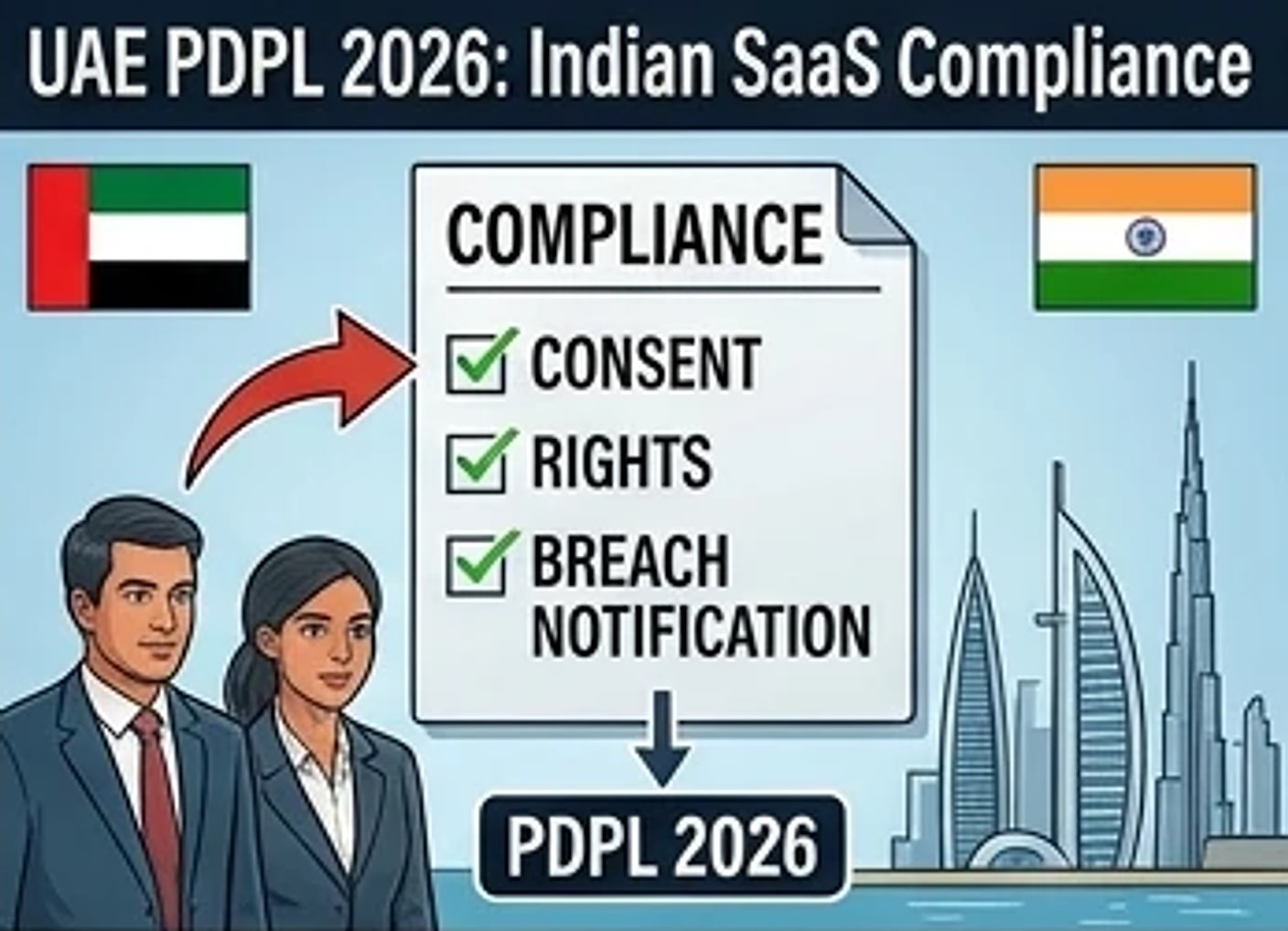
Even without final regulations, the law tells you the shape of the duties. Lawful basis, with consent as the main one, plus others such as contract and legal obligation. Transparency through a privacy notice. Purpose limitation and data minimisation. Accuracy, storage limits and security. Rights for individuals: access, correction, erasure, objection and portability. A duty to report breaches to the Data Office and to affected people in prescribed cases. The duties that shape UAE PDPL compliance are familiar.
Cross-border transfers are regulated. Personal data may go to countries with an adequate level of protection, or on the basis of contracts, binding rules or other grounds. For an Indian SaaS company hosting UAE data in India, that means contract terms, a transfer assessment and perhaps an adequacy decision once the regulations say how it works. Keep a record of transfers.
Some controllers have to appoint a data protection officer and carry out impact assessments in higher-risk cases. A practical plan is to align with the DPDP Act and the GDPR as a baseline, since much overlaps, then add UAE-specific items when the regulations arrive. Our post on the DPDP Act and UAE PDPL together covers the overlap. UAE PDPL compliance can piggyback on DPDP and GDPR work.
Free zones and sector laws
The UAE has several data protection regimes. DIFC has its own Data Protection Law (2020), ADGM has its Data Protection Regulations (2021), and both have active regulators. Companies based in those zones follow those rules, not the federal PDPL. The DIFC ADGM data protection laws are in some ways stricter, with fines and detailed requirements, and DIFC has a regulation on AI systems. UAE PDPL compliance differs in free zones.
Other free zones, such as those in Dubai or Sharjah that do not have their own data law, are generally subject to the federal PDPL. Sector rules add more: health data law, financial regulations, telecom rules and the Central Bank’s requirements. Which regime applies depends on where the controller is established and what data it handles.
For an Indian SaaS company, the first question for each UAE customer is which regime governs it. Ask. A customer in DIFC will want DIFC-compliant terms. A mainland bank will want security and localisation commitments. Put those in the contract and keep a short register of customers by regime. UAE PDPL compliance depends on which regime governs each customer.
Questions people ask
In short, plan now, document your reasoning and don’t promise dates you can’t back. When the regulations land, your records will make the transition easy. UAE PDPL compliance rewards early records.
Related reading: the UAE PDPL and Indian apps, the DPDP Act and Dubai AI startups, AI startups in Dubai using Indian data, the DPDP Act for US SaaS companies, DPDP compliance for small businesses and DIFC and ADGM crypto token rules; also UAE data localisation.
Quick answers
Is UAE PDPL compliance mandatory in 2026?
The law is in force, but enforcement is tied to the issue of executive regulations, which commentary says had not been issued as of mid-2026. Confirm the current status with UAE counsel and the Data Office.
Does the UAE PDPL apply to an Indian company?
It can, if the company processes personal data of people in the UAE as a controller or processor, even from India. Financial free zones such as DIFC and ADGM have their own laws.
What should Indian SaaS firms do now for UAE PDPL compliance?
Map your role and data flows, update privacy notices, put data processing and transfer terms in contracts, prepare breach and rights processes, and identify which regime applies to each UAE customer.
Is UAE PDPL compliance mandatory in 2026?
The law is in force but enforcement depends on the regulations. Confirm the current status with UAE counsel.
Final word
Halverton & Co. is an Indian law firm advising NRIs, founders, investors and businesses in Dubai and across the UAE on Indian law, including DPDP Act and cross-border data protection compliance for Indian SaaS companies with UAE customers, alongside UAE-licensed counsel. We practise in Jharkhand, Maharashtra and before the Supreme Court of India, and work alongside UAE-licensed counsel, who advise on UAE law. Halverton & Co.: Where tech needs law! If you have a question about Indian law, write to us at office@halvertonandco.com, or get in touch.
This article reflects developments reported up to 31 October 2026. It is for general information only, is not legal advice, and does not create an advocate-client relationship. Halverton & Co. is an Indian law firm and does not advise on UAE law; UAE-law points should be confirmed with UAE-licensed counsel.
Sources
Related practice area
Technology & AI Law
Contracts, data protection and AI policies for products that handle other people’s data.
View the practice areaComments
No account needed. Comments are reviewed before they appear, so yours will show here once approved. Please do not share confidential details or describe your own legal matter: replies are general discussion, not legal advice, and do not create an advocate-client relationship. For your own situation, write to office@halvertonandco.com.