Key takeaways
- Many advisers treat airdrops and staking rewards as income from other sources at fair market value on receipt.
- Selling the tokens later is taxed at 30% on the gain with no loss set-off.
- There is no official guidance on the receipt-stage rate, and sources conflict.
- Keep a ledger with dates, quantities and rupee values for every reward.
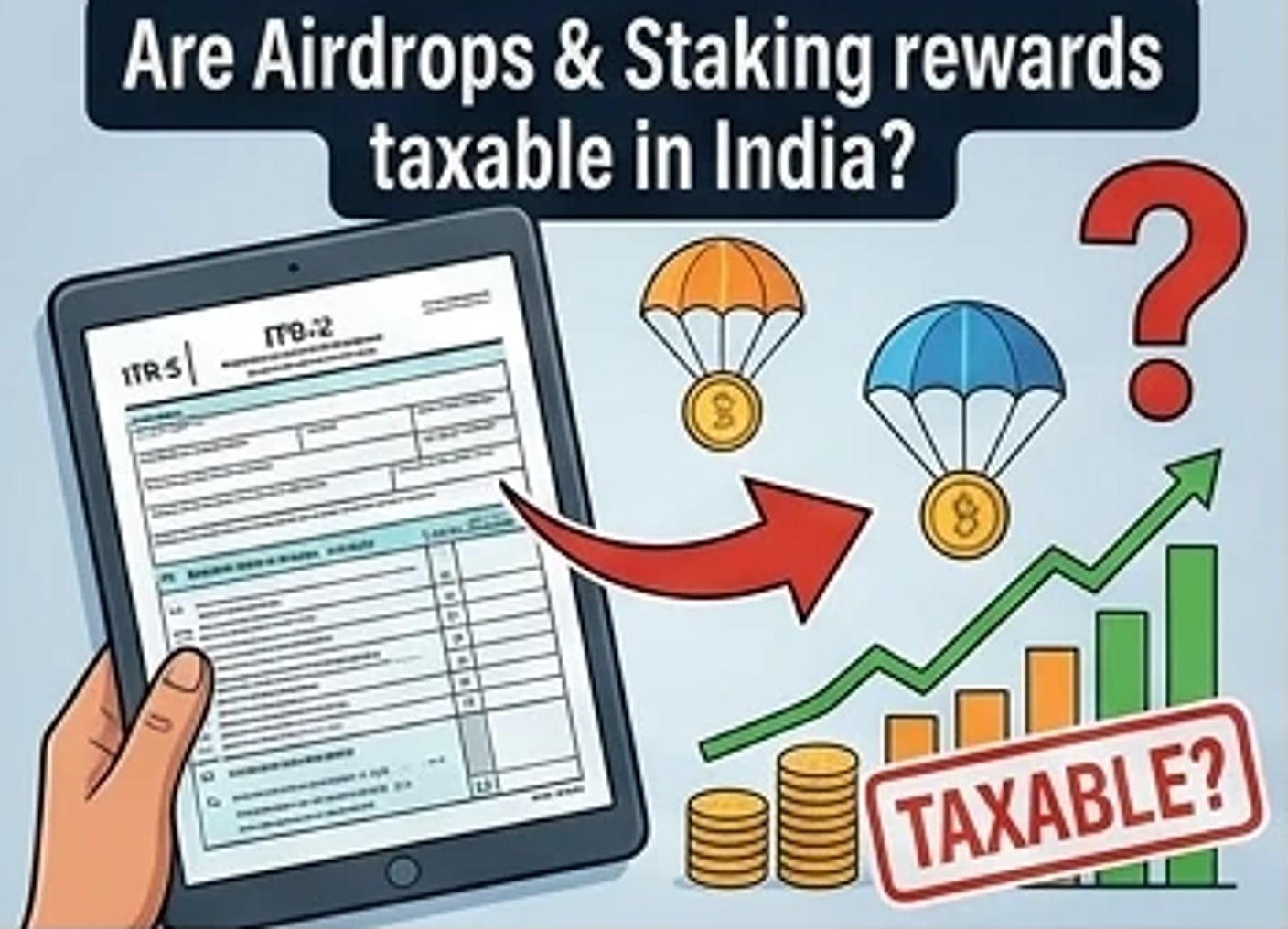
Airdrop tax India is one of those questions where the honest answer is, it depends who you ask. A token lands in your wallet for free, or you earn staking rewards for locking up coins. Is that income when it arrives? Is it taxed again when you sell? India has a clear 30% rule for selling virtual digital assets, but no detailed official guidance on what happens at the point of receipt.
So practitioners work from the general scheme of the Income-tax Act and from common sense, and the views differ. This piece sets out the most defensible reading, the points that remain open, and what to do about records while the law catches up. Treat it as a way to plan questions for your adviser, not as a final answer, and check for any CBDT clarification before you file. Airdrop tax India has no clear rule at the receipt stage, so use a consistent method.
The two moments that matter
With any airdrop or staking reward, there are two separate tax moments. The first is the receipt: the day the tokens arrive in your wallet. The second is the disposal: the day you sell, swap or spend them. India’s special crypto tax regime deals clearly with the second and says very little about the first. Airdrop tax India has two tax moments to keep apart.
The tax on disposal is the familiar one. Under Section 115BBH of the old Act, now carried into the Income-tax Act, 2025, income from the transfer of a virtual digital asset is taxed at a flat 30%, with only the cost of acquisition deductible and no set-off of losses. That much is settled.
The receipt side is where airdrop tax India advisers differ. There is no provision that says in terms that an airdrop or a staking reward is taxed in a particular way. People reach an answer by asking which existing head of income fits. On receipt, airdrop tax India advisers disagree.
Tax when you receive the tokens
The most commonly stated view is that tokens received for free are taxable as income from other sources when you receive them, valued at fair market value on that date. Several advisers rely on Section 56(2)(x), which taxes property received without consideration above a threshold, or on the general head of income from other sources. The airdrop fair market value on receipt becomes the taxable amount. Many airdrop tax India advisers treat receipt as income under Section 56 income from other sources crypto holders should note.
Staking rewards are treated similarly: income when received, at fair market value. The staking rewards tax India approach is that rewards for providing a service, locking coins to validate a network, are income. Some view them as business income if you stake at scale. Others argue they are not taxable until sold, because the reward is a new asset with a nil cost, but that is the minority view.
The rate is the other question. Some guides say the receipt amount is taxed at your slab rate. Others say the 30% special rate applies. We have not found an official statement on this, and sources conflict. The conservative approach is to ask your adviser how they will treat it and to document why. Airdrop tax India taxpayers can’t rely on official guidance for the rate.
Tax when you sell
When you later sell or swap the airdropped token, the 30% rate under Section 115BBH applies to the gain. The usual reading is that the cost of acquisition is the fair market value you were taxed on at receipt, which stops you being taxed twice on the same value. If you weren’t taxed on receipt, the cost may be nil and the whole sale price is the gain. For sale, airdrop tax India rules are simple: 30% on the gain.
| Moment | Common view | Open point |
|---|---|---|
| Receipt of airdrop or reward | Income at fair market value on that date | Slab rate or 30% |
| Later sale or swap | 30% on gain, cost is the value taxed at receipt | If nothing was taxed, cost may be nil |
| TDS | Usually no buyer to deduct | Platform-paid rewards |
| Losses | No set-off | Harsh after a price fall |
Tax on selling airdropped tokens 30% is therefore straightforward in form and fact-dependent in amount. A token received at a notional value of ₹10,000 and sold for ₹15,000 produces a gain of ₹5,000 if the receipt value counts as cost. If it counts as nil, the gain is ₹15,000. That’s a big difference and a reason to record the value on the day of receipt.
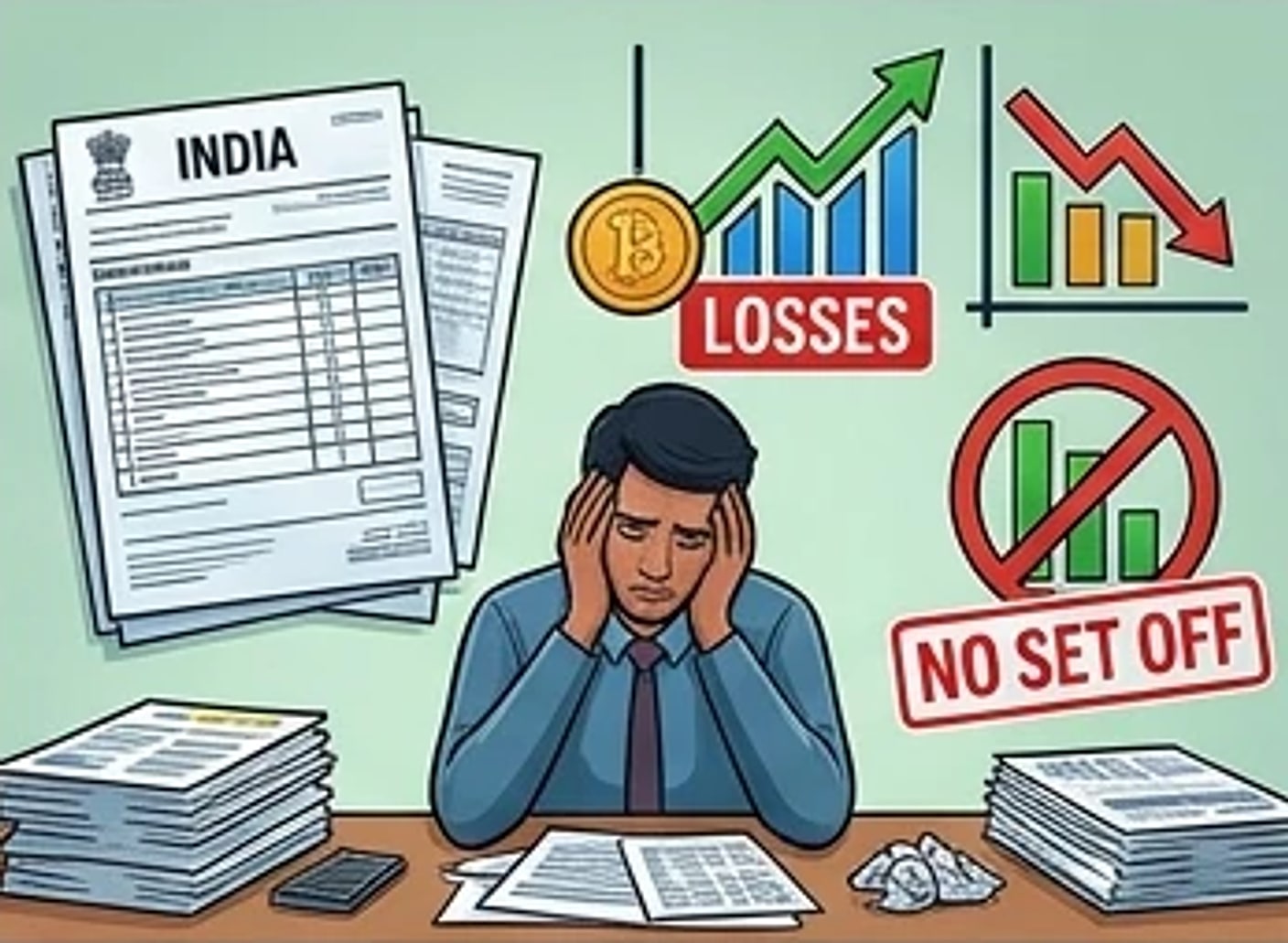
Remember there is no loss relief. If the token fell in value after receipt and you sell below the amount you were taxed on, the loss can’t be set off. People who were taxed at receipt on a high valuation and then watched the price collapse can end up paying tax on value they never kept. That is a harsh outcome and one reason the receipt question matters. Airdrop tax India can bite twice if value fell after receipt.
Records, TDS and open questions
Keep a ledger. For every airdrop or reward, record the date, the token, the quantity, the market price in rupees from a reliable source and where you got it. If you receive many small rewards, a software tool or spreadsheet that imports wallet data is worth the effort. Your adviser will need it to take any position, and so will the department if it asks. Good records are the best defence in airdrop tax India disputes.
On TDS, Section 194S requires 1% deduction on payment for the transfer of a virtual asset above a threshold. Staking rewards and airdrops are not usually paid for by a buyer, so there may be no one to deduct it. TDS on staking rewards is therefore usually not triggered at receipt, but that is a point of interpretation. A platform that pays you rewards may deduct tax at its own view, so check your statements.
Unsettled issues remain. Hard forks, liquidity mining, rebasing tokens, NFT drops, and tokens from a project you never asked for each raise the same question. Some commentators call for clarification from the CBDT and nothing authoritative has come. Until it does, choose a reasonable position, document it, and be ready to explain it. Until clarity arrives, airdrop tax India positions should be documented.
Questions people ask
For the average holder with a few airdrops, the goal isn’t perfection. It is a consistent method, saved screenshots and a note of why you chose it. For airdrop tax India taxpayers, a consistent method matters most.
Related reading: crypto tax in India: 30% and 1% TDS, why crypto losses cannot be set off in India, claiming credit for 1% TDS on crypto, what Budget 2026 changed for crypto tax, the crypto reporting penalty in India and what to do about a crypto nudge email; also US tax on staking rewards.
Quick answers
Is airdrop tax India taxpayers face due when I receive the tokens?
Most advisers say yes: free tokens are income from other sources at fair market value on receipt. But there is no express rule and views differ on the rate. Take advice and keep records.
How are staking rewards taxed in India?
The common view is that staking rewards are income when received, valued at fair market value, and the later sale of the reward tokens is taxed at 30% under the VDA rules. There is no official guidance, so positions vary.
Is there TDS on airdrops?
Section 194S applies to payments for the transfer of a virtual digital asset, so there is usually no buyer to deduct tax on an airdrop. Whether a platform paying rewards must deduct tax is a point of interpretation.
Is there TDS on airdrops?
Section 194S applies to payments for the transfer of a VDA, so there is usually no buyer to deduct tax on an airdrop.
Final word
Halverton & Co. is an Indian law firm advising founders, startups, technology companies and investors on Indian law, including Indian tax and regulatory questions for crypto holders, founders and platforms, alongside tax advisers. We practise in Jharkhand, Maharashtra and before the Supreme Court of India, and act as fractional legal counsel for technology-driven businesses. Halverton & Co.: Where tech needs law! If you have a question about Indian law, write to us at office@halvertonandco.com, or get in touch.
This article reflects developments reported up to 31 October 2026. It is for general information only, is not legal advice, and does not create an advocate-client relationship. Halverton & Co. is an Indian law firm.
Sources
Related practice area
Crypto, Web3 & Digital Assets
Advice for virtual digital asset businesses on registration, reporting and structure.
View the practice areaComments
No account needed. Comments are reviewed before they appear, so yours will show here once approved. Please do not share confidential details or describe your own legal matter: replies are general discussion, not legal advice, and do not create an advocate-client relationship. For your own situation, write to office@halvertonandco.com.