Key takeaways
- Income from transferring a virtual digital asset is taxed at a flat 30%, with only the cost of acquisition deductible.
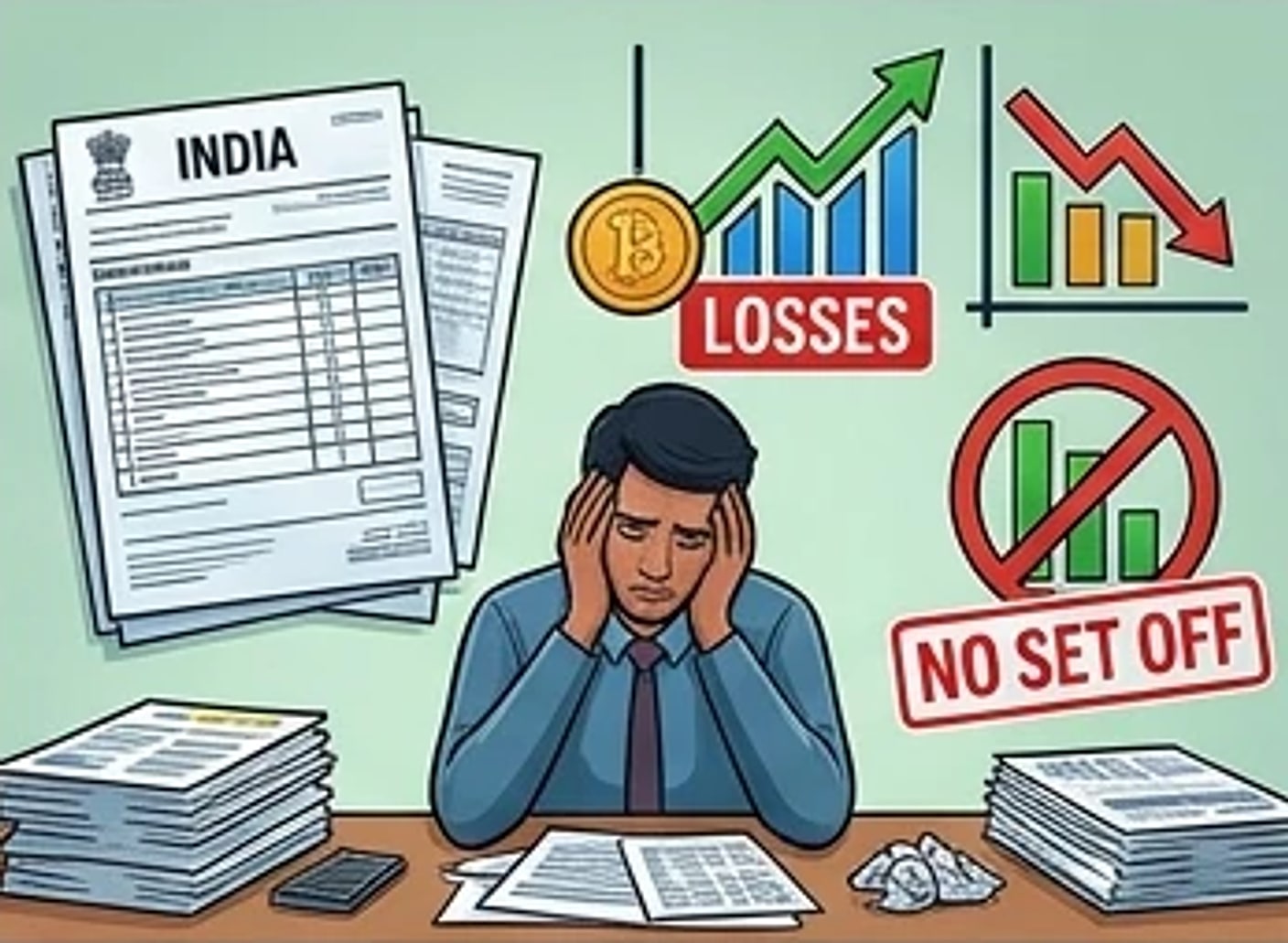
- A loss on a virtual digital asset cannot be set off against any other income and cannot be carried forward.
- Each transfer is generally looked at separately, so a loss on one coin does not reduce tax on a gain on another.
- Report every transfer in the VDA schedule and claim credit for TDS, even in a loss year.
If you have lost money on crypto in India, here is the unwelcome part up front. The crypto loss set off India rules don’t let you use that loss against anything. Not against another crypto gain, not against salary, not against business income, and not in a later year. A flat 30% tax on gains sits next to a rule that gives you nothing back on losses.
Budget 2026 looked at the regime and kept it. So a lot of people are asking what, if anything, they can do. There are a few things, mostly about records, timing and not making it worse. We’ll go through the rule, the maths, the awkward cases and what to report in your return. Section numbers have moved under the new Income-tax Act, so check the current text before you file. Put simply, crypto loss set off India is not allowed under the VDA rules, and a virtual digital asset loss not allowed for set-off is simply gone.
What the rule says
The tax on income from transfer of virtual digital assets sits in Section 115BBH of the old Income-tax Act, and the Income-tax Act, 2025 re-enacts it with new numbering. Two lines matter. Income is taxed at a flat 30%. And no deduction is allowed except the cost of acquisition, which excludes fees, gas costs and anything else you spent. On crypto loss set off India, the rule is blunt, and the Section 115BBH no set-off provision explains why.
The second line is what kills losses. The law also says that a loss from transfer of a virtual digital asset can’t be set off against income from any other source, and can’t be carried forward to later years. That’s the Section 115BBH no set-off rule in one sentence. A VDA loss simply disappears for tax purposes. Remember that crypto loss set off India is blocked in both directions.
A 1% TDS applies on many transfers too, whether you made money or not. That TDS is an advance, not a final tax, but in a loss year the credit can be hard to use. More on that below. The Budget 2026 changes were mostly about reporting by platforms, not about relaxing any of this. Budget 2026 did not change crypto loss set off India rules.
The maths of a loss year
Take a plain example. You buy a token for ₹5 lakh and sell it for ₹3 lakh. There is no income to tax, so nothing is payable on that trade. That’s fine. But the ₹2 lakh loss is dead: it doesn’t reduce your other income, and you can’t carry it into next year. The maths of crypto loss set off India shows how the 30% tax works in a loss year. The tax on crypto loss India 30% regime applies only to gains.
| Trade | Result | Tax effect |
|---|---|---|
| Buy ₹5 lakh, sell ₹3 lakh | Loss of ₹2 lakh | No tax, no relief |
| Sell another coin for ₹2 lakh gain | Gain of ₹2 lakh | 30% tax on the gain |
| Net position | Break-even | Tax still due on the gain |
| Next year | Loss cannot be carried forward | Nil benefit |
Now add a second trade. You also sold another coin for a ₹2 lakh gain the same year. Your tax is 30% of ₹2 lakh, even though you are down ₹0 overall across the two trades. The loss on the first can’t be netted off against the gain on the second, as the commonly understood reading goes. That is the harsh part, and the one that surprises people.
A third point on TDS. If the platform deducted 1% on each sale, you may have paid tax in advance on trades that lost money. In a year where you owe nothing, that credit can come back as a refund when you file. Keep your TDS certificates and the annual tax statement and match them to your records. This is the part of crypto loss set off India that hurts: tax is due on gains but a loss gives nothing back.
Gains and losses in the same year
Some people ask whether they can “net” within crypto at least. The general reading of the provision is that each transfer is looked at separately and a gain on one asset can’t be reduced by a loss on another. Tax advisers have treated this as the safer view, and a taxpayer who nets them risks a notice. If a large sum is in play, take written advice.
That makes year-end behaviour matter. Selling a losing coin to “book the loss” achieves nothing for tax, so tax loss harvesting, familiar in other countries, is pointless here. Equally, selling winners and keeping losers can’t be offset. Selling for tax reasons can only make things worse because of the fees and the 1% TDS. Crypto loss set off India also affects year-end selling, so don’t sell just to book a loss.
Swapping one token for another is also a transfer in most views. A crypto-to-crypto swap that produces a gain is taxable even if you never touched rupees. Keep a clear ledger that shows the rupee value of every swap on the date it happened. A swap can create a gain even though it ends in a loss overall, which is the harsh side of crypto loss set off India.
What you can still do
Report everything. Your ITR has a schedule for virtual digital assets where you list each transfer, the cost and the gain. A loss still goes in the return, even though it won’t reduce your tax. Leaving it out may invite a mismatch with the platform’s own reporting to the department, which is a bigger risk than the loss itself. For crypto loss ITR reporting, list each transfer in the VDA schedule.
Check TDS credits. Match every 1% deduction against Form 26AS and the annual information statement and claim credit. Ask the platform to correct returns that don’t match. If the TDS exceeds your tax, claim the refund. Our post on claiming credit for 1% TDS goes through the steps in detail.
Look at the larger picture. A loss on crypto isn’t helped by the tax code, but your overall plan can be: avoid concentrated bets, think about cost basis before you sell, keep personal spending out of the same wallets, and accept that tax will be 30% on any gains. If you receive crypto from abroad or hold it overseas, add the reporting rules for foreign assets. There is no crypto loss carry forward India recognises, so plan around that.
Questions people ask
Not what anyone hopes to hear, and the rule has been criticised often. But it has been kept, and for now planning around it beats arguing with it. Crypto loss set off India has few exceptions, which is why records matter.
Related reading: crypto tax in India: 30% and 1% TDS, what Budget 2026 changed for crypto tax, claiming credit for 1% TDS on crypto, airdrop and staking tax in India, the crypto reporting penalty in India and what to do about a crypto nudge email; also crypto debit cards in the UAE, Telegram crypto signal groups in India and crypto payments to Indian freelancers.
Quick answers
Can I set off crypto losses against other income in India?
No. Under the VDA tax rules a loss from the transfer of a virtual digital asset can’t be set off against any other income, and can’t be carried forward to later years. A crypto loss carry forward India taxpayers hope for does not exist under the current VDA rules.
Do I have to report crypto losses in my ITR?
Yes, report all VDA transfers in the relevant schedule, including losses, so your return matches the platform’s reporting even though the loss gives no tax benefit. Crypto loss ITR reporting still applies even when the loss gives no tax relief.
Is the crypto loss carry forward India rule likely to change?
Budget 2026 kept the regime, so there is no relief at present. Policy can change, so watch the Finance Act and CBDT notices.
Do I still report a crypto loss?
Yes. Report all transfers so the return matches the platform’s reporting, even though the loss gives no tax benefit.
Final word
Halverton & Co. is an Indian law firm advising founders, startups, technology companies and investors on Indian law, including Indian tax and compliance questions on virtual digital assets for investors, founders and NRIs. We practise in Jharkhand, Maharashtra and before the Supreme Court of India, and act as fractional legal counsel for technology-driven businesses. Halverton & Co.: Where tech needs law! If you have a question about Indian law, write to us at office@halvertonandco.com, or get in touch.
This article reflects developments reported up to 31 October 2026. It is for general information only, is not legal advice, and does not create an advocate-client relationship. Halverton & Co. is an Indian law firm.
Sources
Related practice area
Crypto, Web3 & Digital Assets
Advice for virtual digital asset businesses on registration, reporting and structure.
View the practice areaComments
No account needed. Comments are reviewed before they appear, so yours will show here once approved. Please do not share confidential details or describe your own legal matter: replies are general discussion, not legal advice, and do not create an advocate-client relationship. For your own situation, write to office@halvertonandco.com.