
Key takeaways
- Section 509 of the Income-tax Act, 2025 requires prescribed reporting entities to furnish statements on crypto-asset transactions.
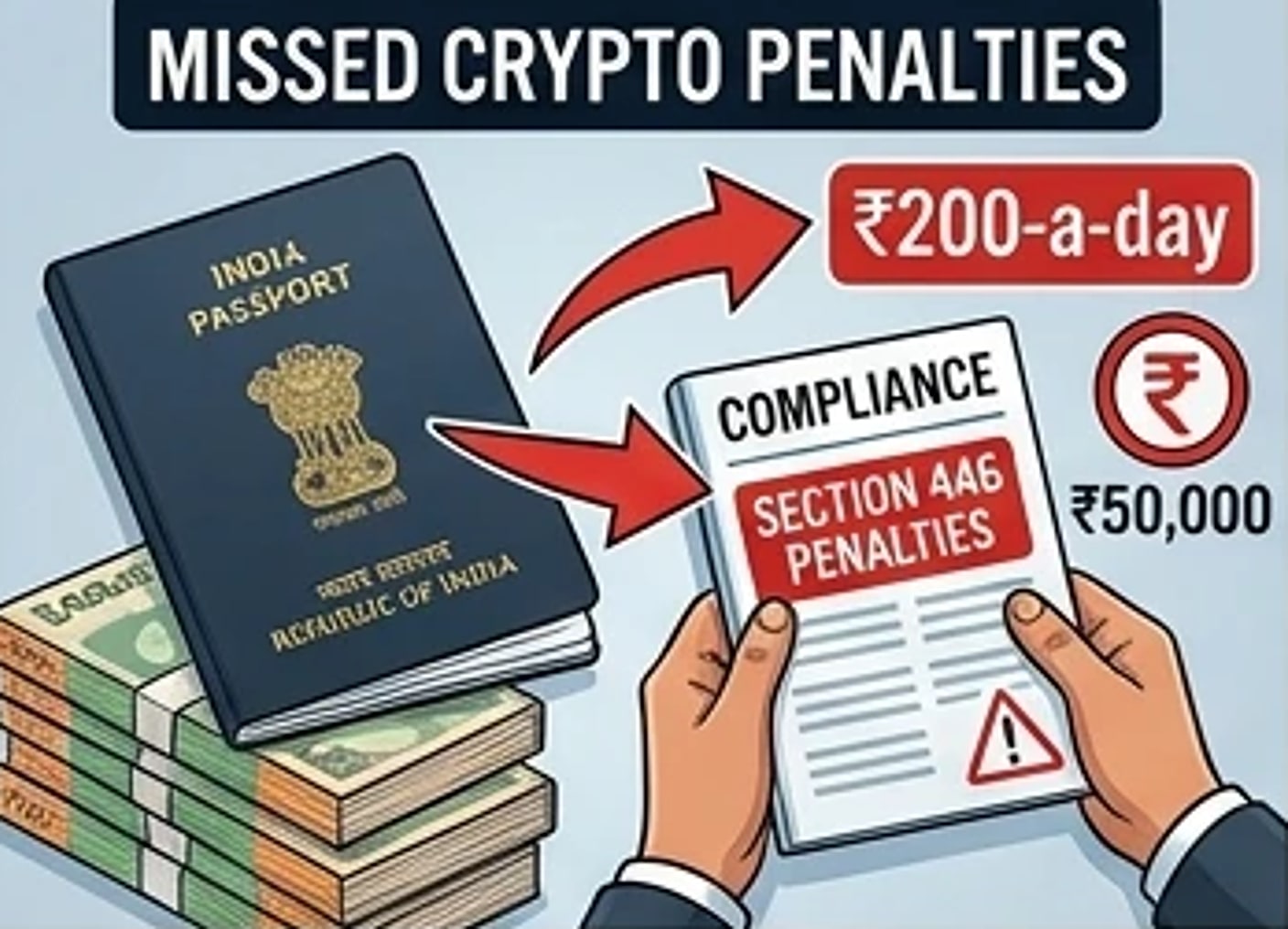
- Reports on Budget 2026 describe a ₹200 per day penalty for failing to furnish the statement and a ₹50,000 penalty for inaccurate information not corrected, from 1 April 2026.
- The regime targets reporting entities such as exchanges, not individual traders.
- Investors feel it through better data matching, so keep your own records of every transfer.
Almost nobody has written about the crypto reporting penalty India introduced from 1 April 2026, and that is odd, because it hits real businesses. Budget 2026 added a penalty regime for crypto-asset reporting. The reporting duty sits in Section 509 of the Income-tax Act, 2025. The penalty sits in Section 446, a number that used to mean something else entirely.
People are quoting two figures: ₹200 for every day of delay and ₹50,000 for giving wrong information that isn’t corrected. Who actually pays? Mostly platforms, not ordinary traders, but the effect reaches investors through their data. A note on sources: most of what’s online is Budget coverage and commentary, so check the enacted text before relying on any number. A crypto reporting penalty India platforms now face is also an investor issue. The Section 509 crypto asset reporting duty and the Section 446 penalty crypto exchanges pay are linked.
What Section 509 requires
Section 509 of the Income-tax Act, 2025 is the crypto-asset reporting provision. It requires prescribed reporting entities to furnish statements about transactions in crypto assets. The class is broad on paper: exchanges, platforms, intermediaries and any other persons the government notifies. It is part of India’s move towards automatic reporting of crypto, in line with the OECD’s Crypto-Asset Reporting Framework. The Section 509 crypto asset reporting duty is the basis of the crypto reporting penalty India introduced.
The statement has to contain the details of users and transactions that the rules specify: identification of the user, the type and quantity of the asset, the value and so on. A reporting entity that gets it wrong has a duty to fix it once it notices. That detail matters because one of the penalties turns on a failure to correct.
The reporting has a long lead-in. Platforms have been filing information on virtual digital asset transactions for some years under earlier provisions. The new section widens and formalises it, and the new penalties give it teeth. The new crypto reporting penalty India platforms face gives the duty teeth.
What the penalties are
Section 446 of the new Act, repurposed from an old provision on audit failures, carries the penalties for failing to furnish a crypto statement or furnishing inaccurate information. Reports on the Budget 2026 proposals describe two main penalties. A late or missing statement attracts ₹200 for each day the failure continues. An inaccurate statement that isn’t corrected as required under Section 509(4) attracts a flat ₹50,000. The crypto reporting penalty India described in Budget coverage has two parts: a Rs 200 per day penalty crypto reporters pay for late filing and a flat penalty for wrong data. A crypto transaction statement penalty 1 April 2026 start date is reported.
| Failure | Penalty as reported | Who is exposed |
|---|---|---|
| Failing to furnish a crypto statement | ₹200 for each day of delay | Reporting entity |
| Inaccurate information not corrected | ₹50,000 | Reporting entity |
| Mismatch with your return | Notice from the department | The investor |
Those are the headline numbers behind the ₹200 per day penalty crypto and ₹50,000 stories. Commentary differs on some details, such as whether the penalty is mandatory or discretionary (some summaries say “may”) and on how it interacts with other penalties. The provisions apply from 1 April 2026 according to the reports.
It would be wise to be careful here. We have seen the proposals and commentary but not been able to verify the final enacted wording of every sub-section. Check the Income-tax Act, 2025 on the department’s site and the Finance Act, 2026 before you quote the figures in a compliance document. Check the enacted text before you quote the crypto reporting penalty India figures.
Who is actually exposed
The penalty targets the reporting entity. A crypto exchange, a broker or another notified intermediary that files late or wrong is the target. A person who simply buys and sells isn’t in that category, and commentary describes the regime as a reporting-entity penalty framework, not a penalty on individual traders. The crypto reporting penalty India imposes targets the reporting entity crypto exchange India users deal with.
For platforms, the exposure is operational. A daily penalty adds up quickly for a late filing that runs for weeks. A sloppy mapping between user records and transactions could produce inaccuracies across thousands of lines. An exchange that has been lax on data quality now has a financial reason to clean it up.
Founders building crypto products for India should ask whether they are a reporting entity. A wallet app, a non-custodial interface, a payments tool that touches crypto and a platform that matches users could all fall into different categories. Get a written view from counsel before launch, not after the first notice. Registration with FIU-IND is a separate duty. Ask whether your product is a reporting entity before the crypto reporting penalty India applies to you.
Why ordinary investors should care
Reporting entities file data on you. That data is matched against what you put in your own return. When the two don’t match, you receive a notice. Better platform reporting, driven by the threat of penalties, means more mismatches get caught, including innocent ones such as a transfer between your own wallets reported as a sale. Investors should care about the crypto reporting penalty India platforms face, since it drives data quality.
That pushes a practical habit. Keep your own records of every transfer, with wallet addresses and dates, so you can explain a mismatch. Check the annual information statement for entries about crypto before you file. If something is wrong, ask the platform to correct its filing, because the duty to correct sits with them.
There is a longer game as well. From 2027 India is expected to start exchanging crypto information with other countries under the OECD framework. That raises the chance that holdings and income abroad, including accounts held by Indians in Dubai, are visible to Indian tax authorities. Report them in your return. Better reporting follows the crypto reporting penalty India introduced.
Questions people ask
In short, this is a platform problem that quietly becomes an investor problem. Clean data on both sides is the cheapest protection. The crypto reporting penalty India platforms are exposed to is mainly a platform issue.
Related reading: crypto tax in India: 30% and 1% TDS, FIU-IND registration for crypto businesses, CARF and crypto data sharing for Indian expats, why crypto losses cannot be set off in India, Web3 regulations in India and claiming credit for 1% TDS on crypto.
Quick answers
What is the new crypto reporting penalty India introduced from 1 April 2026?
Reports on Budget 2026 describe a ₹200 per day penalty for failing to furnish a crypto statement and a ₹50,000 penalty for inaccurate information not corrected, under Section 446 for reporting required by Section 509. Check the enacted text.
Do ordinary crypto investors pay these penalties?
Commentary says the penalties apply to reporting entities such as exchanges and intermediaries, not to individual traders. Investors are affected indirectly through data mismatches.
What is Section 509 of the Income-tax Act, 2025?
It is the provision requiring prescribed reporting entities to furnish statements on crypto-asset transactions to the tax authorities.
Do ordinary traders pay these penalties?
Commentary says the penalties apply to reporting entities, not individual traders. Check the enacted text.
Final word
Halverton & Co. is an Indian law firm advising founders, startups, technology companies and investors on Indian law, including regulatory and tax compliance for crypto platforms and founders in India, including reporting entity analysis. We practise in Jharkhand, Maharashtra and before the Supreme Court of India, and act as fractional legal counsel for technology-driven businesses. Halverton & Co.: Where tech needs law! If you have a question about Indian law, write to us at office@halvertonandco.com, or get in touch.
This article reflects developments reported up to 31 October 2026. It is for general information only, is not legal advice, and does not create an advocate-client relationship. Halverton & Co. is an Indian law firm.
Sources
Related practice area
Crypto, Web3 & Digital Assets
Advice for virtual digital asset businesses on registration, reporting and structure.
View the practice areaComments
No account needed. Comments are reviewed before they appear, so yours will show here once approved. Please do not share confidential details or describe your own legal matter: replies are general discussion, not legal advice, and do not create an advocate-client relationship. For your own situation, write to office@halvertonandco.com.