Key takeaways
- Governing law, seat and arbitral rules are three different choices and should be written separately.
- Foreign awards from notified countries such as the US can be enforced in India under Part II, with narrow grounds for refusal under Section 48.
- Indian courts can grant interim relief under Section 9 in support of foreign-seated arbitrations unless the parties exclude it.
- Avoid pathological clauses that mix court and arbitration jurisdiction or name a non-existent institution.
An arbitration clause India US contract drafters write in a hurry is often the clause that costs the most later. Two parties, one in Austin and one in Hyderabad, sign a services agreement. The clause says “disputes will be settled by arbitration” and not much else. Two years on, there is a dispute over unpaid invoices, and the argument is about where the case should be heard, under which rules, and whether an award can be enforced against assets in India.
Getting the clause right is not complicated, but it needs decisions at the start: the seat, the institution, the governing law and a few practical details. Below is how the main choices work for US and Indian tech companies, how Indian courts treat foreign awards, and the mistakes we see most. The statutory points are from the Arbitration and Conciliation Act, 1996. Case law moves, so check recent decisions before relying on a particular rule. A good arbitration clause India US contract parties can both live with starts by separating seat, rules and governing law.
Seat, rules and governing law: three different things
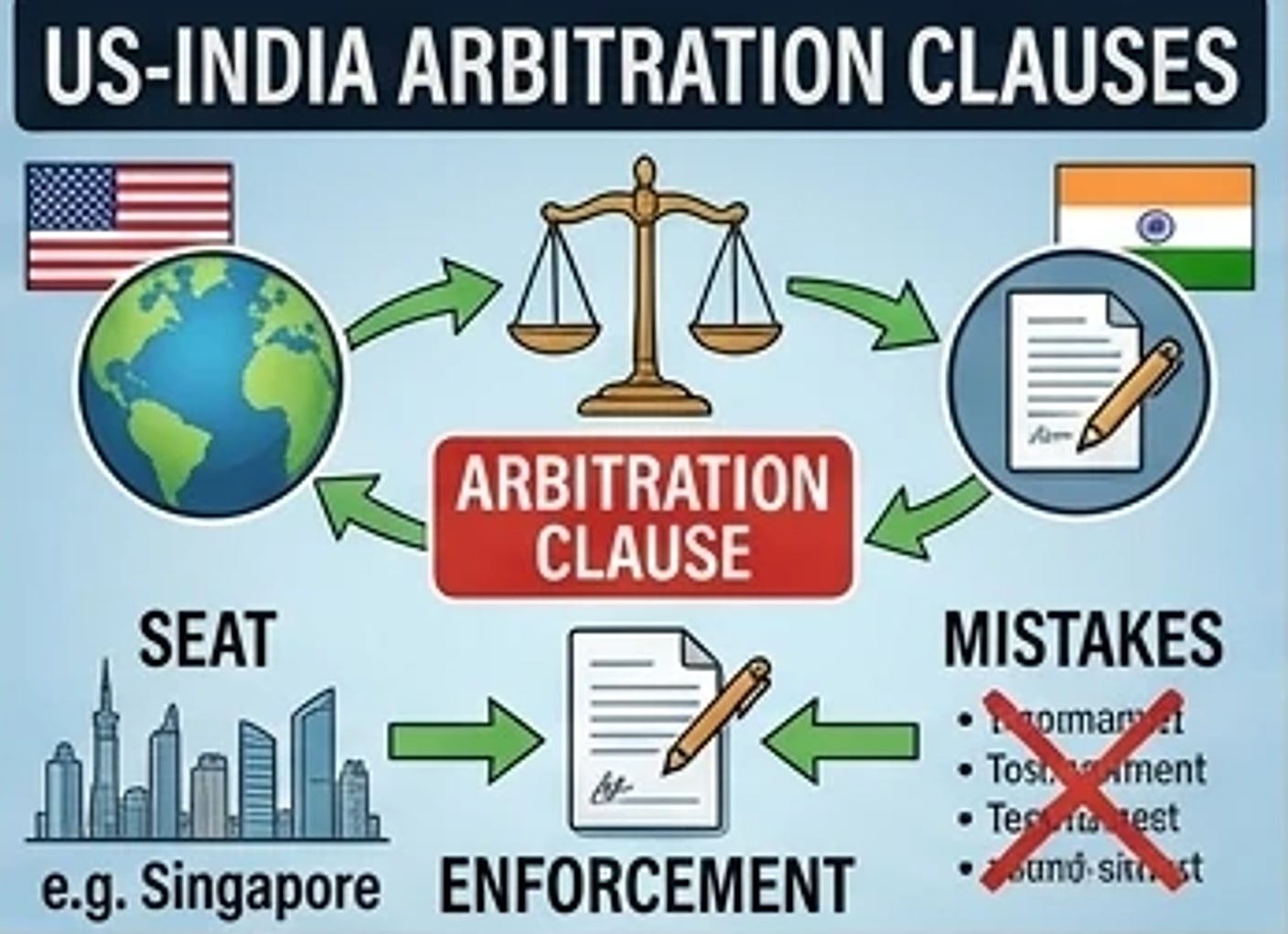
Many clauses mix three separate ideas. The governing law decides the substance of the contract: what the obligations mean. The seat, or legal place, of arbitration decides which courts supervise the process and which country’s arbitration law applies. The rules, such as ICC, SIAC, LCIA or ICDR, decide how the arbitration is run, including appointment of arbitrators and timetable. The arbitration clause India US contract drafters write should name the seat, rules and law separately.
They can all be different. A contract can be governed by New York law, seated in Singapore and run under SIAC rules. That is common for US-India deals. Problems arise when a clause says “arbitration in India under New York law” without saying which institution or which rules, or when it names a venue, not a seat, and leaves the law of the arbitration unclear.
Write each choice out. Name the seat as a city and country. Name the institution and rules. Say the governing law of the contract and that the arbitration agreement is governed by the law of the seat, if that is what you intend. A clear arbitration clause India US contract parties can both follow saves months of procedural fights.
Choosing the seat
A seat in India gives the Indian party home advantage and local courts to support it, but a US party may worry about delay and unfamiliar procedure. A seat in the US gives the opposite. A neutral seat such as Singapore, London or Dubai is a typical compromise. The seat of arbitration Singapore London India choice is driven by neutrality, the quality of the courts, the speed of enforcement and where the assets are. Where the assets are decides much of the arbitration clause India US contract seat choice.
Think about where you will need to enforce. If the other side’s assets are in India, an award will need to be enforced there, and a foreign-seated award goes through Part II of the Arbitration Act. If the assets are in the US, you will enforce under the Federal Arbitration Act and the New York Convention. A neutral seat means both sides enforce abroad.
Consider cost and speed too. SIAC and the ICC offer expedited procedures for smaller claims. For low-value tech contracts a documents-only or fast-track clause may make sense. For large ones, a three-arbitrator tribunal gives more security but costs more. Choose a number of arbitrators and say how they are appointed.
Enforcement in India under Part II
India is a party to the New York Convention, and the United States and many other countries are notified as reciprocating territories. A foreign award from a notified country can be enforced in India as if it were a decree of an Indian court under Part II of the Act, by applying to the High Court with jurisdiction. The New York Convention enforcement India Part II route is well used. An award under an arbitration clause India US contract can be enforced under Part II.
| Choice | What it decides | Example |
|---|---|---|
| Governing law | Meaning of the obligations | New York law |
| Seat | Supervisory courts and arbitration law | Singapore |
| Rules and institution | How the arbitration is run | SIAC or ICC |
| Enforcement | Where the award is enforced | India under Part II |
Grounds for refusing enforcement are narrow. Section 48 lists them, including incapacity, invalid agreement, lack of notice, an award that goes beyond the submission, and a violation of India’s public policy. In Vijay Karia v Prysmian (2020) the Supreme Court read the public policy ground narrowly and said courts should not review the merits. The foreign award public policy Section 48 ground has become harder to use.
Interim relief is also possible. Since the 2015 amendments, Indian courts can grant interim measures under Section 9 in support of foreign-seated arbitrations unless the parties have agreed otherwise. Interim relief Section 9 foreign seated arbitration orders can freeze assets in India. Emergency arbitrator orders raise more questions in Indian courts, so check recent decisions. Limitation for enforcement is generally three years from the award, so don’t delay.
Common mistakes
The first is a pathological clause: one that is unclear, contradictory or incomplete. Examples include clauses that name a non-existent institution, give jurisdiction to courts and arbitrators at once, or leave the number of arbitrators and the method of appointment blank. A pathological arbitration clause invites a fight about whether the clause works at all. The commonest arbitration clause India US contract mistake is a pathological clause.
The second is mixing in court jurisdiction. A clause that says disputes go to arbitration but that the courts of Bangalore have exclusive jurisdiction can confuse the picture, unless it is clear that the courts are the supervisory courts at the seat. Say that courts at the seat have supervisory jurisdiction only.
Others: forgetting confidentiality, ignoring stamp duty (Indian law has rules on stamping agreements, though recent Supreme Court decisions say an unstamped arbitration agreement does not make the clause void), leaving out a step for negotiation or mediation (India’s Mediation Act, 2023 may help), failing to cover multi-contract disputes and choosing a language of arbitration that isn’t suited to the documents. A short checklist at drafting stage prevents most of these. Before you sign an arbitration clause India US contract, check stamping and confidentiality.
Questions people ask
If you do one thing, put the arbitration clause in front of a lawyer who has run an arbitration, not only drafted one. They know which words cause trouble. An arbitration clause India US contract deserves a lawyer who has run an arbitration.
Related reading: enforcing a UK judgment or award in India, enforcing a Dubai judgment or award in India, hiring contractors in India from the US, data processing agreements with Indian vendors, licensing US software in India: withholding tax and permanent establishment risk for Indian teams; also ADA website liability for developers and SaaS agreements with Indian customers; also DIFC Courts versus Dubai Courts for crypto disputes.
Quick answers
What is the best seat for an arbitration clause India US contract parties can accept?
There is no single best seat. Neutral seats such as Singapore or London are common compromises, but the right choice depends on where assets are, the courts’ record and cost. Name the seat clearly.
Can a US arbitration award be enforced in India?
Yes, if the US is a notified reciprocating territory, which it is, an award can be enforced in India under Part II of the Arbitration Act through the High Court, subject to narrow grounds for refusal in Section 48.
What is a pathological arbitration clause?
It is a defective clause that is unclear, inconsistent or incomplete, such as naming a wrong institution or mixing court and arbitration jurisdiction, which can lead to disputes about whether it is valid.
What is a pathological arbitration clause?
A defective clause that is unclear, inconsistent or incomplete and invites a dispute about whether it works.
Final word
Halverton & Co. is an Indian law firm advising US companies, founders, investors and law firms on Indian law, including cross-border technology contracts and arbitration involving Indian parties, working alongside US counsel. We practise in Jharkhand, Maharashtra and before the Supreme Court of India, and work alongside US counsel, who advise on US law. Halverton & Co.: Where tech needs law! If you have a question about Indian law, write to us at office@halvertonandco.com, or get in touch.
This article reflects developments reported up to 31 October 2026. It is for general information only, is not legal advice, and does not create an attorney-client relationship. Halverton & Co. is an Indian law firm and does not advise on US law; US-law points should be confirmed with US counsel.
Related practice area
Startups & Venture
From incorporation to term sheet. The documents a company needs to be fundable.
View the practice areaComments
No account needed. Comments are reviewed before they appear, so yours will show here once approved. Please do not share confidential details or describe your own legal matter: replies are general discussion, not legal advice, and do not create an advocate-client relationship. For your own situation, write to office@halvertonandco.com.