Key takeaways
- A permanent establishment can arise from a fixed place, a dependent agent or a service PE under the India-US treaty and Indian law.
- The Supreme Court’s Formula One and Hyatt decisions focus on control and substance.
- A subsidiary providing services at arm’s length is generally treated as separate, but parent control can change that.
- Document the structure and keep Indian staff away from contract negotiation unless it is planned and priced.
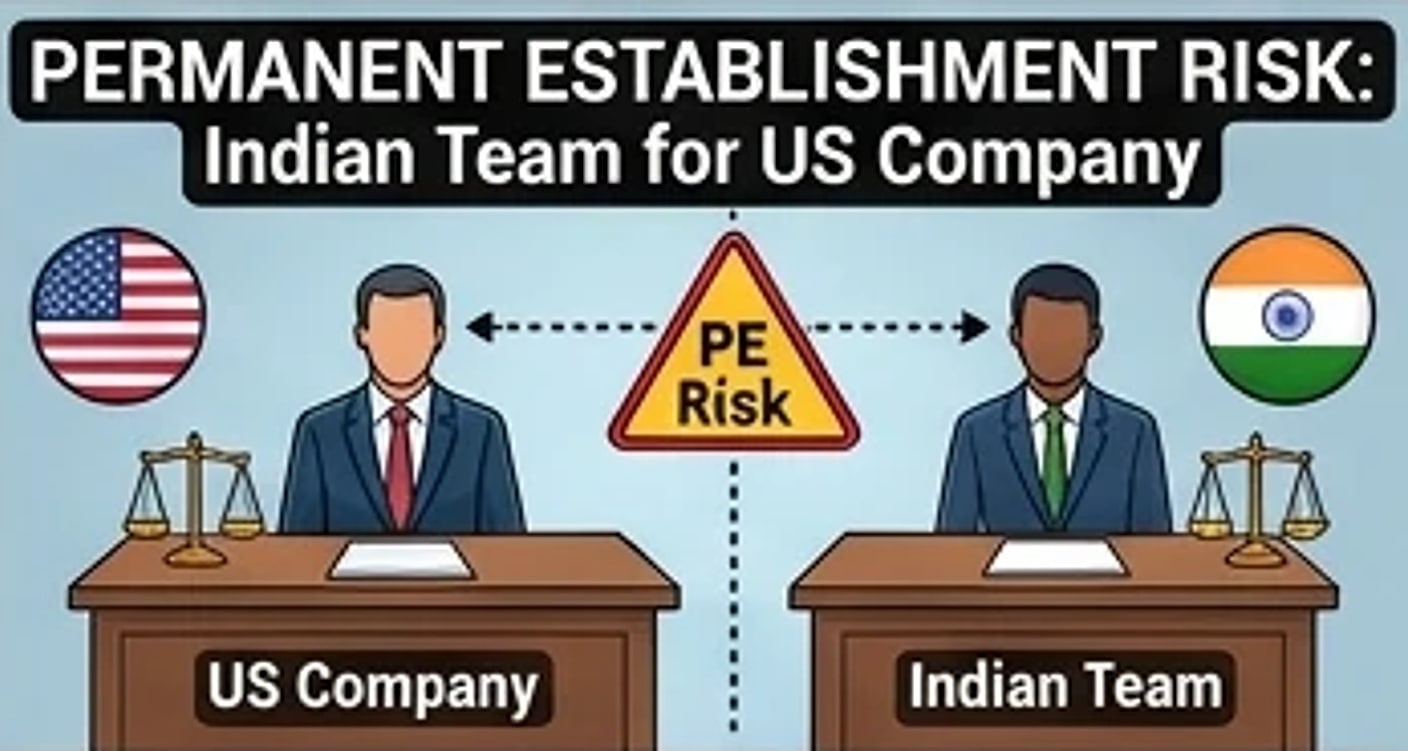
A US company that builds a team in India often asks one question late: does the team create a taxable presence? The permanent establishment India US company risk is real when staff, offices or agents in India go beyond support work and start to carry on the US company’s business. A PE can expose a share of the company’s profits to Indian tax and bring filing duties, so it is worth testing before the team grows.
This guide explains the main routes to a PE under the India-US tax treaty and Indian case law, including fixed place, dependent agent and service PE, summarises the Formula One, Morgan Stanley and Hyatt decisions, and lists practical ways to lower the risk. It is general information, not tax advice. Treaty text and facts decide each case, so take advice from tax professionals in both countries. The permanent establishment India US company analysis below is a screening tool, not a conclusion.
What a PE is and why it matters
A permanent establishment is a threshold in tax treaties. Under the India-US treaty and Indian law, business profits of a foreign company are taxable in India only to the extent attributable to a PE there. Without a PE, the US company’s business income is generally not taxed in India, although royalties, fees for technical services and other items may be taxed separately. Permanent establishment India US company disputes usually start with a notice that cites premises, people or contract authority.
Why does this matter for an Indian team? A development centre, a sales office, a remote engineer or a contract manufacturer could all be argued to create a PE if the facts fit. If the Indian tax authorities find a PE, they can assess profits attributable to it, require a tax return, and charge interest and penalties. Disputes can last years.
Many US companies avoid the issue by setting up an Indian subsidiary that provides services on arm’s length terms. A subsidiary is a separate taxpayer, and under Indian case law its presence does not by itself make a PE for the parent. But facts such as control, authority to conclude contracts and the way the parent uses the Indian premises can change that.
Fixed place, dependent agent and service PE
A fixed place permanent establishment India authorities allege arises where the foreign company has a place of business in India through which it carries on business. The place need not be owned. It is enough that it is at the company’s disposal, and commentary on recent cases says effective control can be enough even without exclusive possession. An office in India used by the US company’s employees, or a home office used regularly for the company’s business, may qualify. The permanent establishment India US company tests differ by type, and treaty wording decides each one.
| Route | Test | Example risk |
|---|---|---|
| Fixed place | Premises at the disposal of the foreign company | Parent uses the Indian office as its own |
| Dependent agent | Habitually concludes contracts for the foreign company | Indian sales staff close deals |
| Service PE | Services through personnel over a time threshold | Long project deputations |
| Control | Substance over form | Parent directs daily work |
A dependent agent PE India exposure arises where a person acts for the foreign company and habitually exercises authority to conclude contracts or plays the principal role in concluding them, in line with the treaty. A sales team that negotiates and closes deals for the US company in India is a classic risk. Independent agents acting in the ordinary course of business are treated differently.
A service PE India US treaty provision exists in many treaties and applies where employees or personnel provide services in the other country for more than a set number of days. The India-US treaty has such a provision with time thresholds, so check Article 5 for the exact conditions. Deputing US staff to India for projects can trigger it, and so can long visits to support an Indian team.
What the Supreme Court has said
In Formula One (2017), the Supreme Court held that a racetrack used for the Grand Prix was a fixed place PE, because the premises were at the disposal of the foreign enterprise and business was carried on through them. In Morgan Stanley (2007), the Court held that an Indian subsidiary providing back-office services on arm’s length terms did not create a PE for the parent, but said that deputed employees who perform stewardship activities could create a service PE.
In July 2025, the Supreme Court in Hyatt International Southwest Asia is reported to have upheld a fixed place PE under the India-UAE treaty because the foreign company exercised operational control over hotels in India. Commentary says the Court looked at substance over form, including control over premises, personnel and brand standards. The Hyatt Supreme Court permanent establishment decision is widely read as raising the bar for parents that exercise close control over Indian operations.
The common thread is control and substance. A subsidiary that works independently and is paid at arm’s length is lower risk. A parent that directs daily work, uses Indian premises as its own and has staff in India who negotiate contracts is higher risk. Courts look at the whole arrangement, not at labels in contracts.
Reducing the risk
Practical steps start with structure. Use an Indian subsidiary or a captive India team with clear service agreements, transfer pricing documentation and arm’s length remuneration. Consider Indian safe harbour rules for IT services where eligible. Keep the subsidiary’s management, systems and decisions genuine. A captive India team tax risk analysis should be done at set-up and after major changes. To manage permanent establishment India US company exposure, record who in India does what for the parent.
Manage people and authority. Do not let Indian staff negotiate or sign contracts for the US company unless that is planned and priced. Limit US employees’ time in India, track days and use secondment agreements where needed. For remote workers in India employed directly by the US company, review whether the home office is at the company’s disposal and consider employer-of-record or subsidiary arrangements, with advice on employment law.
Keep records. Maintain intercompany agreements, time sheets, organisation charts, board minutes and evidence of independent decision making. Review the position yearly. If a notice arrives, respond within time and involve tax counsel early, since treaty relief and mutual agreement procedures may be available.
Next steps and quick answers
Map your India footprint, list who does what, test it against the PE categories, check transfer pricing and document the structure. This is general information, not tax or legal advice. Halverton & Co. does not advise on US tax law. Revisit your permanent establishment India US company review whenever the Indian team changes role or size.
Related reading: setting up an Indian subsidiary of a US company, hiring contractors in India from the US, licensing US software in India: withholding tax and royalties, selling SaaS to India from the US: GST, offshore legal teams and US firms and hiring and IP assignment for Indian developers; also the Companies House ID verification deadline for Indian directors and the UK Patent Box for software built in India.
Quick answers
Does having a development team in India create a PE?
Not automatically. A subsidiary providing services at arm’s length is generally treated as separate, but control, premises and contract authority can change the result.
Can one employee in India create a PE?
It can, if their activities meet the treaty tests, for example by habitually concluding contracts for the foreign company or working from premises at its disposal.
What is the main lesson from Hyatt?
Commentary says it shows the Supreme Court looks at substance and control, not only form.
Does one remote employee in India create a PE?
It can, if the treaty tests are met, for example by habitually concluding contracts or using premises at the company’s disposal. Take tax advice.
Final word
Halverton & Co. is an Indian law firm advising US companies, founders, investors and law firms on Indian law, including Indian tax and structuring questions for US companies with India teams, subsidiary set-up and cross-border contracts. We practise in Jharkhand, Maharashtra and before the Supreme Court of India, and work alongside US counsel, who advise on US law. Halverton & Co.: Where tech needs law! If you have a question about Indian law, write to us at office@halvertonandco.com, or get in touch.
This article reflects developments reported up to 31 October 2026. It is for general information only, is not legal advice, and does not create an attorney-client relationship. Halverton & Co. is an Indian law firm and does not advise on US law; US-law points should be confirmed with US counsel.
Sources
Related practice area
Startups & Venture
From incorporation to term sheet. The documents a company needs to be fundable.
View the practice areaComments
No account needed. Comments are reviewed before they appear, so yours will show here once approved. Please do not share confidential details or describe your own legal matter: replies are general discussion, not legal advice, and do not create an advocate-client relationship. For your own situation, write to office@halvertonandco.com.