Key takeaways
- A DPA with an Indian vendor should limit use to your instructions, which is also a core term of California’s service provider rules.
- Require prior notice of sub-processors, defined security controls and clear location and transfer terms.
- CERT-In requires certain incidents to be reported within six hours, so the vendor may already have a duty to report in India.
- Agree audit rights, return and deletion at exit, and liability that reflects a data breach.
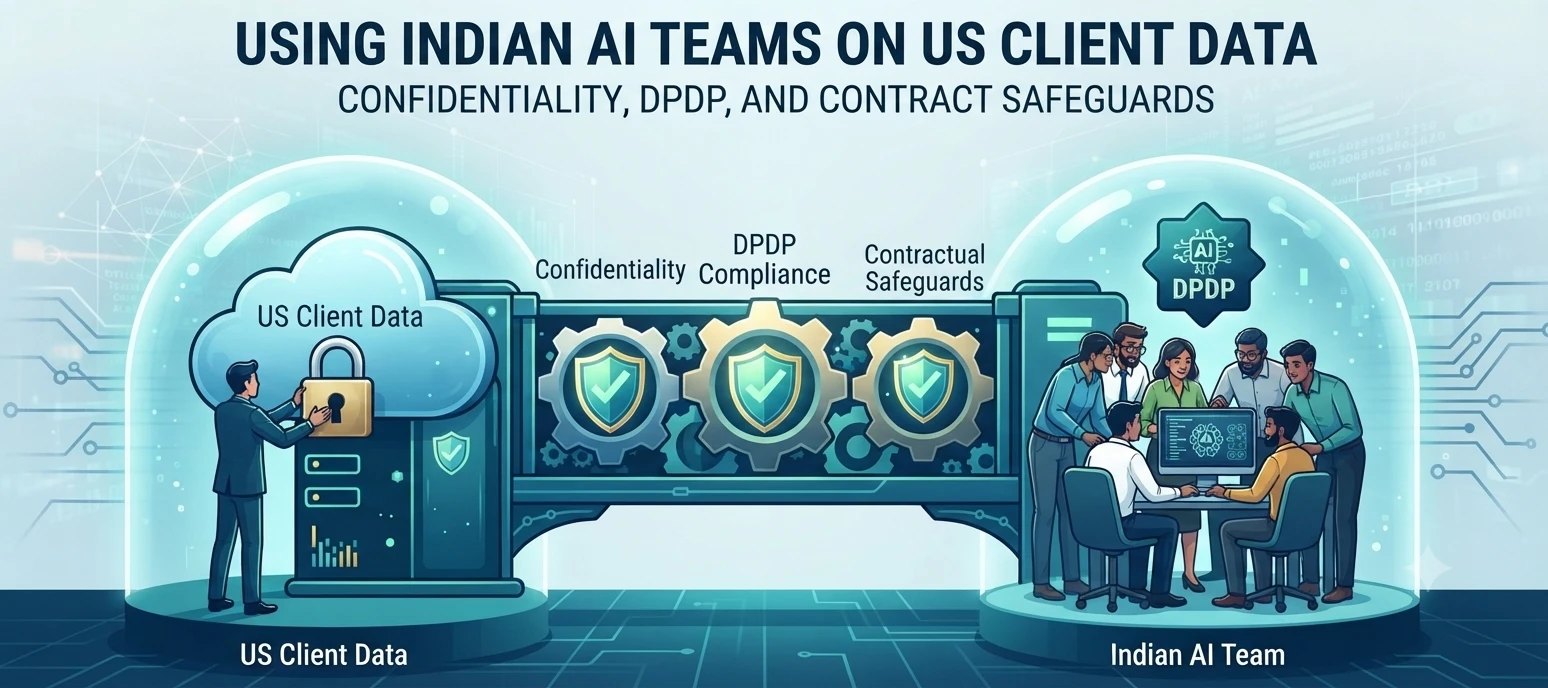
A DPA Indian vendor arrangement is where US privacy law, Indian data protection law and plain operational reality meet. Your vendor in India runs customer support, builds software or processes records, and it touches personal data of people in the United States. California’s law says you need a contract with certain terms. Other state laws say similar things. India’s DPDP Act adds duties for the party that processes data for you.
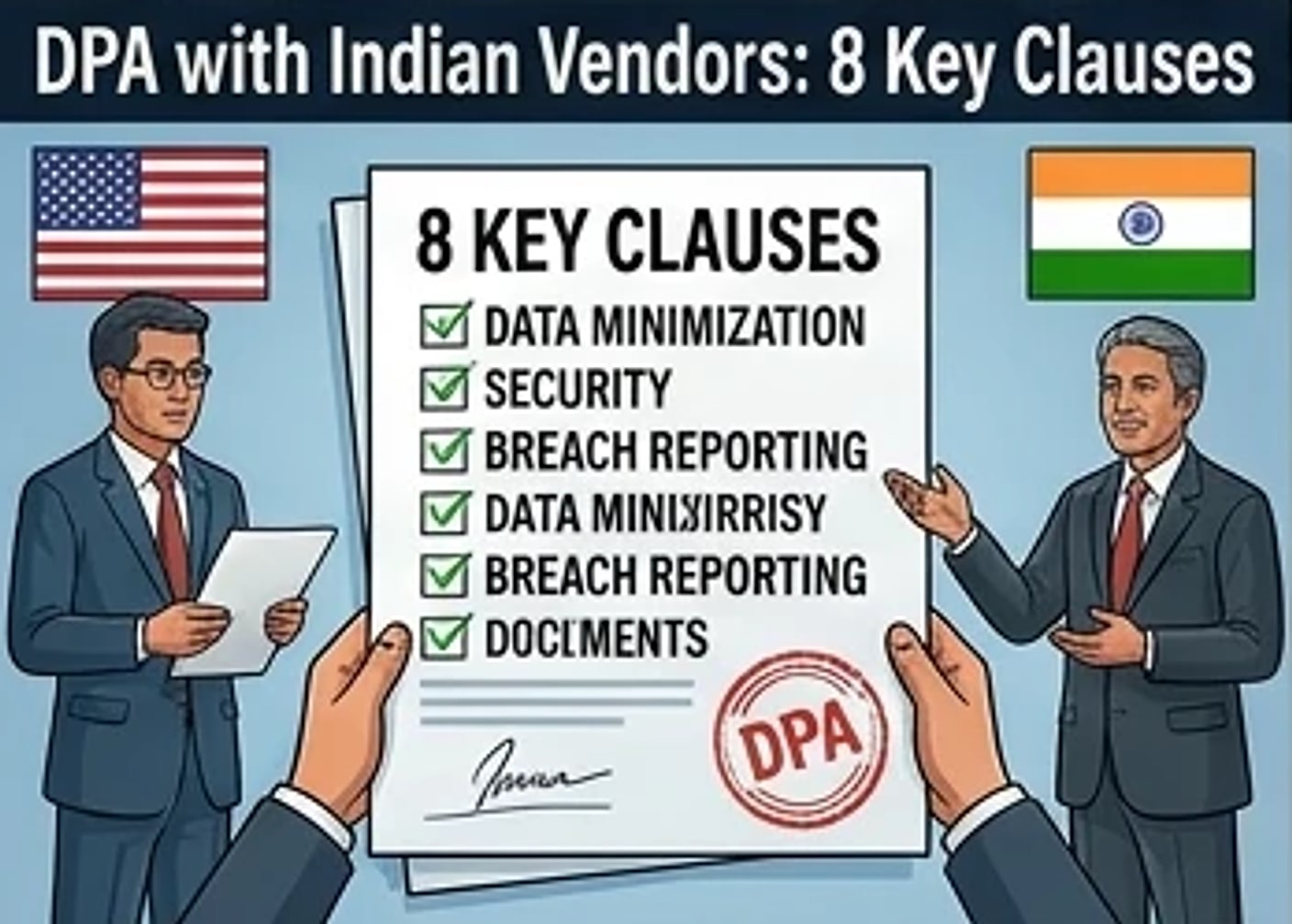
Most contracts that fail do so on a handful of clauses, not on length. Here are eight that matter, in the order a negotiation tends to take them, with the reasons behind each. It isn’t a template, and sector rules such as HIPAA need more. Treat it as a checklist to compare against your current paper, then take US and Indian advice before you sign. A DPA Indian vendor contract is also a DPDP Act data processor contract. Start with the eight clauses below.
Clauses 1 and 2: scope and instructions, security
Clause one defines what the vendor may do with the data and why. It should say the vendor processes personal data only on your documented instructions, for the stated business purpose, and not for its own purposes, including training its own models, unless you agree. This is the core of the CCPA service provider contract terms: California requires the contract to limit use to specified purposes and to bar selling or sharing the data. A DPA Indian vendor deal starts with scope.
Clause two covers security. Don’t write “industry standard” and stop. List the controls you expect: encryption in transit and at rest, access control with multi-factor authentication, logging, staff background checks, separation of client data, vulnerability management and secure development. Reference a recognised standard such as ISO 27001 or SOC 2 if the vendor has one, and require the vendor to keep it current.
On the Indian side, a data processing agreement India vendor US company relationship also meets the DPDP Act. The Act places obligations on data fiduciaries, and where a processor is engaged, the fiduciary stays responsible and must have a valid contract. A well-drafted DPA can serve both purposes. Your DPA Indian vendor paper should reflect the DPDP Act.
Clauses 3 and 4: sub-processors and transfers
Clause three is sub-processors. Vendors often use cloud providers, offshore partners or freelancers. Require prior notice and a right to object to any new sub-processor, flow down the same obligations in writing, and make the vendor liable for its sub-processors. A sub-processor approval clause that lets the vendor appoint anyone without notice defeats the purpose of the contract. A DPA Indian vendor needs a sub-processor clause that bites.
Clause four deals with location and transfers. State where data will be stored and accessed. If data moves from the US to India, say so, and consider US state rules and any sector rules. If you handle EU or UK personal data as well, you will need transfer mechanisms under the GDPR. India has a negative-list approach to transfers out under the DPDP Act and sector localisation rules in some areas, so check any financial or health data rules.
Add a clause on government access. Say what the vendor must do if a government body demands data: notify you where lawful, challenge overbroad requests and disclose the minimum. It is rarely used but valuable when it is. Cross-border terms in a DPA Indian vendor deal should cover location and government access.
Clauses 5 and 6: breach notice and audit
Clause five is breach notification. Require the vendor to tell you promptly, ideally within 24 to 72 hours, though shorter is better for your own deadlines, and to give details and cooperate. Indian law adds its own clock: CERT-In requires certain incidents to be reported within six hours of noticing them, so the vendor may already have a duty to report in India. A breach notification vendor CERT-In six hours clause should require the vendor to copy you on any Indian report. Every DPA Indian vendor contract needs a breach clause.
US state laws set their own deadlines for you to notify individuals and regulators, some as short as 30 days or less, so you need the vendor’s information quickly. Require the vendor to preserve evidence, help with investigation and bear reasonable notification costs where the breach was its fault.
Clause six covers audit and assurance. You need some way to check the vendor does what it promises: audit rights on notice, questionnaires, evidence of certifications and penetration test summaries. Vendors resist on-site audits, so agree a staged process that starts with documents and reserves on-site audits for serious concerns or after an incident. Audit rights in a DPA Indian vendor deal need to be practical.
Clauses 7 and 8: deletion and liability
Clause seven deals with return and deletion. At the end of the contract, or on request, the vendor must return or securely delete the data and certify it. Cover backups and the time they take to expire. If the vendor must retain some data under Indian law, say so and require continued protection. Many disputes arise because nobody wrote down what happens at the end. A DPA Indian vendor contract should say what happens to data at the end.
| Clause | What it covers | Check |
|---|---|---|
| Scope and instructions | Use only for stated purposes | No own-purpose use or training |
| Security | Named controls and standards | Certifications kept current |
| Sub-processors | Notice, objection and flow-down | Vendor liable |
| Location and transfers | Where data is stored and accessed | Government access |
| Breach notice | Prompt notice and cooperation | CERT-In six hours |
| Audit | Staged audit rights | Documents first |
| Return and deletion | At exit and on request | Backups |
| Liability | Cap, indemnity and insurance | Higher cap for data breach |
Clause eight is liability and indemnity. A normal liability cap may be too low for a data breach. Consider a higher or separate cap for data protection breaches, an uncapped indemnity for gross negligence or wilful breach, and insurance requirements for cyber cover. Think about enforcement too: if the vendor has no assets in the US, you might want a guarantee or a clause on governing law and arbitration seat that works for both sides.
Finally, check sector add-ons. If protected health information is involved, HIPAA requires a business associate agreement with specific terms. If you process payment data, PCI DSS rules apply. And if the vendor will process children’s data, DPDP requires verifiable parental consent in some cases. Each of these adds requirements beyond the eight clauses here. Add sector terms if your DPA Indian vendor handles health or payment data.
Questions people ask
A final tip: read the vendor’s own standard DPA before you start. Often it has most of what you need, in the wrong order, with the dangerous parts in a schedule. A DPA Indian vendor paper is only as good as the clauses that bite.
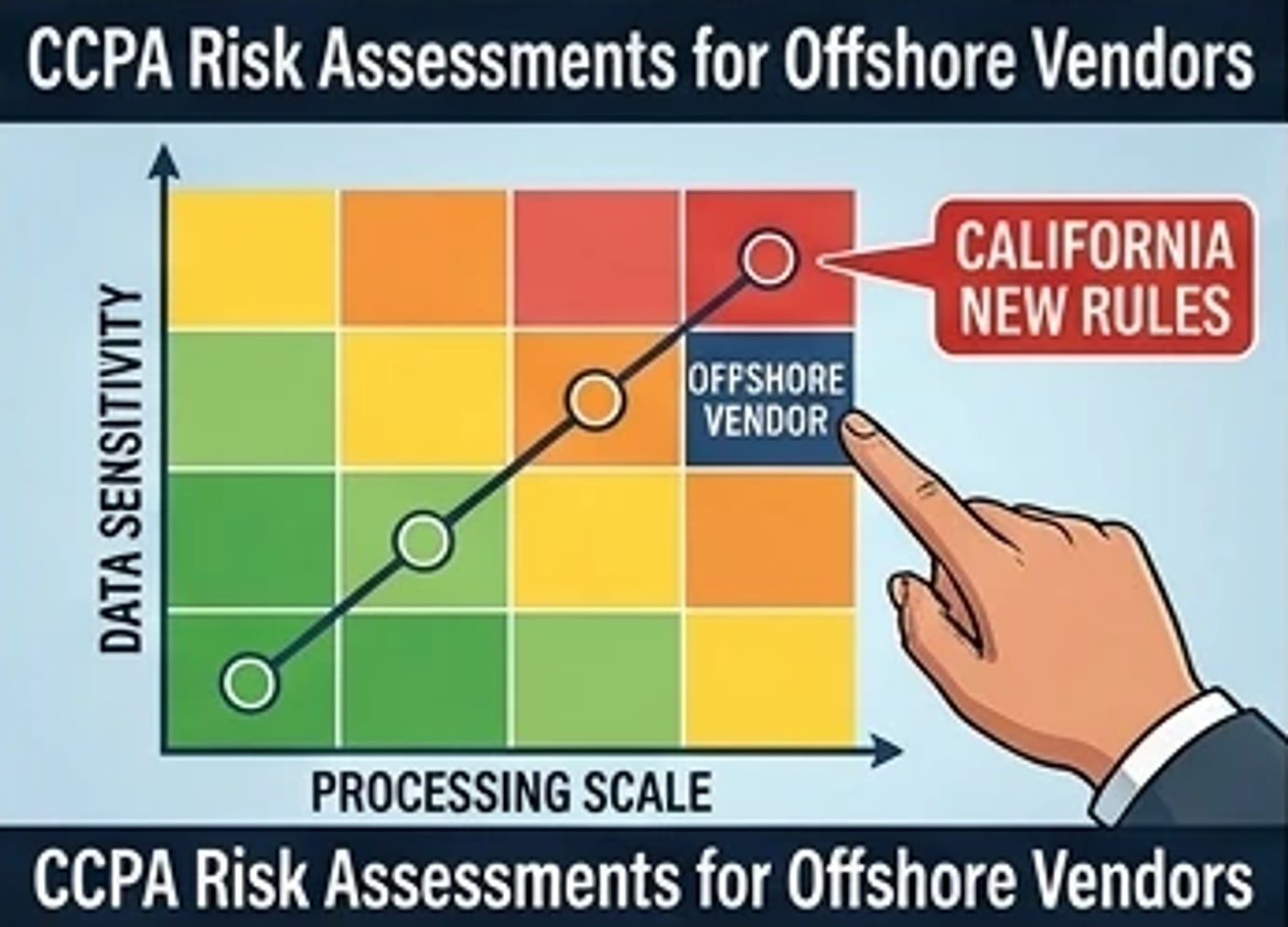
Related reading: offshore AI teams and data privacy in India, the DPDP Act for US SaaS companies, the CERT-In six-hour rule for startups, CCPA risk assessments for offshore vendors, CCPA and DPDP side by side and DPDP breach notification vs UK GDPR; also SaaS agreements with Indian customers.
Quick answers
What should a DPA Indian vendor contract include?
At minimum: processing only on instructions for a stated purpose, security measures, sub-processor controls, location and transfer terms, breach notification, audit rights, return and deletion, and liability and indemnity terms, plus any sector clauses such as HIPAA.
Does California law require a contract with an Indian vendor?
Yes, where the vendor is a service provider or contractor under the CCPA. The contract must limit its use of the personal information and include other required terms. Take US advice on the exact requirements.
Does the DPDP Act apply to my Indian vendor?
It applies to processing of digital personal data in India. A vendor acting as a processor works under a contract with the data fiduciary, who remains responsible, so align the DPA with DPDP duties.
Does the DPDP Act apply to my Indian vendor?
It applies to processing in India, and a processor works under a contract with the data fiduciary, who remains responsible.
Final word
Halverton & Co. is an Indian law firm advising US companies, founders, investors and law firms on Indian law, including technology and data protection contracts between US companies and Indian vendors, covering DPDP, CERT-In and offshore processing, alongside US counsel. We practise in Jharkhand, Maharashtra and before the Supreme Court of India, and work alongside US counsel, who advise on US law. Halverton & Co.: Where tech needs law! If you have a question about Indian law, write to us at office@halvertonandco.com, or get in touch.
This article reflects developments reported up to 31 October 2026. It is for general information only, is not legal advice, and does not create an attorney-client relationship. Halverton & Co. is an Indian law firm and does not advise on US law; US-law points should be confirmed with US counsel.
Sources
Related practice area
Technology & AI Law
Contracts, data protection and AI policies for products that handle other people’s data.
View the practice areaComments
No account needed. Comments are reviewed before they appear, so yours will show here once approved. Please do not share confidential details or describe your own legal matter: replies are general discussion, not legal advice, and do not create an advocate-client relationship. For your own situation, write to office@halvertonandco.com.