Key takeaways
- US companies can engage Indian contractors directly without an Indian entity, provided the relationship is genuinely independent.
- Indian contractors own the code they write unless they assign it in writing.
- A long-term, full-time, integrated contractor risks being treated as an employee under India’s labor codes in force since 21 November 2025.
- Move to an employer of record or a subsidiary as the team grows and becomes core to the business.
For a US startup, hiring contractors in India often starts informally: a referral, an Upwork profile, a quick video call, and a developer or designer starts work the next Monday. It’s fast, flexible and cost-effective. It’s also a legal arrangement under Indian law, with consequences for IP ownership, tax and employment status that most founders never consider.
This guide explains what US companies need to know about hiring contractors in India: what the contract must cover, how to secure IP, the misclassification risk under India’s new labor codes, the tax issues, and when to move to an employer of record or your own Indian entity.
Why US companies hire contractors in India
India offers a deep pool of skilled engineers, designers, analysts and support professionals, and US companies have long used Indian contractors to build products and scale operations without setting up a local company. Hiring contractors in India avoids the cost and time of incorporating a subsidiary, and suits early-stage startups that need flexibility.
But “contractor” is a legal status, not a label you choose. Under Indian law, whether someone is an independent contractor or an employee depends on the reality of the relationship: who controls how and when the work is done, whether the person is integrated into your business, whether they work exclusively for you, and how they’re paid.
Keep records of every engagement, too. Platforms such as Upwork make hiring contractors in India easy, and their standard terms include some IP provisions. But those terms may not match your needs or satisfy Indian formalities, so many companies sign their own contractor agreement alongside the platform terms for key developers. Getting the structure right protects both sides. The contractor gets clear terms and timely payment. The US company gets ownership of the work, confidentiality, and protection from claims that the person was really an employee.
What the contractor agreement must cover
A proper contract is the first step in hiring contractors in India. It should describe the services, deliverables and timelines; set out the fees, payment schedule and currency; and confirm that the contractor is responsible for their own taxes, equipment and working arrangements. Indian contractors receiving payments from abroad will usually need to issue invoices, and depending on their turnover, GST may apply to their services.
IP is the second essential. Under Indian copyright law, a contractor owns the copyright in what they create unless they assign it in writing, and Section 19 of the Copyright Act has specific rules on assignments: if the duration isn’t stated it defaults to five years, if the territory isn’t stated it defaults to India, and unexercised rights can lapse after one year. The contract should include a present, worldwide, full-term assignment that expressly excludes those defaults. We explain the traps in our guide to IP assignment in India.
Confidentiality and data protection come next. If the contractor handles personal data, India’s Digital Personal Data Protection Act, 2023 and your own US obligations may both apply; see our guide to India’s DPDP Act for US SaaS companies. Finally, include termination rights, dispute resolution and governing law. Be careful with non-competes: under Section 27 of the Indian Contract Act, post-termination non-competes are generally unenforceable in India, so rely on confidentiality and non-solicitation instead.
| Clause | What to include |
|---|---|
| Services and fees | Scope, deliverables, timelines, payment schedule and currency; contractor handles own taxes and equipment |
| IP assignment | Present, worldwide, full-term assignment excluding the Section 19 defaults; moral rights waiver |
| Confidentiality and data | Confidentiality terms; DPDP Act and US privacy obligations if personal data is handled |
| Termination and disputes | Termination rights, governing law and forum; rely on confidentiality rather than non-competes |
Misclassification risk under India’s labor codes
India’s four new labor codes took effect on November 21, 2025, consolidating dozens of older laws and expanding social security. See our guide to the new labour codes for startups. If a long-term, full-time contractor works exclusively for you, follows your schedule, reports to your managers, uses your systems and is integrated into your team, there’s a risk that an Indian authority or court treats them as an employee.
The consequences of misclassification in India can include claims for statutory benefits such as provident fund and gratuity, protections on termination, and compliance obligations for the employer. The practical difficulty for a US company with no Indian entity is that it may not even be set up to comply. Gig and platform arrangements raise a related issue; see our guide to gig and platform workers under the Social Security Code.
Document that independence in practice, not just on paper, because authorities look at how the relationship actually works when hiring contractors in India. Reduce the risk by structuring genuine independence: project-based scopes, the contractor’s own tools and working hours, freedom to work for other clients, invoicing rather than salaried payments, and no employee-style benefits or titles. Where you want someone full-time and fully integrated into your team, it’s usually better to employ them properly, through an employer of record or your own Indian subsidiary.
Tax and permanent establishment risk
Hiring contractors in India can also create tax questions for the US company. If an Indian contractor habitually concludes contracts on the company’s behalf, or the company’s business is effectively carried on through a fixed place in India, Indian tax authorities could argue that the US company has a “permanent establishment” in India, making some of its profits taxable there under the India-US tax treaty.
For most startups using contractors for development, design or support, the risk is manageable, but it grows with the size and seniority of the Indian team. Contractors in sales or business development roles who negotiate or sign deals with Indian customers raise the risk most. Keep contracting authority with the US company, and take advice from an Indian tax adviser as the Indian team grows.
Payments also need care. Pay through proper banking channels, keep invoices and contracts, and confirm whether any Indian withholding or reporting applies. Contractors receiving foreign currency will need to follow India’s foreign exchange rules on their side. Equity for Indian team members raises its own questions; see our guide to stock options for Indian employees of a US startup.
When to use an EOR or your own entity, remedies and quick answers
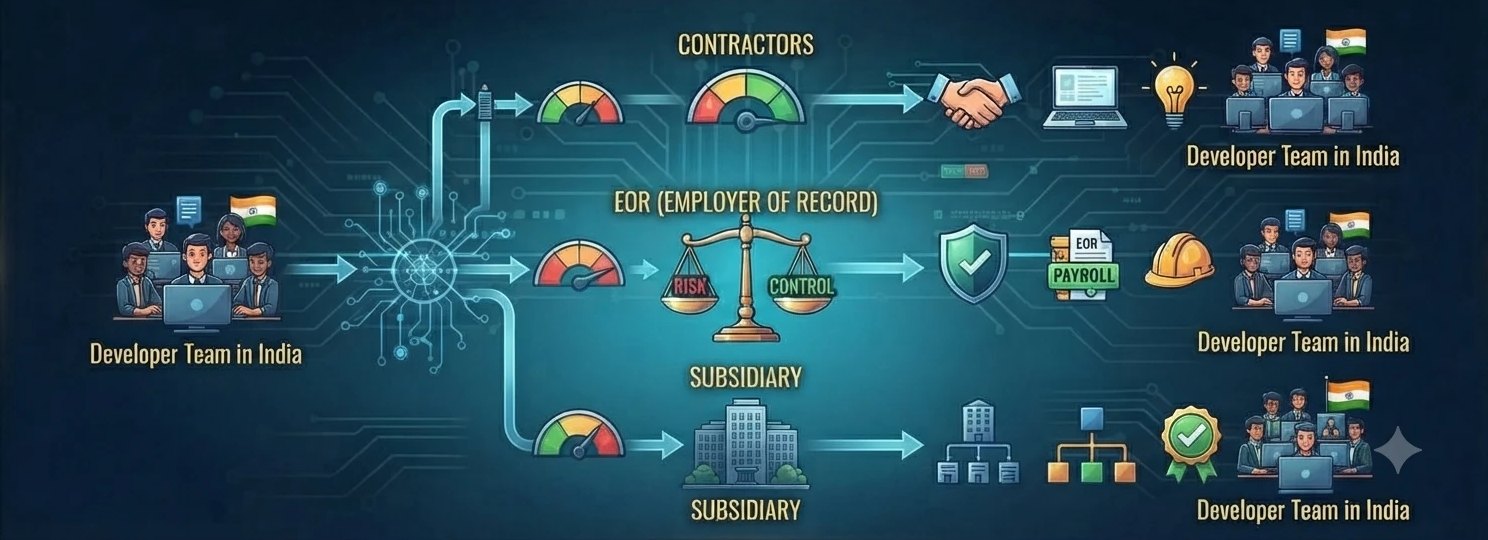
As your Indian team grows, consider an employer of record (EOR), which employs people on your behalf and handles payroll and compliance, or your own Indian subsidiary, which gives you full control and is often more cost-effective at scale. Many startups move from contractors to an EOR at around five to ten people, and to a subsidiary when the team becomes a core part of the business. That headcount range is a rule of thumb, not a legal threshold. See our guide to setting up an Indian subsidiary.
If a dispute arises with a contractor over payment, IP or confidentiality, the remedies depend on the contract: arbitration or court proceedings in the chosen forum, injunctions to protect confidential information, and copyright claims if code is misused. A well-drafted contract makes every one of these remedies easier to use.
Quick answers
Can a US company hire contractors in India without an Indian entity?
Yes. US companies commonly engage Indian independent contractors directly, provided the relationship is genuinely independent and the contract is properly drafted.
Do Indian contractors own the code they write?
Yes, unless they assign it in writing. Use a present, worldwide, full-term assignment that excludes the Copyright Act’s default rules.
When should we switch to an EOR or subsidiary?
When contractors become full-time, integrated team members, or when the team grows large enough that misclassification and tax risks increase.
Related reading: hiring developers in India from the UK; also paying Indian developers from a Dubai Web3 company; also open-source licence audits for US startups; also trade secret remedies when former employees take code.
Final word
Halverton & Co. is an Indian law firm that advises on Indian law, including contractor agreements, IP assignment, employment structuring and labor code compliance. We practice in Jharkhand, Maharashtra and before the Supreme Court of India, and we work alongside US counsel, who advise on US law. Halverton & Co.: Where tech needs law! If you have a question about Indian law, write to us at office@halvertonandco.com, or get in touch.
This article reflects developments reported up to early October 2026. It is for general information only, is not legal advice, and does not create an attorney-client relationship. Halverton & Co. is an Indian law firm and does not advise on US law.
Related practice area
Startups & Venture
From incorporation to term sheet. The documents a company needs to be fundable.
View the practice areaComments
No account needed. Comments are reviewed before they appear, so yours will show here once approved. Please do not share confidential details or describe your own legal matter: replies are general discussion, not legal advice, and do not create an advocate-client relationship. For your own situation, write to office@halvertonandco.com.