Key takeaways
- In Ross the Third Circuit treated Westlaw headnotes as protectable and rejected fair use for a competing, non-generative AI tool.
- In Eastern Book Company v. D.B. Modak the Supreme Court of India protected creative editorial additions such as headnotes but not mere copy-editing of judgments.
- Risk sits in a publisher’s editorial layers, not in the judgments themselves.
- Build the corpus from primary sources, annotate it yourself, license what you want from commercial databases and keep a lineage file.
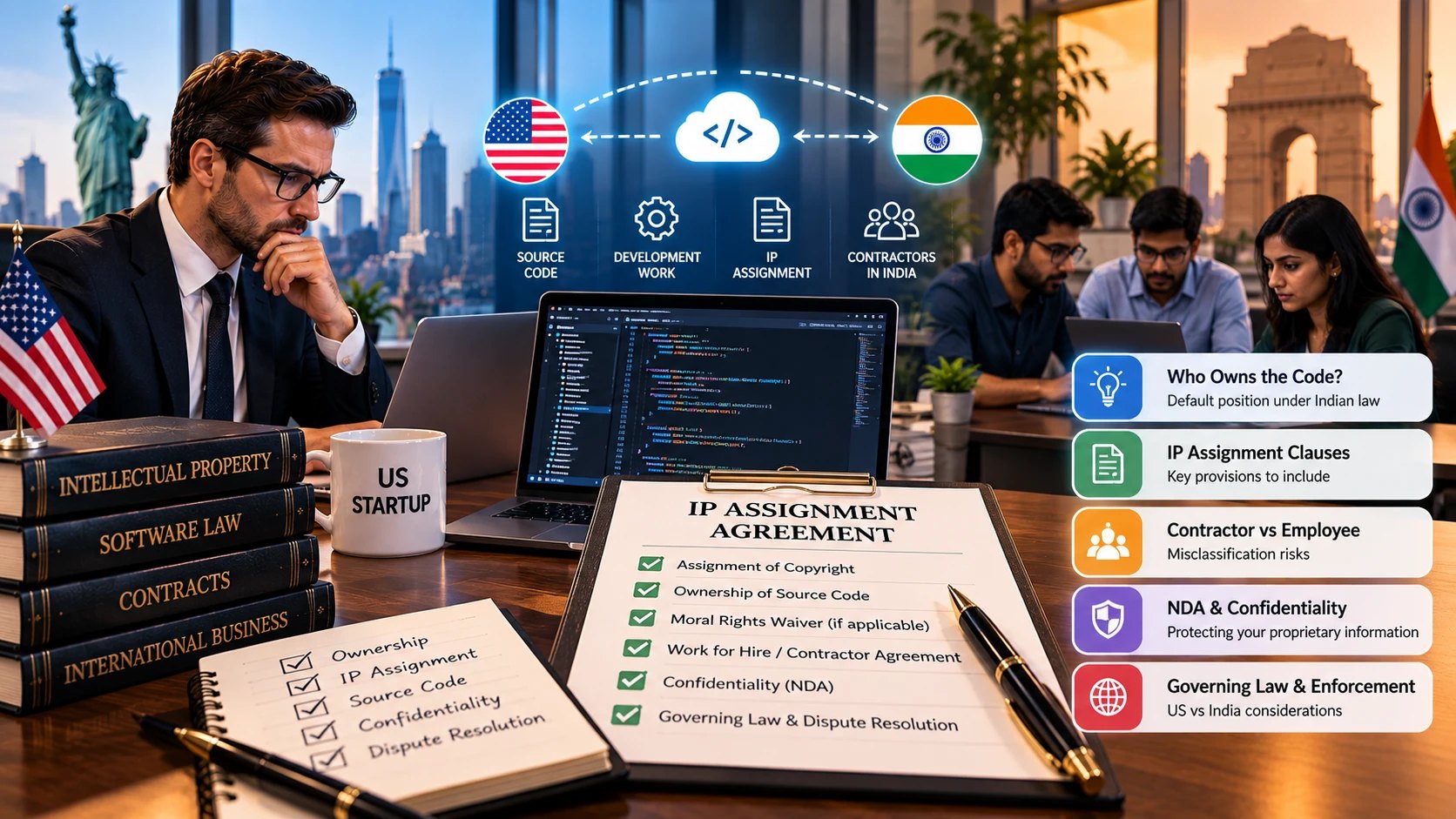
A US legal AI company wants to add Indian law to its product. The obvious source is the large commercial databases that publish Indian judgments with editorial features: headnotes, case summaries, cross-references and indexes. The Third Circuit’s September 2026 decision in Thomson Reuters v. Ross, which held that copying Westlaw’s headnotes to train an AI tool was not fair use, makes the question urgent. If a US court protects American headnotes, what about Indian ones?
India has its own Supreme Court authority on this exact subject: Eastern Book Company v. D.B. Modak, decided in 2007. This guide compares the Indian and US positions, explains what can and cannot be protected in an Indian law report, where training on Indian databases would be risky, and how a US AI company can build Indian legal AI on a safe data footing. It is written from the Indian-law perspective; US copyright points belong to US counsel.
What Ross decided about headnotes
In Thomson Reuters v. ROSS Intelligence, the Third Circuit affirmed on 29 September 2026 that ROSS’s use of Westlaw headnotes to train an AI legal research tool was not fair use. The headnotes, short summaries of the legal points in judicial opinions written by Westlaw’s editors, were treated as protectable because they involve enough human creativity to meet the originality standard (Jenner & Block; Akin Gump; Haynes Boone). The District of Delaware had already found, in February 2025, that the headnotes had a sufficient creative spark, even though they summarise legal points that are themselves free for anyone to use (Ballard Spahr).
This is the idea behind the US originality standard from the Supreme Court’s decision in Feist v. Rural Telephone: facts and raw information are free for all to use, but a creative selection, arrangement or expression of them can be protected, and the threshold is low. The Third Circuit also held that the use was not fair use, treating ROSS’s use as minimally transformative and as harming a market for licensing the headnotes as AI training data (Ballard Spahr; Mondaq).
The ruling is limited. ROSS’s tool was not generative, and the court distinguished generative systems. But for any AI company, the lesson is that editorial layers added by a publisher to public legal materials can be protected, and that copying them to train a competing product is risky.
What Indian law says: Eastern Book Company v. D.B. Modak
Indian law reached a comparable position earlier. In Eastern Book Company v. D.B. Modak, reported at (2008) 1 SCC 1, the Supreme Court considered whether the publisher of the Supreme Court Cases law reports could claim copyright in its edited versions of judgments. The Court held that the judgments themselves cannot be monopolised and that mere copy-editing, which involves labour and little else, does not earn copyright. But it held that headnotes, footnotes, editorial notes and similar additions can qualify for protection because some creativity is involved in producing them (Indian Kanoon; Bar & Bench; Law Times Journal).
The Court chose a middle path between the old “sweat of the brow” approach, under which effort alone creates copyright, and the stricter US-style test of a modicum of creativity. Relying on the Canadian Supreme Court’s decision in CCH v. Law Society of Upper Canada, it required skill and judgment that is more than mechanical, without requiring creativity of a very high order. Commentators have noted a tension in the way the opinion draws on both standards (SpicyIP; Intepat).
The comparison with Ross is therefore close. Both courts treat the underlying judgment as free for all to use and the creative editorial layer as protectable, and both look at whether the editors exercised judgment in selecting and expressing what to say. The Indian authority is a Supreme Court decision on Indian law reports, so it is directly relevant to Indian databases. The two systems are not identical, because the Indian standard of skill and judgment sits between the two extremes, and each question must be decided on the particular material.
Applying both rules to Indian legal databases
Break a legal database into layers. The judgments are the official work of the courts and generally free to use. Under the Copyright Act, 1957, reproduction of a judgment or order of a court is not an infringement unless the court has prohibited publication, which is why free sources such as the courts’ own websites and public aggregators exist. The headnotes, summaries, keyword indexes, classification schemes, paragraph tagging and cross-references written by a publisher’s editors are the layers most likely to attract protection, if they show the creativity and judgment the Court described.
| Layer | Likely protection in India | Training risk |
|---|---|---|
| Judgments and orders | Not a publisher’s work; reproduction is generally permitted unless the court prohibits it | Lower, but check each source’s terms and personal data |
| Mechanical copy-editing and formatting | Unlikely to qualify after Eastern Book Company | Low |
| Headnotes, summaries and editorial notes | Can qualify if they show skill, judgment and creativity | Higher, as in Ross |
| Classification schemes, tagging and cross-references | Depends on the creativity in selection and arrangement | Medium to higher |
Not every feature will qualify. Mechanical formatting, a citation, a paragraph number or a plain copy of a judgment is unlikely to be protected under Eastern Book Company. Short summaries that closely track the judgment’s own words may be harder to protect than original analysis. A US court would ask a similar question about originality, and then ask whether training on the material was fair use.
For a US AI company, the exposure comes from the editorial layers, not from the judgments. Training on a vendor’s curated headnotes, taking its classification of issues as a taxonomy, or using its summaries as supervised labels is the pattern in Ross. Training on the underlying judgments from official or open sources is a different matter, and the extra value you add by your own annotation can be yours.
Contracts, scraping and jurisdiction
Copyright is only one of the issues. Most commercial legal databases are accessed under licence terms that prohibit scraping, text and data mining or use to train AI. A breach of those terms can lead to a contract claim, termination and, where access controls were bypassed, other claims, even if copyright is unclear. Read the terms before you sign up, and don’t assume that a subscription authorises bulk extraction.
Jurisdiction can cut both ways. A US company copying an Indian publisher’s material in the US raises a question of US law, and foreign works are protected in the US under international treaties, and, unlike US works, are not required to be registered with the Copyright Office before a lawsuit is filed (US counsel should confirm). An Indian publisher can also sue in India where the copying reaches Indian users, and the Indian Copyright Act gives civil remedies and criminal penalties for infringement. A Delhi High Court judge refused an interim injunction in ANI v. OpenAI in July 2026 and viewed AI training as arguably fair dealing, but that ruling is interim and on appeal, and it concerned news content, not a competing database.
Indian data protection law also matters. Judgments are public records, but they contain personal data of parties and witnesses, and, from 13 May 2027, the DPDP Act, 2023 will govern how a company that processes personal data of people in India uses it. Sensitive categories, such as judgments involving children, require particular care.
A safe data strategy, remedies and quick answers
A defensible strategy has five parts. Build the core corpus from primary sources: the Supreme Court and High Court websites and other official or open repositories, with a record of each source’s terms. Do your own annotation: write your own summaries, labels and taxonomies, with a documented process that shows human judgment rather than copying. License what you want from commercial databases, in writing, with a clear grant for training and for the specific outputs you plan. Keep a data lineage file. And avoid claims in your marketing that you have trained on a named publisher’s content unless you have a licence. If a publisher complains, stop the use under challenge, preserve records and take advice quickly, because cooperative early resolution is usually cheaper than litigation in either country. An Indian publisher can seek an injunction and damages, and a US publisher’s claim would be under US law. Founders who built on questionable data can retrain on a clean corpus and, where appropriate, approach the publisher for a retrospective licence.
Related reading: Thomson Reuters v. Ross and legal tech startups, how US AI companies should structure data deals after Ross, AI training data licensing with Indian publishers, AI copyright in India vs the US, ANI v. OpenAI and AI training as fair dealing, the DPIIT AI copyright working paper and the DPDP Act for US SaaS companies; also software copyright protection in India.
Quick answers
Are headnotes in Indian law reports protected by copyright?
Potentially, yes. In Eastern Book Company v. D.B. Modak, the Supreme Court held that headnotes, footnotes and editorial notes can be protected because they involve creativity, while mere copy-editing of a judgment is not enough.
Can a US AI company train on Indian court judgments?
The judgments themselves are not protected as a publisher’s work, and reproducing a court’s judgment is generally permitted under the Copyright Act, 1957 unless the court prohibits it, but check each source’s terms and privacy issues.
Does the Ross ruling make training on Indian headnotes unlawful?
Ross is a US decision on US headnotes, but it shows a US appellate court treating editorial headnotes as protectable and rejecting fair use for a competing tool, so training on a vendor’s headnotes carries real risk.
Are headnotes in Indian law reports protected by copyright?
Potentially. In Eastern Book Company v. D.B. Modak, the Supreme Court held that headnotes, footnotes and editorial notes can be protected where creativity is involved, while mere copy-editing of a judgment is not enough.
Can I train on judgments from the Supreme Court’s own website?
The judgments themselves are not a private publisher’s work, and the Copyright Act, 1957 generally permits their reproduction unless the court prohibits it. Check the website’s terms and handle personal data in line with the DPDP Act.
Final word
Halverton & Co. is an Indian law firm advising US companies, founders, investors and law firms on Indian law, including copyright and database rights, AI training data strategy and technology contracts for companies using Indian legal content. We practise in Jharkhand, Maharashtra and before the Supreme Court of India, and work alongside US counsel, who advise on US law. Halverton & Co.: Where tech needs law! If you have a question about Indian law, write to us at office@halvertonandco.com, or get in touch.
This article reflects developments reported up to late October 2026. It is for general information only, is not legal advice, and does not create an attorney-client relationship. Halverton & Co. is an Indian law firm and does not advise on US law; US-law points should be confirmed with US counsel.
Sources
Related practice area
Intellectual Property
Trade marks, copyright, patents and designs. Searched, filed, licensed and enforced under Indian law.
View the practice areaComments
No account needed. Comments are reviewed before they appear, so yours will show here once approved. Please do not share confidential details or describe your own legal matter: replies are general discussion, not legal advice, and do not create an advocate-client relationship. For your own situation, write to office@halvertonandco.com.