Key takeaways
- Section 8 requires Form 3 within six months of the Indian filing and updates on corresponding foreign applications until grant.
- Form 27 working statements are now filed once every three financial years, and the first block for pre-March 2023 grants was due on 30 September 2026.
- India has no continuations, so plan around divisional applications and the possibility of pre-grant opposition.
- Request examination within 31 months for applications filed after the 2024 Rules, and 48 months for earlier ones.
US patent practitioners handling an Indian filing for a client often find the process familiar in outline and different in detail. There is no US-style duty to submit prior art to the examiner, but there is a specific duty to tell the Indian Patent Office about the client’s foreign filings. There are no continuations, but there are divisionals. And there is a yearly, now triennial, working statement that has no US counterpart.
This guide explains the points where Indian prosecution differs for a US firm: the entry routes and local-agent requirements, Form 3 and the Section 8 disclosure duty, Form 27 and working statements, the examination deadlines, and the mistakes that cost clients their rights. It is written from the Indian-law perspective; US patent practice points belong to US counsel.
How Indian prosecution differs for US practitioners
Entry into the Indian system is by a direct Indian filing within the twelve-month Paris Convention period, or by national phase entry from a PCT application, which is generally due at 31 months from the priority date. The applicant needs an address for service in India, and, in practice, prosecution is handled through an Indian registered patent agent or an advocate who is authorised to act before the Patent Office. A US firm usually instructs an Indian firm to do this and stays in control of strategy.
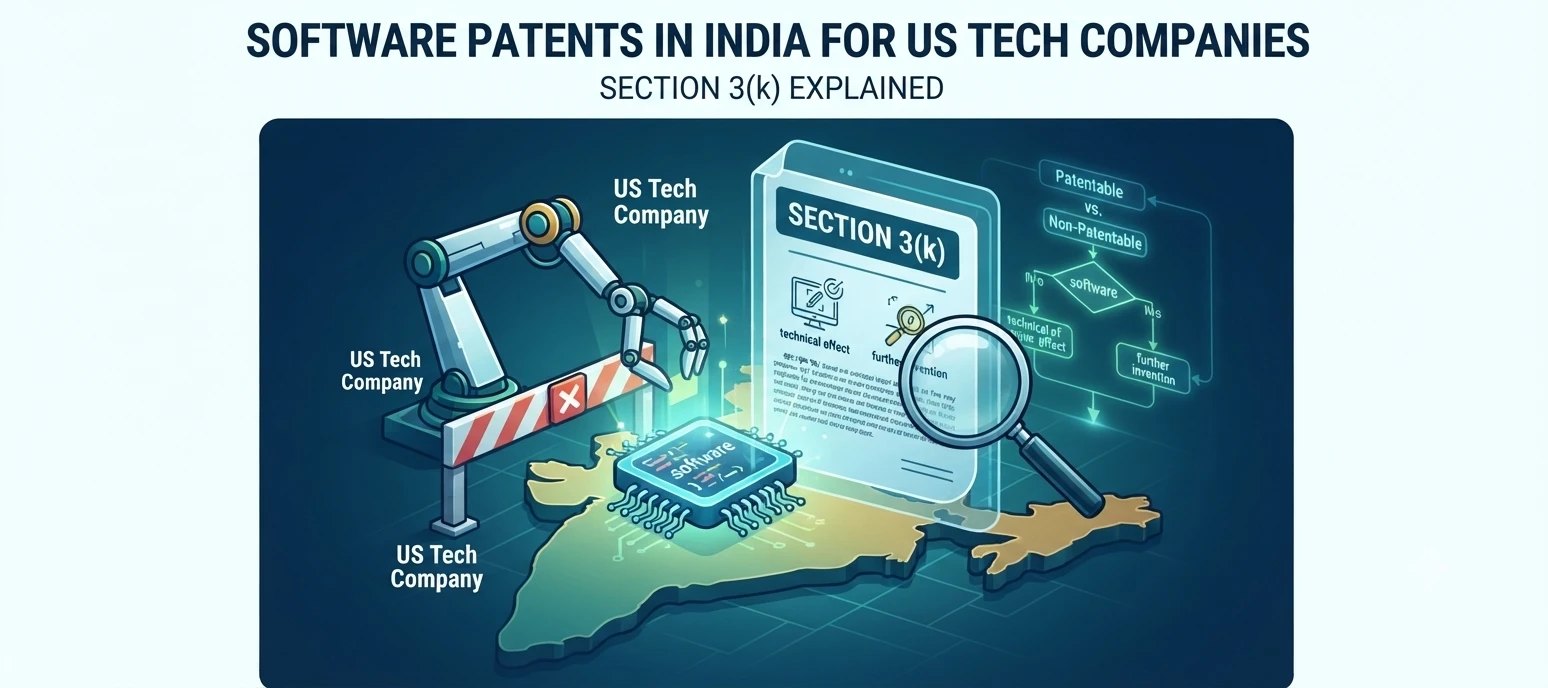
The substantive law has its own exclusions. Section 3 of the Patents Act, 1970 lists subject matter that is not an invention, including Section 3(d) on new forms of known substances, which matters for pharmaceutical claims, and Section 3(k) on computer programmes per se, mathematical and business methods and algorithms, which matters for software claims. The Patent Office issued revised guidelines on computer-related inventions in 2025, and software claims should be drafted around technical effect rather than abstract steps. US claims often need rewriting for India, and claims drafted as a business method are unlikely to survive.
| Topic | US practice | India |
|---|---|---|
| Disclosure of foreign prosecution | Information disclosure statement | Form 3 under Section 8, within six months of filing, kept updated until grant |
| Continuations | Available | Not available; divisional applications only |
| Working of the patent | Not required | Form 27 once every three financial years, with compulsory licence exposure |
| Local representation | Registered US practitioner | Address for service in India; prosecution through an Indian patent agent or advocate |
| Software claims | Section 101 and technical improvement tests | Section 3(k) and technical effect; business methods excluded |
Some US devices don’t exist. There is no continuation practice, no terminal disclaimer and no requirement to file an information disclosure statement, though the foreign-filings disclosure under Section 8 serves a related function. Divisional applications are available to pursue unity-of-invention issues, and pre-grant opposition is available to third parties at any point before grant, so build the possibility of an opposition into your timeline and your client’s expectations.
Form 3 and the Section 8 disclosure duty
Section 8 of the Patents Act requires an applicant who has filed for the same or substantially the same invention abroad to tell the Controller, on Form 3, giving details of those applications. The statement and undertaking has to be filed within six months of the Indian filing date, and the applicant undertakes to keep the Controller informed, up to the date of grant, of details of any further corresponding applications filed abroad (SS Rana; Khurana & Khurana; Intepat). For a PCT national phase entry, the statement is usually filed with or soon after the entry.
The Controller can also ask for details of how corresponding foreign applications were processed, including objections and amendments, and the applicant has to supply them. Sources differ on the timing of updates after a first examination report, with some saying within three months of the report, so check the Rules and any Patent Office practice notes in force. Our approach is to file an updated Form 3 whenever a corresponding application is filed or decided, and to confirm to the client in writing that this will be done.
The consequences of non-compliance are significant. Failure to disclose, or false statements, can be raised as grounds for pre-grant opposition under Section 25(1) and for post-grant opposition, and can lead to revocation of a granted patent, and commentators note that Indian courts have treated Section 8 defaults as serious (Khurana & Khurana; Mondaq). US counsel who are used to a clearer duty of candour defence should still keep a complete, current record of foreign prosecution history for each Indian application.
Form 27 and working statements
A US patentee with an Indian patent, and any licensee under it, must file a statement of the working of the patent in India on Form 27. After the Patents (Amendment) Rules, 2024, the statement is filed once for every three financial years, not every year, and it no longer asks for revenue figures (Khurana & Khurana). The first block for patents granted on or before 31 March 2023 covered 2023-24 to 2025-26, with the statement due by 30 September 2026. For patents granted from 15 March 2024, the first due date is 30 September 2027 (Conventus Law).
Working means, broadly, whether the invention has been worked on a commercial scale in India, by manufacture, import or licence. The point behind the form is the compulsory licensing system: under the Patents Act, a patent that is not worked in India after three years from grant can be the subject of a compulsory licence application. US clients who sell the patented product into India or have licensed it should be able to say so, and a client that doesn’t work the patent in India should still file and explain why.
Create a calendar entry for each Indian patent, and keep the information needed for the form, such as import and licensing records, with your Indian agent. The Patent Office has said the three-year period applies going forward, so missing earlier statements can’t be rolled into the new block. A failure to furnish information required under the Act can attract a fine, and the filing record may be raised in a compulsory licence application (K&S Partners). If a statement has been missed, file it late with an explanation rather than leaving the gap.
Examination deadlines and responses
After the application is published, usually eighteen months from the priority date unless an early publication is requested, the applicant must request examination. For applications filed after the 2024 Rules, the period is 31 months from the priority or filing date, whichever is earlier, and earlier applications have 48 months (Mondaq). Treat the 31-month deadline as the default. An application without a request is treated as withdrawn, and there is no easy route back.
The Patent Office then issues a first examination report. The period for responding has generally been six months, with the possibility of an extension on request, but our research did not confirm the position under the 2024 amendments, so check it on receipt of each report. Responses typically address Section 3 objections, novelty and inventive step and clarity, with claim amendments as needed. Hearings are available under Section 14 before the Controller refuses an application, and decisions can be appealed to the High Court.
Other dates continue after grant. Renewal fees are payable each year from the third year after filing. A third party can file a post-grant opposition within twelve months of the publication of the grant. Fee concessions exist for startups, small entities and educational institutions, and the 80% rebate was introduced in 2024, but eligibility depends on Indian-law definitions and has to be established at the time of each payment, so check with your Indian agent before claiming. Keep one docket for all of this, and share it with the client.
Common mistakes, remedies and quick answers
The mistakes we see most often are these. Form 3 is filed once and never updated. Form 27 is forgotten because the client’s US team doesn’t know it exists. The request for examination date is calculated from the wrong date, or the 31-month and 48-month rules are confused. US-style claims are filed without adaptation and meet Section 3(k) or Section 3(d) objections. The address for service is out of date and notices are missed. And the Indian agent isn’t given the foreign prosecution history in time. Many of these are fixable, with a late Form 3, a late Form 27 or a request to restore a lapsed patent within the limited period allowed. A missed request for examination is much harder to cure, which is why it deserves the earliest and most prominent reminder. Agree with your Indian associate on a reporting routine, a shared calendar and a checklist for each new filing. And review the portfolio once a year to decide whether each patent is worth its renewal fees.
Related reading: patent deadlines under India’s 2024 patent rules, software patents in India for US tech companies, patent paralegal support from India, trademark docketing outsourcing and USPTO deadlines, outsourcing legal work to India: an ABA 08-451 checklist and choosing an offshore legal support partner; also filing in India after a US provisional patent and patent opposition in India for UK companies; also whether you can patent AI.
Quick answers
Do I need to file Form 3 for every Indian application?
Yes, if you have filed or later file corresponding applications abroad. The statement is due within six months of the Indian filing, and you must keep the Controller updated until grant.
How often is Form 27 due?
Once every three financial years, within six months of the end of the block. The first deadline for patents granted before 31 March 2023 was 30 September 2026.
Can a US firm file directly at the Indian Patent Office?
An applicant can file with an Indian address for service, but prosecution is normally handled by an Indian registered patent agent or advocate, so US firms usually instruct an Indian associate.
What is Section 8 of the Indian Patents Act?
It requires an applicant who has filed for the same or substantially the same invention abroad to tell the Controller, on Form 3, giving details of those applications, and to keep the Controller informed until grant. Failure can be raised in opposition and revocation.
Does India have continuation applications?
No. Divisional applications are available to deal with unity-of-invention issues, but there is no continuation practice and no terminal disclaimer.
Final word
Halverton & Co. is an Indian law firm advising US companies, founders, investors and law firms on Indian law, including coordination of Indian patent prosecution with US counsel, Form 3 and Form 27 compliance, and enforcement strategy. We practise in Jharkhand, Maharashtra and before the Supreme Court of India, and work alongside US counsel, who advise on US law. Halverton & Co.: Where tech needs law! If you have a question about Indian law, write to us at office@halvertonandco.com, or get in touch.
This article reflects developments reported up to late October 2026. It is for general information only, is not legal advice, and does not create an attorney-client relationship. Halverton & Co. is an Indian law firm and does not advise on US law; US-law points should be confirmed with US counsel.
Sources
Related practice area
Intellectual Property
Trade marks, copyright, patents and designs. Searched, filed, licensed and enforced under Indian law.
View the practice areaComments
No account needed. Comments are reviewed before they appear, so yours will show here once approved. Please do not share confidential details or describe your own legal matter: replies are general discussion, not legal advice, and do not create an advocate-client relationship. For your own situation, write to office@halvertonandco.com.