Key takeaways
- India is a Berne Convention member and the International Copyright Order, 1999 extends Indian copyright to UK works without registration.
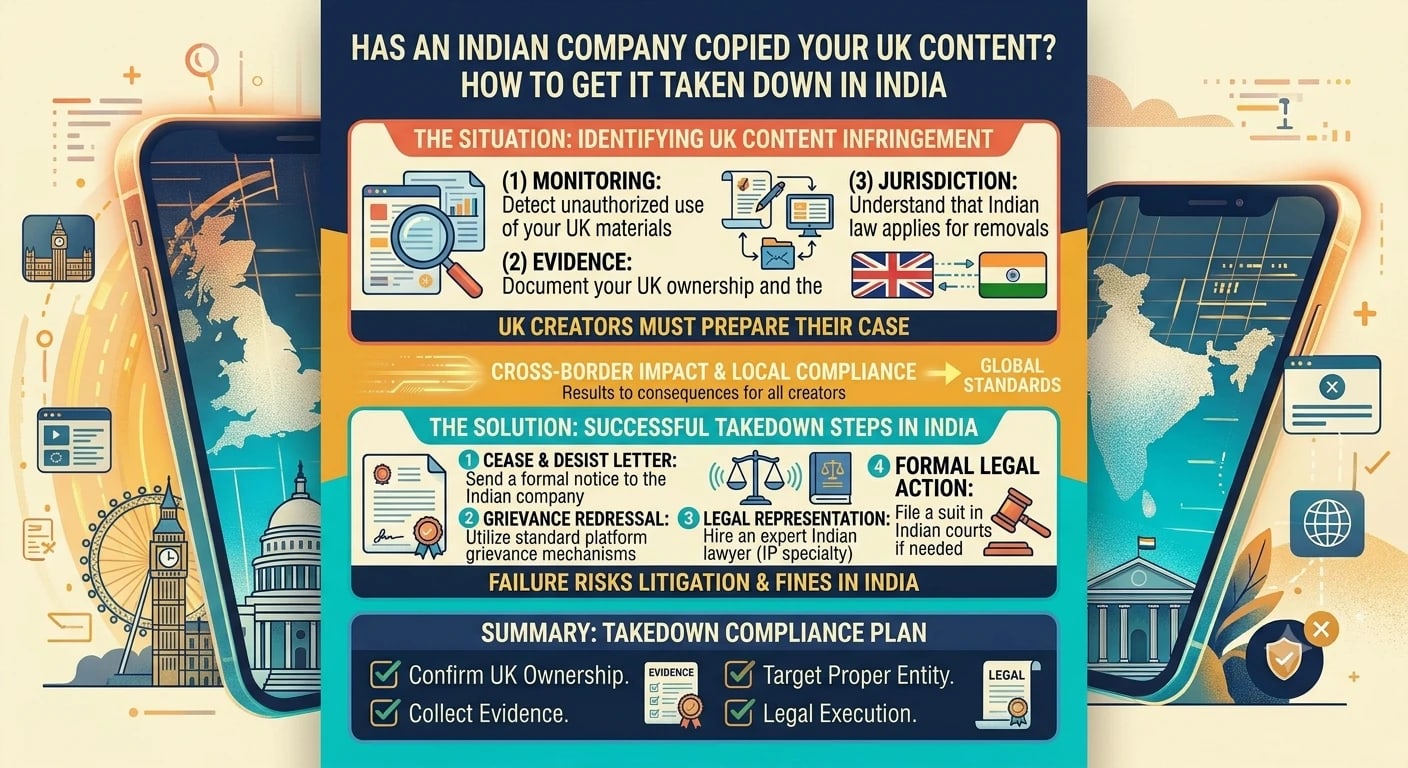
- Capture evidence first, then report to the host, registrar and platform, and send a legal notice.
- Section 52(1)(c) and Rule 75 allow a 21-day disablement on a written complaint, after which a court order is needed.
- The Delhi High Court can grant injunctions, local commissioners and John Doe orders in serious cases.
Finding your text, photos or designs on an Indian company’s website is infuriating, and the instinct is to send an angry email. A better path is a structured one. A UK business that has suffered copyright infringement India UK company owners face can protect its rights in India without registering there, because India recognises UK copyright. The steps are: preserve evidence, report to platforms and hosts, send a proper legal notice and, if needed, go to court.
This guide explains why UK works are protected in India, how to build the evidence, which takedown routes work fastest, when to send a legal notice, how the Delhi High Court handles these cases and what it costs in time and effort. It is written by an Indian law firm for UK readers. UK law points should be confirmed with your UK solicitors.
Your rights in India
India is a member of the Berne Convention, and the International Copyright Order, 1999 applies the Copyright Act, 1957 to works first published in Berne countries, including the UK. A UK business therefore has copyright in India in its original text, photographs, designs, software and videos without registering them in India. UK copyright is the same copyright for this purpose, and the Indian courts apply the Indian Act to decide infringement in India. UK copyright protection in India does not need local registration. That makes copyright infringement India UK company disputes enforceable locally. Owners often ask what to do when an Indian website copied my content, and the answer starts with evidence.
The Act gives the owner exclusive rights to reproduce, publish and communicate the work to the public. Copying a substantial part without permission infringes, and Section 51 sets out the test. Remedies include injunctions, damages, an account of profits and delivery up under Section 55, and criminal penalties for knowing infringement under Section 63. Ideas and facts are not protected, so the copying must be of original expression.
Registration of copyright in India is not required to sue, but a certificate can help as evidence. If you have a UK registration or a dated record of creation, keep it. What you need most is proof that you created the work first and that the Indian company copied it. Look for matching text, identical images, copied errors and similar layout, and consider how the company obtained your content.
Build your evidence first
Capture the infringing pages before you contact anyone, because they may vanish. Save full-page screenshots with the URL and date visible, save the HTML source and use a web archive or a notarised capture if the matter is serious. Record the company’s name, address, domain registration details and hosting provider using WHOIS and public records. Keep your original files, drafts and publication dates. Evidence is the first step in any copyright infringement India UK company case.
| Item | Why it matters | Tip |
|---|---|---|
| Dated screenshots and page source | Content may vanish | Capture URL and date |
| Originals and drafts | Prove you created first | Keep the files |
| Side-by-side comparison | Shows substantial copying | Mark matching parts |
| Host and registrar details | Identify who can remove it | Use WHOIS |
| Proof of harm | Supports urgent relief | Customer confusion, lost sales |
Prepare a clear comparison. Put your original and the copy side by side and mark the matching parts. If the copying is of a large part of your site, list each page and each URL. If the copy was published as an advertisement or product listing, note where it appears and who sees it. This comparison is the base for notices, platform reports and, if needed, a court filing.
Work out the commercial harm. Lost sales, price pressure, confusion among customers and damage to reputation affect the strength of an urgent application. Note any customer messages that show confusion. Check whether the Indian company has a licence or permission from you, from a former agent, or from a freelancer who owned the copyright. Sometimes the problem is a licensing gap, not deliberate copying.
Takedown routes and the legal notice
Start with the hosting provider and platform. If the content is on a social media site or marketplace, use its copyright complaint form. For a website, send a written complaint to the hosting company and the domain registrar with the URLs and proof of ownership. Under Section 52(1)(c) of the Copyright Act and Rule 75 of the Copyright Rules, 2013, an intermediary that receives a proper written complaint can disable access for 21 days, and the owner must obtain a court order in that time to keep it down.
Send a legal notice to the Indian company. A good notice identifies your work, shows ownership, lists the infringing URLs, demands removal within a short deadline, asks for an account of use and states that you will go to court if the infringement continues. Send it by email and courier to the company’s registered address. An Indian lawyer’s notice is usually taken more seriously than an email from a foreign business. A legal notice copyright infringement India lawyers send should be precise. Notices are central to a copyright infringement India UK company dispute.
Be careful with threats. Section 60 of the Copyright Act allows a person who is threatened with infringement proceedings without justification to sue for groundless threats. Make sure your claim is correct and your notice is accurate. Keep the tone firm and factual. Many disputes settle at this stage with removal, an apology and sometimes a payment, especially if the company has copied through a careless contractor.
Going to court in India
If the copying continues or the harm is significant, file a civil suit. Under Section 62(2) of the Copyright Act, you can sue where the defendant carries on business, or where you reside or carry on business, which for a foreign plaintiff usually means the defendant’s location. The Delhi High Court’s Intellectual Property Division hears many such cases and can grant interim injunctions quickly where the evidence is clear. Section 62 Copyright Act jurisdiction rules decide where you sue. A Delhi High Court copyright suit foreign plaintiff files follows the same rules as for Indian owners.
In urgent cases courts can grant ex parte orders, appoint a local commissioner to seize or copy evidence and issue John Doe orders against unknown infringers. Courts also direct registrars and internet service providers to block sites. You will need an affidavit, proof of ownership, evidence of copying and an explanation of urgency. A UK business may file through a power of attorney, and a company officer’s affidavit can be sworn in the UK, with formalities.
Think about cost and proportion. Court action takes time and money, and it makes sense where infringement is large, repeated or commercially harmful. For small copying by a small company, a notice and platform complaint may be enough. Coordinate your UK advisers and Indian counsel. If you want to claim damages, collect evidence of the infringer’s sales and profits early. Weigh cost before you escalate any copyright infringement India UK company matter.
Next steps and quick answers
Within a week: capture evidence, identify the host and the company, report to the platform and send a short notice through an Indian lawyer. Within a month: decide whether to go to court. Keep records of your original works in a central folder, and consider a watch service to find copies. This is general information, not legal advice. Treat copyright infringement India UK company problems as urgent.
Related reading: copyright takedowns in India for US creators, protecting Dubai creators from Indian copycats, counterfeit goods and UK brands in India, lookalike domains using your UK brand, enforcing a UK judgment in India, copyright licences in India and defending a UK brand in an Indian opposition; also dynamic injunctions against pirate sites in India; also what all rights reserved means in law, US copyright registration for foreign companies and DMCA takedowns in India; also photo copyright takedowns in India.
Quick answers
Is UK copyright protected in India?
Yes. India is a Berne Convention member and the International Copyright Order, 1999 extends the Copyright Act’s protection to UK works, with no registration needed in India.
How do I get copied website content removed in India?
Capture evidence, report to the host, registrar and platform, send a legal notice through an Indian lawyer and, if needed, sue in the Delhi High Court for an injunction. Section 52(1)(c) and Rule 75 allow a 21-day disablement on a written complaint.
Can I sue an Indian company in India as a foreign business?
Yes. A foreign owner can sue in Indian courts for infringement of its work. Under Section 62(2) you can file where the defendant does business, or where you carry on business. Take advice on formalities and costs.
Do I need an Indian lawyer to send a notice?
It is not required, but a notice from an Indian lawyer is usually taken more seriously and avoids mistakes such as a groundless threat.
Can a foreign company sue in India?
Yes. Under Section 62(2) you can sue where the defendant carries on business or where you do, subject to formalities.
Final word
Halverton & Co. is an Indian law firm advising UK companies, founders, investors and law firms on Indian law, including copyright enforcement in India for UK businesses, content takedowns, IP litigation and brand protection. We practise in Jharkhand, Maharashtra and before the Supreme Court of India, and work alongside your UK solicitors, who advise on English law. Halverton & Co.: Where tech needs law! If you have a question about Indian law, write to us at office@halvertonandco.com, or get in touch.
This article reflects developments reported up to 31 October 2026. It is for general information only, is not legal advice, and does not create a solicitor-client relationship. Halverton & Co. is an Indian law firm, is not authorised or regulated by the Solicitors Regulation Authority, and does not advise on English law; UK-law points should be confirmed with UK advisers.
Sources
Related practice area
Intellectual Property
Trade marks, copyright, patents and designs. Searched, filed, licensed and enforced under Indian law.
View the practice areaComments
No account needed. Comments are reviewed before they appear, so yours will show here once approved. Please do not share confidential details or describe your own legal matter: replies are general discussion, not legal advice, and do not create an advocate-client relationship. For your own situation, write to office@halvertonandco.com.