Key takeaways
- A YouTube copyright strike is a claim by someone who says they own the content, not a court judgment; you can ask for a retraction, send a counter notification or let it expire after Copyright School.
- Indian law has no general fair use rule; Section 52 fair dealing covers criticism, review and reporting, and Section 60 protects against groundless threats.
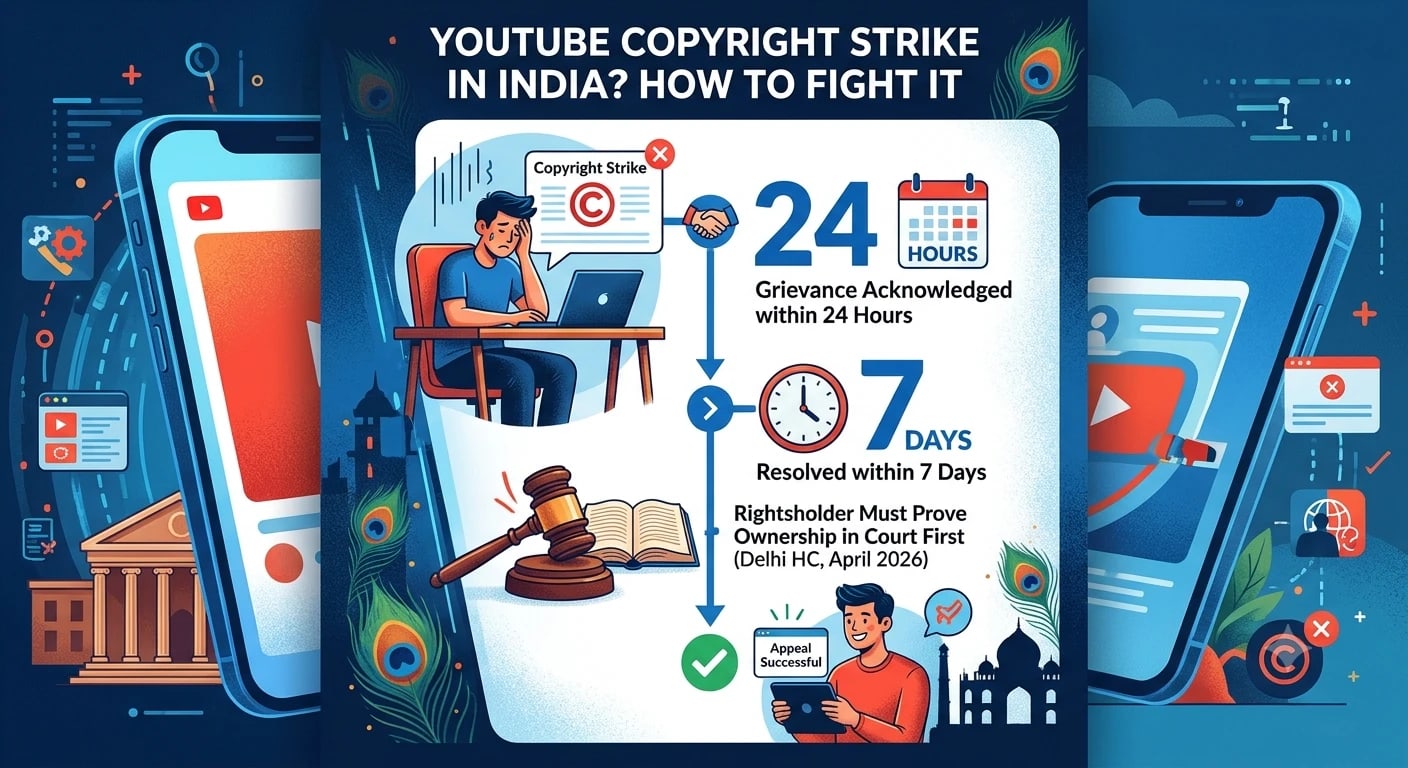
- The IT Rules amendment in force from 20 February 2026 is reported to require grievance acknowledgement within 24 hours and resolution within 7 days.
- Keep licences and project files, use short clips only for real commentary and act within days of a strike.
A YouTube copyright strike India creators receive can remove a video, freeze live streaming and, after three strikes, end a channel. For a full-time creator, that is a threat to income, not just to one upload. The good news is that a strike is not a court judgment. It is a claim by someone who says they own the content, and you have several ways to answer it, from asking for a retraction to sending a counter notification.
This guide explains the difference between a claim and a strike, how Indian copyright law shapes the dispute, how to fight a strike step by step, what the 2026 IT Rules timelines add and how to avoid strikes in future. It is general information for creators. If a rights holder threatens a lawsuit, take advice from an Indian IP lawyer quickly.
Claim, strike and what each does
A copyright claim usually comes from Content ID, YouTube’s automated matching system. It can block the video, monetise it for the claimant or track it, but it does not by itself put your channel at risk. A copyright strike is different. It follows a formal removal request from a rights holder. The video comes down, and the strike counts against your channel. That difference decides your next move after a YouTube copyright strike India creators receive. Completing Copyright School leads to Copyright School strike removal once 90 days have passed.
The consequences build up. One strike restricts features such as live streaming, and it expires after 90 days if you complete YouTube’s Copyright School. Three strikes can lead to termination of the channel. Understanding the copyright strike vs copyright claim distinction matters, because the best response to each is different: a claim can often be disputed inside YouTube, while a strike needs a retraction or a counter notification.
Creators in India also face a practical problem. Content ID cannot judge whether your use is fair dealing, such as a short clip used for criticism or review. It matches, and the system then favours the claimant. That is why a creator with a strong defence can still lose a video, and why a clear record of your own work and your reasons for any third-party material is your main protection.
What Indian law says
Indian copyright law is the Copyright Act, 1957. Section 51 defines infringement, and Section 52 lists acts that are not infringement, including fair dealing for criticism, review and reporting current events. Unlike the US, India has no general fair use test. Courts look at purpose, amount used, effect on the original and whether the use substitutes for it. A short, transformative clip is stronger than a long, unaltered one. These provisions are the legal frame for any YouTube copyright strike India creators dispute.
Platforms are intermediaries. Under Section 52(1)(c), read with Rule 75 of the Copyright Rules, 2013, an intermediary that receives a written complaint from the owner can disable access for 21 days and may restore the content unless the complainant produces a court order within that period. The Supreme Court’s 2015 decision in Shreya Singhal v. Union of India also says that platforms need not act on private complaints alone for unlawful content under Section 79, but they act on court or government orders.
Section 60 adds a shield. A person who is threatened with a copyright suit without justification can sue for a declaration and damages for groundless threats of copyright infringement, unless the threatener starts a suit promptly. A Delhi High Court ruling was reported in 2026 on a related point: a private claimant could not obtain a takedown direction under the IT Rules without first establishing before a court that the content is its property. Check the order before you cite it. That is the main false copyright strike remedy India law provides.
How to fight a strike step by step
Step one: read the strike. YouTube shows who filed it, which video and which timestamps. Check whether the claim is correct. If you used licensed music, original footage or a clip that is fair dealing, note the reason. If the claimant is a real owner and you used their content without permission, the cleanest route is to ask for a retraction politely, or to remove the video and complete Copyright School. Handling a YouTube copyright strike India creators get is easier with a written plan.
| Option | What it does | When to use it |
|---|---|---|
| Ask for a retraction | Claimant withdraws the strike | Mistaken or unclear claims |
| Counter notification | Sworn statement that removal was wrong | You are confident you own or may use the content |
| Copyright School | Strike expires after 90 days | You did infringe |
| Grievance officer complaint | Platform must acknowledge and resolve within set times | Platform does not respond |
| Legal notice or suit | Groundless threats remedy under Section 60 | Claimant threatens a suit without basis |
Step two: ask the claimant to retract. If the claim is a mistake, contact the claimant through the email YouTube gives, explain the facts and attach proof. Many strikes are withdrawn at this stage. Keep copies of every message. Step three: if there is no retraction and you believe the strike is wrong, send a counter notification. This is a legal statement that the removal was a mistake or that you have a right to use the content, made under penalty of perjury, so only use it when you are confident.
Step four: understand what happens next. After a counter notification, YouTube passes it to the claimant, who must file a court action within the time YouTube states, usually about ten business days, or the video can be restored. If the claimant sues in India, the dispute moves to court, and you should take legal advice at once. Never file a counter notification to buy time, and never use a false claim of your own to retaliate. This is the counter notification YouTube India creators most often need.
The 2026 IT rules timelines
The Information Technology Amendment Rules, 2026 took effect on 20 February 2026. Reports say they cut the time for intermediaries to resolve user grievances from fifteen days to seven days, and the grievance rules continue to require an acknowledgement within 24 hours. Those timelines apply to complaints made to the platform’s grievance officer, such as a wrongful takedown or a false strike. Check the text of Rule 3(2) for the exact wording. Those timelines also help when a YouTube copyright strike India creators challenge is ignored.
Use the grievance route as a backup. If YouTube does not respond to your appeal, send a written complaint to its India grievance officer, keep the acknowledgement and note the date. If the platform does not respond within the period, you can escalate to the Grievance Appellate Committee, where it is available, or seek relief from a High Court. These steps work best with a short, well-documented complaint, not a long argument.
Remember what the rules do not do. They do not change the Copyright Act, and they do not decide who owns the content. They set response times for platforms. A rights holder who files a wrongful strike can still be challenged under Section 60, and a creator who infringes can still be sued. Treat the IT Rules as a process tool and the Copyright Act as the source of your rights.
Next steps and quick answers
Prevent strikes by using original or licensed material, keeping licences and receipts, and using short clips only for real commentary with your own analysis. Keep a folder with the project files, music licences and permissions for every video. If you receive a strike, act within days, not weeks. This is general information, not legal advice for your channel. A single YouTube copyright strike India channels receive should trigger a review of your workflow.
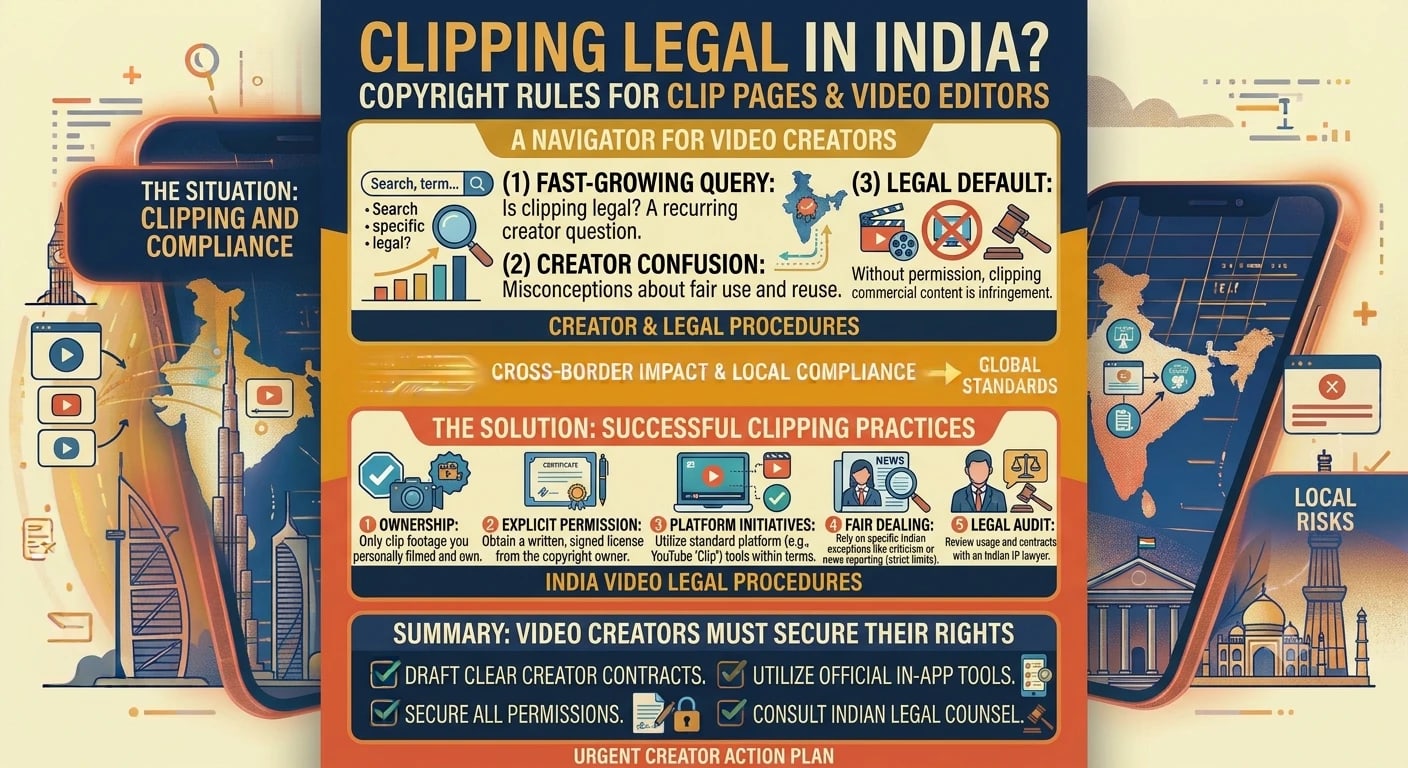
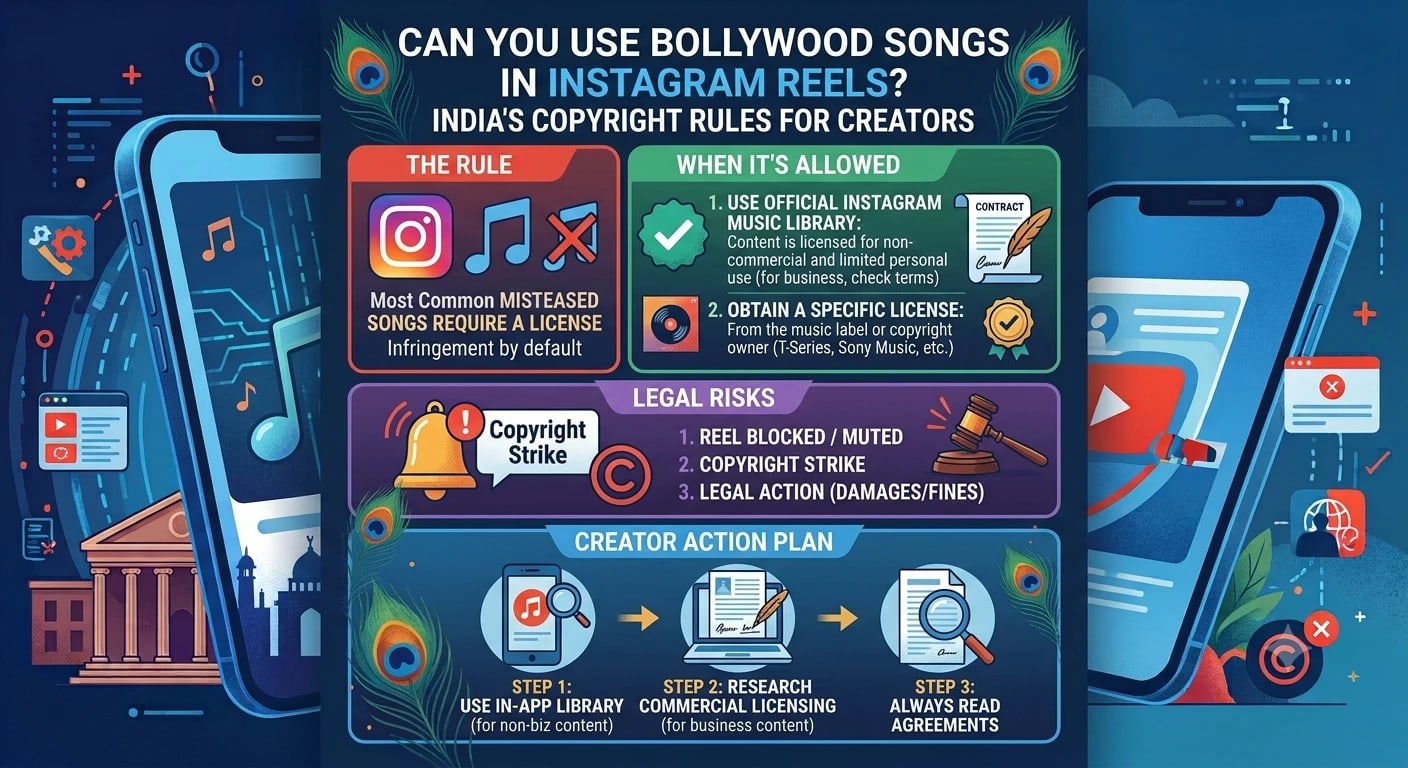
Related reading: is clipping legal in India, copyright takedowns in India for US creators, using Bollywood songs in Instagram reels, protecting Dubai creators from Indian copycats, labelling AI-generated content under the IT Rules 2026, the Sahyog portal and content takedowns and who owns influencer content in India; also DMCA takedowns in India.
Quick answers
What is the difference between a YouTube copyright claim and a copyright strike?
A claim is usually automated through Content ID and affects monetisation or visibility of one video. A strike follows a formal removal request, takes the video down and counts towards channel termination after three strikes.
How do I send a counter notification on YouTube in India?
Open the strike in YouTube Studio, choose the counter notification option, give the required details and a statement of good faith. Only do it if you are confident, because it is made under penalty of perjury and may lead to court action.
Can I take action if someone files a false copyright strike against me?
Yes. You can ask for a retraction, send a counter notification, use the grievance process and, in some cases, sue for groundless threats under Section 60 of the Copyright Act. Take advice before you act.
How long does a YouTube copyright strike last?
A strike generally expires after 90 days if you complete Copyright School, and three strikes can lead to channel termination. Check YouTube’s current policy.
Is the April 2026 Delhi High Court ruling on takedowns final?
We could only confirm an order reported on 1 May 2026 in which a takedown plea under the IT Rules was withdrawn after the court said ownership must be proved before a court. Read the order before relying on it.
Final word
Halverton & Co. is an Indian law firm advising founders, startups, technology companies and investors on Indian law, including copyright and content takedown disputes, creator and media law, and technology and platform compliance. We practise in Jharkhand, Maharashtra and before the Supreme Court of India, and act as fractional legal counsel for technology-driven businesses. Halverton & Co.: Where tech needs law! If you have a question about Indian law, write to us at office@halvertonandco.com, or get in touch.
This article reflects developments reported up to 31 October 2026. It is for general information only, is not legal advice, and does not create an advocate-client relationship. Halverton & Co. is an Indian law firm.
Sources
Related practice area
Intellectual Property
Trade marks, copyright, patents and designs. Searched, filed, licensed and enforced under Indian law.
View the practice areaComments
No account needed. Comments are reviewed before they appear, so yours will show here once approved. Please do not share confidential details or describe your own legal matter: replies are general discussion, not legal advice, and do not create an advocate-client relationship. For your own situation, write to office@halvertonandco.com.