Key takeaways
- Copyright protects a game’s code, art, audio and text, including UK works under the International Copyright Order, 1999, but not its mechanics.
- Trade marks and passing off protect the name and trade dress.
- App store reports, a legal notice and Rule 75 are the fastest routes; courts handle serious copying.
- India’s Online Gaming Act, 2025 can affect real-money clones and monetisation.
A clone of your game can appear on Indian app stores within weeks of your launch. UK developers often ask whether clone game copyright India law will help. The honest answer is partly. Copyright protects your code, graphics, audio and text, but not your game mechanics or ideas. Trade marks and passing off protect your name and branding. The strongest cases combine these with fast takedown requests to app stores.
This guide explains what is protected and what is not, how Indian courts have treated game cloning, how to remove clone apps from Google Play, the Apple App Store and other channels, when to sue, and how to prepare before launch. It is written by an Indian law firm for UK developers. UK law points should be confirmed with UK advisers.
What copyright protects in a game
A game is a bundle of works. The source code is protected as a literary work, the art, characters and user interface as artistic works, the music and sound as musical works and sound recordings, and the story and text as literary works. Under the Copyright Act, 1957, the owner has the exclusive right to copy and adapt each of them. The International Copyright Order, 1999 extends this protection in India to works from the UK and other Berne countries, without registration.
Copyright is strongest where the clone copies your concrete expression. A copycat that takes your sprites, character designs, level layouts, sounds or code is infringing. If the clone uses your assets with minor changes, a court can find a substantial copy. Evidence of copying is key: compare screens, extract assets from the clone and, where possible, show matching code or errors.
UK developers should therefore keep a clear record of authorship. Keep source repositories with commit history, original art files, contracts with freelancers that assign copyright and dated builds. Ownership of copyright in work by freelancers needs a written assignment, and Indian law requires assignments to be in writing and to state rights, duration and territory. Good records make a clone game copyright India claim much easier to prove.
What it does not protect
Copyright does not protect ideas, rules or game mechanics. The principle that game mechanics not protected by copyright applies in India as in the UK and US. A match-three game or a battle royale format can be copied in mechanics so long as the copier does not take your protected expression. The Scrabulous dispute is often cited: reports say that the Delhi court’s reasoning treated the game itself as an uncopyrightable idea, while the name raised a trade mark issue. Clone game copyright India claims therefore need evidence of copied expression.
| Element | Protected by | Notes |
|---|---|---|
| Source code | Copyright (literary work) | Keep repository history |
| Art, characters, UI | Copyright; possible design registration | Assets copied are infringement |
| Game name and logo | Trade marks; passing off | Register in classes 9, 41 and 42 |
| Rules and mechanics | Not protected by copyright | Ideas can be copied |
That means game cloning copyright India disputes often turn on how much of your expression was taken. A clone that rebuilds the mechanics with its own art and code may not infringe copyright. You may still have other claims. If the clone uses a confusingly similar name, icon or trade dress, trade mark infringement or passing off may apply. If it misleads players into thinking it is your game, that is passing off even without registered rights.
Plan your IP accordingly. Register trade marks for your game name and logo in India, in classes 9, 41 and 42 where relevant. Consider design registration for distinctive icons and interfaces, which now has a clearer route for GUIs in India. Keep distinctive branding consistent so that customers recognise it. A mix of rights gives you more ways to act, and a trade dress passing off game India claim can succeed where copyright alone cannot.
Takedown routes for clone apps
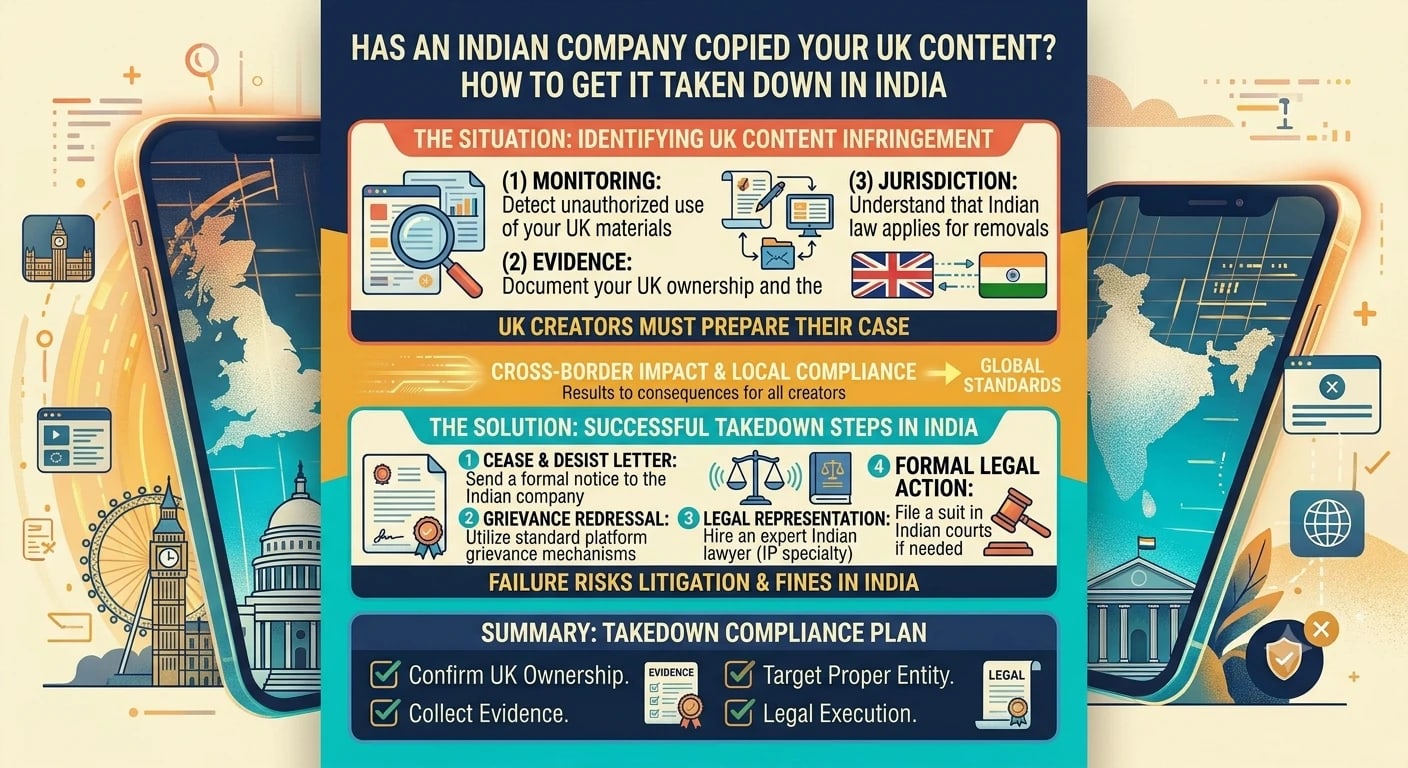
The fastest route is the app store. Google Play and the Apple App Store accept reports of intellectual property infringement through their forms. A Google Play clone app takedown India developers request needs the app’s link, proof of your rights, a description of what was copied and a good-faith statement. For an Apple App Store infringement report India users file, use Apple’s content dispute process and give similar details. Report each store separately, and also report to alternative Android stores and to the clone’s website host. Takedowns are the quickest part of any clone game copyright India plan.
Keep reports precise and factual. Show side-by-side screenshots, identify copied assets, include your registration numbers for any trade marks and explain the confusion risk. If the store asks the developer to respond, be ready for a counter-claim. Platforms usually act within days where copying is clear, and slower where the claim is about mechanics. Do not exaggerate, since false claims can lead to penalties or loss of your own listing.
Add Indian-law steps. Under Section 52(1)(c) of the Copyright Act and Rule 75 of the Copyright Rules, 2013, an intermediary that receives a proper written complaint can disable access for 21 days, and you must obtain a court order in that time to keep it down. A legal notice to the developer, the publisher and the platform’s India grievance officer often leads to removal. Track the developer’s other apps, since clone operators usually publish many.
When to go to court
Court action makes sense where a clone is damaging sales or a serious infringer is repeating. Indian courts, including the Delhi High Court, have granted injunctions in game and app disputes, and have issued dynamic injunctions against rogue websites and apps. Courts have also directed platforms to remove apps in suitable cases, as in app disputes outside Delhi. Gaming companies have sued each other over alleged copying of game formats, and the outcomes depend on the facts. Courts are the last step in a clone game copyright India strategy.
A suit needs preparation. You will need proof of ownership, evidence of copying, an explanation of urgency, a clear list of the claims, and a local lawyer. A UK developer can sign a power of attorney and swear affidavits with the required formalities. Under Section 62(2) of the Copyright Act, you can sue where you carry on business or where the defendant is, subject to the court’s rules. Courts may order the defendant to disclose revenue and account for profits.
Check regulatory issues as well. India’s Promotion and Regulation of Online Gaming Act, 2025 restricts real-money games, and a clone that operates as an unlawful real-money game may be removable on that basis too. If your game is free to play, the Act may not apply to you, but it affects the market. Take advice on how it applies to monetisation features, such as paid entry contests, before you launch in India.
Next steps and quick answers
Before launch in India, file trade marks, keep ownership records and prepare an enforcement folder. After launch, search app stores monthly for clones, report quickly and escalate serious cases. Keep your tone factual. This is general information, not legal advice. Build clone game copyright India steps into your launch plan.
Related reading: protecting a US app in India, India’s Online Gaming Act and UK gaming companies, registering app screens and icons as designs, clone apps copying a crypto brand, software copyright protection in India, Indian trade mark classes explained and the Online Gaming Act, 2025.
Quick answers
Does copyright protect my game in India?
Copyright protects your code, art, audio and text, including works from the UK under the International Copyright Order, 1999, but not your ideas or game mechanics. Clone game copyright India claims need evidence that your expression was copied.
How do I get a clone app removed from Google Play in India?
Submit an infringement report with the app link, proof of your rights, a comparison of what was copied and a good-faith statement. Send a legal notice and use Rule 75 of the Copyright Rules if needed. Escalate to court for serious copying.
Can I stop someone copying my game mechanics?
Usually not by copyright. Mechanics are ideas. You may still act if the clone copies your assets or confuses players through your name or trade dress. Trade marks and passing off can help.
Can I stop a clone that copies my game rules?
Usually not by copyright, because rules and mechanics are ideas. You can act if it copies your assets or confuses players through your name or trade dress.
How fast can a clone leave Google Play?
Often within days where copying is clear, but timing varies. Report with evidence and your trade mark details.
Final word
Halverton & Co. is an Indian law firm advising UK companies, founders, investors and law firms on Indian law, including gaming and app IP protection, trade mark and copyright enforcement in India and platform takedowns. We practise in Jharkhand, Maharashtra and before the Supreme Court of India, and work alongside your UK solicitors, who advise on English law. Halverton & Co.: Where tech needs law! If you have a question about Indian law, write to us at office@halvertonandco.com, or get in touch.
This article reflects developments reported up to 31 October 2026. It is for general information only, is not legal advice, and does not create a solicitor-client relationship. Halverton & Co. is an Indian law firm, is not authorised or regulated by the Solicitors Regulation Authority, and does not advise on English law; UK-law points should be confirmed with UK advisers.
Sources
Related practice area
Intellectual Property
Trade marks, copyright, patents and designs. Searched, filed, licensed and enforced under Indian law.
View the practice areaComments
No account needed. Comments are reviewed before they appear, so yours will show here once approved. Please do not share confidential details or describe your own legal matter: replies are general discussion, not legal advice, and do not create an advocate-client relationship. For your own situation, write to office@halvertonandco.com.