Key takeaways
- The DMCA is US law; it helps with US-based platforms that honour notices but does not bind Indian hosts or websites.
- India protects US works through the Berne Convention and the International Copyright Order, 1999, without registration.
- Indian removals work through platform complaints, Section 52(1)(c) and Rule 75, the IT Rules and court orders.
- The Delhi High Court can grant interim injunctions, John Doe and dynamic orders in clear cases.
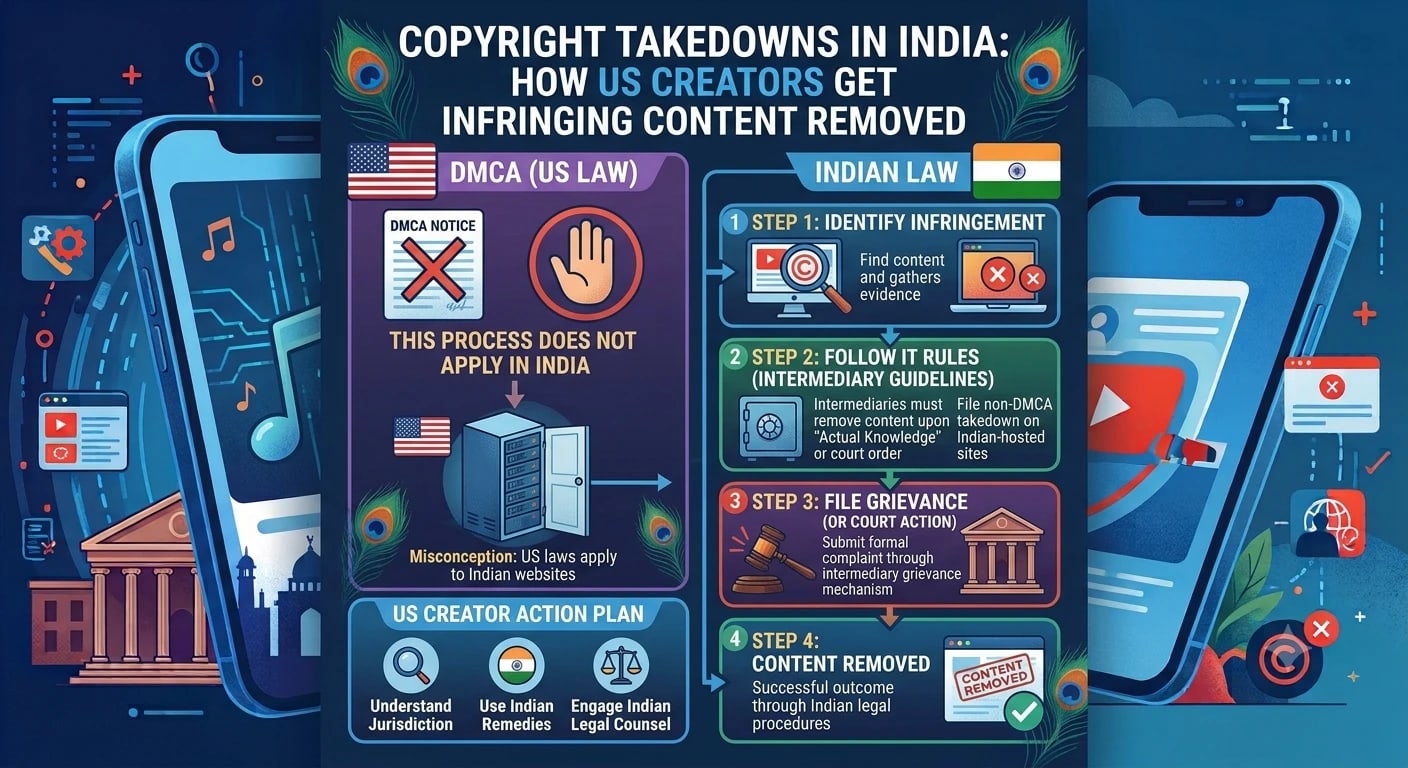
Many US creators assume that a DMCA notice will remove infringing content in India. It will, sometimes, but not because Indian law accepts it. The Digital Millennium Copyright Act is a US statute. A DMCA takedown India strategy works when the infringing content sits on a US-based platform that honours DMCA notices, such as YouTube, Instagram or Google Search. It does not work as a legal command against an Indian host or an Indian website.
This guide explains what DMCA notices can and cannot do for content in India, how Indian copyright law protects US works, how takedowns work through platforms, hosts and the IT Rules, when to go to the Delhi High Court and what a US creator should prepare. It is written by an Indian law firm. US law points should be confirmed with US counsel.
What a DMCA notice can and cannot do
A DMCA notice is a request under US law to a service provider to remove infringing material, with a promise that the sender is the owner or authorised and is acting in good faith. US platforms have built their policies around it, and many accept notices about content posted by users anywhere in the world. So if a copycat in India uploads your video to YouTube, a DMCA-style notice to YouTube can work. So a copyright takedown notice India platforms accept can work even when the copier is in India.
It does not bind an Indian company by force of law. An Indian hosting provider, website operator or registrar is subject to Indian law, not to the DMCA. Some respond to DMCA notices as a matter of policy, and some do not. A US court judgment or notice does not have automatic effect in India, and ignoring a DMCA notice carries no Indian penalty on its own. Sending a DMCA notice Indian website host operators ignore wastes time. That is the key limit of a DMCA takedown India strategy.
A common mistake is sending threatening DMCA letters to Indian site owners and waiting. If they are not in the US and have no US presence, there may be no US remedy that works quickly. A DMCA takedown India approach therefore needs a second track based on Indian law, for hosts, registrars and courts in India, and a way to check where the content is actually hosted.
How Indian law protects US works
India is a member of the Berne Convention, and the International Copyright Order, 1999 extends the protection of the Copyright Act to works of foreign countries that are Berne members, including the US. A US creator therefore has Indian copyright without registering in India, and can sue for infringement in Indian courts. Registration of the work in India is optional and not a condition of suing, though it can help as evidence. US copyright protection in India does not need local registration. Protection comes first; a DMCA takedown India notice only helps with enforcement.
The Copyright Act, 1957 gives the owner exclusive rights, and Sections 51 and 55 allow civil remedies such as injunctions, damages and accounts of profits. Section 63 provides criminal penalties for knowing infringement. The Act applies to online copying and communication to the public. A suit can be filed where the defendant resides or where the plaintiff resides or works for gain, under Section 62(2), which makes the Delhi High Court a common choice.
Not everything that looks like copying is infringement. Ideas, facts and short phrases are not protected, and fair dealing allows limited use for criticism, review and news. Check that what was taken is a substantial part of your original expression before you escalate. If you hold licences or co-own works, confirm that you have the right to enforce, and gather proof of authorship such as drafts, project files and publication dates.
Takedown routes in India
Route one is the platform. Most large platforms accept copyright complaints through a web form. Provide the URL of the infringing page, your original work, proof of ownership, your contact details and a statement of good faith. This works for YouTube, Instagram, Facebook, X and Google Search, whether the infringer is in India or not. Keep a record of every report and response.
| Route | Basis | Speed |
|---|---|---|
| Platform complaint form | Platform policy | Days |
| Notice to an intermediary | Section 52(1)(c) and Rule 75: 21-day disablement | Days, but a court order is needed to keep it down |
| IT Rules order | Rule 3(1)(d) on a court or government order | Needs an order first |
| Delhi High Court injunction | Copyright Act remedies, John Doe and dynamic orders | Days to weeks in clear cases |
Route two is the intermediary rule in Indian law. Under Section 52(1)(c) of the Copyright Act and Rule 75 of the Copyright Rules, 2013, an intermediary that receives a written complaint from the owner can disable access to the content for 21 days, and the owner must obtain a court order within that time to keep it down. Send a clear notice to the host or platform’s India grievance officer, with the details the Rule requires, and diarise the 21-day period. The Section 52 Copyright Act intermediary 21 days rule gives you a short window to get a court order.
Route three is the IT Rules and government orders. Under Rule 3(1)(d) of the IT Rules, 2021, as amended, an intermediary must remove content on a court order or a government notification, and the 2026 amendments shortened the time to comply with such orders. This route needs a court order first. Also check the registrar and the hosting provider for abuse contacts, and consider a legal notice to the site operator, which sometimes ends the matter quickly. Combine these routes with a DMCA takedown India notice for US platforms.
When to go to court
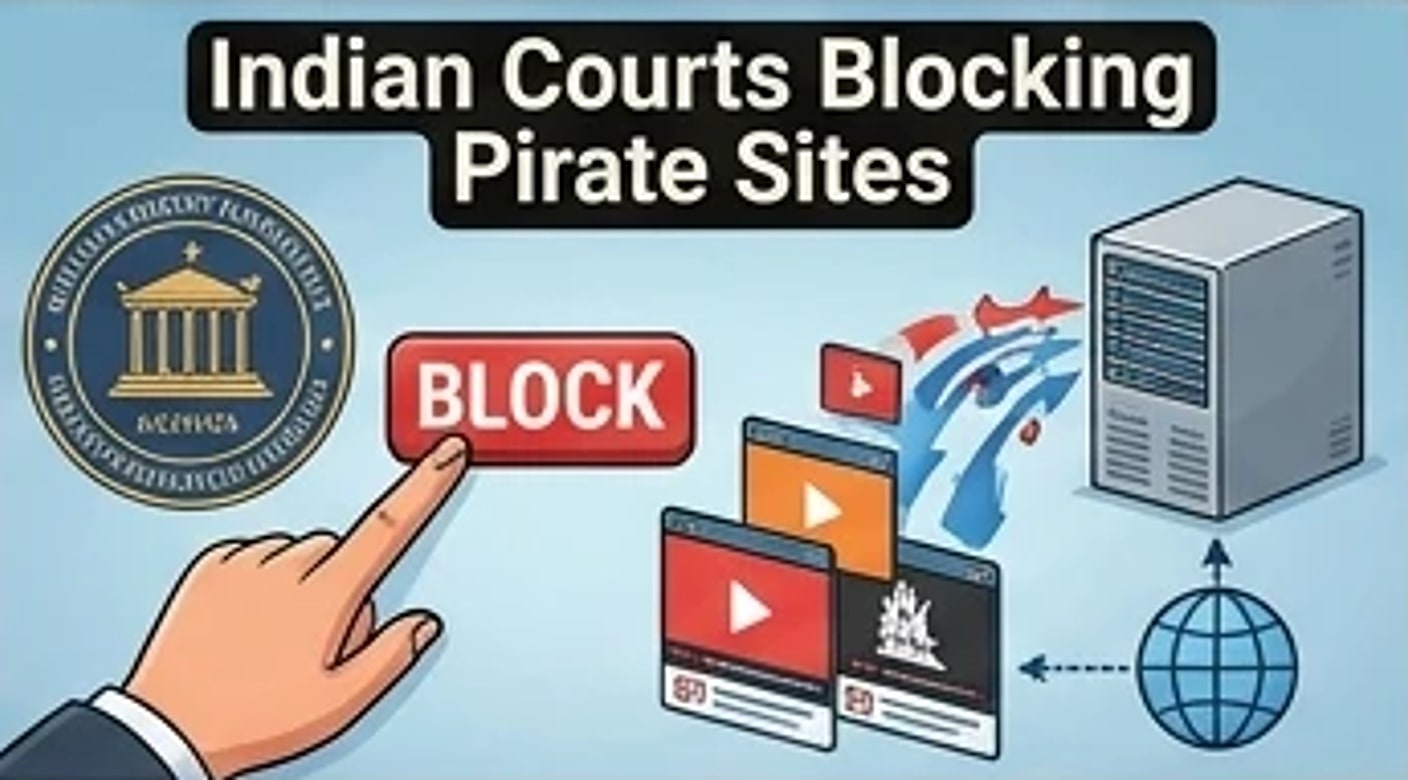
The Delhi High Court has an Intellectual Property Division that deals with piracy and copying quickly. It has granted John Doe orders against unnamed defendants, dynamic injunctions that extend to mirror sites, and directions to registrars and internet service providers to block domains. These orders are common in cases about film piracy and large-scale copying, and they can also help a creator with a serious, repeated problem. A John Doe order Delhi High Court copyright cases use can reach unnamed infringers.
Going to court needs preparation. You will need proof that you own the work, evidence of copying, screenshots with dates and URLs, a note of the harm and a lawyer who can file a suit and an application for an interim injunction. Courts expect you to act promptly once you know. Costs depend on the case, but a suit for a single page of copied content may not be worth it unless there is commercial damage.
Plan before you file. Try platform and intermediary routes first, but do not wait for months. Consider the pre-institution mediation rule under Section 12A of the Commercial Courts Act, which is not required where urgent interim relief is sought. If you are a US creator without Indian counsel, an Indian law firm can coordinate with your US lawyer and send the first legal notice, which often works faster than a US letter.
Next steps and quick answers
Make a standard file for each infringement: original work, proof of ownership, URLs, dated captures, platform reports and replies. Report first to the platform, then send an Indian-law notice to the host and operator, and escalate to court for serious cases. Register your works in the US if you plan to sue there. This is general information, not legal advice. This file serves both a DMCA takedown India request and an Indian legal notice.
Related reading: copied UK content taken down in India, protecting Dubai creators from Indian copycats, got a YouTube copyright strike in India, is scraping Indian websites for AI training legal, lookalike domains using your brand, protecting a US app in India and the Sahyog portal and content takedowns; also dynamic injunctions against pirate sites in India; also US copyright registration for foreign companies and DMCA takedowns in India.
Quick answers
Does the DMCA apply in India?
No. The DMCA is US law. It helps with content on US-based platforms that honour DMCA-style notices, but it does not bind Indian hosts or websites. Indian removals work through platform policies, Section 52 of the Copyright Act, the IT Rules and court orders.
Is US copyright protected in India?
Yes. India is a member of the Berne Convention, and the International Copyright Order, 1999 extends Indian copyright protection to works from member countries, including the US, without registration in India.
How fast can an Indian court remove pirated content?
The Delhi High Court can grant interim injunctions and John Doe or dynamic orders quickly in clear cases, sometimes within days. Timing depends on the evidence and the court’s schedule.
Does a DMCA notice work against an Indian website host?
Not as a matter of Indian law. Some hosts respond as a matter of policy, so combine it with an Indian-law notice.
Do I need to register my US work in India?
No. The International Copyright Order, 1999 extends Indian copyright protection to works from Berne countries, including the US, without registration.
Final word
Halverton & Co. is an Indian law firm advising US companies, founders, investors and law firms on Indian law, including copyright enforcement and takedowns in India for foreign creators and companies, IP litigation and platform compliance. We practise in Jharkhand, Maharashtra and before the Supreme Court of India, and work alongside US counsel, who advise on US law. Halverton & Co.: Where tech needs law! If you have a question about Indian law, write to us at office@halvertonandco.com, or get in touch.
This article reflects developments reported up to 31 October 2026. It is for general information only, is not legal advice, and does not create an attorney-client relationship. Halverton & Co. is an Indian law firm and does not advise on US law; US-law points should be confirmed with US counsel.
Sources
Related practice area
Intellectual Property
Trade marks, copyright, patents and designs. Searched, filed, licensed and enforced under Indian law.
View the practice areaComments
No account needed. Comments are reviewed before they appear, so yours will show here once approved. Please do not share confidential details or describe your own legal matter: replies are general discussion, not legal advice, and do not create an advocate-client relationship. For your own situation, write to office@halvertonandco.com.