Every founder who has run an Indian private company for more than a year knows the feeling. The product is moving, the team is growing, and then a compliance calendar arrives with board meetings, filings and penalties that seem designed for a company ten times your size. The Corporate Laws Amendment Bill 2026 is the government’s biggest attempt in years to change that.
The Corporate Laws (Amendment) Bill, 2026 was introduced in the Lok Sabha on 23 March 2026 by the Ministry of Corporate Affairs, and it amends both the Companies Act, 2013 and the Limited Liability Partnership Act, 2008, with a focus on decriminalisation, easier compliance and more corporate flexibility (SCC Online). It was sent to a Joint Parliamentary Committee, and on 3 August 2026 the committee tabled its report in both Houses, recommending adoption with clause-wise modifications. This guide explains what the Corporate Laws Amendment Bill 2026 changes for startups, what the JPC added, and what founders should do while the Bill makes its way through Parliament.
Where the Corporate Laws Amendment Bill 2026 stands today
The most important thing to understand about the Corporate Laws Amendment Bill 2026 is that it is still a Bill. Nothing in it binds your company yet. As of early October 2026 it had not been passed by both Houses (PRS Legislative Research). After introduction in March, the Bill went to a Joint Parliamentary Committee for clause-by-clause scrutiny, and the committee invited representations from industry, regulators, professional bodies and lawyers. The JPC’s August report backs the Bill and recommends further decriminalisation of procedural lapses, as well as compliance relief and easier CSR norms for small businesses.
According to the committee, the purpose of the Bill is to promote ease of doing business by decriminalising provisions, easing compliance for one person companies, small companies, producer companies and startups, recognising new corporate concepts, and removing drafting ambiguities. Once Parliament passes the Bill and it receives Presidential assent, the Ministry of Corporate Affairs is expected to bring different provisions into force on different dates through notifications, so the new company law will arrive in phases rather than all at once.
For founders, this creates a planning window. You can’t yet rely on the new rules, but you can see clearly where Indian company law is heading and design your structures, ESOP plans and compliance processes so they fit both the current Companies Act and the amended version.
The changes that matter most for startups and small companies
| Area | Current law | Under the Bill |
|---|---|---|
| Small company: paid-up capital limit | ₹10 crore | ₹20 crore |
| Small company: turnover limit | ₹100 crore | ₹200 crore |
| Fast-track merger approval (members) | 90% of members | 75% of members present and voting |
| Fast-track merger approval (creditors) | Nine-tenths | Three-fourths |
| Mandatory CSR net profit threshold | ₹5 crore | ₹10 crore |
A wider definition of “small company”
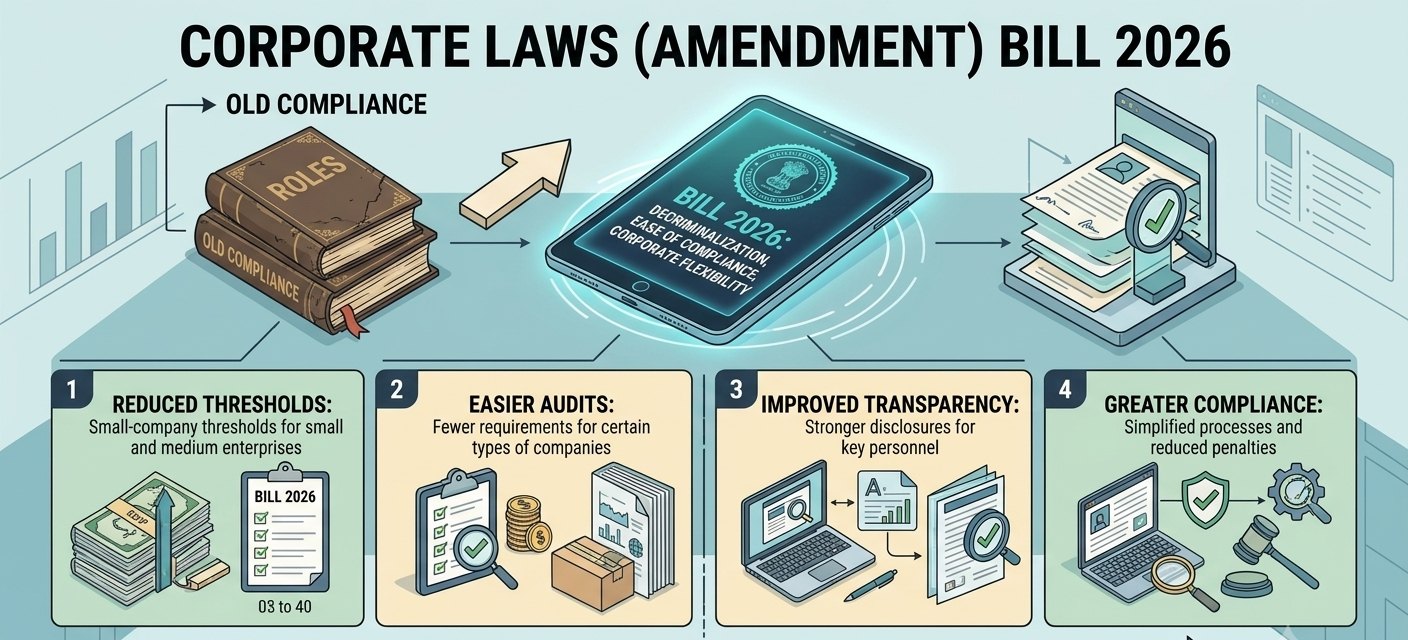
The headline change for most startups is the expanded definition of a small company. The Bill doubles the thresholds, raising the paid-up capital limit from ₹10 crore to ₹20 crore and the turnover limit from ₹100 crore to ₹200 crore. That matters because small companies already enjoy lighter compliance under the Companies Act, and the Bill extends further relief: fewer mandatory board meetings, with the option of a single board meeting a year for small companies, simplified financial statements and legal recognition for virtual general meetings. Many Series A and even Series B startups that outgrew the small company category will move back into it.
Equity compensation: RSUs and SARs
Equity compensation is the second big change for startups. The Bill formally recognises restricted stock units (RSUs) and stock appreciation rights (SARs) by extending the employee preferential-allotment provision in Section 62(1)(b) to cover them, and it excludes allottees under such schemes from the private placement limits in Section 42(2). In plain terms, Indian startups will be able to offer the kind of equity packages that global tech companies use, without forcing everything into an ESOP structure. For how each instrument works, see our guide to RSUs, SARs and phantom stock beyond ESOPs, and for today’s ESOP rules, ESOPs for Indian startups.
Easier restructuring
Third, restructuring becomes easier. The Bill lowers the approval thresholds for fast-track mergers under Section 233, from 90% to 75% of members present and voting, and from nine-tenths to three-fourths of creditors, and centralises jurisdiction before a single NCLT bench. For startups planning group reorganisations, acquisitions of smaller companies, or reverse flips back to India, this removes one of the most common practical obstacles: a handful of minority shareholders holding up a routine merger. Our guide to fast-track mergers covers the mechanics.
Decriminalisation, CSR and other compliance relief
The single biggest theme of the Corporate Laws Amendment Bill 2026 is decriminalisation. The Bill replaces imprisonment or fines with civil penalties for a range of procedural violations (AZB & Partners). Filing delays, documentation lapses and similar technical defaults would be handled by adjudicating officers through monetary penalties rather than criminal prosecution. For founders, that significantly reduces the personal risk that comes with being a director of an Indian company, although serious offences such as fraud remain criminal.
On corporate social responsibility, the Bill raises the net profit threshold that triggers mandatory CSR from ₹5 crore to ₹10 crore. Startups that have just turned profitable will have more breathing room before they need a CSR policy, a committee and a mandatory spend.
The JPC also supported reducing the pre-deposit required to appeal against penalties, which matters to startups and MSMEs that want to challenge a penalty without locking up scarce cash, and it backed steps to strengthen NCLT capacity, which remains a cause of delay in corporate proceedings. Other reforms in the package include designating the Insolvency and Bankruptcy Board of India as the Valuation Authority under the Companies Act, broader enforcement powers for the National Financial Reporting Authority, a framework for converting specified trusts into LLPs, and permission for companies and LLPs in International Financial Services Centres to issue and maintain share capital in foreign currency where IFSCA allows it.
What founders should do before the Bill becomes law
The worst response to the Corporate Laws Amendment Bill 2026 is to relax compliance now because “it’s all going to be decriminalised anyway”. Until the amendments are notified, the current Companies Act applies in full, including its penalties, director disqualification rules and prosecution provisions. A missed annual filing today can still lead to disqualification of your directors under Section 164(2), whatever the future law says.
The better approach is to use this period to prepare. Check whether your company will qualify as a small company under the new thresholds and what that will change in your compliance calendar. If you’ve been considering RSUs or SARs for senior hires, start designing the plan now so it can be adopted soon after the relevant provisions come into force. If a group restructuring, acquisition or reverse flip is on the horizon, map how the new fast-track merger thresholds would affect your timeline and shareholder approvals. And if you’re facing a penalty under the current law, take advice on whether to resolve it now or whether the proposed reduction in appeal pre-deposits may help. If you are winding a company down, see our guide to shutting down a startup legally.
Founders should also keep an eye on the rules. Much of the practical detail of the Corporate Laws Amendment Bill 2026, including exact penalty amounts, procedures for adjudication and the mechanics of RSU and SAR schemes, will sit in rules made by the Ministry of Corporate Affairs after the Bill is passed. As one commentary points out, until the relevant rule amendments come through, nothing changes automatically. Settling founder equity and exit terms early also helps; see our guide to founders’ agreements in India.
Remedies, risks and quick answers for founders
Even after decriminalisation, company law will continue to give founders and investors real remedies. Minority shareholders will still be able to approach the NCLT for oppression and mismanagement under Sections 241 and 242, penalty orders will remain appealable, and fast-track mergers will still allow objections from regulators and creditors, which can send a scheme to the NCLT. Startups should expect enforcement to shift from criminal courts to adjudicating officers and penalties, so good records and timely filings will matter just as much as before.
Quick answers
Is the Corporate Laws Amendment Bill 2026 law yet?
No. It was introduced in March 2026 and the Joint Parliamentary Committee tabled its report on 3 August 2026, but the Bill still has to be passed and notified before it takes effect.
What is the new small company definition?
The Bill proposes paid-up capital of up to ₹20 crore and turnover of up to ₹200 crore, double the current limits.
Does the Bill allow RSUs and SARs for Indian startups?
Yes. It extends Section 62(1)(b) to cover such instruments, though the detailed rules will follow after the Bill is passed.
Final word
At Halverton & Co., we work with founders, startups and technology-driven businesses on company law compliance, restructuring and equity compensation. We practise in Jharkhand, Maharashtra and before the Supreme Court of India, and act as fractional legal counsel for companies that need senior legal support without a full in-house legal team. Halverton & Co. is built on a simple idea: Where tech needs law! If this issue affects your business, write to us at office@halvertonandco.com, or get in touch, and we’ll help you work out where you stand.
This article reflects the law and developments reported up to early October 2026. Please take advice on your specific facts before acting.
Related practice area
Startups & Venture
From incorporation to term sheet. The documents a company needs to be fundable.
View the practice area