For most of the last decade, the playbook for an ambitious Indian startup was simple. Incorporate in Delaware or Singapore, make the Indian company a subsidiary, and raise money from global VCs who were comfortable with US or Singapore law. Lawyers called it “flipping”.
That playbook is now running in reverse. PhonePe moved its domicile from Singapore to India in 2022. Razorpay completed its reverse flip from the US to India in May 2025 through the new fast-track merger route (Lexology). Groww, Meesho and Pine Labs have since listed on Indian exchanges after moving home (CalcGuru). Reverse flipping India-bound holding companies has become one of the defining corporate law trends of this cycle.
This guide explains what reverse flipping involves, the legal routes available, the tax bill that usually decides the matter, the FEMA and Companies Act compliance, and the remedies available when something goes wrong.
Why Indian startups are reverse flipping now
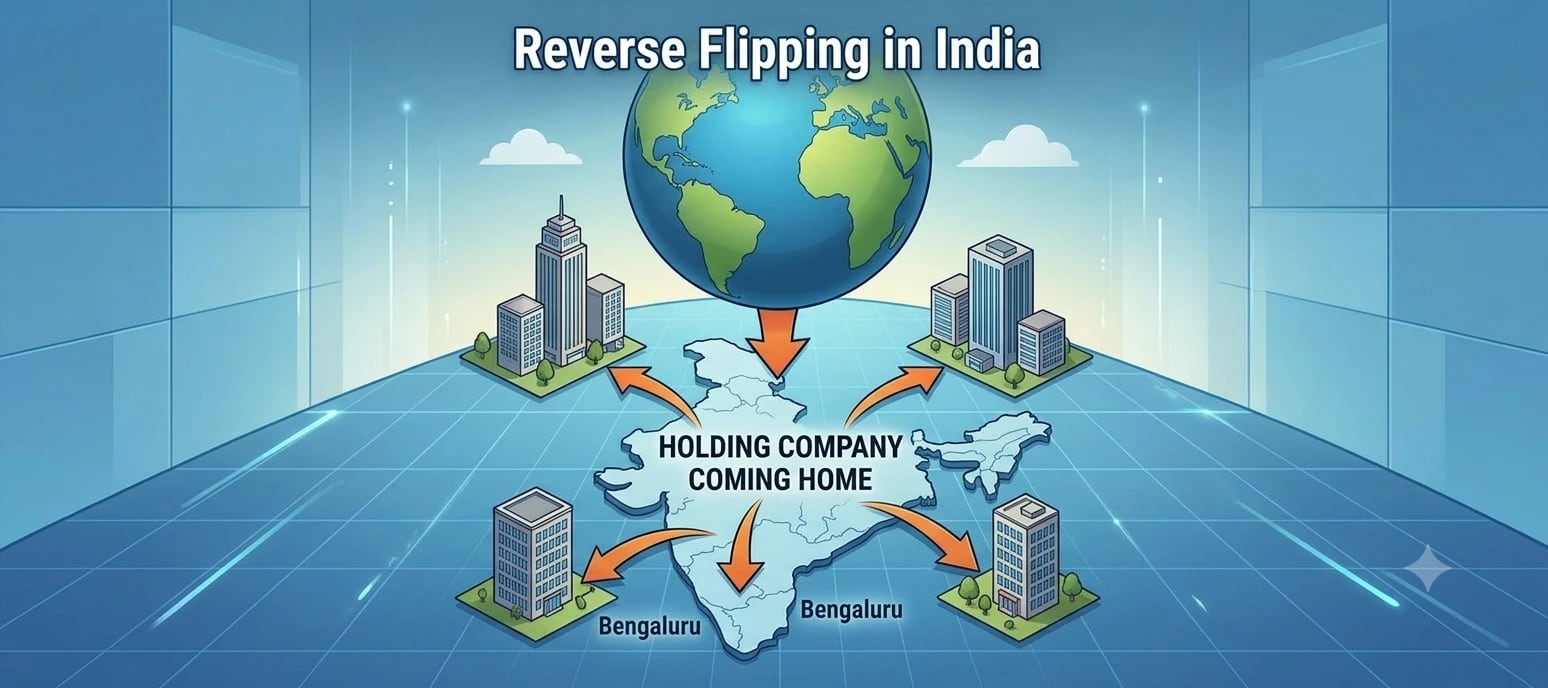
A reverse flip means moving the top holding company of a group from a foreign jurisdiction back to India, so that the Indian company becomes the parent and the foreign entity disappears or becomes a subsidiary. Three forces are driving the trend.
- The Indian IPO market. Indian public markets now value tech companies generously, and listing on the NSE or BSE in practice requires an Indian company. A Delaware parent cannot simply list in Mumbai.
- Regulatory comfort. Regulators, customers and government buyers in sensitive sectors such as fintech, payments and data increasingly prefer an India-domiciled parent.
- Easier legal routes. Since 17 September 2024, an amendment to the merger rules has allowed a foreign holding company to merge into its Indian wholly owned subsidiary through the faster Section 233 route, approved by the Regional Director instead of the National Company Law Tribunal (NCLT) (TaxGuru).
In our view, reverse flipping is no longer a question of “if” for venture-backed Indian companies planning an Indian IPO. It is a question of “when” and “at what tax cost”. Founders who plan the reverse flip two or three years before an IPO give themselves far more options than those who scramble six months out.
The legal routes: inbound merger, share swap and fast-track approval
There are three main ways to reverse flip into India. Each has a different timeline, approval path and tax result.
Route 1: Inbound cross-border merger (NCLT route)
Section 234 of the Companies Act, 2013, read with the merger rules and the Foreign Exchange Management (Cross Border Merger) Regulations, 2018, allows a foreign company to merge into an Indian company. The scheme is approved by the NCLT, and a merger that complies with the FEMA regulations is treated as having the RBI’s approval.
Route 2: Fast-track inbound merger
From 17 September 2024, a foreign holding company can merge into its Indian wholly owned subsidiary under the fast-track procedure in Section 233, with approval from the Regional Director rather than the NCLT, subject to RBI requirements (TaxGuru). This route, first introduced as Rule 25A(5), was consolidated into Rule 25 of the merger rules by an amendment notified on 4 September 2025 (Global Law Experts). Practitioners plan for roughly four to six months end to end. On 29 May 2026, the RBI also notified the Foreign Exchange Management (Cross Border Merger) (Amendment) Regulations, 2026 to support this framework, replacing references to the NCLT with a “Competent Authority” (TaxGuru). Commentary differs on whether prior RBI approval is still needed for the fast-track route after that amendment (EY), so confirm the current position before you file.
Route 3: Share swap
The foreign holding company’s shareholders swap their shares for shares of the Indian company, which becomes the new parent. The foreign entity is then wound up or kept as a subsidiary. This is simple to document but usually triggers capital gains tax for shareholders.
| Route | Who approves | Typical timeline | Main issue |
|---|---|---|---|
| NCLT inbound merger | NCLT, with RBI deemed approval if FEMA-compliant | Often 6 to 12 months | Time and tribunal process |
| Fast-track inbound merger | Regional Director (confirm RBI position) | About 4 to 6 months | Only for a foreign holdco merging into its Indian wholly owned subsidiary |
| Share swap | Corporate approvals, FEMA filings | Shortest | Usually a large capital gains tax bill |
The tax bill: the real cost of a reverse flip
If there’s one thing every founder should understand about reverse flipping, it’s this: the legal process is now quick, but the tax cost can be enormous. PhonePe’s investors reportedly paid close to ₹8,000 crore in tax when the company moved home in 2022, which is why tax structuring is the first workstream, not the last.
Share swaps are usually taxable
When a shareholder exchanges shares of the foreign parent for shares of the Indian company, it is generally treated as a transfer. Indian tax may apply on the indirect transfer of Indian assets, and the shareholder’s home country may tax the gain too.
Mergers can be tax-neutral in India, but conditions are strict
Indian tax law exempts certain amalgamations from capital gains tax, both for the merging company and its shareholders, provided the amalgamated company is Indian and the statutory conditions are met. These exemptions were in Section 47 of the Income-tax Act, 1961 and have successor provisions in the Income-tax Act, 2025, which applies from 1 April 2026. The catch is the other side of the border. A US or Singapore shareholder may still face tax at home unless the merger also qualifies as a tax-free reorganisation under that country’s law.
Valuation matters
Cross-border mergers and swaps need valuations on both sides, and FEMA pricing rules apply to shares issued to non-residents. Tax authorities scrutinise these valuations closely.
Practical advice: model the tax for every class of shareholder, including founders, ESOP holders, Indian residents and foreign funds, before choosing a route. For large deals, consider an advance ruling for certainty.
FEMA, Companies Act and IPO compliance: what founders miss
A reverse flip touches almost every part of a company’s legal life. These are the issues founders most often underestimate.
- FDI compliance for the new shareholding. Once the Indian company becomes the parent, every foreign investor holds Indian shares as foreign direct investment. Pricing, sectoral caps and reporting under the FEMA Non-Debt Instruments Rules all apply.
- Press Note 3 investors. If any shareholder is from a country sharing a land border with India, government approval may be required, and a declaration must be filed in the merger process (CBIL NLUO).
- Legacy ODI problems. Indian resident founders and employees who held shares in the foreign parent may have outbound investment (ODI) reporting gaps. These need to be regularised, often by paying late submission fees, before the flip.
- IP and contracts. If the foreign parent owns the group’s IP, trademarks or key customer contracts, they must move to the Indian company, with proper assignments and stamp duty. Our guides on founders’ agreements and IP assignment, software patents and trademark registration cover how each type of IP is assigned.
- ESOPs. Options over foreign parent shares must be replaced with an Indian ESOP scheme that complies with the Companies Act, without creating unintended tax events for employees. See our guide to ESOPs for Indian startups.
- IPO readiness. SEBI’s ICDR Regulations contain rules on promoter lock-in and minimum holding periods for shares offered in an IPO. The timing of the reverse flip relative to the draft red herring prospectus matters.
Risks, legal remedies and a reverse flip checklist
Reverse flips fail or stall for predictable reasons. Here are the remedies when they do.
- Objections in the fast-track route. If the Registrar, Official Liquidator or Regional Director objects, or the Regional Director isn’t satisfied that the scheme is fair, the matter can be referred to the NCLT under Section 233. An NCLT order can be appealed to the NCLAT under Section 421.
- FEMA contraventions. Late reporting can usually be fixed by paying a late submission fee. Substantive contraventions can be compounded by the RBI. Without compounding, penalties under Section 13 of FEMA can go up to three times the amount involved.
- Tax disputes. Assessments can be challenged before the appellate authorities and the Income Tax Appellate Tribunal. Seeking an advance ruling before the transaction is the best way to avoid a dispute.
- Shareholder disputes. Dissenting investors usually have rights under the shareholders’ agreement, often enforceable through arbitration. Minority shareholders in the Indian company retain the oppression and mismanagement remedy under Sections 241 and 242.
Founder’s reverse flipping checklist
- Model the tax for every shareholder class.
- Audit legacy ODI and FDI filings.
- Map the IP, contracts and licences that must move.
- Choose the route (fast-track, NCLT or swap) and sequence the RBI application.
- Redesign the ESOP scheme.
- Align the timeline with your IPO plans.
If you are still raising money before you flip, see how early-stage instruments work in India in our guide to SAFE notes, iSAFEs and CCDs.
Quick answers
What is reverse flipping in India?
It means moving a startup’s holding company from abroad back to India, usually through an inbound merger or a share swap, so the Indian company becomes the parent.
How long does a reverse flip take?
A fast-track inbound merger typically takes about four to six months. An NCLT merger takes longer, and a share swap is quicker but usually taxable.
Is reverse flipping tax-free?
Not automatically. A qualifying merger can be tax-neutral in India, but shareholders may face tax in their home countries, and share swaps are usually taxable.
Related reading: how fast-track mergers get easier under the 2026 Bill, and the wider Corporate Laws Amendment Bill 2026; also setting up an Indian subsidiary for a US company; also reverse flip from Delaware to India; also setting up a Dubai crypto holding company.
Final word
At Halverton & Co., we work as legal counsel for startups, founders and technology-driven businesses on reverse flipping, FEMA compliance, cross-border mergers and IPO readiness. We practise in Jharkhand, Maharashtra and before the Supreme Court of India, and act as fractional legal counsel for companies that need senior legal support without a full in-house team. Halverton & Co.: Where tech needs law!
Write to us at office@halvertonandco.com, or get in touch, to discuss your situation.
This article reflects the law and developments reported up to early October 2026. Rules in this area change often; please take advice on your specific facts before acting.
Related practice area
Startups & Venture
From incorporation to term sheet. The documents a company needs to be fundable.
View the practice area