ESOPs are the closest thing a startup has to a magic trick. You can’t match a big company’s salary, so you offer a slice of the future instead. Done well, ESOPs build loyalty and can change employees’ lives at an exit. Done badly, they leave people with a tax bill on paper gains, options that lapse the day they resign, and a deep sense of being misled.
This guide explains how ESOPs for startups in India work under the Companies Act, how to design a fair ESOP scheme, how ESOP taxation works under the new Income-tax Act, 2025, the mistakes that hurt employees most, and the legal remedies when ESOP promises go wrong.
How ESOPs work under Indian company law
An employee stock option is a right, not an obligation, to buy a company’s shares at a fixed price (the exercise price) after a vesting period. For unlisted Indian companies, ESOPs are governed by Section 62(1)(b) of the Companies Act, 2013 and Rule 12 of the Companies (Share Capital and Debentures) Rules, 2014. Listed companies follow SEBI’s Share Based Employee Benefits and Sweat Equity Regulations, 2021.
The core rules every founder should know:
- Shareholder approval. An ESOP scheme must be approved by a special resolution of shareholders, with prescribed disclosures.
- Minimum one-year vesting. There must be at least one year between the grant of options and their vesting.
- Who can receive ESOPs. Promoters, members of the promoter group, and directors who hold more than 10% of the shares generally cannot receive ESOPs. DPIIT-recognised startups have a relaxation that allows options to be granted to promoters and such directors for up to ten years from incorporation.
- Options are personal. Options can’t be transferred, pledged or mortgaged.
- Death and incapacity. If an employee dies or becomes permanently incapacitated, the rules protect the employee or their heirs, so the scheme can’t simply cancel those options.
A startup without a properly approved ESOP scheme can’t validly grant options. That sounds obvious, but it’s common to see offer letters promising “0.5% ESOPs” years before any scheme exists. Founders should also settle their own equity and vesting first; see our guide to founders’ agreements in India.
Designing a fair ESOP scheme: vesting, exercise and leaver terms
Most ESOP disputes come from scheme design, not bad intentions. The terms that matter most:
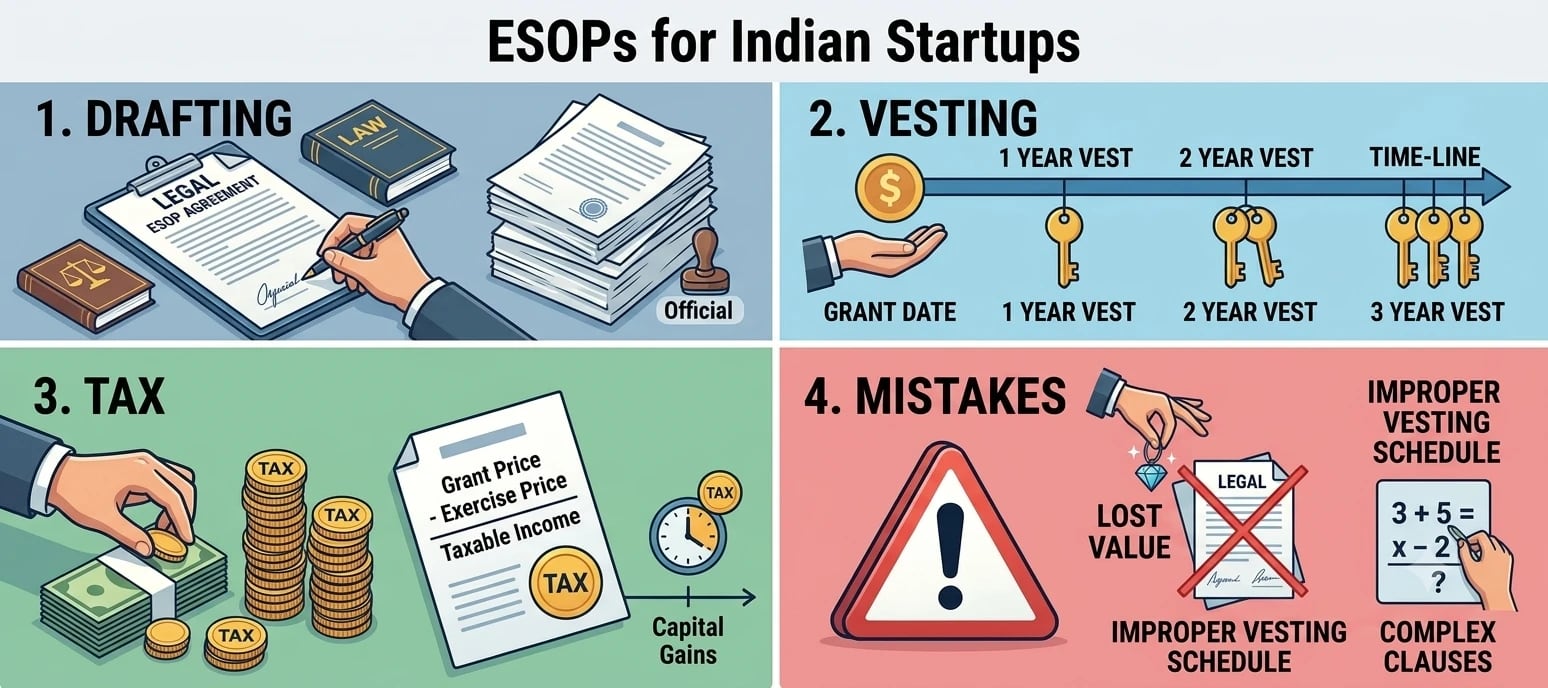
- Vesting schedule. The common market standard is four years with a one-year cliff, then monthly or quarterly vesting. Performance-linked vesting is allowed but must be measurable.
- Exercise window. This is the single most important employee-protection term. Many schemes give leavers only 30 or 90 days to exercise vested options, which forces people to pay tax and the exercise price before any liquidity. Extended exercise windows, or exercise only at a liquidity event, are far fairer.
- Good leaver and bad leaver. Define “cause” narrowly and objectively. Vague terms like “conduct detrimental to the company” invite disputes.
- Acceleration. Decide whether vesting accelerates on an acquisition (single trigger) or only if the employee is also let go (double trigger).
- Liquidity. Spell out how employees can realise value: secondary sales, company buybacks, or exit events.
- ESOP trust or direct allotment. An ESOP trust can warehouse shares and make buybacks easier, but it adds administration.
If your company has reverse flipped, or still has a foreign parent, employees holding options in the foreign entity raise extra FEMA and tax questions. These need to be handled before the cap table becomes too complicated. See our guide to reverse flipping in India. Option pools also affect how early-stage rounds are priced; our guide to SAFE notes, iSAFEs and CCDs explains how.
ESOP taxation in India under the Income-tax Act, 2025
ESOP taxation in India happens at two points, and the new Income-tax Act, 2025, which replaced the 1961 Act from 1 April 2026, keeps the same basic structure (Treelife).
Stage 1: tax at exercise
When an employee exercises options, the difference between the fair market value of the shares on the exercise date and the exercise price is a taxable perquisite, treated as salary and taxed at slab rates. For unlisted shares, the fair market value comes from a registered valuer’s report. The employer must deduct tax at source.
The eligible startup deferral
Employees of “eligible startups”, meaning those with DPIIT recognition and an Inter-Ministerial Board certificate under Section 80-IAC (now Section 140 of the 2025 Act), can defer the Stage 1 tax. Under the 1961 Act, the deferral lasted until the earliest of 48 months, leaving the company, or selling the shares. Under Section 392(3) of the 2025 Act, the window is 60 months for shares allotted on or after 1 April 2026 (Treelife). The bigger catch is eligibility: only a small fraction of DPIIT-recognised startups hold the IMB certificate, so most startup employees get no deferral at all.
Stage 2: tax at sale
When the shares are sold, capital gains tax applies on the difference between the sale price and the fair market value on the exercise date. For unlisted shares held for more than 24 months, long-term capital gains are taxed at 12.5%. Shorter holdings are taxed at slab rates.
Buybacks are taxed differently again
Between 1 October 2024 and 31 March 2026, buyback proceeds were taxed as deemed dividends on the gross amount. Budget 2026 restored capital gains treatment from 1 April 2026, so shareholders are taxed only on their actual gain, while promoters pay an additional buyback tax (TaxGuru; Outlook Business; Tax2Win). For employees, this makes ESOP buybacks considerably more attractive than before.
The ESOP mistakes that hurt employees most
- Promising ESOPs without a scheme. An offer letter promise is not an option grant. Without a shareholder-approved scheme and a grant letter, the employee’s rights are uncertain.
- Short exercise windows. Forcing a departing employee to exercise within 30 or 90 days, at their own cost, with tax due on paper gains, is the most common source of resentment.
- Exercising without liquidity. Employees who exercise early in a startup without the deferral pay real tax on gains they can’t sell.
- Ignoring valuation. Outdated or unsupportable fair market values create tax exposure for both the company and the employee.
- Vague bad leaver clauses. Broad forfeiture rights that let the company cancel vested options on subjective grounds may be unenforceable and almost always lead to disputes.
- Poor records. Missing grant letters, unsigned acceptances and outdated cap tables make it impossible to prove who holds what at an exit.
ESOP disputes: legal remedies for employees and founders
When an ESOP promise breaks down, both sides have remedies.
- For employees. Start with the scheme document and grant letter, which form the contract. Send a legal notice setting out the vested options and the breach. If there’s an arbitration clause, invoke it, and seek interim relief under Section 9 of the Arbitration and Conciliation Act if the company is about to complete an exit or buyback that would defeat your rights. Otherwise, a civil suit can seek damages or, in suitable cases, specific performance of the obligation to allot shares.
- For founders and companies. Clear forfeiture and clawback rules, applied consistently, are the best defence. Where a bad leaver has breached confidentiality or non-solicitation obligations, the company can seek injunctions.
- Tax disputes. If the employer fails to deduct tax correctly, the company faces interest and penalties as a defaulter. Employees can contest incorrect perquisite valuations through the usual appeal process.
Quick answers
When are ESOPs taxed in India?
Twice: at exercise, as a salary perquisite, and at sale, as capital gains. Employees of eligible startups can defer the exercise-stage tax.
Can founders get ESOPs?
Generally not, but DPIIT-recognised startups can grant ESOPs to promoters and directors holding more than 10% for up to ten years from incorporation.
What happens to my ESOPs if I resign?
Unvested options usually lapse. What happens to vested options depends on the exercise window in your scheme, so read it before you resign.
Related reading: RSUs, SARs and phantom stock beyond ESOPs, the Income-tax Act 2025 and where the ESOP deferral now sits, and the Corporate Laws Amendment Bill 2026; also stock options for Indian employees of a US startup; also legal due diligence on Indian startups; also paying Indian developers from a Dubai Web3 company.
Final word
At Halverton & Co., we work as legal counsel for startups, founders and technology-driven businesses on ESOP scheme design, ESOP taxation, cap table clean-ups and ESOP disputes. We practise in Jharkhand, Maharashtra and before the Supreme Court of India, and act as fractional legal counsel for companies that need senior legal support without a full in-house team. Halverton & Co.: Where tech needs law!
Write to us at office@halvertonandco.com, or get in touch, to discuss your situation.
This article reflects the law and developments reported up to early October 2026. Rules in this area change often; please take advice on your specific facts before acting.
Related practice area
Startups & Venture
From incorporation to term sheet. The documents a company needs to be fundable.
View the practice area