Key takeaways
- Platform complaints are the fastest remedy, and a court order is usually the most effective route against stubborn listings.
- The Delhi High Court has granted John Doe and dynamic injunctions against fake sites and apps, including in 2025 and 2026, and foreign brands can sue where users in India are targeted.
- Section 69A blocking is a government power, not a route for ordinary trade mark disputes.
- A Dubai firm that serves Indian users without FIU-IND registration should take advice on its own position before asking an Indian court for relief.
A Dubai exchange or Web3 platform discovers an app with its name and logo in an Indian app store, or on a website, or being shared in Telegram groups. The app looks like yours, but it is not. Indian users are depositing money into it. Some of those users will blame your brand when the money disappears, and a few will write to your support team or to regulators.
Clone apps and fake exchanges are one of the most common brand problems for crypto businesses with a global following. Indian law offers real tools against them, from platform takedowns to Delhi High Court orders that block copies as they appear. This guide explains how clones work, what to do first, what the courts have done in comparable cases, the regulatory caution that Dubai firms need to apply before going to an Indian court, and how to build a standing brand-protection programme. UAE-law points should be confirmed with UAE counsel.
How clone apps and fake exchanges work
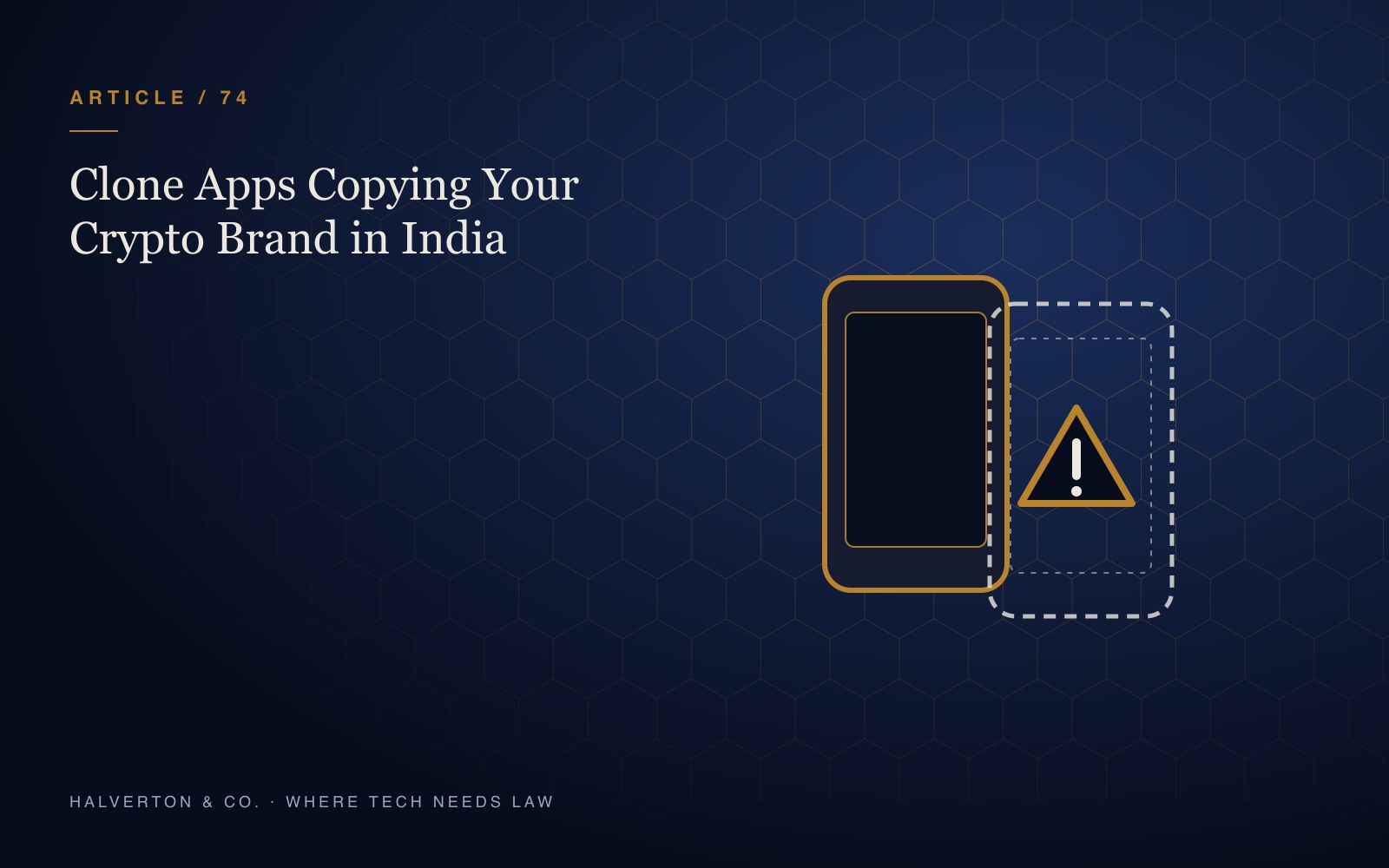
A typical clone copies your name, logo, colour scheme and app screenshots. It may be listed in an app store under a slightly different name, distributed as an installable file from a website, or promoted through social media ads and messaging groups. Users deposit money, see a convincing dashboard and sometimes even withdraw small amounts, until the scammers block withdrawals or close the site. Some clones only collect login credentials or personal data.
The Indian dimension is that scammers choose audiences where the original brand is known and where payments are easy. If your brand has Indian followers, even without Indian operations, it is a target. The clone doesn’t need to serve many people for the damage to be real: a single viral complaint can harm your reputation, and Indian users who lose money can complain to the police or regulators, naming your brand.
Act early and keep evidence. Record the app listing, developer name, package identifier, download link, website addresses, payment details given to users, social media accounts and any ads, with dates and screen recordings. Save the files, not just screenshots, and note the hosting provider and domain registrar. This evidence supports every route that follows, from a platform complaint to an urgent court application.
Platform takedowns first
The fastest remedy is usually a complaint to the platform. App stores, hosting providers, domain registrars and social media services all have trade mark and impersonation complaint channels, and they act faster when you give them clear evidence and a trade mark registration number. A registration in India makes a complaint about an Indian listing easier to support, but a registration elsewhere and evidence of your reputation can also work. Keep your complaint short, factual and attached to the evidence, and copy the developer contact so that the platform has the notice it needs.
In India, online intermediaries enjoy conditional protection from liability under Section 79 of the Information Technology Act, 2000, which depends on following due diligence rules and acting on proper notices. The leading interpretation is that an intermediary must act when it receives a court order or a government notification, and platforms are generally more responsive when they see a court order than when they see a private letter. That is why court orders are often the most effective route against stubborn listings.
A word on government blocking. Section 69A of the Information Technology Act allows the government to block access to online content on specified public-interest grounds, and it has been used to block large numbers of apps (SFLC; LiveLaw). It is a government power exercised through a formal process, not a route that a brand owner can invoke for an ordinary trade mark complaint, so don’t plan around it. The practical route to blocking for a brand owner is a court order that directs the relevant authority and intermediaries to act.
| Route | Speed | What you need |
|---|---|---|
| App store, host, registrar or social platform complaint | Fastest, often days | Trade mark details, evidence of copying, clear screenshots and package or domain details |
| Court injunction (including John Doe and dynamic orders) | Days in clear cases | Prima facie case, urgency, evidence and an Indian counsel on standby |
| Criminal complaint for cheating by personation | Variable | Victim details and transaction records; coordinate with UAE counsel |
| Government blocking under Section 69A | Not a brand-owner route | A formal government process on limited public-interest grounds |
Court remedies in India
A registered owner can sue for infringement under the Trade Marks Act, 1999, and any brand owner can sue for passing off, which protects goodwill without registration. Foreign companies can sue in India. A court looks at whether the defendant’s activity targets users in India, and the Delhi High Court has exercised jurisdiction over a website that allowed transactions from India in a case involving the Tata name used for a crypto-currency (World Trademark Review; Moneylife). That case is a useful reminder that a clone aimed at Indian users, or a site with an Indian payment route, gives an Indian court a basis to act.
The Delhi High Court has been willing to grant wide orders against anonymous defendants in fraud and brand-impersonation cases. It has issued “John Doe” orders against unknown parties, directed registrars to suspend domains and ordered disclosure of registrant details. Recent examples include a dynamic injunction in favour of Premji Invest in August 2025 against fraudulent domains, apps and social media ads that also covers mirror sites, an injunction in March 2026 for Dream11 against rogue apps using confusingly similar marks, and orders protecting crypto-related names such as Mudrex and Sequoia Capital in a fake-exchange case (BananaIP; SCC Online; Medianama; LiveLaw). A dynamic injunction allows the plaintiff to add newly discovered mirror sites to the order without starting again, which suits clones that reappear under new names.
To get this type of order you will usually need to show a prima facie case, urgency and the balance of convenience, with the evidence described above. Courts have granted relief within days in clear cases. Expect to give an undertaking, to identify what you know about the defendants and to return to court as new copies appear. Costs and time depend on how many defendants there are and how often they change.
Clean hands and regulatory cautions for Dubai firms
A Dubai crypto firm should think carefully before going to an Indian court. An injunction is a discretionary remedy, and a court may look at the applicant’s own conduct. If your platform serves users in India without being registered with India’s Financial Intelligence Unit as a virtual digital asset service provider, a defendant or the court may raise that. Indian law treats offshore platforms that serve Indian users as subject to anti-money laundering registration, and in 2025 and 2026 FIU-IND issued notices to dozens of offshore platforms, in some cases with directions to take down their apps (Outlook Business; CryptoSlate).
That does not mean you cannot sue. It means you should know your own position before filing. If you don’t serve India, say so, and show that you exclude Indian users through your terms, your KYC and your payment rails: that supports your case that Indian users who deal with a clone are being deceived about who they are dealing with. If you do serve Indian users, take advice on registration, or on restructuring, before approaching an Indian court, because an application can draw attention to your status.
Fraud on users can also be reported to the police. Victims in India can file complaints through the National Cyber Crime Reporting Portal, and offences such as cheating by personation using a computer resource can be pursued under the Information Technology Act, 2000 and the Bharatiya Nyaya Sanhita, 2023. Coordinate with your UAE counsel on any parallel report to the authorities in Dubai. A public notice on your website and social channels, listing your official links and warning about clones, helps users and shows courts that you took steps.
Building a brand protection programme, remedies and quick answers
A standing programme costs far less than repeated emergency applications. Register your brand in India, either directly or by designating India through the Madrid system from your UAE mark, in the classes that match your services, so that you can enforce quickly. Monitor app stores, domain registrations, search advertising and social media for your name and common misspellings. Publish an official links page and keep it up to date. Prepare a template notice and an evidence checklist so that your team can collect proof on the day. Keep an Indian law firm on standby with the documents it needs for an urgent application, so that you don’t waste days on onboarding. Track each clone, each notice and each result, because that history shows a court the scale of the problem. If a clone has already caused losses to users, consider whether to cooperate with law enforcement and to publish a clear statement, and take advice before offering refunds. Finally, align your brand protection with your compliance position: the stronger your own compliance record, the easier it is to enforce.
Related reading: why Dubai exchanges also need FIU-IND registration, crypto fraud between Dubai and India, Web3 trade marks in India and the UAE, the Sahyog portal and content takedowns, when a crypto exchange is hacked, enforcing a Dubai judgment or award in India and FIU-IND registration for crypto exchanges; also copyright registration in India for Dubai-based creators; also protecting a US app in India and clone games and UK developers in India.
Quick answers
Can a Dubai company get an Indian court order against a clone app?
Yes. Indian courts have granted injunctions to Indian and foreign brands against fake sites and apps, especially where users in India are targeted, but you should check your own regulatory position first.
Do I need an Indian trade mark registration to act?
Not strictly, because passing off protects unregistered goodwill, but a registration makes platform complaints and court applications faster and easier.
Is government blocking available against clone apps?
Section 69A blocking is a government power on limited public-interest grounds. For ordinary brand disputes, the practical route is a court order directing intermediaries and authorities to act.
What evidence should I collect about a clone app?
The app listing, developer name, package identifier, download link, website addresses, payment details given to users, social media accounts and ads, with dates and screen recordings. Save the files, not just screenshots, and note the hosting provider and registrar.
Can I add new mirror sites to an existing injunction?
Where the court has granted a dynamic injunction, as in the Premji Invest case, newly discovered mirror sites that copy the same content can be added without starting again. The Delhi High Court has granted such orders in recent brand-impersonation cases.
Final word
Halverton & Co. is an Indian law firm advising NRIs, founders, investors and businesses in Dubai and across the UAE on Indian law, including trade mark enforcement and brand protection in India for UAE crypto and Web3 businesses, including urgent injunctions against clone apps and fake exchanges. We practise in Jharkhand, Maharashtra and before the Supreme Court of India, and work alongside UAE-licensed counsel, who advise on UAE law. Halverton & Co.: Where tech needs law! If you have a question about Indian law, write to us at office@halvertonandco.com, or get in touch.
This article reflects developments reported up to late October 2026. It is for general information only, is not legal advice, and does not create an advocate-client relationship. Halverton & Co. is an Indian law firm and does not advise on UAE law; UAE-law points should be confirmed with UAE-licensed counsel.
Sources
Related practice area
Crypto, Web3 & Digital Assets
Advice for virtual digital asset businesses on registration, reporting and structure.
View the practice areaComments
No account needed. Comments are reviewed before they appear, so yours will show here once approved. Please do not share confidential details or describe your own legal matter: replies are general discussion, not legal advice, and do not create an advocate-client relationship. For your own situation, write to office@halvertonandco.com.