Key takeaways
- Crypto gifted to a relative is generally not taxable on receipt in India, because gifts from relatives are exempt.
- Gifts of property from non-relatives can be taxed in the recipient’s hands if their total value exceeds ₹50,000 in a year.
- When the family member sells, the gain is taxed at 30% using the giver’s original cost, so purchase records are essential.
- The 1% TDS does not usually apply to a pure gift, but it applies when the recipient later sells.
Many NRIs in Dubai who’ve done well in crypto want to share some of it with family back home: a parent, a sibling, a child studying in India. Sending a few thousand dollars of Bitcoin or USDT to a family member’s wallet takes seconds. Working out the Indian tax and legal consequences takes rather longer.
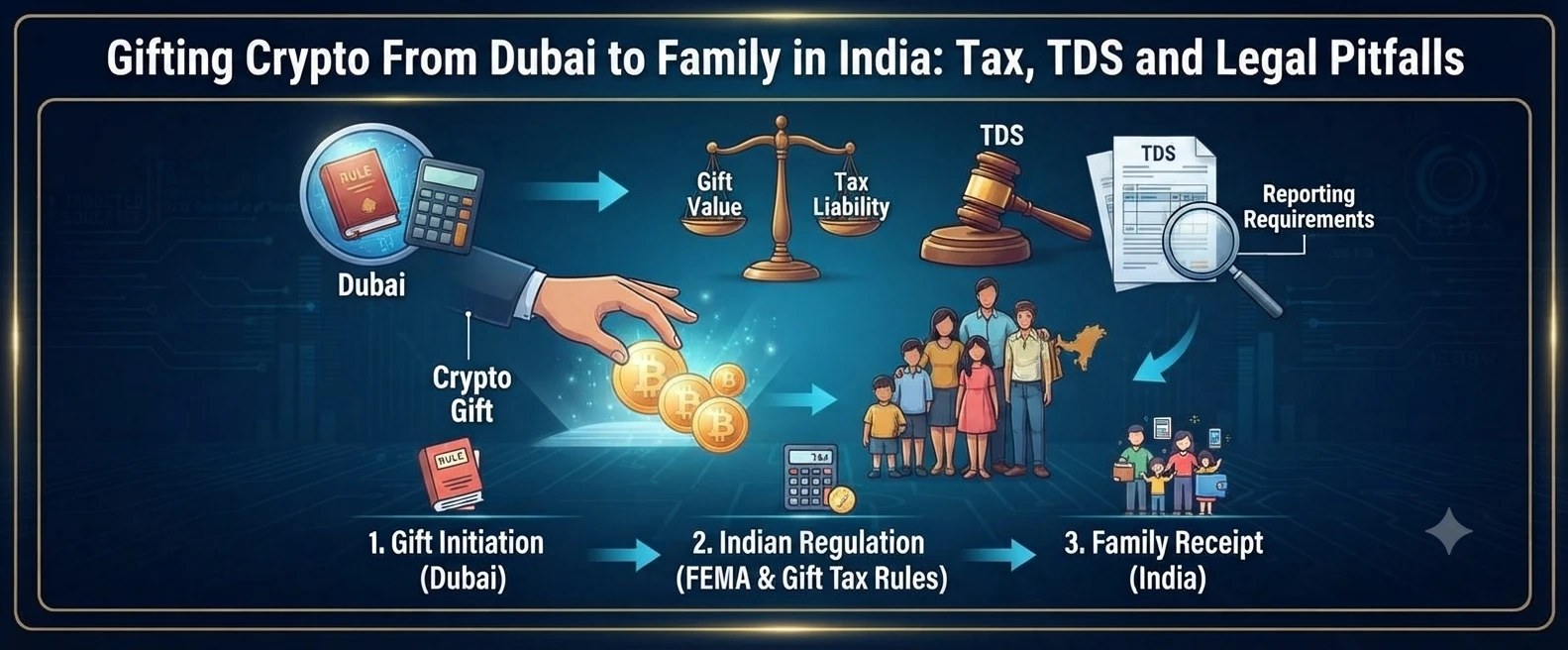
This guide explains what happens under Indian law when you’re gifting crypto from Dubai to family in India: when the gift is taxable, the exemption for relatives, how the recipient is taxed when they sell, TDS, reporting, and the foreign exchange questions to keep in mind.
Is a crypto gift taxable in India?
Indian tax law treats crypto as a “virtual digital asset”, and it taxes certain gifts of property as income in the recipient’s hands. Under the gift rules carried into the Income-tax Act, 2025, a person who receives property, including virtual digital assets, without consideration may be taxed on its value if the aggregate value of such gifts exceeds ₹50,000 in a year.
The key exemption is for gifts from “relatives”. Indian tax law defines relatives broadly to include a spouse, parents, siblings, children and other close family members, and the spouses of some of them. Gifts from relatives are exempt from tax in the recipient’s hands, whatever their value. So gifting crypto from Dubai to a parent, sibling or child in India is generally not taxable when received.
For NRIs in Dubai, the relationship test is usually easy to meet for parents, siblings, spouses and children, which makes gifting crypto to close family in India straightforward from a gift-tax point of view. Gifts to people outside the definition, such as friends, cousins in some cases, or a fiancée before marriage, are taxable for the recipient if they exceed ₹50,000 in aggregate in a year. Gifts received on the occasion of marriage and certain other specified occasions are also exempt. Check the relationship carefully before assuming a gift is tax-free.
| Giver | Taxable for the recipient on receipt? | Note |
|---|---|---|
| Spouse, parent, sibling, child or other relative under Indian tax law | No: gifts from relatives are exempt whatever their value | The relationship test is usually easy to meet for close family |
| Gift on the occasion of marriage and certain other specified occasions | No: exempt | Check the occasion carefully |
| Friends, some cousins, a fiancée before marriage | Yes, if the aggregate value of such gifts exceeds ₹50,000 in a year | Report as income in the year of receipt |
| Later sale by the recipient (any giver) | Gain taxed at 30% plus cess, with only the cost of acquisition deductible | The recipient needs the giver’s purchase records to prove cost |
How the family member is taxed when they sell
Even if receiving the gift isn’t taxable, selling it is. When the family member in India sells or swaps the crypto, the gain is taxed at India’s flat 30% rate for virtual digital assets, plus cess, with no deductions other than cost of acquisition and no set-off of losses against other gains.
The cost of acquisition is the critical question. For gifted assets, Indian tax law generally allows the recipient to use the previous owner’s cost of acquisition, and for gifts that were taxed on receipt, the value that was taxed. In the special regime for virtual digital assets, the cost of acquisition is the only deduction allowed, so the recipient must be able to prove what the original purchase cost was. If they can’t, the tax department may treat the cost as nil and tax the entire sale value.
That makes documentation essential. When gifting crypto, the NRI should give the family member a record of the original purchase (exchange statements showing date, price and quantity) and a short signed gift letter or deed confirming the gift, the date, the asset and the relationship.
TDS, reporting and records
India’s 1% TDS on transfers of virtual digital assets applies to payments for transfers, so it doesn’t usually arise on a pure gift with no consideration. It will apply when the family member later sells the crypto on an Indian exchange, where the exchange deducts it, or to a P2P buyer, who is responsible for deducting it.
The recipient must report the sale in Schedule VDA of their Indian income tax return, with dates, cost of acquisition and sale value. If the gift itself was taxable, because the giver isn’t a relative, it must be reported as income in the year of receipt. Indian exchanges also report users’ transactions under Section 509 of the Income-tax Act, 2025, so unreported sales are increasingly likely to be noticed.
Keep a simple file: the gift letter, the giver’s purchase records, wallet addresses and transaction hashes for the transfer, and records of each later sale. It will save a great deal of trouble if the tax department asks questions.
FEMA, banking and practical pitfalls
Where the crypto sits before the gift also matters. Crypto bought on a VARA-licensed platform in Dubai and transferred to a family member’s wallet in India leaves a clear record on both sides, which helps if questions arise later. Crypto bought through informal channels in Dubai is much harder to document. Foreign exchange rules add another layer. India’s FEMA framework contemplates gifts from NRIs to residents through banking channels, but it doesn’t expressly address crypto gifts sent from abroad to an Indian wallet. That uncertainty is one reason many advisers suggest that NRIs gift money through normal banking channels, and leave the recipient to decide whether to buy crypto in India, rather than transferring crypto directly.
Converting gifted crypto into rupees also carries the same practical risk as other P2P sales: if the buyer pays with funds from a fraud victim, the family member’s bank account can be frozen in a cyber investigation. Selling through an FIU-registered Indian exchange with bank transfers reduces that risk.
Large gifts may also raise questions from the recipient’s bank in India, especially if the family member converts crypto to rupees and deposits significant sums. A short note explaining that the funds came from gifting crypto by a relative in Dubai, backed by documents, can resolve these questions quickly. Finally, consider the family member’s own position. A student or retired parent who suddenly holds and sells significant crypto may face questions from the tax department or their bank. Clear records of the gift and its source protect them.
Getting it right and remedies
If you’re gifting crypto from Dubai to family in India, confirm the recipient is a “relative” under Indian tax law, document the gift and your original cost, consider whether a cash gift through banking channels is simpler, and make sure the recipient understands that selling triggers 30% tax and reporting. If a family member has already sold gifted crypto without reporting it, they can correct their return through an updated return within 48 months of the end of the relevant assessment year, with additional tax. If they receive a notice, they should respond with the gift documentation and purchase records, and appeal any assessment that ignores the cost of acquisition.
Related reading: sending USDT from Dubai to India, returning to India from Dubai with crypto, crypto inheritance for NRIs in Dubai, a bank account frozen after a P2P crypto trade, crypto tax in India, why India may still tax Indians in Dubai on crypto and what to do about a crypto nudge email.
Quick answers
Is a crypto gift from an NRI to a parent in India taxable?
Receiving it is generally not taxable, because gifts from relatives are exempt. But the parent pays 30% tax on any gain when they sell.
What cost does the recipient use when selling gifted crypto?
Generally the giver’s original cost of acquisition, so the giver’s purchase records are essential.
Does 1% TDS apply to a crypto gift?
Not usually on a pure gift without consideration, but it applies when the recipient later sells.
What is the threshold for a taxable crypto gift?
Gifts of property, including virtual digital assets, received without consideration may be taxed in the recipient’s hands if the aggregate value exceeds ₹50,000 in a year, unless the giver is a relative or another exemption applies.
What documents should I give the family member?
A record of the original purchase (exchange statements showing date, price and quantity) and a short signed gift letter or deed confirming the gift, the date, the asset and the relationship.
Final word
Halverton & Co. is an Indian law firm advising NRIs, founders, investors and businesses in Dubai and across the UAE on Indian law, including crypto gifts, family tax planning, VDA reporting and FEMA questions for NRIs. We practise in Jharkhand, Maharashtra and before the Supreme Court of India, and work alongside UAE-licensed counsel, who advise on UAE law. Halverton & Co.: Where tech needs law! If you have a question about Indian law, write to us at office@halvertonandco.com, or get in touch.
This article reflects developments reported up to early October 2026. It is for general information only, is not legal advice, and does not create an advocate-client relationship. Halverton & Co. is an Indian law firm and does not advise on UAE law; UAE-law points should be confirmed with UAE-licensed counsel.
Related practice area
Crypto, Web3 & Digital Assets
Advice for virtual digital asset businesses on registration, reporting and structure.
View the practice areaComments
No account needed. Comments are reviewed before they appear, so yours will show here once approved. Please do not share confidential details or describe your own legal matter: replies are general discussion, not legal advice, and do not create an advocate-client relationship. For your own situation, write to office@halvertonandco.com.