Key takeaways
- India has no text and data mining exception, and Section 52 fair dealing is the closest argument.
- On 24 July 2026 the Delhi High Court refused ANI an interim injunction against OpenAI, reportedly treating storage of articles for training as fair dealing at the prima facie stage; ANI has appealed.
- Sections 43 and 66 of the IT Act, website terms and the DPDP Act add separate risks.
- Map sources, respect barriers and opt-outs, licence valuable content and filter personal data.
Is it legal to scrape Indian websites for AI training? There is no single Indian rule that says yes or no. The answer depends on four bodies of law: copyright, the Information Technology Act, contract and data protection. India has no text and data mining exception, the leading court case, ANI v. OpenAI, produced only an interim ruling, and the law is moving. For scraping Indian websites AI training legal risk therefore needs a layered assessment.
This guide explains how each body of law applies, what ANI v. OpenAI decided and did not decide, how personal data rules affect scraped content, what to do about robots.txt and terms of service, and a practical risk checklist for US AI companies. It is written by an Indian law firm. US law points should be confirmed with US counsel, and nothing here is a guarantee of safety.
The four legal layers
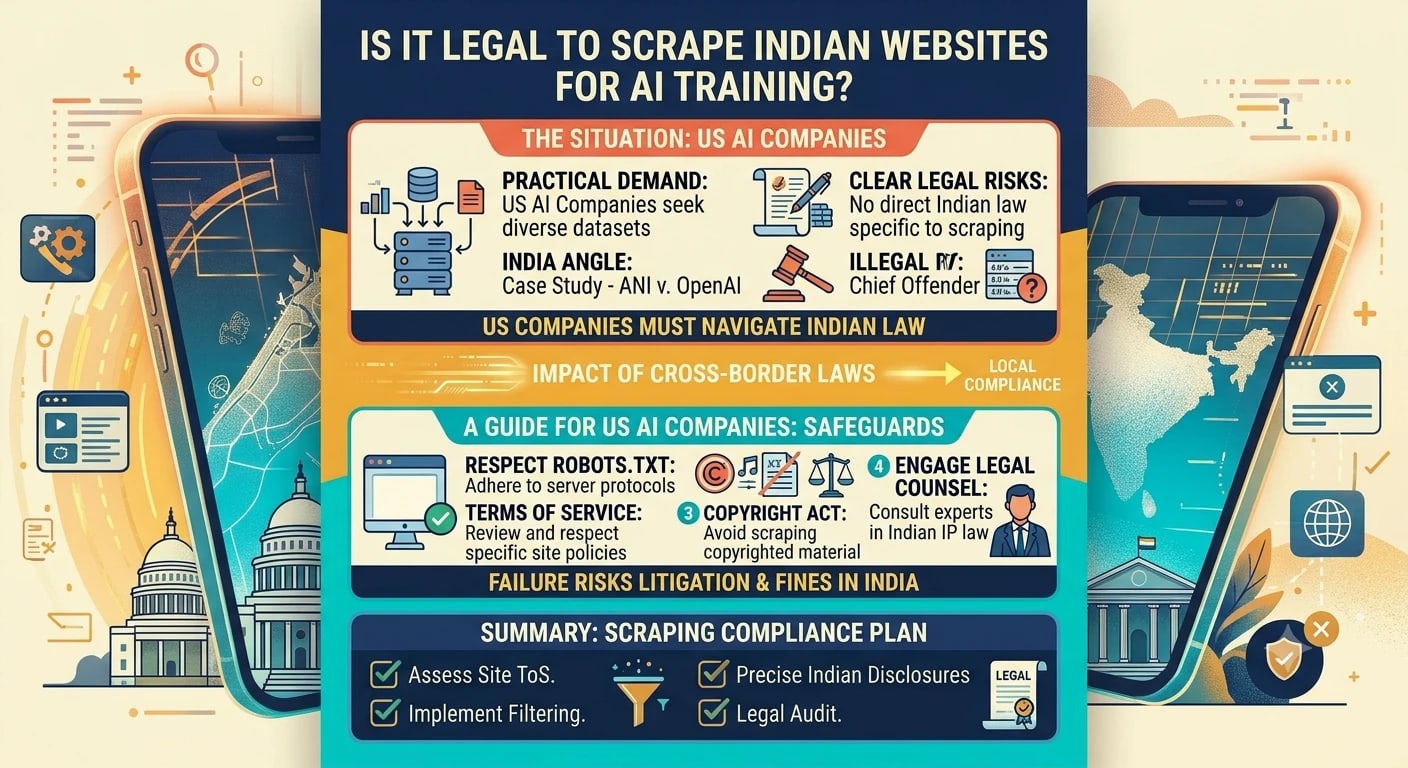
First, copyright. Scraped text, images and video can be protected works, and copying them to a training set can be infringement unless an exception applies. Second, the Information Technology Act, 2000, which penalises unauthorised access to a computer system or network in Sections 43 and 66. Third, contract, because a website’s terms of use may ban scraping and bind users who accept them. Fourth, data protection, because pages may contain personal data. Anyone asking whether web scraping legal India rules allow should look at all four. Each layer shapes the scraping Indian websites AI training legal question.
| Layer | Issue | Lower risk practice |
|---|---|---|
| Copyright | Copying protected text, images and video | Licences for high-value content |
| IT Act, Sections 43 and 66 | Access without permission | Respect logins, paywalls and rate limits |
| Contract | Terms of use that ban scraping | Review terms and honour opt-outs |
| DPDP Act, 2023 | Personal data in scraped pages | Filter personal data from datasets |
Each layer has its own risk and its own defences. A page that is public and unprotected is more likely to pass the access test than one behind a login. A site whose terms ban scraping gives the owner a contract claim even if copyright is unclear. A dataset that includes names, photos and contact details engages the Digital Personal Data Protection Act, 2023. A careful assessment looks at all four together.
There is also no single regulator or statute for scraping. Indian courts decide case by case, often on interim injunction applications, and judges look at the facts of the harm. Publishers, news agencies and platforms have been active litigants. A company that scrapes at scale from Indian sources should expect questions about its sources, filters and opt-outs, whether from rights holders, customers or investors.
Copyright and ANI v. OpenAI
India has no statutory exception for text and data mining. The closest tool is Section 52 of the Copyright Act, 1957, which lists permitted acts including fair dealing for private use, research, criticism and review. Whether training an AI model fits those categories is untested at final stage. A government working paper by the Department for Promotion of Industry and Internal Trade has proposed a mandatory blanket licence model, called one nation one licence, but it is a proposal. A text and data mining exception India lacks would remove much of this uncertainty.
In ANI v. OpenAI, the Delhi High Court on 24 July 2026 refused ANI an interim injunction, reportedly holding at the prima facie stage that OpenAI’s storage of ANI’s articles to train ChatGPT fell within Section 52 fair dealing. The court also held that it had jurisdiction. ANI has appealed, and a Division Bench issued notice in September 2026. It is an interim, non-final view, not a ruling that scraping is legal. The ANI v OpenAI scraping dispute is the main Indian reference point.
Take care with the lesson. The case concerned particular facts and a specific defendant, and the court said nothing that would protect output that reproduces protected text or that bypasses a paywall. Publishers have also intervened in the proceedings. For a US company, the sensible reading is that Indian law is open to arguments on training as fair dealing, but that risk remains until a higher court or the legislature decides. This is the current state of the scraping Indian websites AI training legal debate.
IT act, contract and data protection
Sections 43 and 66 of the IT Act deal with access to a computer system without the owner’s permission, and downloading or extracting data from it. Courts have not settled whether scraping a public page is access without permission. Bypassing technical barriers, such as logins, rate limits, captchas or paywalls, makes the claim much stronger. Respecting such barriers reduces the risk. Courts have not yet settled how Section 43 IT Act scraping claims apply to public pages.
Terms of service can be enforced as contracts, and Indian law recognises click-wrap and browse-wrap agreements in some circumstances. If a site’s terms prohibit scraping and you have accepted them, for example by creating an account, you risk a breach claim, and the site may also block you. robots.txt is a technical signal, not a law, but ignoring it is evidence of bad faith and can support a claim that you accessed without permission. The robots.txt legal status India courts will give it is still unclear.
Personal data raises separate questions. The DPDP Act applies to digital personal data processed in India, and to processing outside India that relates to offering goods or services to people in India. It has an exemption for personal data that the data principal has made publicly available themselves, but not for all public data. Scraping profiles, comments or contact lists needs a lawful basis analysis, and the DPDP Rules, 2025 set the operational detail. Take advice on filtering personal data out of training sets. Personal data adds a fourth strand to the scraping Indian websites AI training legal analysis.
A risk checklist for AI companies
Map your sources. Record which Indian sites you scrape, when and under what terms. Respect robots.txt and technical barriers, and honour opt-outs and takedown requests. Avoid paywalled and login-protected content unless you have a licence. Keep logs of crawls, which help you show good faith if a claim arrives.
Prefer licences for high-value Indian content. News agencies, publishers and databases are actively asserting rights, and licensing deals reduce risk and give cleaner provenance. Where you rely on fair dealing or a similar defence, document the purpose, the amount used and why your use does not substitute for the original. Filter personal data and sensitive categories from datasets, and keep a deletion process.
Watch the output side. Guard against models that reproduce protected text verbatim, since output claims are separate from training claims. Add contract terms with customers on Indian content, review indemnities and ask about insurance. Monitor ANI v. OpenAI, the DPIIT proposal and any new IT or data rules. Treat scraping Indian websites AI training legal analysis as a living assessment, not a one-time sign-off.
Next steps and quick answers
Audit your Indian training sources this quarter, remove content behind barriers, add opt-out handling, negotiate licences for the most valuable publishers and brief your board on the legal position. This is general information, not legal advice, and US counsel should advise on US law. Revisit the scraping Indian websites AI training legal position each quarter.
Related reading: ANI v. OpenAI and fair dealing, the DPIIT paper on AI and copyright, AI training data licensing with Indian publishers, AI training data provenance audits, AI and copyright in India and the US, copyright in legal headnotes and AI training and Getty v. Stability AI at the Court of Appeal; also web scraping law in the US and web scraping law in India.
Quick answers
Is web scraping legal in India?
There is no blanket rule. Scraping can raise copyright, IT Act, contract and data protection issues. Public, non-personal data accessed without bypassing barriers is lower risk, but the law is unsettled for AI training.
What did ANI v. OpenAI decide about scraping for AI training?
On 24 July 2026 the Delhi High Court refused an interim injunction and reportedly treated the storage of articles for training as fair dealing at the prima facie stage. ANI has appealed, so it is not a final ruling.
Does India have a text and data mining exception?
No. India has no specific text and data mining exception. Section 52 fair dealing is the closest argument, and the government has floated a licensing model in a working paper.
Does robots.txt have legal force in India?
It is a technical signal, not a statute, but ignoring it is evidence of bad faith and can support an access claim.
Is public data free to use for training?
Not necessarily. Public availability does not remove copyright, contract or data protection rules.
Final word
Halverton & Co. is an Indian law firm advising US companies, founders, investors and law firms on Indian law, including AI and copyright law, data protection, technology contracts, and India-related disputes for AI companies. We practise in Jharkhand, Maharashtra and before the Supreme Court of India, and work alongside US counsel, who advise on US law. Halverton & Co.: Where tech needs law! If you have a question about Indian law, write to us at office@halvertonandco.com, or get in touch.
This article reflects developments reported up to 31 October 2026. It is for general information only, is not legal advice, and does not create an attorney-client relationship. Halverton & Co. is an Indian law firm and does not advise on US law; US-law points should be confirmed with US counsel.
Sources
Related practice area
Technology & AI Law
Contracts, data protection and AI policies for products that handle other people’s data.
View the practice areaComments
No account needed. Comments are reviewed before they appear, so yours will show here once approved. Please do not share confidential details or describe your own legal matter: replies are general discussion, not legal advice, and do not create an advocate-client relationship. For your own situation, write to office@halvertonandco.com.