Key takeaways
- California’s regulations on risk assessments, cybersecurity audits and automated decision-making took effect on 1 January 2026, with staggered compliance dates.
- A risk assessment is required for significant risk processing such as selling or sharing personal information, processing sensitive data or using automated decision-making for significant decisions.
- Businesses will ask offshore vendors for data flows, model descriptions, security evidence and sub-processor details.
- Update vendor contracts to require help with assessments and notice of material changes.
A CCPA risk assessment sounds like something only the company that owns the customer data has to worry about. In practice the vendor in India that runs the support desk, hosts the database or tags the training data gets pulled in, because the business can’t do the assessment without it. California’s updated regulations, effective 1 January 2026, make risk assessments a formal duty for certain kinds of processing, and they also set up rules on automated decision-making and cybersecurity audits.
If you are a US company with offshore vendors, or an Indian vendor with California customers, the questions are straightforward. Which processing needs an assessment? What will the business ask you for? Which deadlines matter? Sources differ on some dates, and none that we found deals directly with service providers, so we flag where you should check the text of the regulations. A CCPA risk assessment is now a formal duty for some kinds of processing, and vendors feel it first.
What the new California rules require
The California Privacy Protection Agency finalised regulations on risk assessments, cybersecurity audits and automated decision-making technology, which the Office of Administrative Law approved in 2025. The CCPA regulations effective January 2026 cover three areas: businesses must carry out and document risk assessments for high-risk processing, some must commission annual cybersecurity audits, and those using automated decision-making technology for significant decisions face notice, opt-out and access duties. The new rules make a CCPA risk assessment mandatory for defined high-risk activities, including automated decisionmaking technology ADMT uses. Cybersecurity audit offshore vendor oversight is part of the picture.
The idea of a risk assessment is familiar from the GDPR’s data protection impact assessment. A business weighs the benefits of a processing activity against the risks to consumers and decides whether to go ahead and with what safeguards. What is new in California is that it has to be documented, kept, and in some cases summarised to the agency with an attestation.
The rules are staggered. Some start early, others take years to bite. That is helpful for planning, but it also creates confusion, and several law firm summaries give slightly different dates. Check the regulatory text, in Title 11 of the California Code of Regulations, before relying on any date. Whichever dates you use, plan the CCPA risk assessment early.
Which processing triggers a CCPA risk assessment
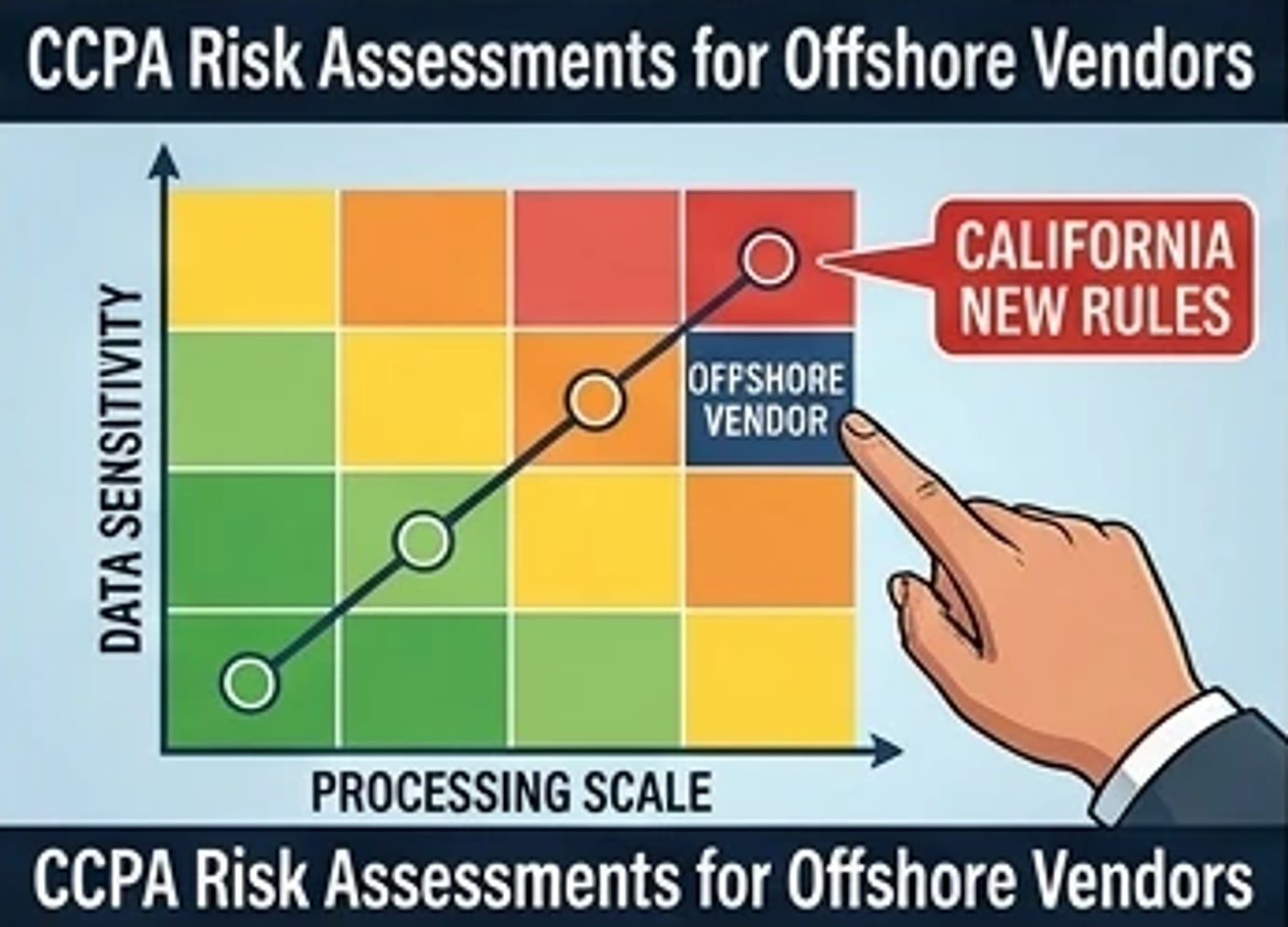
A CCPA risk assessment is required when processing presents significant risk to consumers’ privacy. The regulations list triggers. Summaries commonly include selling or sharing personal information, processing sensitive personal information, using automated decision-making technology for a significant decision such as employment, credit, housing, education or healthcare, and certain profiling or monitoring, including of employees and students, and using personal information to train some technologies. A CCPA risk assessment is triggered by specific kinds of processing.
That significant risk processing risk assessment list matters to vendors because many of those activities are outsourced. A call centre that records and scores customer conversations, an HR platform that ranks candidates, a data labelling team that handles sensitive images, an analytics provider whose tool is used to decide credit offers: each can feed a business’s assessment.
A business that has no such processing doesn’t need one. Start with an inventory of activities, mark each against the triggers and keep the reasoning. A short note saying why a process isn’t covered is often as useful as an assessment. Write down why a process is or isn’t covered, because a CCPA risk assessment may be requested.
What vendors will be asked to provide
Expect questions. The business needs to describe the processing, the categories of data, the purposes, the benefits and harms, the safeguards and how the system works. A service provider that can’t explain its own processing will slow everything down. The service provider assistance risk assessment duty is real in practice, even if the regulations put the primary burden on the business. To complete a CCPA risk assessment, a business needs facts only its vendor holds.
| Item | Date reported | Note |
|---|---|---|
| Regulations in effect | 1 January 2026 | Staggered compliance |
| Existing high-risk activities | End of 2027 | Complete assessments |
| Summary and attestation | 1 April 2028 onwards | For 2026 and 2027 assessments |
| Automated decision-making | 1 January 2027 | Check final text |
| Cybersecurity audits | 2028 to 2030 by revenue | Dates differ by source |
Practical requests are likely to include: data flow diagrams, descriptions of models and logic, accuracy and bias testing, security controls and certifications, sub-processors and their locations, retention and deletion, and incident history. Vendors that keep this material ready can answer in days. Vendors that don’t will find their customers asking for it in a rush before a deadline.
Contracts need to catch up. The CCPA already requires service provider contracts to include specific terms. Add a clause requiring the vendor to provide the information needed for risk assessments, audits and ADMT notices within a stated time, and to notify the business of material changes to the processing. For an offshore vendor, say where the information will come from and who owns it. Contracts should say how a vendor will help with a CCPA risk assessment.
Deadlines and audits
For risk assessments, summaries say businesses must begin conducting them for new high-risk activities from 1 January 2026. For processing already under way before the regulations took effect, the deadline to complete assessments is reported as the end of 2027. Summaries of submissions to the agency, with an attestation, are reported as due by 1 April 2028 for assessments conducted in 2026 and 2027, and by 1 April of the following year after that. Deadlines for a CCPA risk assessment depend on whether the processing was already running.
Cybersecurity audits are staggered by revenue. One firm lists 1 April 2028 for businesses over $100 million, 1 April 2027 for those between $50 million and $100 million (sic, as reported), with later dates for smaller ones, while another gives a range running into 2030. The audit rules matter to vendors because an independent auditor will test the business’s controls, including vendor oversight.
Automated decision-making technology rules are reported to apply from 1 January 2027. If your offshore team builds or runs ADMT for a California business, expect requests for explanations, opt-out mechanics and access responses. Keep a calendar and check the final text, since a wrong date can be costly. A US adviser should confirm how the rules apply to your company.
Questions people ask
A simple step to take this month: ask each offshore vendor what they would need from you, and what they can give you, for an assessment. The answers show where the gaps are. One step this month: ask each vendor how it would support a CCPA risk assessment.
Related reading: data processing agreements with Indian vendors, offshore AI teams and data privacy in India, CCPA and DPDP side by side, the DPDP Act for US SaaS companies, AI-washing and the FTC and dark patterns and the CCPA guidelines; also CIPA website wiretap lawsuits and BIPA compliance for face recognition.
Quick answers
What is a CCPA risk assessment?
It is a documented evaluation, required by California’s updated regulations, of the benefits and risks of processing that presents significant risk to consumers, such as selling or sharing personal information, processing sensitive data or using automated decision-making for significant decisions.
Does a CCPA risk assessment apply to my offshore vendor?
The duty falls mainly on the business, but vendors that process data for it will be asked for information and may need contract terms to assist. Check the regulations and your contract.
When do the new CCPA rules start?
The regulations took effect on 1 January 2026, with staggered compliance dates for risk assessments, cybersecurity audits and automated decision-making technology. Confirm dates in the regulatory text.
Does a CCPA risk assessment apply to my vendor?
The duty falls on the business, but vendors will be asked for information and may need contract terms to assist.
Final word
Halverton & Co. is an Indian law firm advising US companies, founders, investors and law firms on Indian law, including data protection and technology contracts for Indian vendors serving US businesses, alongside US counsel. We practise in Jharkhand, Maharashtra and before the Supreme Court of India, and work alongside US counsel, who advise on US law. Halverton & Co.: Where tech needs law! If you have a question about Indian law, write to us at office@halvertonandco.com, or get in touch.
This article reflects developments reported up to 31 October 2026. It is for general information only, is not legal advice, and does not create an attorney-client relationship. Halverton & Co. is an Indian law firm and does not advise on US law; US-law points should be confirmed with US counsel.
Sources
Related practice area
Technology & AI Law
Contracts, data protection and AI policies for products that handle other people’s data.
View the practice areaComments
No account needed. Comments are reviewed before they appear, so yours will show here once approved. Please do not share confidential details or describe your own legal matter: replies are general discussion, not legal advice, and do not create an advocate-client relationship. For your own situation, write to office@halvertonandco.com.