Key takeaways
- OFAC’s advisories say paying a sanctioned person can violate US sanctions, and civil liability is strict.
- Timely reporting to law enforcement, cooperation and a strong security programme are mitigating factors.
- A vendor in India can create US exposure if US persons, banks or services are involved.
- Contracts should bar payments without consent and require immediate notice.
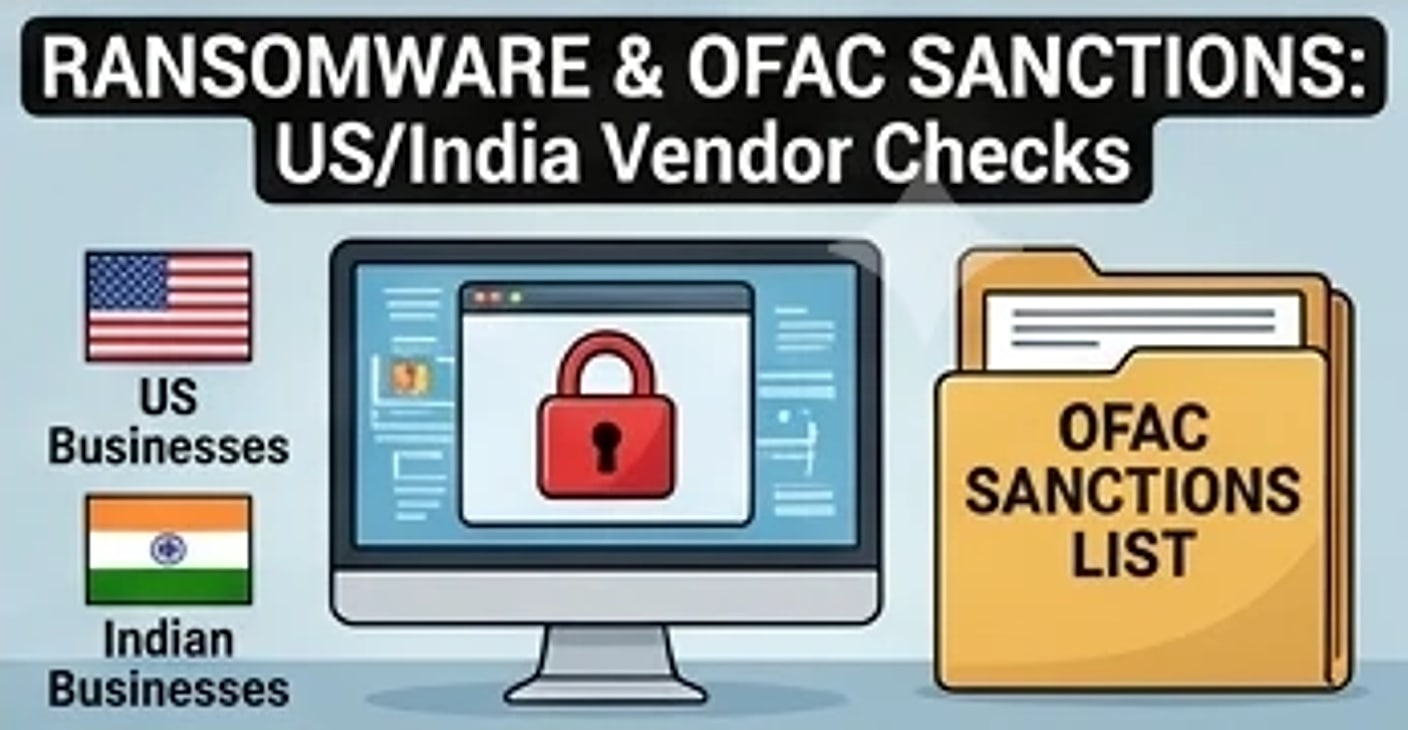
Ransomware payment OFAC risk does not stop at the border of the company that was attacked. If an Indian vendor holding US company data is hit and someone pays a ransom, the payment may touch US sanctions law, particularly if funds move through US banks or involve US persons. The Treasury’s Office of Foreign Assets Control has said in published advisories that paying a ransom to a sanctioned person or a comprehensively sanctioned jurisdiction can create liability.
This guide explains the OFAC framework in plain terms, the mitigating factors the agency has described, how reporting duties under CIRCIA fit in, and what US companies should check in vendor contracts and playbooks when work is done in India. It is written by an Indian law firm for US readers, and it is general information. US counsel should advise on US sanctions and reporting law. Ransomware payment OFAC exposure is a contract and governance issue as much as a technical one.
The OFAC position in brief
OFAC has published advisories, first in 2020 and updated in 2021, on the sanctions risks of facilitating ransomware payments. The core message is that US persons are generally prohibited from engaging in transactions, directly or indirectly, with individuals or entities on the Specially Designated Nationals list, other blocked persons and comprehensively sanctioned jurisdictions. A ransomware payment may fall within that prohibition if the recipient is sanctioned. Ransomware payment OFAC rules are enforced on a strict liability basis in civil cases.
OFAC enforces on the basis of strict liability in civil cases. That means a person can face civil penalties even if they did not know the recipient was sanctioned. The OFAC ransomware advisory strict liability point is therefore important: lack of knowledge is not a defence to civil liability, although it may affect the penalty OFAC chooses. Check the current advisory and enforcement guidelines.
The advisory also covers those who help with payments, such as financial institutions, cyber insurance firms and incident response companies. It encourages organisations to report attacks to law enforcement and to follow good cyber hygiene. OFAC has designated several ransomware actors and related infrastructure, so screening of wallet addresses and counterparties is now part of response planning.
Why Indian vendors add risk
A US company’s data is often held by vendors: software developers, support teams, call centres and back-office providers. When a vendor in India suffers an attack, the US company faces data loss, downtime and legal exposure, and may be asked to pay or to fund a payment. Sanctions risk Indian vendor ransomware events create comes from the possible involvement of US persons, US dollars or US-origin services. Ransomware payment OFAC concerns arise for the US customer even when the vendor controls the response.
OFAC’s reach is not limited to US persons. Non-US persons who cause a US person to violate sanctions, for example by routing dollar payments through US banks or using US-based service providers, can face exposure. A vendor that pays in cryptocurrency through a US-linked exchange or with US insurance money may therefore involve the US company’s compliance.
There is also a governance gap. Many vendor contracts say little about ransomware, payments or decision rights. If the vendor decides alone to pay, the US customer may not know until later. Contracts should state who can decide, how quickly the customer must be told and whether payments are allowed at all. Align with your insurer’s requirements as well.
Mitigating factors and reporting
OFAC’s guidance says it will consider certain mitigating factors when deciding on enforcement. These include a meaningful and timely self-initiated report of the attack to law enforcement or other relevant agencies such as the FBI, CISA or Treasury, and full and timely cooperation with them. A strong cybersecurity programme before the attack is also relevant. Mitigating factors OFAC ransomware matters rely on are described as part of a risk-based compliance approach.
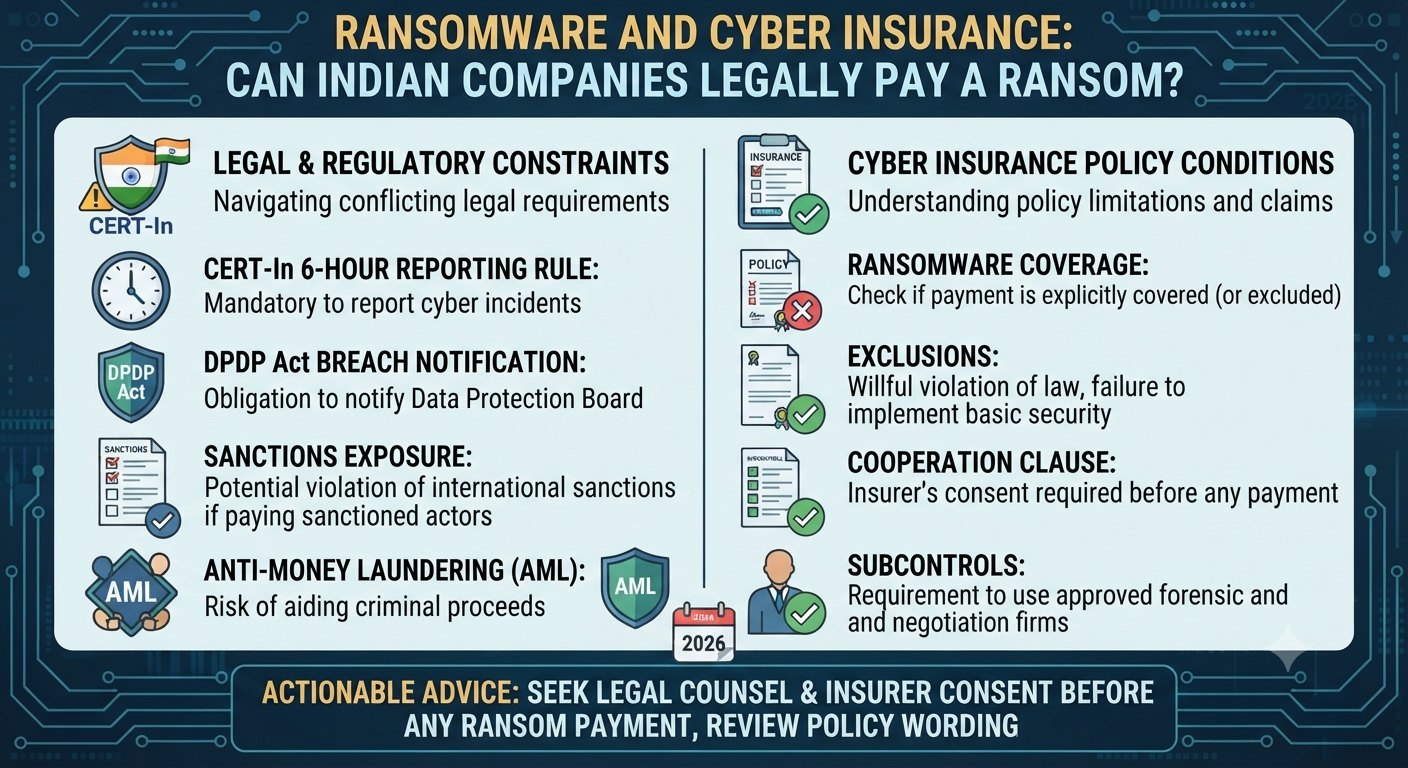
The Cyber Incident Reporting for Critical Infrastructure Act of 2022, known as CIRCIA, will require covered entities to report significant cyber incidents to CISA within 72 hours and ransom payments within 24 hours, once final rules take effect. CIRCIA ransom payment reporting rules were still being finalised according to earlier reporting, so check CISA’s current status. Sector rules, SEC disclosure and state breach laws may also apply.
FinCEN has issued advisories on ransomware and the role of money services businesses. Expect questions from banks and insurers. Keep a record of the sanctions checks you performed, the information considered and who approved decisions. A well-documented process is your best evidence of good faith.
Contract and playbook checklist
Start with the vendor contract. Require immediate notice of any security incident, a duty to cooperate and to preserve evidence, and a clause that the vendor will not pay or negotiate a ransom involving customer data without the customer’s prior written consent. A vendor contract ransomware payment clause should also require sanctions screening if any payment is allowed, and compliance with US sanctions laws. A vendor clause on ransomware payment OFAC screening is a basic control.
| Item | What to include | Why |
|---|---|---|
| Notice | Immediate notice of incidents | Customer can act in time |
| Payment control | No payment without written consent | Sanctions and governance |
| Screening | Check wallets and counterparties | OFAC strict liability |
| Reporting | Law enforcement and CISA steps | Mitigating factors |
| Insurance | Cover and sanctions exclusions | Funding and claims |
Build the playbook. Name who makes payment decisions, who contacts law enforcement, who screens wallet addresses and counterparties, and who speaks with the insurer. Retain breach counsel and forensic firms in advance. Include steps to check whether the threat actor is on a sanctions list or linked to one, and to document the result. Decide how to deal with Indian authorities and CERT-In where Indian systems are involved.
Test and insure. Run a joint exercise with your Indian vendor, review insurance terms on ransom coverage and sanctions exclusions, and confirm the vendor’s own cyber insurance. Check backup and recovery capabilities, since reliable backups reduce the pressure to pay. Review all of this yearly.
Next steps and quick answers
Update contracts, adopt a playbook, check insurance, train the response team and keep records. This is general information, not legal advice. Halverton & Co. is an Indian law firm and does not advise on US law. Revisit your ransomware payment OFAC playbook after any change in sanctions designations.
Related reading: ransom payments and cyber insurance in India, a ransomware attack in India: the first 24 hours, the CERT-In six-hour rule for startups, the UK ransomware payment ban, offshore AI teams and data privacy in India and permanent establishment risk for Indian teams; also AI-washing and the FTC.
Quick answers
Is it illegal to pay a ransomware demand?
Not always, but paying a sanctioned person or entity can violate US sanctions, and OFAC applies strict liability in civil cases. Take advice before any payment.
Can OFAC penalise a company when its vendor pays?
It can if the facts show a violation involving US persons or a US nexus. Contract controls and prompt reporting reduce risk.
What reduces OFAC risk after an attack?
OFAC says timely self-reporting, cooperation with law enforcement and a strong cybersecurity programme are mitigating factors.
Is it illegal to pay a ransom?
Not always, but paying a sanctioned party can violate US sanctions. Take advice before any payment.
Final word
Halverton & Co. is an Indian law firm advising US companies, founders, investors and law firms on Indian law, including vendor risk, outsourcing contracts and cyber incident questions for US companies with teams or vendors in India. We practise in Jharkhand, Maharashtra and before the Supreme Court of India, and work alongside US counsel, who advise on US law. Halverton & Co.: Where tech needs law! If you have a question about Indian law, write to us at office@halvertonandco.com, or get in touch.
This article reflects developments reported up to 31 October 2026. It is for general information only, is not legal advice, and does not create an attorney-client relationship. Halverton & Co. is an Indian law firm and does not advise on US law; US-law points should be confirmed with US counsel.
Sources
Related practice area
Technology & AI Law
Contracts, data protection and AI policies for products that handle other people’s data.
View the practice areaComments
No account needed. Comments are reviewed before they appear, so yours will show here once approved. Please do not share confidential details or describe your own legal matter: replies are general discussion, not legal advice, and do not create an advocate-client relationship. For your own situation, write to office@halvertonandco.com.