
Key takeaways
- A resident Indian buying shares in a Dubai company makes an overseas direct investment under the Overseas Investment Rules, 2022.
- Commentary says an individual cannot invest in an entity engaged in financial services or in one with a controlled subsidiary or step-down subsidiary.
- Funding usually uses the LRS limit, reported at USD 250,000 a year, and Form FC must be filed before the first investment.
- Ask the investor to take FEMA advice before wiring and ask your UAE lawyer to check the company’s structure.
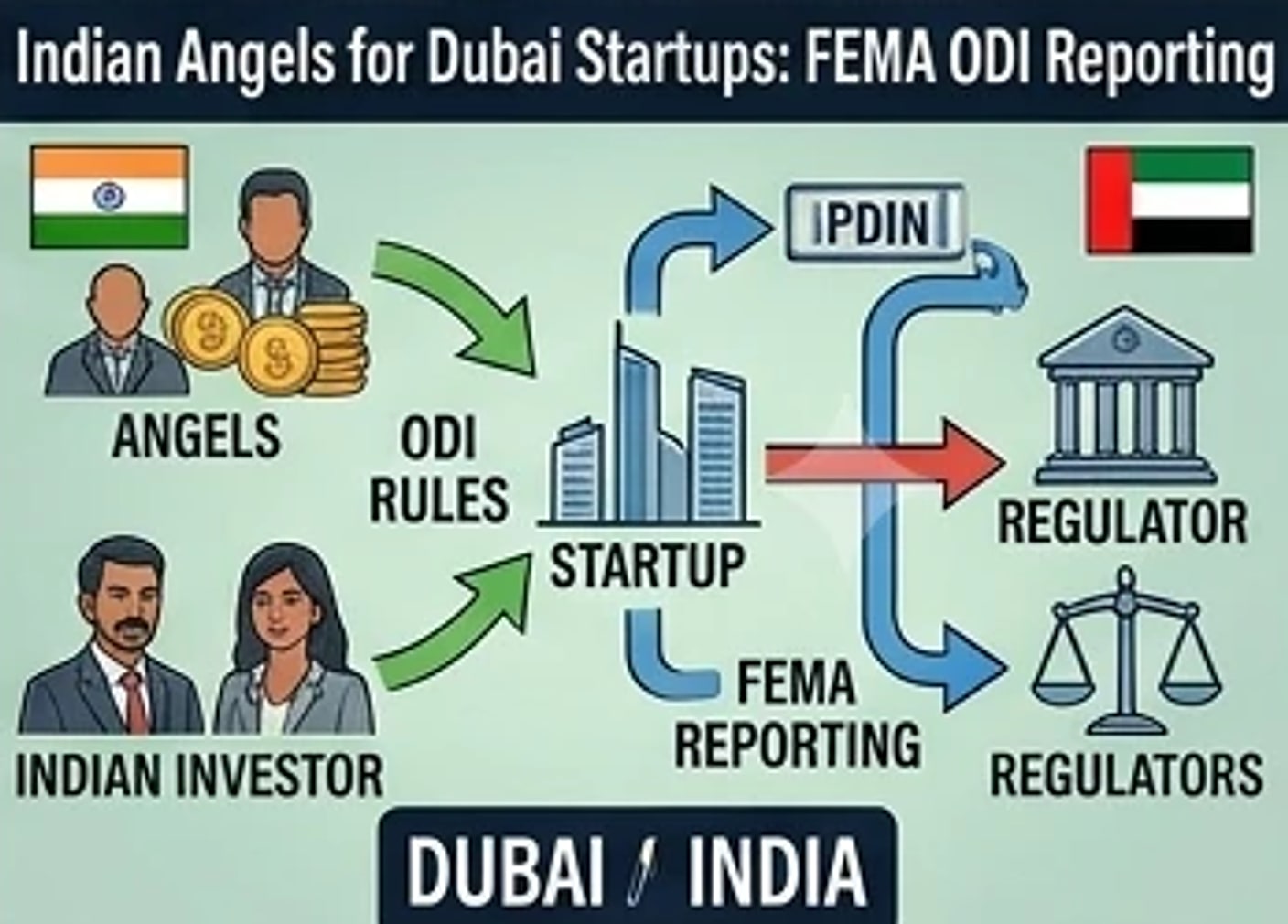
Dubai founders often find that their first cheque comes from an Indian friend, relative or angel. It is easy to say yes and wire the money. For the Indian investor, though, an Indian investor Dubai startup ODI deal is an overseas direct investment under FEMA, with rules that can stop it dead if the company has the wrong kind of structure.
The point is not that it can’t be done. It can, often. It is that the checks fall on the Indian side as much as the Dubai side, and a founder who doesn’t understand them can lose the investor’s money or create a compliance problem for both. Below is how the Overseas Investment Rules, 2022 apply to an individual investor, what to check in your company, and the reporting. The details come from commentary, so confirm them against the rules and RBI’s current directions. An Indian investor Dubai startup ODI deal is an overseas investment under FEMA, and the Overseas Investment Rules 2022 individual route has conditions.
Why an Indian angel needs to care about ODI
When a resident Indian buys shares in a foreign company, it is an overseas investment. Under the Foreign Exchange Management (Overseas Investment) Rules, 2022, residents can make overseas direct investment in an unlisted foreign entity, but only within a set of conditions and reporting steps. The rules also say that a person may stay within the annual remittance limit and still breach the overseas-investment conditions. Any Indian investor Dubai startup ODI cheque is an overseas direct investment.
That is a point founders miss. They look at the investor’s annual limit under the Liberalised Remittance Scheme and conclude that anything inside it is fine. Money going abroad to buy shares in a company is governed by the investment rules first and the LRS second.
So when an Indian investor says they would like to put in ₹50 lakh, your first question is not about the valuation. It is whether your company qualifies and how the investment will be routed and reported. So when an Indian investor Dubai startup ODI conversation starts, check the company before the valuation.
The conditions that can block the deal
For a resident individual, commentary on Schedule III of the Overseas Investment Rules says the investment can be made in an operating foreign entity that is not engaged in financial services activity, and that does not have a subsidiary or step-down subsidiary in which the individual has control. A company that does financial services, which can include some fintech, lending, crypto or investment businesses, is a problem. The Indian investor Dubai startup ODI conditions for individuals are strict.
| Check | Why | Who |
|---|---|---|
| Operating entity, not in financial services | Individuals cannot invest in financial services entities | Both advisers |
| No controlled subsidiary or step-down subsidiary | Condition for individual ODI | Indian adviser |
| LRS limit and Form FC | Funding route and unique identification number | Authorised dealer bank |
| Instrument | Equity is cleaner than notes | Both advisers |
The ODI financial services activity not allowed condition catches many Dubai startups. A payments company, a crypto exchange, a lending marketplace or an investment platform may be classed as financial services. If your business is close to the line, take advice on the Indian classification, which may differ from the UAE licensing view.
The step-down subsidiary control resident individual rule is the second. If the individual has control of the foreign entity and it has subsidiaries, the investment isn’t permitted. A minority angel without control is in a different position. Where the individual holds a small stake without control, commentary says they are not restricted by the presence of subsidiaries. Check what “control” means under the rules, because it is defined by reference to voting rights, board seats and the ability to direct decisions. A minority angel is better placed in an Indian investor Dubai startup ODI deal than a controlling one.
LRS, Form FC and reporting
Individuals typically use their annual LRS limit to fund an overseas investment. Commentary says the limit is currently USD 250,000 per resident individual per financial year, April to March. The LRS limit USD 250,000 per financial year is shared with other overseas spend, such as travel, education and gifts, so an angel’s real room can be smaller. Check the current limit with the bank. For an Indian investor Dubai startup ODI deal, the LRS route is the usual funding method.
Before the first investment, the investor files a form with the authorised dealer bank, called Form FC, and receives a unique identification number from the RBI for the foreign entity. The first investment shouldn’t be made before the Form FC unique identification number is issued. After that, there are annual performance reports and reporting of any changes, so the investor has a continuing duty.
Some money isn’t subject to LRS. Funds earned and kept abroad while the person was non-resident can be used differently, though reporting still applies. Shares received as a gift or by inheritance sit under their own rules. Because the permutations are many, a short call with an Indian FEMA adviser is cheap insurance for both investor and founder. After the first Indian investor Dubai startup ODI payment, annual reporting continues.
Structuring the Dubai side
Founders can help the investor by telling them early what the company does, who owns it and whether it has subsidiaries. Provide a short description of the business activity, the shareholding chart, the licence and the intended use of funds. If the business is borderline on the financial services point, say so and let the investor take advice. Founders can make an Indian investor Dubai startup ODI deal easier by being upfront.
Think about the instrument. A priced equity round is the cleanest for ODI purposes. Convertible notes and SAFEs raise extra questions about whether and when they count as equity for FEMA, and about whether a loan is allowed. Ask an Indian adviser before agreeing a note with an Indian investor.
Prepare the paperwork on your side: share certificates or an equivalent record, a signed subscription agreement, the company’s register of members and a way to receive the funds into the company’s account with proper records. Check the shareholders’ agreement too. Exit, drag and information rights should be workable under both UAE and Indian law. Our posts on Dubai holding companies and FEMA cover the related questions.
Questions people ask
In short: ask the investor to take Indian advice before they wire, and ask your own UAE lawyer to check the company’s activity and structure. Ask any Indian investor Dubai startup ODI partner to take FEMA advice before they wire.
Related reading: Indian angel investors in a UK startup, a Dubai holding company for an Indian founder: FEMA, Indian laws that still apply to Indian founders in Dubai, SAFE and convertible notes in India, ESOPs at a Dubai startup for Indian employees and setting up an AI company in Dubai.
Quick answers
Can an Indian resident invest in a Dubai startup?
Yes, within the Overseas Investment Rules, 2022 and the LRS limit, if the Dubai company is an operating entity not engaged in financial services and meets the control and subsidiary conditions. The investor must also file Form FC and report.
What is the LRS limit for an Indian angel investing abroad?
Commentary says USD 250,000 per resident individual per financial year, shared with other overseas remittances. Confirm the current limit with an authorised dealer bank.
Can a Dubai fintech startup take money from an Indian individual?
Often not under the ODI rules, because individuals can’t invest in entities engaged in financial services activity. Take advice on how the Indian rules classify your business.
Can a Dubai fintech take money from an Indian individual?
Often not under the ODI rules, because individuals cannot invest in entities engaged in financial services.
Final word
Halverton & Co. is an Indian law firm advising NRIs, founders, investors and businesses in Dubai and across the UAE on Indian law, including FEMA, overseas investment and cross-border structuring for Indian investors and founders of UAE companies, alongside UAE-licensed counsel. We practise in Jharkhand, Maharashtra and before the Supreme Court of India, and work alongside UAE-licensed counsel, who advise on UAE law. Halverton & Co.: Where tech needs law! If you have a question about Indian law, write to us at office@halvertonandco.com, or get in touch.
This article reflects developments reported up to 31 October 2026. It is for general information only, is not legal advice, and does not create an advocate-client relationship. Halverton & Co. is an Indian law firm and does not advise on UAE law; UAE-law points should be confirmed with UAE-licensed counsel.
Sources
Related practice area
Startups & Venture
From incorporation to term sheet. The documents a company needs to be fundable.
View the practice areaComments
No account needed. Comments are reviewed before they appear, so yours will show here once approved. Please do not share confidential details or describe your own legal matter: replies are general discussion, not legal advice, and do not create an advocate-client relationship. For your own situation, write to office@halvertonandco.com.