For years, Indian startups competing for engineers against Google, Microsoft and well-funded US companies have faced an awkward problem. The big tech offer letter says “RSUs”. The Indian startup offer letter says “ESOPs”, with an exercise price, a vesting cliff, a tax bill at exercise and a lot of explaining. Candidates often don’t understand why the two look so different.
That gap is about to narrow. Under the Corporate Laws (Amendment) Bill, 2026, RSUs and SARs would receive formal recognition in Indian company law. This guide explains how restricted stock units, stock appreciation rights and phantom stock work in India today, what the Bill changes, how each is taxed, and the legal remedies available when equity compensation promises go wrong. If you are new to employee equity, start with our guide to ESOPs for Indian startups.
How RSUs, SARs and phantom stock differ from ESOPs
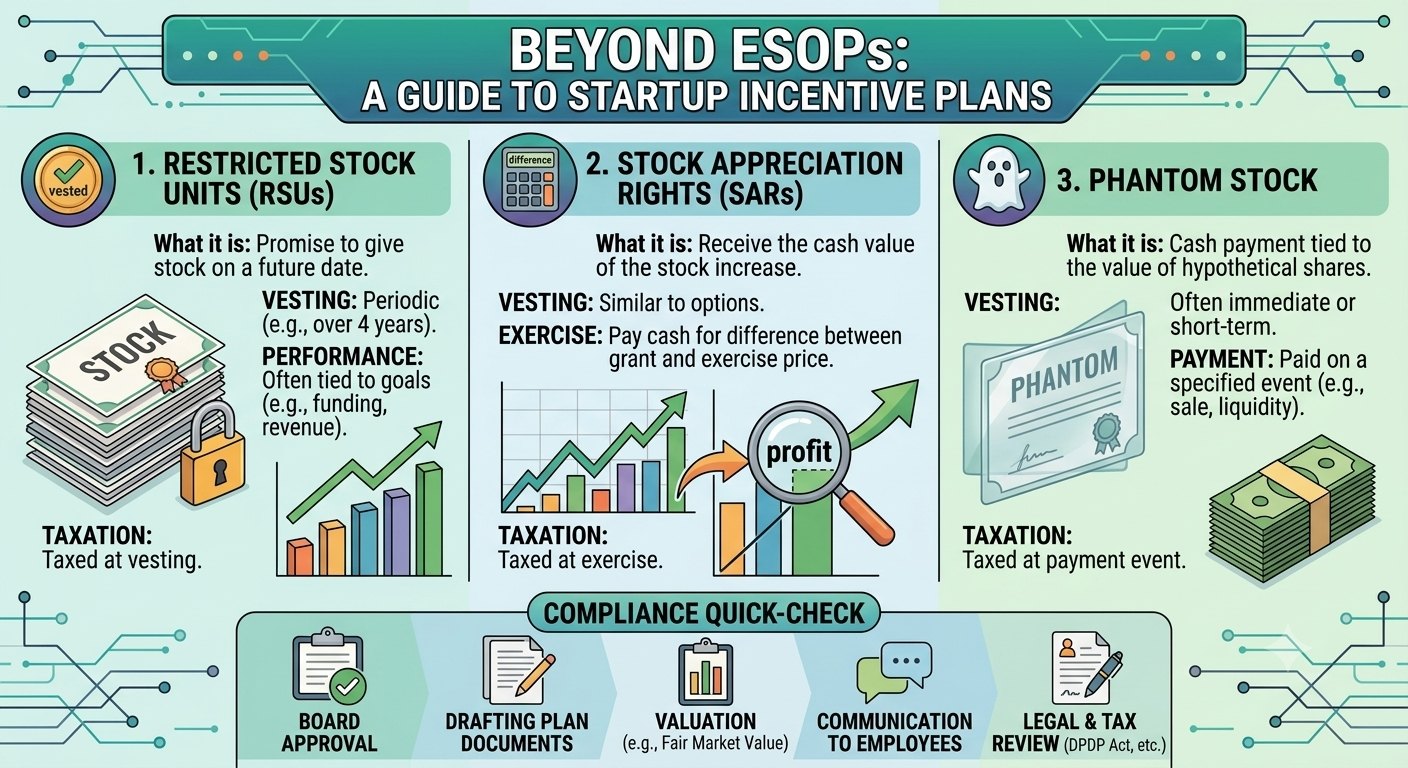
An ESOP is an option: the employee gets the right to buy shares later at a fixed exercise price, and must pay that price to become a shareholder. A restricted stock unit (RSU) is a promise to deliver shares, usually at no cost or a nominal cost, once vesting conditions are met. The employee doesn’t have to find money to exercise, which is why RSUs are so popular with listed technology companies.
A stock appreciation right (SAR) gives the employee the increase in value of a share over a reference price, without the employee buying the share. SARs can be settled in shares (equity-settled SARs) or in cash (cash-settled SARs). Phantom stock goes one step further from real equity: the employee gets a cash bonus linked to the value of a notional number of shares, often paid at an exit or liquidity event, and never becomes a shareholder at all.
| Instrument | What the employee gets | Settled in |
|---|---|---|
| ESOP | Right to buy shares at a fixed exercise price | Shares, after paying the exercise price |
| RSU | A promise of shares at no or nominal cost once vesting conditions are met | Shares |
| SAR | The increase in value of a share over a reference price | Shares (equity-settled) or cash (cash-settled) |
| Phantom stock | A cash bonus linked to the value of notional shares, often paid at an exit | Cash; the employee never becomes a shareholder |
Each of these tools solves a different problem. RSUs are best when you want employees to own shares without paying for them. Equity-settled SARs reward growth while issuing fewer shares, because only the gain is delivered. Cash SARs and phantom stock let founders share upside without diluting the cap table or adding shareholders, which is often attractive to investors in early-stage startups.
The legal position today, and what the 2026 Bill changes
Under the current Companies Act, 2013, unlisted companies issue employee equity mainly through ESOPs under Section 62(1)(b) and Rule 12 of the Companies (Share Capital and Debentures) Rules, 2014, or through sweat equity. Listed companies can use SARs under SEBI’s Share Based Employee Benefits and Sweat Equity Regulations, 2021. For unlisted startups, RSUs have usually been squeezed into the ESOP framework, for example by granting options with a nominal exercise price, and cash SARs and phantom stock have been run as contractual bonus plans rather than as securities.
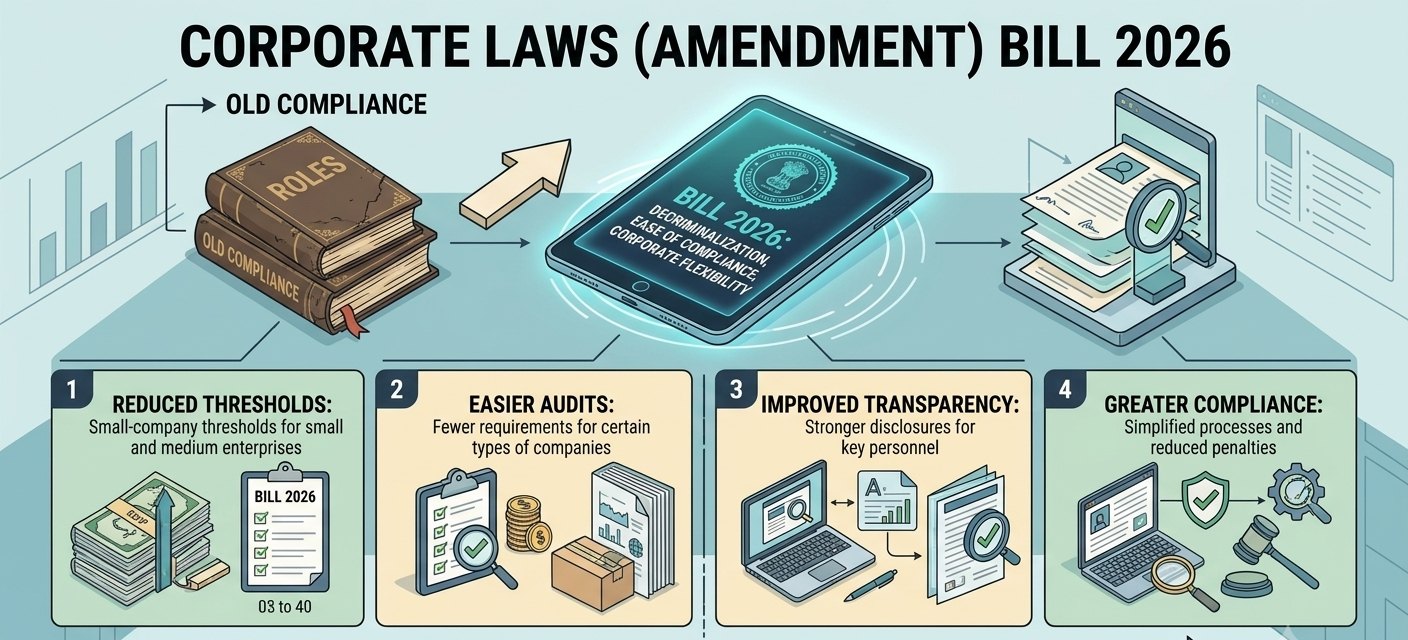
The Corporate Laws (Amendment) Bill, 2026 changes this. It expands preferential allotment to employees under Section 62(1)(b) to cover RSUs and SARs, and excludes allottees under such schemes from the private placement limits in Section 42(2), because shareholder approval is already obtained for the scheme. Commentators have noted that the proposed amendment to Section 68, which deals with buybacks, also matters when structuring SARs with any share-settled component. Our overview of the Corporate Laws Amendment Bill 2026 covers the rest of the package.
The Joint Parliamentary Committee tabled its report on the Bill on 3 August 2026 and recommended adoption with modifications. Until the Bill is passed and the relevant provisions and rules are notified, startups should continue to structure RSUs and SARs within the current law. The recognition is coming, but it isn’t here yet.
How RSUs, SARs and phantom stock are taxed in India
Tax drives employee behaviour more than almost anything else, so it’s worth getting right. When an employee receives shares under an RSU or an equity-settled SAR, the value of the shares, less anything the employee pays, is generally taxed as a salary perquisite in the year of allotment, at the employee’s slab rate. The employer must deduct tax at source. For unlisted shares, the value comes from a registered valuer’s report.
When the employee later sells those shares, capital gains tax applies to the difference between the sale price and the value on which perquisite tax was paid. For unlisted shares held for more than 24 months, long-term capital gains are taxed at 12.5%. Cash-settled SARs and phantom stock are simpler but less tax-efficient: the cash payout is taxed as salary in the year it is paid, with no capital gains treatment.
Employees of eligible startups can defer the tax on ESOP shares at allotment until the earliest of a fixed period, leaving the company or selling the shares. Under the Income-tax Act, 2025, this deferral sits in Section 392(3) read with Section 289(3), and it is available only to startups holding the Inter-Ministerial Board certificate. Whether RSUs and share-settled SARs qualify depends on how they are structured as “specified securities”, so take advice before promising employees a deferral. Our guide to the Income-tax Act 2025 for startups explains the renumbered sections.
Designing an equity plan beyond ESOPs
The right mix depends on your stage. Early-stage startups with few employees and a tight cap table often do well with a simple ESOP plan for the core team and phantom stock or cash SARs for a wider group. Growth-stage companies hiring senior talent from global firms may want RSUs, which candidates already understand, once the law clearly allows them. Companies planning an IPO need to align any plan with SEBI’s regulations well in advance.
For many founders, the answer will be a blend: ESOPs for early employees who joined when the valuation was low, RSUs and SARs for later senior hires who expect global-style packages, and phantom stock for advisers or regional teams. Offering RSUs and SARs in India alongside ESOPs, rather than instead of them, is often the most flexible approach once the law allows it. Whatever you choose, the plan document matters more than the label. Spell out vesting schedules, performance conditions, what happens when someone leaves, how and when payouts are made, how the value is calculated, and what happens on an acquisition or IPO. For phantom stock and cash SARs, define the valuation method precisely, because disputes over “what the share was worth” are the most common source of conflict.
Startups with a foreign parent company should also remember FEMA. Indian employees receiving RSUs or SARs in a foreign holding company are acquiring overseas securities, which is generally permitted for employee schemes but carries reporting obligations. If you’re planning a reverse flip, redesigning the equity plan around the Indian company is part of the work; see our guide to reverse flipping in India.
Disputes, legal remedies and quick answers
Equity compensation disputes usually start when someone leaves or when an exit happens. For employees, the plan document and grant letter are the contract. If a company refuses to deliver vested RSUs, pay out vested SARs or honour phantom stock after an exit, the employee can send a legal notice, invoke arbitration if the plan has an arbitration clause, and seek interim relief under Section 9 of the Arbitration and Conciliation Act to stop a transaction that would defeat their rights. A civil suit for damages or specific performance is available where there’s no arbitration clause. For companies, clear and objective leaver and forfeiture rules, applied consistently, are the best defence against such claims.
Quick answers
Can an Indian private company issue RSUs today?
Not as a separate statutory instrument. Startups usually structure RSUs as ESOPs with a nominal exercise price. The Corporate Laws Amendment Bill 2026 would formally recognise RSUs and SARs once enacted.
How is phantom stock taxed in India?
The cash payout is taxed as salary in the year it is paid, at the employee’s slab rate.
Are SARs better than ESOPs?
Not always. SARs avoid the need to pay an exercise price and issue fewer shares, but the right choice depends on your stage, investors and tax position.
Related reading: stock options for Indian employees of a US startup.
Final word
At Halverton & Co., we work with founders, startups and technology-driven businesses on ESOP, RSU, SAR and phantom stock plans, and equity compensation disputes. We practise in Jharkhand, Maharashtra and before the Supreme Court of India, and act as fractional legal counsel for companies that need senior legal support without a full in-house legal team. Halverton & Co. is built on a simple idea: Where tech needs law! If this issue affects your business, write to us at office@halvertonandco.com, or get in touch, and we’ll help you work out where you stand.
This article reflects the law and developments reported up to early October 2026. Please take advice on your specific facts before acting.
Related practice area
Startups & Venture
From incorporation to term sheet. The documents a company needs to be fundable.
View the practice areaComments
No account needed. Comments are reviewed before they appear, so yours will show here once approved. Please do not share confidential details or describe your own legal matter: replies are general discussion, not legal advice, and do not create an advocate-client relationship. For your own situation, write to office@halvertonandco.com.