Ask a managing partner at a regional firm what keeps them up at night and you’ll hear about recruitment, rising salaries, fixed-fee pressure from clients and the sheer volume of routine work that has to be done properly but can’t be billed at full rates. Legal outsourcing for UK law firms has become one of the most practical answers, and India, with its common law tradition and English-speaking legal workforce, is the natural partner.
But the first question any solicitor asks is the right one: “What will the SRA think?” This guide explains how the SRA approaches outsourcing, the duties that stay with your firm, what can and can’t be sent offshore, and a practical checklist for outsourcing legal work to India without compromising your regulatory position. For the day-to-day picture, see our guide to paralegal support for solicitors.
How the SRA approaches outsourcing
The first thing to know is that the SRA doesn’t have a dedicated outsourcing rulebook. The SRA Standards and Regulations are generally described as containing no explicit reference to outsourcing, so check the SRA’s current guidance before you rely on this summary. Instead, outsourcing is governed by the same principles and codes that apply to everything your firm does: acting in clients’ best interests, maintaining confidentiality, supervising work properly, managing risk and keeping your firm’s systems effective.
In principle, you may outsource anything, provided you meet your legal and regulatory obligations. But you can’t divest yourself of responsibility for compliance with the SRA’s requirements, and you remain accountable to the SRA when work is delivered through others. In practice, that means the outsourcing provider becomes part of your firm’s delivery model, and the SRA will judge the result as if your own staff had done the work.
The Law Society has published a practice note on outsourcing, relevant to all firms and sole practitioners authorised by the SRA, which is worth reading alongside your own compliance manual. Outsourcing is a staple of many firms’ operating models, delivering cost and efficiency gains for firms and clients. Legal outsourcing for UK law firms is mainstream. The question is how to do it well.
The duties that stay with your firm
Supervision is the first. Under the SRA Code of Conduct for Solicitors, where you supervise or manage others providing legal services, you remain accountable for the work carried out through them and must supervise it effectively. Offshore team members are no exception. Your solicitors should give clear instructions, review the work before it’s relied on, and keep a record of that review.
Confidentiality is the second. Your duty to keep clients’ affairs confidential doesn’t change because a document has crossed a border. Outsourcing risks around confidentiality, supervision and practice management must not be ignored in pursuit of efficiency. You need a written agreement with the provider covering confidentiality, data security, conflicts and the return or destruction of documents, plus a lawful basis for any international transfer of personal data under UK GDPR; see our guide to UK GDPR transfers to India.
Client care is the third. Clients are entitled to understand who is doing their work and how they’re being charged. Many firms include an outsourcing clause in their terms of business, explaining that certain support work may be carried out by trusted third-party providers, including overseas, under the firm’s supervision. Some clients, particularly financial institutions and public bodies, have their own outsourcing restrictions, so check engagement terms before sending their work offshore.
| Duty | What it means in practice |
|---|---|
| Supervision | Clear written instructions, review before reliance, and a recorded review |
| Confidentiality | Written agreement on confidentiality, security, conflicts and return or destruction of documents |
| Data protection | A UK GDPR transfer mechanism and a transfer risk assessment |
| Client care | Tell clients about outsourcing in your terms of business; check client-specific restrictions |
| Reserved activities | Never outsource them to a provider that is not authorised to carry them out |
Reserved legal activities: the line you can’t cross
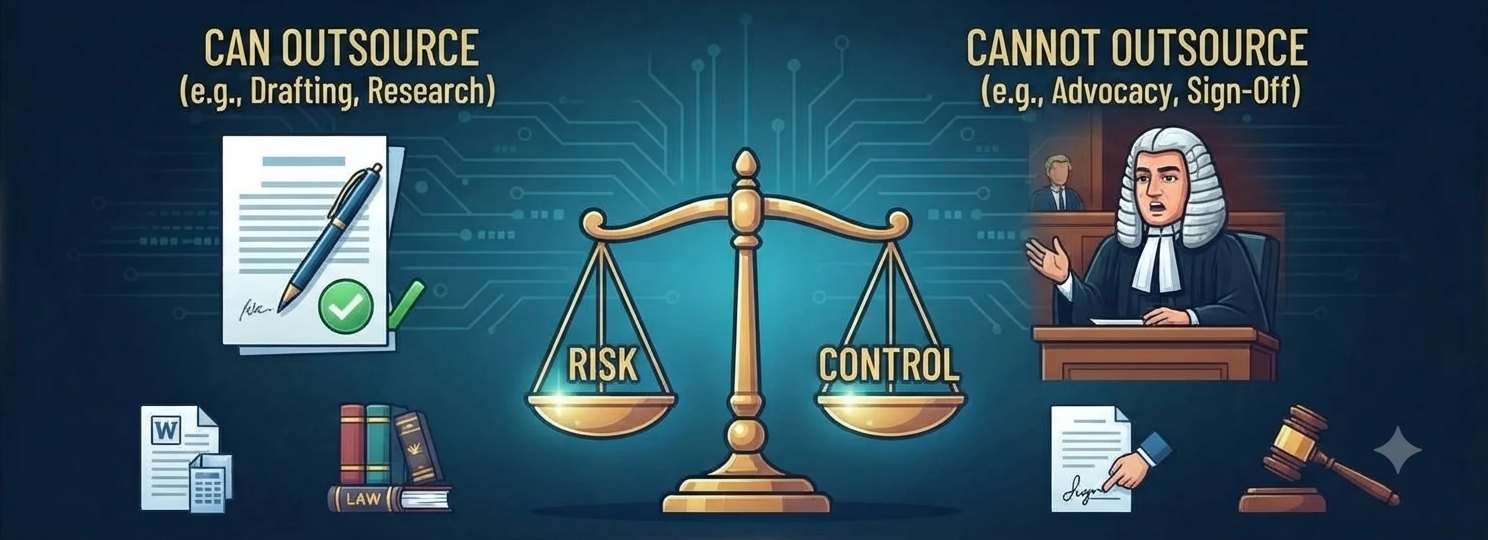
The firm limit on legal outsourcing for UK law firms is reserved legal activities. You must not outsource the provision of reserved legal services to any provider that isn’t authorised by the SRA or another approved regulator to provide them. Under the Legal Services Act 2007, reserved legal activities are the exercise of rights of audience, the conduct of litigation, reserved instrument activities (broadly, certain conveyancing and registration work), probate activities, notarial activities and the administration of oaths. We explain each in our guide to reserved legal activities.
That doesn’t mean an offshore team can’t help with matters involving those activities. A team in India can prepare research, draft documents for a solicitor’s review, organise disclosure, summarise witness evidence or prepare chronologies for litigation. What it can’t do is conduct the litigation, take steps in proceedings, or carry out the reserved activity itself. Your solicitor makes the decisions, signs and files.
A useful test is simple: if the task is a reserved activity, or requires the exercise of independent legal judgement on a client’s behalf, it stays with authorised people in your firm. If it produces a draft, a summary, a search or an analysis your solicitor reviews and adopts, it can be outsourced.
A practical checklist for outsourcing legal work to India
Before you start, carry out due diligence on the provider: qualifications and experience of the team, references from other UK firms, data security arrangements and certifications, insurance, and the professional rules that bind its staff in India. Record your assessment, because it’s evidence of the risk management the SRA expects.
Put a written services agreement in place. It should cover the scope of work, confidentiality and data protection (including UK GDPR transfer terms), conflict checks, quality standards and turnaround times, subcontracting restrictions, audit rights, business continuity, intellectual property in work product, termination and exit arrangements, and governing law and dispute resolution.
Then manage the work. Name a supervising solicitor for each matter, give written instructions, restrict access to the documents each task needs, review every deliverable and keep a file note. Review the arrangement periodically, at least annually, and whenever the scope changes. If something goes wrong, your COLP will need to assess whether it’s reportable, so make sure the provider is contractually obliged to tell you about incidents quickly. For the equivalent US framework, see our ABA 08-451 checklist.
Getting started, remedies and quick answers
Small and mid-sized practices often gain the most. A high-street or regional firm can’t always justify a full-time research lawyer or an additional litigation paralegal, but it can use legal outsourcing for UK law firms on a flexible basis, paying only for the work it needs. The best way to begin is with a small pilot: one practice area, a defined task such as legal research or document review, a fixed fee and a three-month review. Measure accuracy, turnaround and fee-earner time saved.
If problems arise, your remedies are both contractual and practical: the services agreement gives you rights to require remedial work, claim damages or terminate, while your supervising solicitor’s review is the safety net that stops errors reaching clients. Any data incident should be assessed promptly for ICO and client notification, and any regulatory issue escalated to your COLP. For IP work, see our guide to trade mark renewals and watching. Have a UK solicitor review your arrangements before relying on this article.
Quick answers
Does the SRA allow UK law firms to outsource work to India?
Yes. The SRA Standards and Regulations don’t prohibit outsourcing, but the firm remains accountable for compliance and must not outsource reserved legal activities to unauthorised providers.
Do we need to tell clients we outsource?
It’s good practice, and often necessary, to explain outsourcing in your terms of business, particularly where client data is transferred overseas.
What work is best suited to outsourcing?
Legal research, document review, first drafts, chronologies, IP searches and renewals, and due diligence support, all under solicitor supervision.
Related reading: UK law firms practising in India.
Final word
Halverton & Co. is an Indian law firm. We do not advise on English law, act in UK proceedings or carry out reserved legal activities, and nothing in this article is an offer of services. If you have a question about the Indian side of an offshore arrangement, such as Indian law, contracts or data protection, you can write to us at office@halvertonandco.com, or get in touch. Halverton & Co.: Where tech needs law!
This article reflects developments reported up to early October 2026. It is for general information only, is not legal advice, and does not create a solicitor-client relationship. Halverton & Co. is an Indian law firm, is not authorised or regulated by the Solicitors Regulation Authority, and does not advise on English law.
Related practice area
Startups & Venture
From incorporation to term sheet. The documents a company needs to be fundable.
View the practice area