Most solicitors know the feeling: a full diary of client calls and court deadlines, and a growing pile of research, bundles, chronologies and first drafts that someone needs to do carefully. Hiring another in-house paralegal isn’t always possible, and agency temps rarely know your files. Offshore paralegal support for solicitors fills that gap.
This guide explains how offshore paralegal teams actually work in practice for UK firms: which tasks they handle best, how supervision and communication work day to day, what it costs, how to protect client data, and how to start. For the regulatory framework, read our guide to what the SRA expects from UK law firms first.
Why UK firms use offshore paralegal support
Outsourcing is a staple of many UK law firms’ operating models, delivering cost and efficiency gains for firms and clients. For smaller and mid-sized firms in particular, offshore paralegal support for solicitors offers access to trained legal staff without the overheads of recruitment, office space and employment costs.
India is a natural fit. Its legal system is rooted in the common law, many Indian statutes trace their origins to English legislation, and Indian lawyers are trained in reading cases, analysing statutes and drafting in English. That makes the learning curve on English legal work far shorter than many firms expect.
The time difference also helps. India is four and a half to five and a half hours ahead of the UK, depending on the time of year, so an offshore team can start work before the London office opens, and work instructed in the morning can often be returned the same day.
Which tasks suit offshore paralegal support
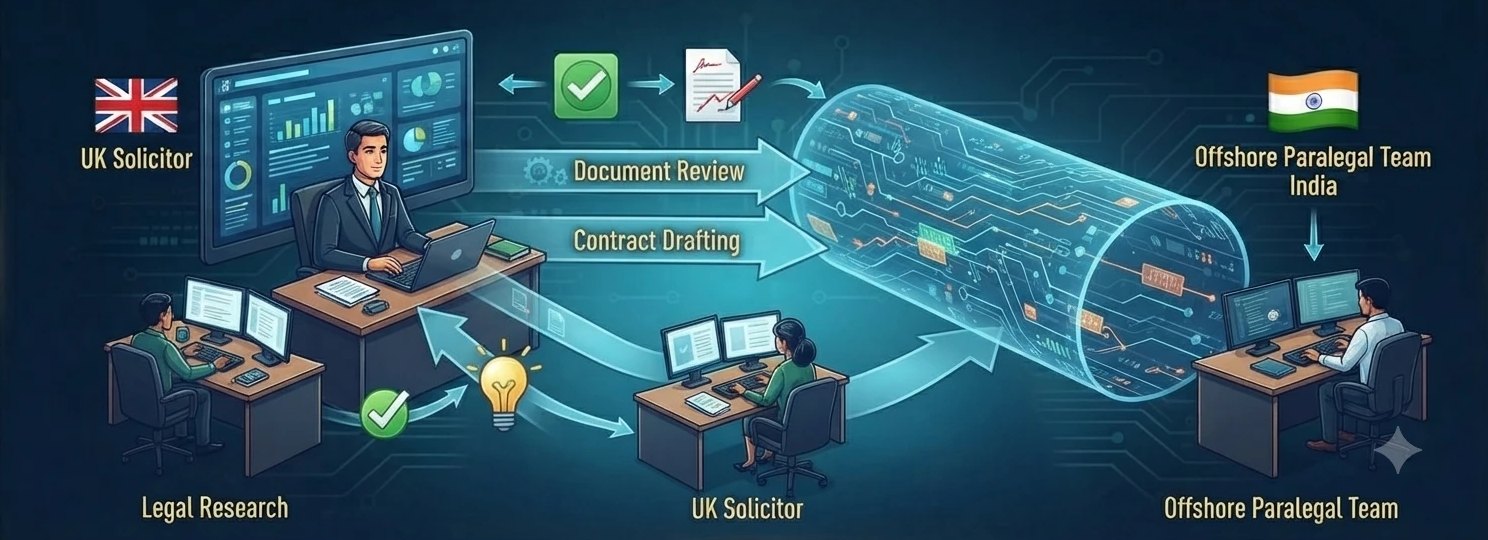
The best tasks for offshore paralegal support for solicitors share three features: clear instructions, a defined output, and a reviewing solicitor. Legal research is the classic example: a note on the current law on a point, a survey of recent cases, or a summary of a regulatory regime, all for the solicitor to check and use.
Litigation support is another strong area: preparing chronologies, dramatis personae and bundles, first-level disclosure review, summarising witness statements and transcripts, and preparing first drafts of routine documents for a solicitor to settle. Commercial and corporate support includes due diligence reviews, contract abstraction, first-draft NDAs and standard agreements, and data room organisation.
IP support works particularly well offshore: trade mark searches and watching, renewal management, portfolio audits and preparing filing documents for an attorney’s review; see our guide to trade mark renewals and watching. Firms also use offshore support for legal know-how work, such as updating precedents and practice notes. Tasks that touch reserved activities need particular care; see our guide to reserved legal activities.
| Area | Typical tasks (all for solicitor review) |
|---|---|
| Research | Notes on current law, surveys of recent cases, regulatory summaries |
| Litigation support | Chronologies, bundles, first-level disclosure review, witness statement and transcript summaries |
| Commercial and corporate | Due diligence reviews, contract abstraction, first-draft NDAs, data room organisation |
| IP | Trade mark searches and watching, renewals, portfolio audits, filing documents |
| Know-how | Updating precedents and practice notes |
How supervision and communication work day to day
Effective paralegal support for solicitors depends on good habits more than technology. Each matter should have a named supervising solicitor who sets the task in writing: the question, the jurisdiction, the format, the deadline and any documents to be used. For new types of work, a short video call at the start saves time later.
It also helps to share your firm’s style guide, precedent bank and examples of good work. A team that knows how your partners like a research note structured, or how your litigation team formats chronologies, produces work that needs far less editing. Good paralegal support for solicitors improves quickly once the offshore team understands your house style. The offshore team should ask questions rather than guess. A shared channel for queries, with an agreed response time, keeps work moving. Deliverables come back with a short covering note explaining what was done, any assumptions made and anything the solicitor should check.
The supervising solicitor reviews every deliverable before it’s relied on. Under the SRA’s approach, the firm remains accountable to the SRA when work is delivered through others, so review isn’t a formality. Over time, as quality is proven, review becomes faster, but it never disappears.
Costs, confidentiality and data security
Turnaround expectations should be agreed per task type, for example same-day for urgent research questions and two to three working days for a full chronology, so that fee earners can plan. Quality grows with continuity. Firms that work with the same small team over months see far better results than those that treat each task as a one-off, because the team learns the firm’s clients, matters and preferences.
Pricing models vary. Many firms use a monthly retainer for a dedicated team member or team, which works well for steady workloads. Others use per-task or fixed-fee pricing for defined projects such as a due diligence exercise or a disclosure review. Fixed and predictable pricing also makes it easier to offer clients fixed fees.
Confidentiality and data protection need careful handling. Outsourcing risks around confidentiality, supervision and practice management must be addressed, not ignored. Sharing personal data with an offshore team is usually a restricted transfer under UK GDPR. The ICO’s own example describes a UK business contracting with an IT support company in India whose staff access UK-held personal data through a VPN, with a restricted transfer occurring when the data becomes accessible. You’ll need an appropriate transfer mechanism, such as the International Data Transfer Agreement, and a transfer risk assessment; see our guide to UK GDPR transfers to India.
Insurance deserves a mention too. Check that your professional indemnity cover and the provider’s own insurance respond appropriately to work carried out offshore, and record the arrangement in your risk register. Practical security measures matter as much as contracts: working inside your firm’s own document management system rather than emailing files, restricted access by matter, no local downloads, multi-factor authentication, and individual confidentiality undertakings from every team member.
Getting started, remedies and quick answers
Start with a pilot of one to three months in a single practice area, with a defined set of tasks and a fixed fee. Measure accuracy, turnaround and how much fee-earner time the work saves. Put a written agreement in place from day one, covering confidentiality, data protection, quality standards, turnaround, intellectual property in work product and termination.
If problems arise, the agreement gives you remedies, from requiring corrections to termination, and the supervising solicitor’s review keeps errors away from clients. Firms that invest time in the first few weeks of instructions usually find that offshore paralegal support for solicitors becomes one of the more reliable parts of their practice. For the US equivalent, see our guide to offshore paralegal services for US law firms.
Quick answers
Can UK solicitors use offshore paralegals?
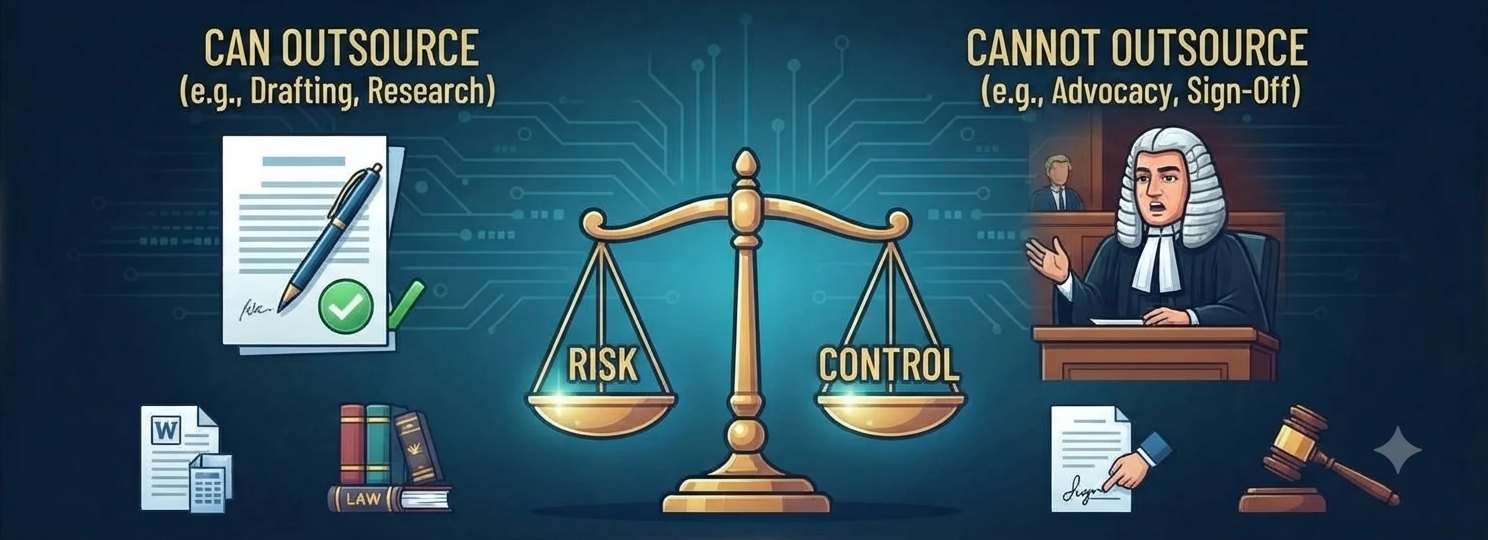
Yes. The SRA doesn’t prohibit outsourcing, but the firm remains accountable, must supervise the work, protect confidentiality and not outsource reserved legal activities.
What tasks are best for offshore paralegal support?
Legal research, chronologies and bundles, disclosure review, due diligence, contract abstraction, first drafts and IP administration.
Is sending client data to India allowed under UK GDPR?
Yes, with a valid transfer mechanism such as the IDTA and a transfer risk assessment, plus appropriate security.
Final word
Halverton & Co. is an Indian law firm. We do not advise on English law, act in UK proceedings or carry out reserved legal activities, and nothing in this article is an offer of services. If you have a question about the Indian side of an offshore arrangement, such as Indian law, contracts or data protection, you can write to us at office@halvertonandco.com, or get in touch. Halverton & Co.: Where tech needs law!
This article reflects developments reported up to early October 2026. It is for general information only, is not legal advice, and does not create a solicitor-client relationship. Halverton & Co. is an Indian law firm, is not authorised or regulated by the Solicitors Regulation Authority, and does not advise on English law.
Related practice area
Startups & Venture
From incorporation to term sheet. The documents a company needs to be fundable.
View the practice area