Every conversation about outsourcing in a UK law firm eventually reaches the same question: “Is this a reserved activity?” It’s the right question, because reserved legal activities are the one area where outsourcing to an unauthorised provider is simply not allowed. But the list of reserved activities is shorter, and the line clearer, than many people assume.
This guide explains the six reserved legal activities under the Legal Services Act 2007, why they matter, what offshore and unauthorised teams can do around them, and how to draw the line safely in day-to-day practice. It builds on our guide to what the SRA expects from UK law firms that outsource to India.
What are reserved legal activities?
The Legal Services Act 2007 reserves six activities to people who are authorised (or exempt) to carry them out. They are the exercise of a right of audience, the conduct of litigation, reserved instrument activities, probate activities, notarial activities and the administration of oaths. Anyone carrying on a reserved legal activity without being entitled to do so commits a criminal offence under the Act.
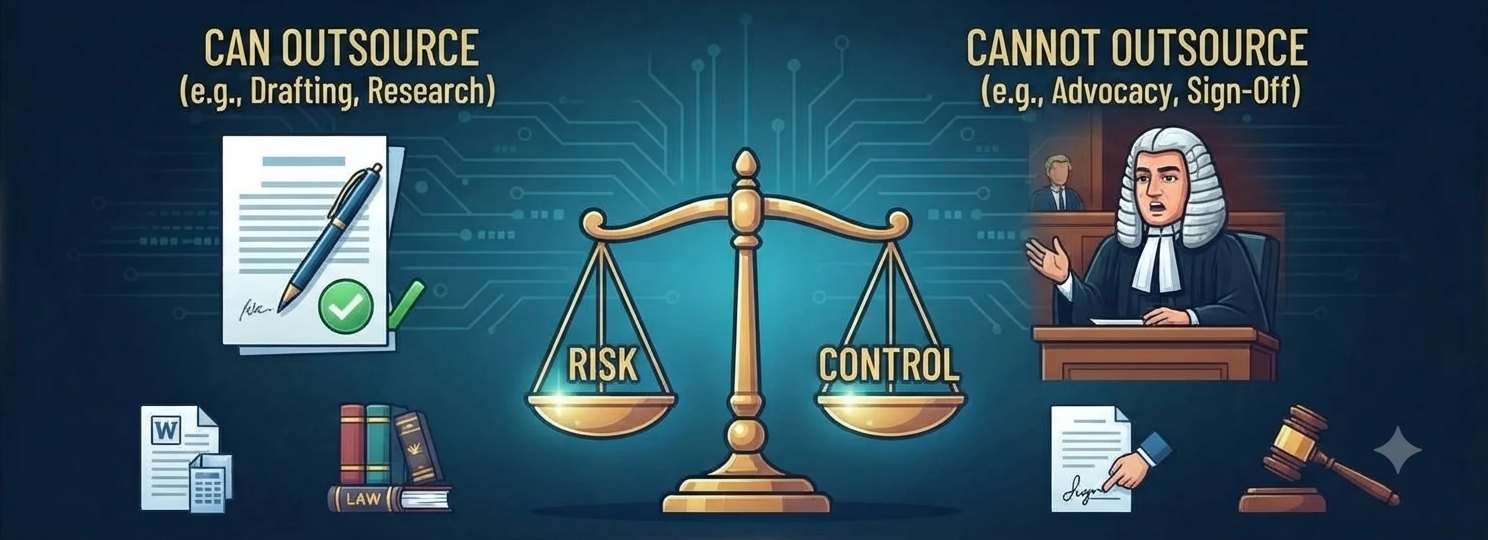
Everything else, which is most legal work, is unreserved. Giving legal advice, drafting most contracts and wills, negotiating settlements and preparing employment documents are all unreserved activities in England and Wales, even though solicitors carry out much of that work. That distinction matters for outsourcing, because unreserved work can be supported by unauthorised people, including offshore teams, while reserved work can’t.
For SRA-regulated firms, the practical rule is that you must not outsource the provision of reserved legal services to any provider that isn’t authorised by the SRA or another approved regulator. Firms can still outsource other work, but they remain accountable to the SRA for it.
| Activity | In broad terms |
|---|---|
| Rights of audience | The right to appear before and address a court |
| Conduct of litigation | Issuing and conducting proceedings and taking formal steps in them |
| Reserved instrument activities | Preparing certain instruments relating to land and registration documents for reward |
| Probate activities | Preparing the papers on which a grant of probate or letters of administration is founded |
| Notarial activities | Work reserved to notaries |
| Administration of oaths | Taking oaths, reserved to those authorised to do so |
The six reserved legal activities in practice
Rights of audience and the conduct of litigation are the two reserved legal activities that affect most practices. A right of audience is the right to appear before and address a court. The conduct of litigation covers issuing proceedings, commencing or defending them, and performing ancillary functions such as taking formal steps in the proceedings. Courts have interpreted “conduct of litigation” with care, so firms should treat formal steps in proceedings, and decisions about them, as reserved.
Reserved instrument activities broadly cover preparing certain instruments relating to land and registration documents for reward, such as transfers of land. Probate activities cover preparing the papers on which a grant of probate or letters of administration is founded. Notarial activities are reserved to notaries, and the administration of oaths to those authorised to take them.
Unreserved work still has its own rules. Will writing and many forms of legal advice can be provided by unregulated businesses, but when an SRA-regulated firm provides them, the firm’s regulatory duties apply in full, whoever does the underlying work. That is why outsourcing arrangements focus on supervision and accountability, not only on reserved legal activities. Note that this is about the law of England and Wales. Scotland and Northern Ireland have their own regulatory arrangements, so firms with practices across the UK should check the position in each jurisdiction.
What unauthorised and offshore teams can do around reserved work
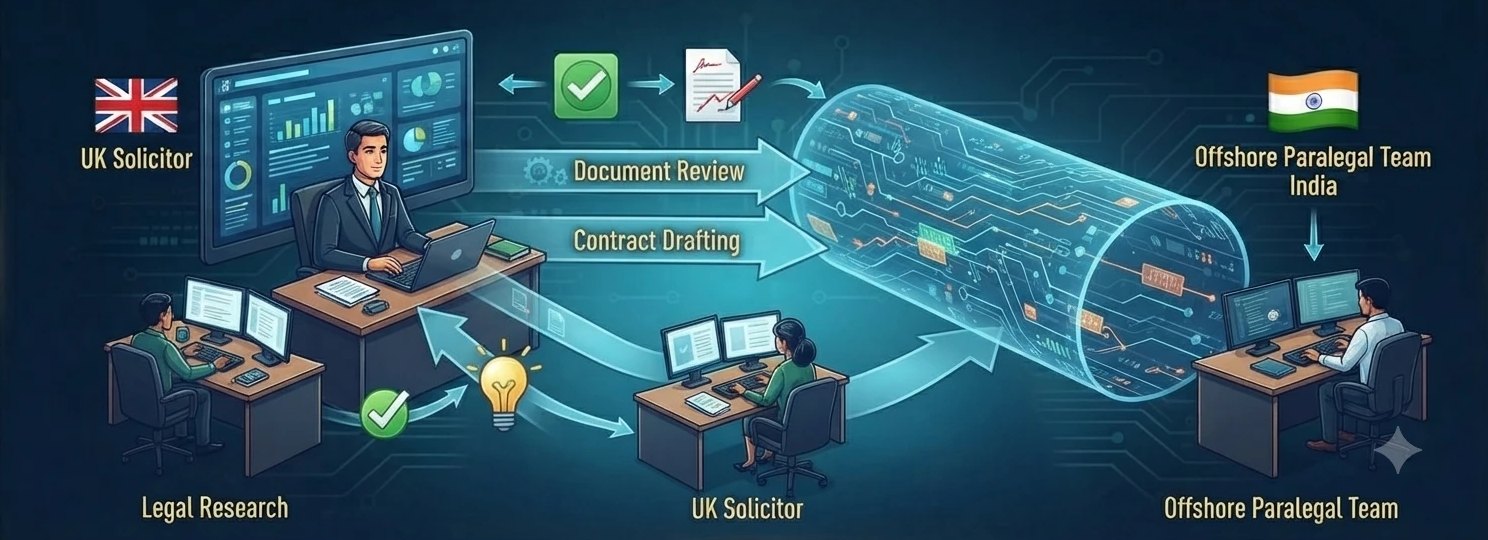
The key insight for outsourcing is that reserved legal activities are narrow acts, while the work around them is broad. In litigation, for example, an offshore team can carry out legal research, prepare first drafts of pleadings and witness statements for a solicitor to settle, review and code disclosure documents, prepare chronologies and bundles, and summarise transcripts. The solicitor with conduct of the litigation reviews, decides, signs and takes the formal steps.
In property and private client work, an offshore team can check title documents, prepare reports on title for review, draft standard documents for a fee earner to approve, and organise estate information. The authorised person prepares the reserved instruments or probate papers, signs off and submits them.
The same logic applies in every practice area. Work that informs or prepares for the reserved act can be supported; the reserved act itself, and the professional judgement behind it, stays with authorised people. That’s how legal outsourcing models used by UK firms remain compliant. See our guide to paralegal support for solicitors for the tasks in practice.
How to draw the line safely
Firms using freelance or consultant solicitors face similar questions, because a self-employed solicitor carrying out reserved legal activities must be properly authorised and insured in their own right. The same discipline of writing down who does what applies. Write the line down. Your outsourcing agreement and internal procedures should list the tasks the provider may perform and expressly exclude reserved legal activities and direct client advice. Instructions to the offshore team should identify the supervising solicitor and the output expected, such as a draft or a summary, rather than an action.
Control access to systems that carry out reserved acts. For example, the offshore team shouldn’t have log-in access to court e-filing systems or the Land Registry portal on your firm’s behalf. That removes the risk of an accidental filing by someone who isn’t authorised.
Review the arrangement whenever your practice changes. A firm that adds immigration, conveyancing or probate work should revisit which tasks touch reserved legal activities and update its outsourcing procedures before work starts flowing offshore. Train both sides. Your fee earners should understand which tasks can be delegated, and the provider’s team should understand why they mustn’t take formal steps or communicate with courts, registries or opponents in your firm’s name. A short briefing at the start of a relationship prevents most problems.
Risks, remedies and quick answers
If a reserved activity is carried out by someone who isn’t entitled to do it, the consequences can be serious: potential criminal liability under the Legal Services Act, regulatory action by the SRA, and challenges to the validity of steps taken in proceedings or transactions. If you discover a breach, stop the activity immediately, take advice, assess whether the step needs to be regularised or repeated by an authorised person, and consider your reporting obligations to the SRA through your COLP. Clear procedures, restricted system access and solicitor sign-off make these problems very unlikely in a well-run outsourcing arrangement. Have a UK solicitor review the summaries here, and check the Legal Services Board’s guidance, before you rely on them. Related reading: trade mark renewals and watching, UK GDPR transfers to India and the US framework in our ABA 08-451 checklist; also UK law firms practising in India.
Quick answers
What are the reserved legal activities?
Rights of audience, conduct of litigation, reserved instrument activities, probate activities, notarial activities and the administration of oaths, under the Legal Services Act 2007.
Can an offshore team help with litigation?
Yes, with research, drafting, disclosure review and bundles, but the conduct of litigation and formal steps must stay with authorised persons.
Is giving legal advice a reserved legal activity?
No. General legal advice is unreserved in England and Wales, although regulated firms remain responsible for advice given in their name.
Final word
Halverton & Co. is an Indian law firm. We do not advise on English law, act in UK proceedings or carry out reserved legal activities, and nothing in this article is an offer of services. If you have a question about the Indian side of an offshore arrangement, such as Indian law, contracts or data protection, you can write to us at office@halvertonandco.com, or get in touch. Halverton & Co.: Where tech needs law!
This article reflects developments reported up to early October 2026. It is for general information only, is not legal advice, and does not create a solicitor-client relationship. Halverton & Co. is an Indian law firm, is not authorised or regulated by the Solicitors Regulation Authority, and does not advise on English law.
Related practice area
Startups & Venture
From incorporation to term sheet. The documents a company needs to be fundable.
View the practice area