Key takeaways
- India protects GIs under the Geographical Indications of Goods (Registration and Protection) Act, 1999, with a Registry in Chennai.
- A foreign GI must first be protected in its country of origin, and the applicant is normally an association or authority.
- The UK-India agreement signed on 24 July 2025 lists GIs in its annexes, but it has effect only once in force and implemented.
- Combine GI registration with certification and ordinary trade marks, monitoring, platform complaints and distributor contracts.
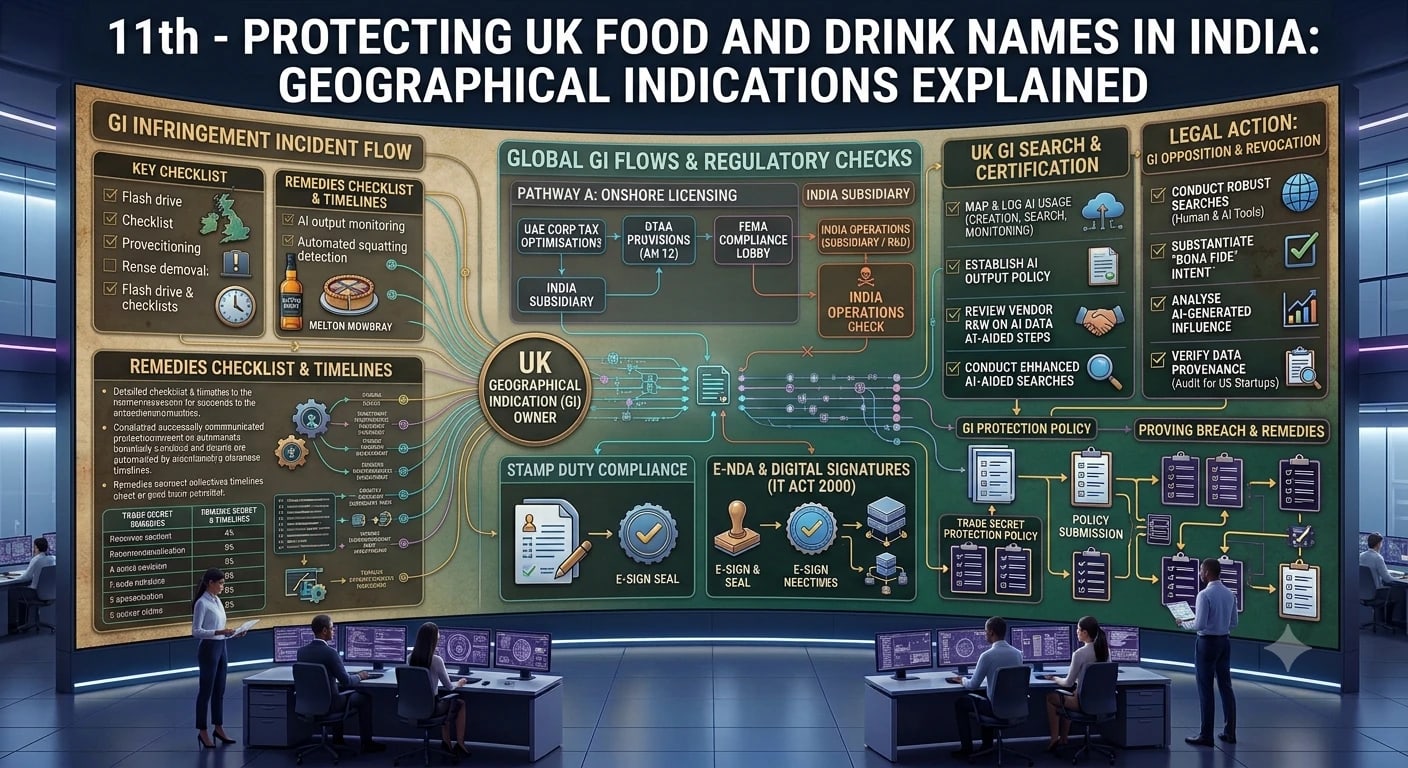
Names such as Scotch whisky, Stilton and Cornish pasty carry reputation built over generations. Copycat products using those names can erode that reputation quickly in a large market such as India. UK producers asking how to protect their products usually need to understand three things: how Indian law protects geographical indications, how the UK-India trade agreement changes the position, and what practical steps a producer should take. This guide explains geographical indication India UK products rely on, from registration to enforcement.
It covers the Geographical Indications of Goods (Registration and Protection) Act, 1999, how foreign GIs can be registered, the effect of the UK-India Comprehensive Economic and Trade Agreement signed in July 2025, other tools such as trade marks and passing off, and a practical plan. It is written by an Indian law firm for UK producers. UK GI scheme questions should be confirmed with your UK advisers.
How GIs work under Indian law
A geographical indication identifies goods as originating from a territory, where a given quality, reputation or other characteristic is essentially attributable to that origin. In India, the Geographical Indications of Goods (Registration and Protection) Act, 1999 and the Rules of 2002 set up a Geographical Indications Registry, with the Registrar based in Chennai, which is part of the office of the Controller General of Patents, Designs and Trade Marks. Registration is the foundation of geographical indication India UK products protection.
Registration gives the registered proprietor and authorised users the right to use the GI and to take action against unauthorised use, with civil remedies by way of injunction and damages and criminal penalties. The Act gives general protection against use that misleads the public or amounts to unfair competition, and additional protection for certain goods, in particular wines and spirits, under Section 22.
A GI is a collective right. It belongs to a producers’ association or a statutory body, not to one company, and individual producers become authorised users. This is different from a trade mark, which belongs to one business. The collective nature affects how a UK GI can be registered, who the applicant is and how quality control is shown. Understanding this structure is the starting point for any plan for geographical indication India UK products.
Registering a UK GI in India
Foreign GIs can be registered in India, but the GI must be protected in its country of origin first, as Section 9 of the Act makes clear. For UK products, this usually means that the name is protected under the UK GI schemes, for example as a Protected Designation of Origin or Protected Geographical Indication, or by other law. The application is made by an association of producers or an authority, with a statement of case, a map of the territory, the specification and evidence of reputation.
Scotch whisky is the most widely cited example. It has been registered as a GI in India and benefits from additional protection for spirits. The Scotch Whisky Association has also used passing off and trade mark law in Indian courts, including in a Delhi High Court action against a local bottler, to stop products that misuse the name. Check the register entry and the year of registration before you cite it. It shows how a geographical indication India UK products rely on can be enforced in practice.
Plan the filing. Agree who will apply and whether a public authority can act as proprietor, as the trade agreement side letters contemplate. Prepare a specification that is precise about territory, method and quality. Appoint an Indian GI agent. The application is examined and published for opposition, and the process can take some time, so start well before you need to enforce. Costs are modest compared with the value of a famous name.
The UK-India trade agreement and GIs
The UK-India Comprehensive Economic and Trade Agreement was signed on 24 July 2025 and includes provisions on geographical indications, with annexes listing the GIs each side will protect, and side letters setting out procedures. The annexes distinguish GIs for wines, spirits, agricultural products and foodstuffs from those for other goods. The agreement sets up a mechanism so that listed names receive protection in the other country.
Check the status of the agreement before you plan around it. A trade agreement takes effect only after each side completes its ratification and domestic steps, and implementation may require changes to Indian rules or a process for registering the listed GIs. Some agricultural GIs were reported to be a sticking point in earlier talks. Confirm which of your products are listed and when protection starts.
Even with a treaty listing, do not assume that enforcement is automatic. A producer may still need to register, record rights, brief customs and platform teams and be ready to take action in an Indian court. The treaty strengthens your position and shows the government’s commitment, but evidence of use, reputation and misuse will remain central to any case. Registration remains the safest base for geographical indication India UK products in the Indian market.
Other tools and enforcement
Use more than one layer of protection. A certification trade mark under the Trade Marks Act, 1999 can be filed by a body that certifies origin or quality, and collective marks can identify members of an association. A producer’s own brand should be registered as an ordinary trade mark. Passing off protects goodwill in a name even where it is not registered, where a competitor’s product misleads buyers about origin or quality.
Enforcement works best with monitoring. Watch Indian marketplaces, import records and the Trade Marks Journal for products that use your names or close variants, such as ’Scotch-style’ or ’Stilton type’. Complaints to e-commerce platforms often work faster than a suit. Customs recordation of rights can help stop imports in some cases. Send a measured legal notice, and go to court for an injunction where there is serious misuse.
Think about the supply side. A product that is exported to India under a distributor’s brand needs a contract that restricts use of the GI name to genuine products and requires labelling that meets Indian food law, including FSSAI rules. Use your brand guidelines and training to prevent accidental misuse by partners. Record all use in India to show reputation over time. Distributor contracts are where geographical indication India UK products are most often misused.
| Tool | Who holds the right | Best for |
|---|---|---|
| Geographical indication | A producers’ association or authority, with authorised users | Names tied to a place, such as Scotch whisky |
| Certification trade mark | A body that certifies origin or quality | Quality and origin schemes |
| Ordinary trade mark | One business | A producer’s own brand |
| Passing off | The business with goodwill in the name | Misleading use where nothing is registered |
| Contracts and labelling | Producer and distributor | Stopping misuse by partners |
Next steps and quick answers
Start with an audit. List your protected names, check where they are protected at home, check whether any are listed in the UK-India agreement, and search the Indian GI register and Trade Marks Registry. Decide which names to register in India, who will apply and what quality controls will be shown. Add certification or ordinary trade mark filings, and set up monitoring. Take advice on timing, since the agreement’s entry into force may change your options. Start now, since geographical indication India UK products need registered rights before a dispute begins.
Related reading: the UK-India trade deal: a legal checklist, UK trade marks in India: Madrid or national filing, counterfeit goods in India: remedies for UK brands, trade mark squatting in India for UK companies, trade mark renewals and watching services for UK firms, defending a UK brand against a trade mark opposition in India and licensing a UK brand to Indian franchisees.
Quick answers
Can UK food and drink names be registered as GIs in India?
Yes, if the name is protected in the UK first and an association or authority applies with a specification and evidence. Scotch whisky is a well-known example.
Does the UK-India trade agreement protect UK GIs automatically?
Not automatically. The agreement lists GIs and sets procedures, but it takes effect only after ratification and implementation. Check the status and register where needed.
What if a competitor in India uses a name like ’Scotch-style’ or ’Stilton type’?
You may have claims under the GI Act, trade mark law and passing off, depending on registration and facts. Gather evidence and take advice before sending a notice.
Is the UK-India trade agreement in force?
It was signed on 24 July 2025, but it takes effect only after each side completes its domestic steps. Check the current status before relying on it.
Who applies for a GI in India?
An association of producers or an authority applies, not one company. Individual producers then become authorised users.
Final word
Halverton & Co. is an Indian law firm advising UK companies, founders, investors and law firms on Indian law, including geographical indications, trade mark and brand protection, food and beverage regulation, and trade agreement compliance for exporters to India. We practise in Jharkhand, Maharashtra and before the Supreme Court of India, and work alongside your UK solicitors, who advise on English law. Halverton & Co.: Where tech needs law! If you have a question about Indian law, write to us at office@halvertonandco.com, or get in touch.
This article reflects developments reported up to late October 2026. It is for general information only, is not legal advice, and does not create a solicitor-client relationship. Halverton & Co. is an Indian law firm, is not authorised or regulated by the Solicitors Regulation Authority, and does not advise on English law; UK-law points should be confirmed with UK advisers.
Sources
Related practice area
Intellectual Property
Trade marks, copyright, patents and designs. Searched, filed, licensed and enforced under Indian law.
View the practice areaComments
No account needed. Comments are reviewed before they appear, so yours will show here once approved. Please do not share confidential details or describe your own legal matter: replies are general discussion, not legal advice, and do not create an advocate-client relationship. For your own situation, write to office@halvertonandco.com.