Key takeaways
- Contractors in India own the copyright in code they write unless there is a written assignment that meets Section 19 of the Copyright Act.
- Section 19 defaults an assignment with no stated duration to five years and with no stated territory to India only.
- No court has recognised an independent copyright in trained model weights, so protect them as trade secrets through contracts and access controls.
- Document the chain of title for code, datasets and weights now, because investors will ask for it in diligence.
A UK startup hires a team in Bengaluru or Pune to build its AI product. A year later, an investor asks a simple question in due diligence: who owns the model? The answer has more parts than founders expect. The code, the training data and the trained model’s weights are different assets, protected by different rules, and the contracts that cover them are often missing or incomplete.
This guide explains who owns what when a UK startup builds AI with Indian developers: the code and architecture, the weights, the datasets, and the outputs. It covers the Indian rules on employment, contractors and assignments that catch UK companies by surprise, the open question of whether weights can be protected by copyright, and what to put in your contracts. It is written from the Indian-law perspective; UK-law points should be confirmed with your UK advisers.
Three layers of AI IP: code, data and model
An AI product has at least three layers. The first is code: the training pipelines, the architecture, the inference system and the application around it. The second is data: the datasets used to train and evaluate the model, and the labels and annotations added to them. The third is the model itself: the architecture’s trained parameters, usually called weights, and associated artefacts such as checkpoints and embeddings. Each layer is protected, if at all, by different rights, and each can have a different owner.
Founders tend to assume that whoever pays for the work owns it. That is true in some places and not in others, and it is not the default in India for work done by independent contractors. The ownership question has to be answered layer by layer, and then checked against the contracts the company actually signed with each developer, annotator and data supplier.
| Layer | Main protection | Key risk |
|---|---|---|
| Code and architecture | Copyright; assignment from employees and contractors | Contractors own code unless it is assigned in writing; Section 19 defaults |
| Training data | Copyright and database rights (UK); compilation copyright (India); licences | Unlicensed or scraped data; personal data duties |
| Weights and checkpoints | Trade secret and contract; copyright is unsettled | No statute in India; leaks are hard to undo |
| Outputs | UK: computer-generated works; India: unsettled | Do not assume protection in both countries |
Investors and acquirers will ask the same questions. A clear chain of title for code, a documented source and licence for every dataset, and a clear position on the weights are now standard requests in diligence for AI companies, and gaps lead to price reductions, special indemnities or failed deals. It is much cheaper to fix the paperwork while the team is small.
Code and architecture: employees, contractors and Section 19
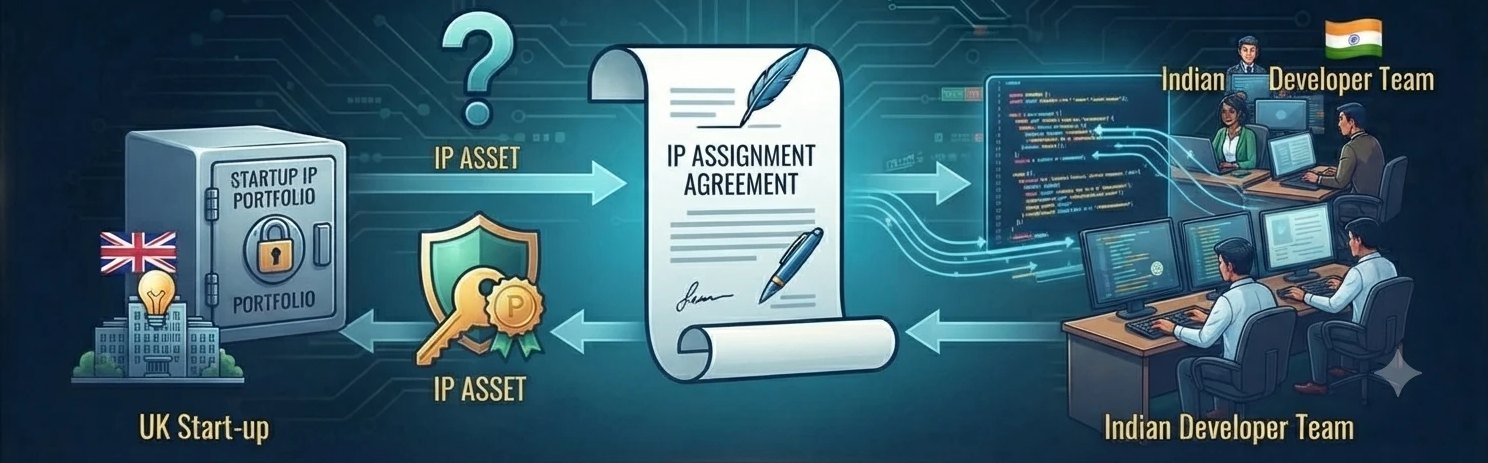
Under India’s Copyright Act, 1957, a computer programme is a literary work. Where an employee writes code in the course of employment under a contract of service, Section 17 generally makes the employer the first owner, unless the contract says otherwise. Independent contractors and freelancers are different. Work done under a contract for services belongs to the contractor unless it is assigned in writing. Many UK startups engage Indian developers as contractors, directly or through agencies, and assume the company owns what they build. Without a signed assignment, that isn’t safe.
When you do assign, Section 19 of the Act adds traps that many UK-style templates miss. An assignment has to be in writing, and it should identify the work and the rights, and state the duration and the territory. If no duration is stated, it is deemed to be five years. If no territory is stated, it is presumed to be India. And an assignment can lapse if the assignee doesn’t exercise the rights within a year, unless the contract provides otherwise. A UK startup that wants worldwide, perpetual rights should say so expressly, include present assignment of future work, and exclude the statutory defaults.
In the UK, the employer is generally the first owner of work created by employees in the course of employment, and a contractor owns their work unless it is assigned, so the concerns overlap, but the Indian formalities are additional and are easy to miss. If the developers are employed by an Indian subsidiary or an employer-of-record, the chain needs a second link: the assignment from the developer to the Indian employer, and the assignment from the Indian employer to the UK company. Each link should be in writing and signed.
Weights: trade secret, contract and an open copyright question
No court that we are aware of has recognised an independent copyright in a trained AI model as such, and academic commentary notes that whether weights count as protected expression is unresolved (Dreyfus; The Leaflet). One Indian commentator argues that the Copyright Act’s definition of a literary work, which includes tables and compilations and computer databases, could cover a model’s parameter file as a structured collection of values, but this is an argument and not an established rule (Khurana & Khurana). Treat copyright protection for weights as possible and unproven.
The reliable protection is confidentiality. Several sources converge on trade secret law as the most appropriate mechanism for safeguarding trained models (Dreyfus; Mayer Brown). India has no dedicated trade secret statute, so protection rests on contracts and the equitable doctrine of breach of confidence. That makes your agreements central. Employment and contractor contracts should name the specific assets, such as trained weights, model parameters, checkpoints, embeddings, prompts and fine-tuning data, instead of relying on a general reference to confidential information, and the technical set-up should make it hard for any individual to copy the weights.
Check your base model licence. If you fine-tune an open-weight model, your fine-tuned weights are usually subject to the base model’s licence, which may restrict commercial use, require attribution, limit the size of the user base or ban certain uses. Your rights over the derivative weights are only as secure as your rights over the base model. Document which model you started from and under which licence, and keep a copy of the licence as it stood on the day you downloaded it.
Datasets: licences, scraping and personal data
Datasets raise the most diligence questions. In the UK, databases can attract copyright and a separate database right where there has been substantial investment in obtaining, verifying or presenting the contents. India has no equivalent sui generis database right, though a compilation can be protected as a literary work if it shows enough skill and judgment in selection and arrangement. If your dataset was built in India by Indian annotators, make sure those annotators assigned their rights to you, and that third-party datasets you used were licensed for commercial training.
Scraped data is a growing risk on both sides of the border. The Delhi High Court’s July 2026 interim ruling in ANI v. OpenAI leaned towards treating training as fair dealing, but the ruling is interim and on appeal, and a government working paper proposes a mandatory licence with statutory royalties. UK courts are still working through how copyright applies to AI training. A dataset built from scraped content is not a safe asset to rely on until the law settles, and its provenance should be documented.
Personal data adds a further layer. Data about people in India falls under India’s Digital Personal Data Protection Act, 2023, with the main obligations from May 2027, and data about people in the UK is covered by UK GDPR. Datasets that mix both need a lawful basis and notices under each regime. And for outputs, the UK’s rule that a computer-generated work has the person who made the arrangements as author has no direct equivalent in India, where the position on AI-generated content is unsettled, so don’t assume that outputs are protected in both countries.
Structuring, disputes and quick answers
A clean structure helps. Many UK startups hold the IP in the UK parent and use an Indian subsidiary as a service provider paid on a cost-plus basis, with a written assignment of all IP the subsidiary’s people create. Contractors sign IP assignments directly to the parent or to the subsidiary with onward assignment. The parent keeps the weights in a controlled environment, with access logged. For diligence, assemble an IP file: employment and contractor agreements, assignments, a list of third-party and open-source components with licences, dataset licences and sources, and the base model licence. If a developer leaves with a copy of the weights or code, act fast: Indian courts can grant interim injunctions against misuse of confidential information, and evidence preserved at the time makes a difference. If an assignment turns out to be defective, a confirmatory assignment signed now is far better than a dispute later.
Related reading: who owns the code: IP assignment for UK start-ups with Indian developers, computer-generated works: how India and the UK treat AI copyright, hiring developers in India from the UK, using Indian tech and AI teams on UK client data, trade secrets in India: protecting source code and algorithms, AI training data licensing with Indian publishers and open-source licence audits for startups with Indian developers; also structuring AI training data licences after Ross and the October 2026 AI music copyright suits; also software copyright protection in India; also Getty v. Stability AI at the Court of Appeal.
Quick answers
Who owns code written by Indian contractors?
The contractor, unless there is a written assignment that satisfies Section 19 of the Copyright Act, covering the rights, the duration and the territory.
Can model weights be protected by copyright?
It is unsettled. The safer route is to protect weights as trade secrets through contracts, access controls and records.
Do I need to register IP for an AI model in India?
No registration is needed for copyright, but software-related patents face Section 3(k), so many AI companies rely on confidentiality instead.
Can I rely on an Indian employer-of-record for IP ownership?
Only if the chain is documented. The developer must assign to the employer, and the employer must assign to the UK company, each in writing and signed, with the Section 19 rights, duration and territory stated.
What should I record about a fine-tuned model?
The base model used, the licence under which you downloaded it (keep a copy as it stood that day), the datasets used and their licences. Fine-tuned weights are usually subject to the base model’s licence.
Final word
Halverton & Co. is an Indian law firm advising UK companies, founders, investors and law firms on Indian law, including IP assignment, technology contracts and ownership structures for AI products built with Indian development teams. We practise in Jharkhand, Maharashtra and before the Supreme Court of India, and work alongside your UK solicitors, who advise on English law. Halverton & Co.: Where tech needs law! If you have a question about Indian law, write to us at office@halvertonandco.com, or get in touch.
This article reflects developments reported up to late October 2026. It is for general information only, is not legal advice, and does not create a solicitor-client relationship. Halverton & Co. is an Indian law firm, is not authorised or regulated by the Solicitors Regulation Authority, and does not advise on English law; UK-law points should be confirmed with UK advisers.
Sources
Related practice area
Intellectual Property
Trade marks, copyright, patents and designs. Searched, filed, licensed and enforced under Indian law.
View the practice areaComments
No account needed. Comments are reviewed before they appear, so yours will show here once approved. Please do not share confidential details or describe your own legal matter: replies are general discussion, not legal advice, and do not create an advocate-client relationship. For your own situation, write to office@halvertonandco.com.