Key takeaways
- HMRC sent about 65,000 crypto nudge letters in 2024-25 and more than 80,000 in 2025-26, according to reports; the letter is a prompt, not a penalty.
- UK exchanges began collecting CARF data on 1 January 2026, with first reports due in 2027.
- India taxes crypto gains at 30% with 1% TDS, and the treatment depends on your Indian residence; double tax relief needs advice from both countries.
- Act promptly: gather records from every platform, correct any errors and take UK and Indian advice.
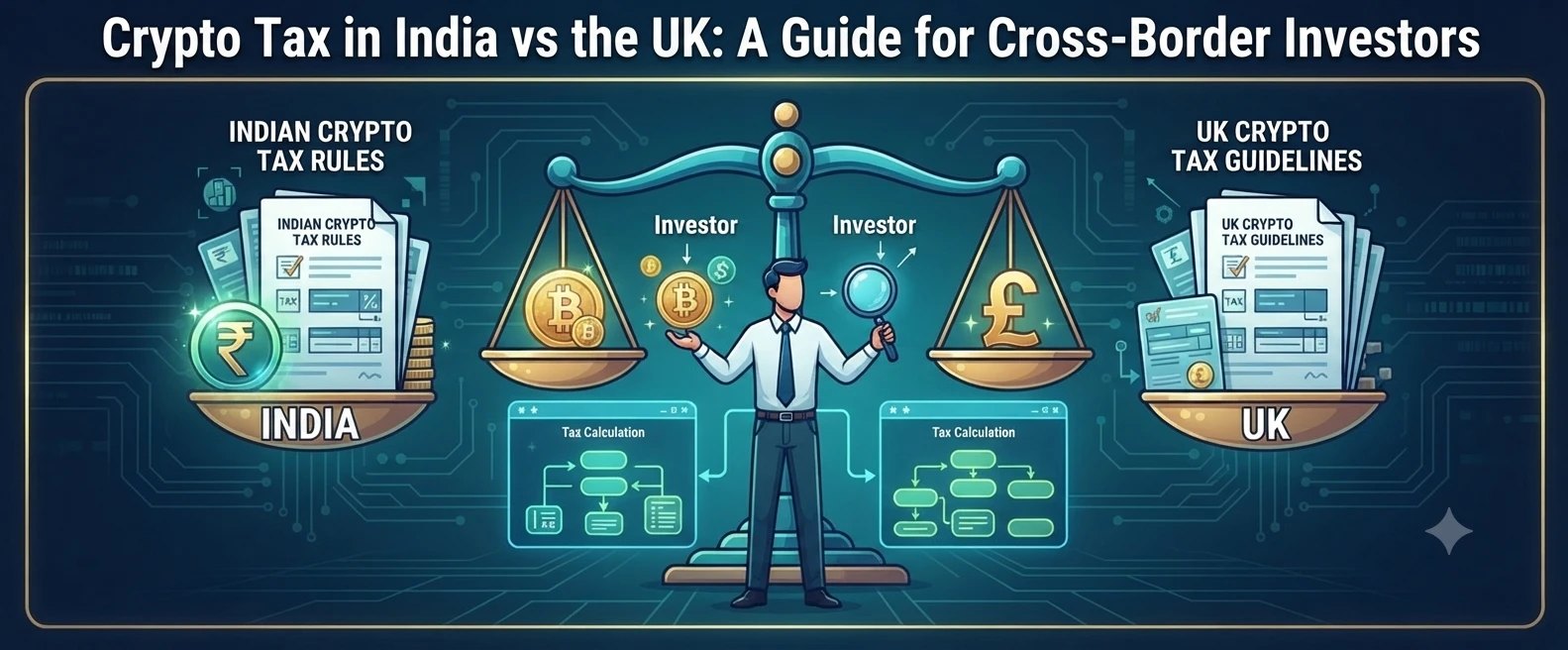
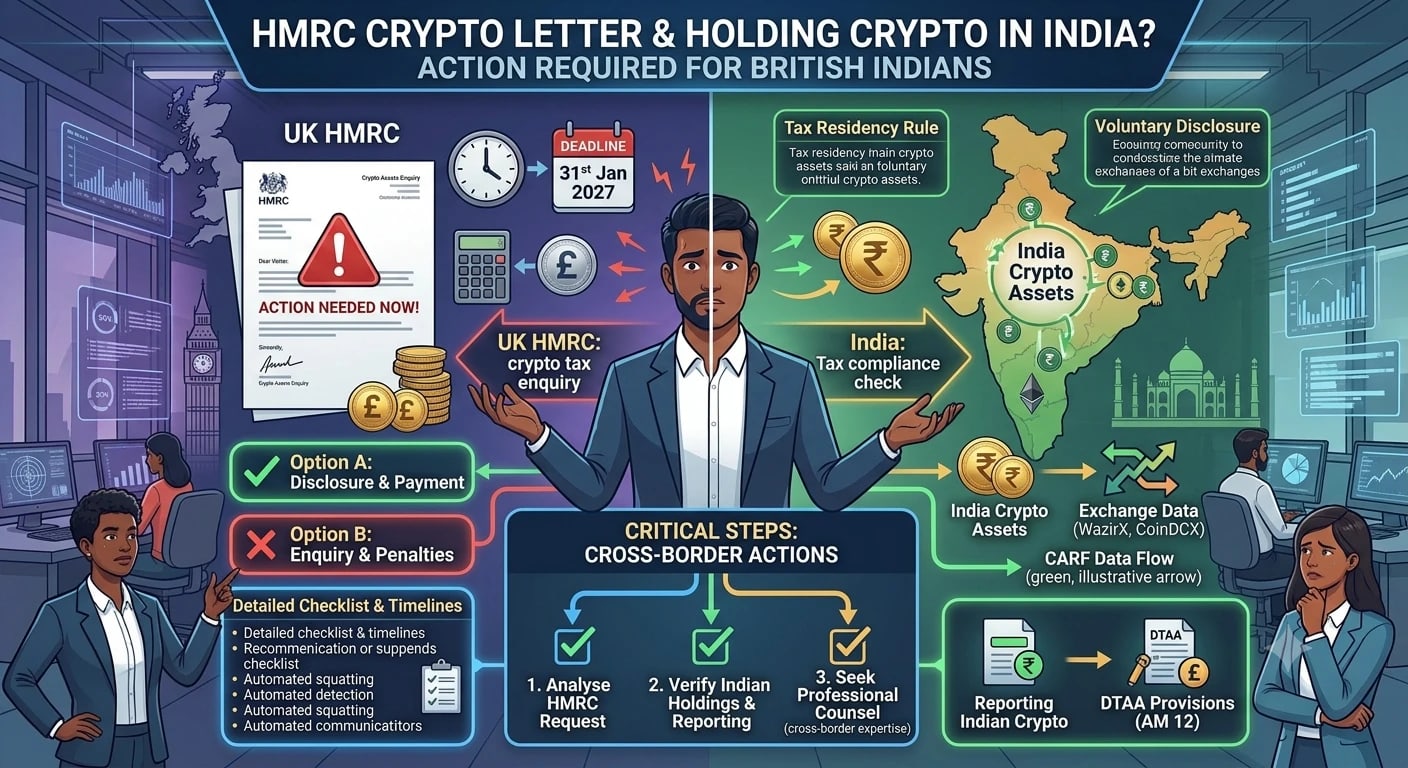
If you have received an HMRC crypto letter and also hold crypto in India, do not ignore it and do not panic. These letters are called nudge letters: they say HMRC believes you may have undeclared crypto gains or income and invite you to check and correct your tax position. For British Indians, the extra challenge is that your crypto may also be taxed in India, so the HMRC crypto letter India question has two sides.
This guide explains what the letter means, what HMRC can see, how UK tax applies to crypto, how Indian rules apply to residents and non-residents, and the steps to take now. It is written by an Indian law firm. UK tax points should be confirmed with a UK tax adviser, and Indian points with an Indian adviser, because the treatment depends on your residence.
What an HMRC crypto letter means
A nudge letter is not a penalty notice or an investigation. It is a prompt. HMRC sends it when it holds data that suggests you traded or received crypto and may not have reported it. Reports say HMRC sent about 65,000 crypto letters in 2024-25, more than double the year before, and more than 80,000 in 2025-26. Most letters rely on information HMRC already receives from exchanges and other sources.
The letter usually asks you to check whether you reported gains, income or both, and to use a disclosure route if you did not. It may give a deadline, and it may warn of penalties if you stay silent and are later found to be inaccurate. Silence is the worst response. If you act promptly and make a full disclosure, penalties are usually lower than if HMRC opens an enquiry later. An HMRC crypto letter India holders receive should be treated as a deadline, not a suggestion.
HMRC’s visibility is also increasing. Under the OECD’s Crypto-Asset Reporting Framework, UK exchanges and service providers began collecting user and transaction data on 1 January 2026, with the first reports due to HMRC in 2027. Information about UK residents who use overseas platforms is expected to arrive through international exchange over time. So the HMRC crypto letter India problem will not disappear if you ignore it.
How UK tax applies to crypto
For most individuals, selling, swapping or spending crypto is a disposal for Capital Gains Tax. You calculate the gain as proceeds less allowable cost, using the UK’s pooling rules, with special matching rules for same-day and 30-day purchases. Crypto received as pay, or from activities such as staking, mining and some airdrops, may be taxed as income. Gifts to a spouse are treated differently from gifts to others.
Your residence matters. UK residents are generally taxed on worldwide gains. From 6 April 2025, the old remittance basis was replaced by a new regime for people who are new arrivals in the UK, with a four-year relief. Check which regime applies to you. Allowances change from year to year, and you must report gains above the annual limits through Self Assessment, even if you have no tax to pay in some cases.
Keep records for every transaction: dates, amounts in pounds, wallet addresses and exchange statements. Crypto tax software helps, but you remain responsible for the figures. If you hold crypto on an Indian exchange, you should still include those disposals in your UK return if you are UK resident, converting values to pounds at the right dates.
The India side
India taxes crypto differently from the UK. Gains on virtual digital assets are taxed at a flat 30% under Section 115BBH of the Income-tax Act, 1961, now carried into the Income-tax Act, 2025, with no deduction except the cost of acquisition and no set-off of losses. A 1% tax deducted at source applies on transfers under Section 194S. These rules apply to Indian tax residents and can apply to non-residents on Indian-source transfers.
Your Indian status decides the rest. A person who stays in the UK may be a non-resident Indian for tax, and then India taxes only income that is received in India or arises or accrues in India. A resident or not-ordinarily-resident person has wider exposure and must report foreign assets. Exchanges in India deduct TDS and report to the tax department, so your Indian activity is visible there, and India has a crypto reporting framework of its own.
Double taxation can arise when both countries tax the same gain. The India-UK double taxation treaty may give relief, and the UK allows credit for foreign tax in some cases, but the rules for crypto are not settled and depend on where the gain arises and on your residence. Take advice from both sides before you claim relief, and keep proof of any Indian tax paid. Double tax is the main reason an HMRC crypto letter India link needs advice from both countries.
What to do now
First, read the letter and note the deadline. Do not ignore it, and do not reply with a guess. Collect your records from every exchange and wallet, including Indian platforms, and rebuild a transaction history for the tax years concerned. HMRC can generally go back four years for careless errors, longer for more serious ones. Identify which years you have reported and which you have not.
| Step | What to do | Why |
|---|---|---|
| Read the letter | Note the deadline and the years covered | Deadlines and look-back periods drive the response |
| Collect records | Exchange statements, wallet histories and Indian platform data | HMRC and Indian authorities may hold the same data |
| Check what you owe | Rebuild gains and income by tax year in pounds | Disclosure must be accurate |
| Disclose and pay | Use HMRC’s disclosure route or amend returns | Prompt disclosure usually lowers penalties |
| Check India | Review Indian returns, TDS credits and any Indian tax due | Avoid double tax and Indian notices |
Second, check what you owe and correct it. If you find unreported gains or income, use HMRC’s disclosure process or amend your returns, and pay what is due. A voluntary, prompt disclosure usually attracts lower penalties than a disclosure after HMRC starts an enquiry. If you also have Indian tax issues, such as unreported Indian gains or missing returns, plan the order of corrections with advisers on both sides.
Third, get professional help. A UK tax adviser can handle the HMRC response, and an Indian adviser can deal with Indian filings, TDS credits and treaty relief. Consider whether you need to correct your Indian return and whether your Indian bank or exchange accounts are in order. Keep copies of everything you send. If the letter looks suspicious, check that it is genuine through HMRC’s official channels before replying. Handling an HMRC crypto letter India cases involve requires both UK and Indian records.
Next steps and quick answers
Set up a clean system from now: one record of all crypto transactions in both countries, a yearly review, and a plan for filing in both the UK and India. If you are moving between the countries, take advice on residence before you move. Treat the HMRC crypto letter India issue as a prompt to put your whole position in order, not just one year. This is general information, not tax advice.
Related reading: crypto tax in India and the UK compared, UK crypto exchanges and Indian users: FIU-IND registration and tax, the crypto nudge email from the tax department, FCA crypto authorisation for overseas firms, what CARF means for Indian expats, crypto tax in India: 30% and 1% TDS and NRI crypto tax notices; also CARF for UK investors with Indian exchange accounts; also crypto as property under UK law.
Quick answers
What should I do if I get an HMRC crypto letter?
Do not ignore it. Check your records, work out whether you reported your crypto gains and income, and make a disclosure if needed. Take advice from a UK tax adviser, and from an Indian adviser if you also hold crypto in India.
Does HMRC know about my Indian crypto?
Not necessarily today, but reporting under the Crypto-Asset Reporting Framework and other exchange of information is increasing. UK residents with crypto in India should assume that information will reach HMRC over time.
Can I be taxed twice on the same crypto gain?
Possibly, if both countries tax it. The India-UK treaty and UK foreign tax credit rules may give relief, but the rules for crypto are not settled. Get advice before you claim it.
Is an HMRC nudge letter an investigation?
No. It is a prompt to check your position, but ignoring it can lead to an enquiry and higher penalties if HMRC later finds an error.
Will HMRC find out about my crypto in India?
Not necessarily today, but reporting under the Crypto-Asset Reporting Framework and other exchange of information is increasing, so assume that data will reach HMRC over time.
Final word
Halverton & Co. is an Indian law firm advising UK companies, founders, investors and law firms on Indian law, including cross-border tax and compliance for NRIs and British Indians, virtual digital asset regulation, and investor advisory on India-UK matters. We practise in Jharkhand, Maharashtra and before the Supreme Court of India, and work alongside your UK solicitors, who advise on English law. Halverton & Co.: Where tech needs law! If you have a question about Indian law, write to us at office@halvertonandco.com, or get in touch.
This article reflects developments reported up to 31 October 2026. It is for general information only, is not legal advice, and does not create a solicitor-client relationship. Halverton & Co. is an Indian law firm, is not authorised or regulated by the Solicitors Regulation Authority, and does not advise on English law; UK-law points should be confirmed with UK advisers.
Sources
Related practice area
Crypto, Web3 & Digital Assets
Advice for virtual digital asset businesses on registration, reporting and structure.
View the practice areaComments
No account needed. Comments are reviewed before they appear, so yours will show here once approved. Please do not share confidential details or describe your own legal matter: replies are general discussion, not legal advice, and do not create an advocate-client relationship. For your own situation, write to office@halvertonandco.com.