Key takeaways
- Under the FCA’s final rules, arranging qualifying cryptoasset staking becomes a regulated activity when the regime starts on 25 October 2027.
- Providing information or analytics about staking, without arranging a transaction, is unlikely to be regulated arranging.
- Retail consumers must receive specified information each time they stake, and ongoing staking needs consent and an annual notification.
- UK consumers can bring an overseas provider into scope, so Indian providers should decide before 28 February 2027 whether to apply, partner or exit.
Staking is how many proof-of-stake networks secure themselves and how many holders earn a return on their tokens. Under the UK’s new cryptoasset regime, arranging staking for consumers becomes a regulated activity. For an Indian company that runs a staking service, a validator business or an app that lets users stake with one click, UK users can bring the whole business within the scope of FCA rules.
This guide explains what the FCA’s final rules say about staking, what counts as a regulated staking activity, what firms must tell consumers, how liquid staking and safeguarding fit in, how the application window and start date work, and what an Indian provider should do now. The UK rules are summarised from secondary sources and the FCA’s policy statements: Halverton & Co. is an Indian law firm, and UK regulatory points must be confirmed with UK advisers.
What the FCA rules say about staking
The FCA published its final cryptoasset rules on 30 June 2026. Staking, safeguarding, lending and trading platforms are dealt with in policy statement PS26/11, and the perimeter, meaning which activities are caught, is covered in PS26/13 and guidance FG26/7. Commentary describes the regime as bringing staking within the regulated activity of arranging qualifying cryptoasset staking, as a distinct activity (Pinsent Masons; Addleshaw Goddard; PwC).
The activity described is arranging an arrangement under which a qualifying cryptoasset is used for the purposes of blockchain validation. That wording is about the arrangement, not about who runs the validator. A business that lets consumers stake through its platform, pools assets, or runs the validator on their behalf can be arranging staking, even if it does not hold the consumer’s keys.
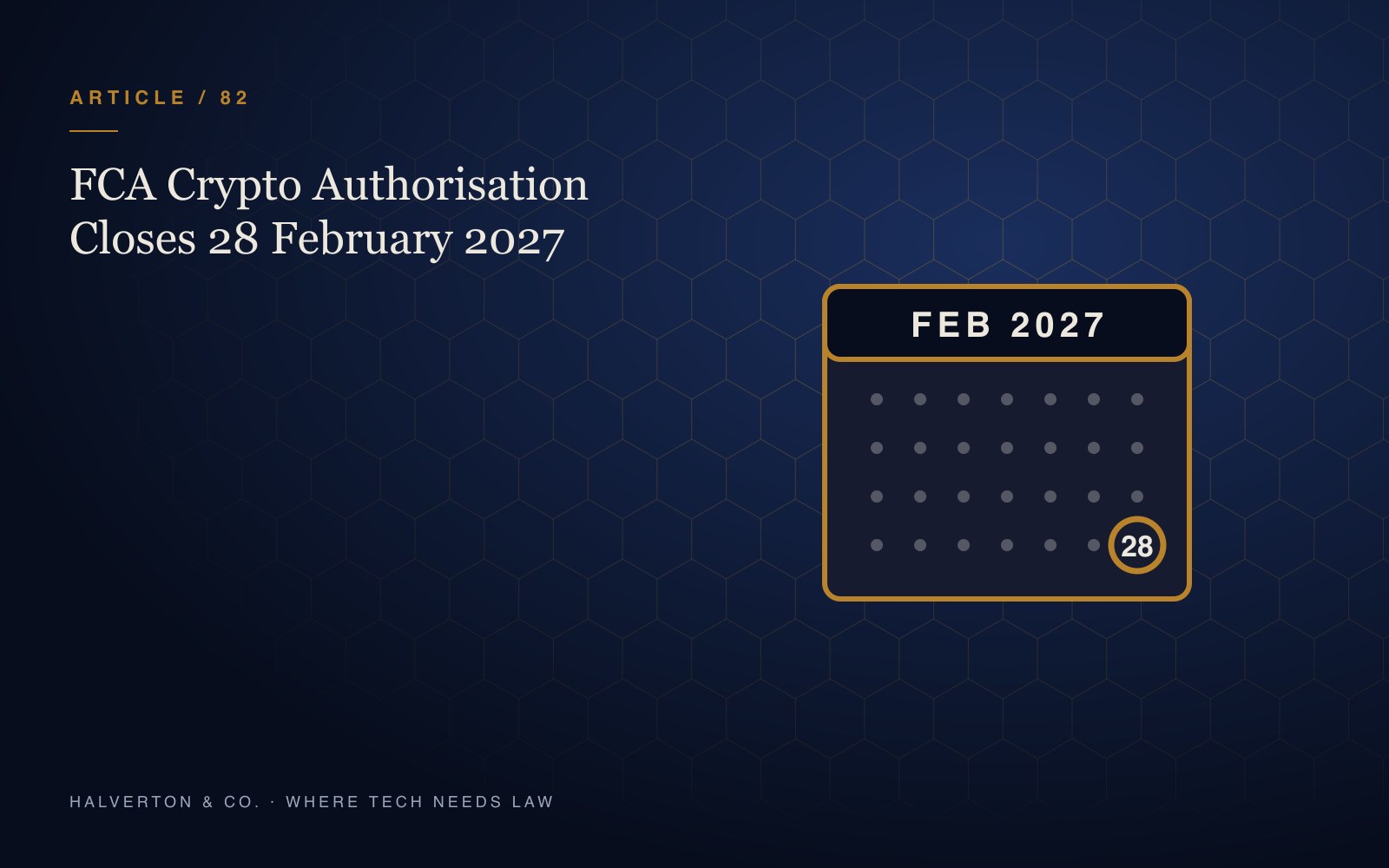
The regime starts on 25 October 2027. An authorisation application window runs from 30 September 2026 to 28 February 2027, and firms that apply inside that window are expected to benefit from transitional protection while the FCA decides. One alert we reviewed gave the start date as 2026, which we believe is a mistake. What happens to firms that apply after the window is unsettled, so do not assume a later route.
What counts as regulated staking
The perimeter guidance says some things are likely to be outside the activity. Providing information or analytics about staking, without arranging a staking transaction, is unlikely to be arranging. A pure software provider that builds tools for others, and does not itself arrange staking for consumers, may be treated differently from a service that does. The FCA looks at substance: who designs the arrangement, who the consumer deals with and who controls the assets.
| Arrangement | Likely regulated? | Why |
|---|---|---|
| Platform stakes customers’ tokens on their behalf | Likely yes | Arranging staking and safeguarding for consumers |
| App lets users delegate to a validator and earns a fee on rewards | Likely yes | The firm designs and arranges the staking transaction |
| Pooled staking product | Likely yes | Combines users’ tokens in one arrangement |
| Information or analytics about staking only | Unlikely | No staking transaction is arranged |
| Own validator using own tokens, no consumers | Unlikely | No consumer participation |
Activities that look more likely to be caught include a custodial platform that stakes customers’ assets, a service that lets users delegate to a validator through its interface and earns a fee on rewards, and a pooled staking product that combines users’ tokens. Operating your own validator with your own tokens, with no consumer participation, is a different case and is less likely to be a regulated staking arrangement.
Because there are many ways to structure staking, firms should write down how each product works step by step: who holds the tokens, who selects the validator, who bears slashing risk, who receives the reward and who markets the service. That description is what you will test against the perimeter guidance and what an FCA application will need.
Slashing deserves particular attention. If a validator misbehaves or goes offline, part of the staked assets can be forfeited. Who bears that loss, the consumer or the provider, and how it is explained, is likely to be a central question in consumer information and in any complaint. Providers who promise to cover slashing are in effect offering a guarantee, which may bring its own regulatory and capital implications. Terms should state clearly who bears each type of loss, and marketing should match the contract.
Pooled and delegated models raise the same question in different forms. If you pool customer tokens into your own validator, you control the technical process and the risk. If you let customers choose from third-party validators, you may still be arranging the transaction, but the allocation of operational risk differs. Document the model for each product and keep the description current as the product changes.
Consumer information, consent and safeguarding
Commentary on PS26/11 says firms must give retail consumers specified information each time they stake, covering matters such as the risks, lock-up or unbonding periods, the possibility of slashing and how rewards are calculated. Where staking is ongoing, the firm needs the consumer’s consent and must send an annual notification, and consumers must be able to stop it (Pinsent Masons; Addleshaw Goddard). We have not reproduced the detailed content requirements, so check the policy statement itself.
Safeguarding rules also apply. Firms that hold cryptoassets for consumers, including assets staked on their behalf, must keep them safe and separate under the new custody requirements. A provider that stakes customers’ tokens will need segregation, reconciliation and record-keeping, and a clear plan for how assets are handled if the provider fails.
Financial promotions are a separate regime that already applies. Marketing staking returns to UK consumers must meet the FCA’s promotion rules, including risk warnings, and a firm that is not authorised needs an authorised person to approve its promotions. Headline yield figures without risk context are a common problem.
Liquid staking, timeline and overseas reach
Liquid staking, where a user stakes a token and receives a derivative token representing the staked position, is treated differently. Commentary says the issuance of a liquid staking token is a separate activity from arranging staking, and may need its own analysis and permissions (PwC; Addleshaw Goddard). A provider that does both should map each activity separately.
The territorial reach point from the previous article in this series applies here. The UK has not extended its overseas persons exclusion to crypto and uses deeming provisions that can treat activity involving UK consumers as carried on in the UK. The FCA’s guidance gives staking as an example: arranging staking is treated as carried on in the UK where the consumer is in the UK, and some staking performed outside the UK at a UK consumer’s direction can fall in scope, subject to exclusions.
Business-to-business staking, for example an Indian validator serving institutions, is generally lower risk, provided that the institutions are not passing UK consumers through to you. Do not assume that a customer’s terms of service protect you; check the real flow of consumers.
What Indian providers should do, remedies and quick answers
Start by counting UK users and mapping each product against the perimeter. If you serve UK consumers, decide before 28 February 2027 whether to apply for authorisation, restructure so that UK consumers are served through an authorised firm, or withdraw from the UK with a proper wind-down. A UK-authorised intermediary route can be commercially attractive for smaller providers, but contracts must allocate regulatory responsibility clearly. Review marketing, because yield claims aimed at UK users can already breach promotion rules. If you are authorised or plan to be, build the consumer information and consent flows now. On the Indian side, check FIU-IND registration as a virtual digital asset service provider, FEMA treatment of any UK subsidiary, and the tax treatment of staking rewards for Indian users, which is a point on which the position is still developing. If the FCA contacts you, respond accurately and take UK advice at once. If you decide to exit, give users enough notice and a way to unstake and withdraw. The most common mistake is to treat the regime as someone else’s problem because the company is Indian: UK users are what bring you into scope.
Record-keeping is a quiet but important point. Keep a dated register of each staking product, its terms, the validator arrangements, the consumer disclosures shown and the consents captured. If a regulator or customer asks how a particular user was onboarded in a particular month, you should be able to answer from records, not memory.
Related reading: FCA crypto authorisation: what Indian firms must do, how the UK crypto regime reaches Indian Web3 startups, UK stablecoin rules for Indian payment startups, UK crypto exchanges serving Indian users and FIU-IND, FIU-IND registration for crypto businesses, crypto tax in India explained and crypto tax in India vs the UK; also the FCA DeFi consultation for Indian protocol developers and UK crypto promotions and Indian influencers.
Quick answers
Is staking a regulated activity in the UK?
Under the FCA’s final rules, arranging qualifying cryptoasset staking becomes a regulated activity when the regime starts on 25 October 2027. Information or analytics alone is unlikely to count as arranging.
Does an Indian staking provider need FCA authorisation for UK users?
Potentially. The UK has no overseas persons exclusion for crypto, and activity involving UK consumers can be treated as carried on in the UK, so UK advice is needed before serving UK users.
Is liquid staking regulated separately?
Commentary says issuing a liquid staking token is a separate activity from arranging staking, so a provider offering both should analyse each separately.
What must a firm tell UK retail consumers about staking?
Commentary on the FCA’s final rules says specified information, such as risks, lock-up periods, slashing and how rewards are calculated, must be given each time a consumer stakes, with consent and an annual notification for ongoing staking. Read the policy statement for the exact content.
Is a liquid staking token regulated?
Commentary treats issuing a liquid staking token as a separate activity from arranging staking, so a provider offering both should analyse each separately with UK advisers.
Final word
Halverton & Co. is an Indian law firm advising UK companies, founders, investors and law firms on Indian law, including FIU-IND registration, FEMA structuring, tax and Indian-law compliance for staking and Web3 providers with overseas users. We practise in Jharkhand, Maharashtra and before the Supreme Court of India, and work alongside your UK solicitors, who advise on English law. Halverton & Co.: Where tech needs law! If you have a question about Indian law, write to us at office@halvertonandco.com, or get in touch.
This article reflects developments reported up to late October 2026. It is for general information only, is not legal advice, and does not create a solicitor-client relationship. Halverton & Co. is an Indian law firm, is not authorised or regulated by the Solicitors Regulation Authority, and does not advise on English law; UK-law points should be confirmed with UK advisers.
Sources
Related practice area
Crypto, Web3 & Digital Assets
Advice for virtual digital asset businesses on registration, reporting and structure.
View the practice areaComments
No account needed. Comments are reviewed before they appear, so yours will show here once approved. Please do not share confidential details or describe your own legal matter: replies are general discussion, not legal advice, and do not create an advocate-client relationship. For your own situation, write to office@halvertonandco.com.