Key takeaways
- A US-style SAFE has no statutory recognition in India and creates FEMA and deposit risks.
- Convertible notes are recognised for DPIIT-recognised startups, with a minimum of ₹25 lakh per investor in a single tranche.
- The iSAFE is structured as compulsorily convertible preference shares, which gives it a clear legal home.
- Angel tax was abolished from assessment year 2025-26, but FEMA pricing and valuation rules still apply.
Every founder who has read a US startup blog knows the SAFE: a simple agreement for future equity, a few pages long, no valuation, no interest, and it converts at the next priced round. So when an angel offers to “do a SAFE”, Indian founders often sign one without a second thought.
That’s a mistake. A US-style SAFE note doesn’t fit neatly into Indian company or foreign exchange law. Used wrongly, it can leave a startup with an illegal deposit, a FEMA violation or an investor whose rights are unclear. This guide explains why SAFE notes in India need careful handling, and compares the instruments that do work: convertible notes, iSAFEs, CCPS and CCDs.
Why the US SAFE doesn’t work neatly in India
A SAFE is a contract, not a share. Indian law cares a great deal about what an instrument is.
- No statutory recognition. Indian law doesn’t define a SAFE. A SAFE issued to a foreign investor isn’t recognised as a security under the Companies Act and isn’t an eligible FDI instrument under FEMA (TaxTMI).
- Deposit risk. Money a company receives that isn’t share capital, and doesn’t fall within an exemption, may be a “deposit” under the Companies (Acceptance of Deposits) Rules, 2014. Private companies can accept deposits only in narrow cases, and contravening the deposit rules attracts heavy fines on the company and possible imprisonment for officers under Section 76A of the Companies Act.
- Private placement rules. Securities issued to investors must follow Section 42: a proper offer letter, money in a separate bank account, and allotment within 60 days, failing which the money must be refunded, with interest if refunded late.
So the question isn’t whether you can use a SAFE in India. It’s which Indian instrument gives you SAFE-like simplicity legally.
Convertible notes: India’s closest legal equivalent
India formally recognised convertible notes for startups in 2017. The conditions are specific:
- The issuer must be a DPIIT-recognised startup.
- Each investor must invest at least ₹25 lakh in a single tranche.
- The note must convert into equity or be repaid within 10 years of issue (iPleaders).
- Amounts meeting these conditions are excluded from the definition of “deposit” under the Acceptance of Deposits Rules.
- Foreign investors can subscribe under FEMA if the startup’s sector allows 100% FDI under the automatic route. The issue must be reported to the RBI in Form CN within 30 days. Investors from countries sharing a land border with India need government approval.
Convertible notes are ideal for bridge rounds and seed rounds where nobody wants to fix a valuation. The ₹25 lakh minimum per investor per tranche is the main obstacle for small angel cheques.
iSAFEs, CCPS and CCDs: the other options
iSAFE
Popularised by 100X.VC, the iSAFE (“India Simple Agreement for Future Equity”) borrows the SAFE’s spirit but is structured as compulsorily convertible preference shares (CCPS), which gives it a clear legal home (TaxGuru). It’s issued as shares from day one, so the usual private placement, valuation and FEMA pricing rules apply.
CCPS
Compulsorily convertible preference shares are the workhorse of Indian venture rounds. They count as equity instruments for FDI, carry investor preferences (liquidation preference, anti-dilution, conversion ratio adjustments) and convert into equity at a fixed ratio or formula. For non-resident investors, the price or conversion formula must be fixed upfront and must respect the FEMA fair value floor.
CCDs
Compulsorily convertible debentures are debt until conversion and can carry interest. For foreign investors, fully and mandatorily convertible debentures are treated as equity instruments. For resident investors, check the deposit exemptions carefully. CCDs are useful where investors want a coupon before conversion.
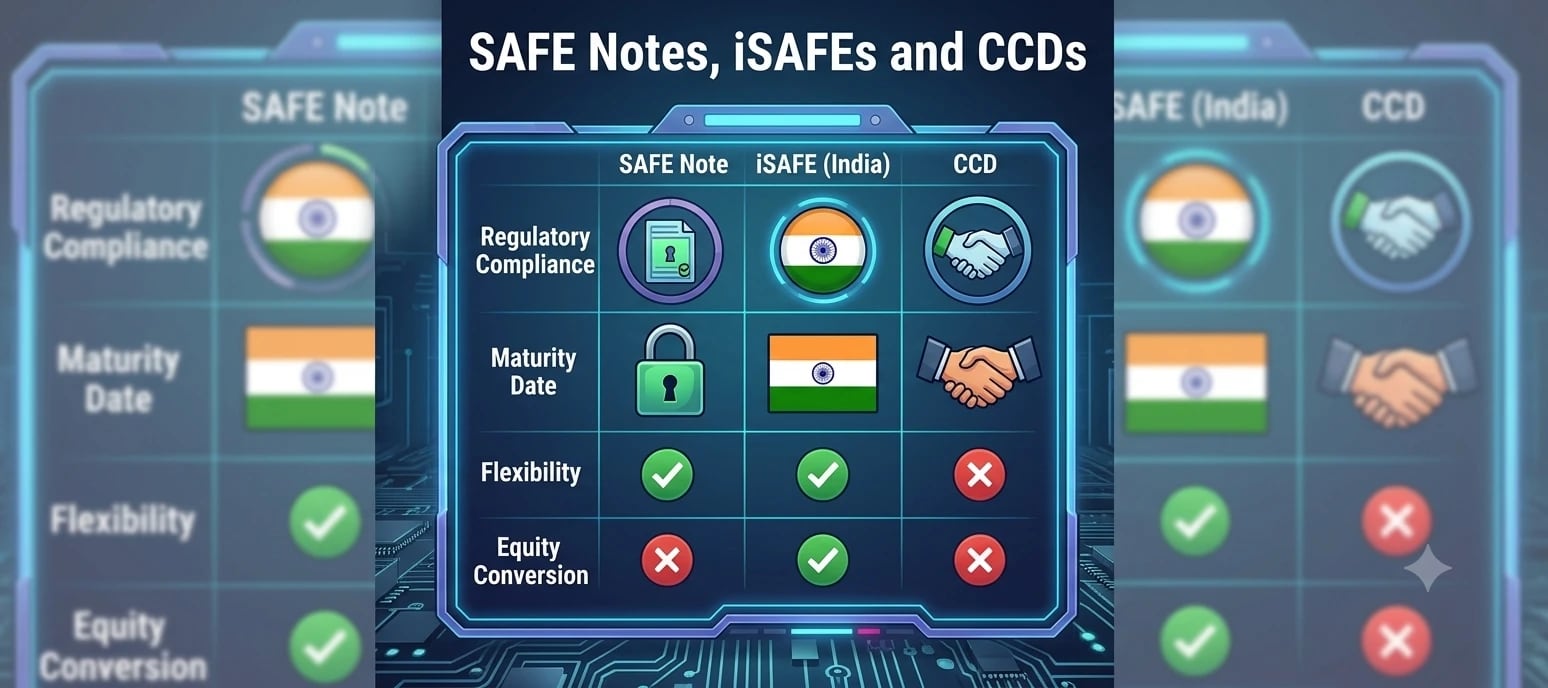
| Instrument | Legal status in India | Valuation needed now? | Best for |
|---|---|---|---|
| US-style SAFE | Not a recognised security; FEMA and deposit risk | No | Avoid for Indian companies |
| Convertible note | Recognised for DPIIT startups; ₹25 lakh minimum, 10-year limit | No (deferred) | Seed and bridge rounds |
| iSAFE (CCPS-based) | Shares issued from day one | Yes, with valuation report | Angel and pre-seed rounds |
| CCPS | Equity instrument for FDI | Yes | Priced seed, Series A and later |
| CCDs | Debt until conversion | Yes, for FEMA pricing | Investors wanting a coupon |
Tax, valuation and compliance after the end of angel tax
Angel tax is gone
The old “angel tax” under Section 56(2)(viib), which taxed share premium above fair value, was abolished by the Finance (No. 2) Act, 2024 from assessment year 2025-26 and isn’t carried into the Income-tax Act, 2025 (VirtualAuditor). That removes a major tax headache for priced rounds.
Valuation still matters
FEMA pricing rules still require shares issued to non-residents to be priced at or above fair value, supported by a valuation report. The Companies Act also requires a registered valuer’s report for preferential allotments. A cheap round for a foreign investor can be a FEMA violation even though angel tax has gone.
Which instrument should you choose?
As a rule of thumb: if you are DPIIT-recognised and each investor is putting in at least ₹25 lakh, a convertible note is the simplest way to defer valuation. If cheques are smaller, or you aren’t DPIIT-recognised, a CCPS-based iSAFE or a small priced CCPS round is the safer choice. If investors want interest before conversion, look at CCDs. Whatever you pick, agree the valuation cap, discount, conversion trigger and long-stop date in writing, and make sure your articles of association allow the instrument before you take the money. Settle founder equity first (see founders’ agreements in India) and plan the option pool with our guide to ESOPs for Indian startups.
Reporting
Foreign investment must be reported to the RBI on time (Form FC-GPR for shares, Form CN for convertible notes). Return of allotment filings with the Registrar of Companies are due within the prescribed time. If your plan is to move the parent company home later, read our guide to reverse flipping in India.
Getting it wrong: legal remedies and how to fix a bad instrument
- Late FEMA reporting. Usually curable by paying a late submission fee through the RBI’s reporting portal.
- Substantive FEMA contraventions, such as issuing an ineligible instrument to a foreign investor. These can be compounded by the RBI. Without compounding, penalties under Section 13 of FEMA can run up to three times the amount involved.
- Accidental deposits. If money was received under an instrument that isn’t exempt, take advice quickly. Converting it into a compliant instrument or refunding it limits exposure under Sections 73 to 76A.
- Private placement failures. Money not allotted within 60 days must be refunded within 15 days, failing which it carries interest. Investors can enforce this.
- Investor and founder disputes over conversion. Conversion terms are contracts. Disputes over valuation caps, discounts or conversion triggers are usually resolved by arbitration, with interim relief under Section 9 of the Arbitration and Conciliation Act.
Quick answers
Are SAFE notes legal in India?
A US-style SAFE has no statutory recognition and creates FEMA and deposit risks. Use a convertible note, or a CCPS-based iSAFE, instead.
What is the minimum for a convertible note in India?
₹25 lakh per investor in a single tranche, issued by a DPIIT-recognised startup, converting or repayable within 10 years.
Is angel tax still applicable?
No. It was abolished from assessment year 2025-26, but FEMA pricing and valuation rules still apply.
Related reading: the Corporate Laws Amendment Bill 2026 and the Income-tax Act 2025 for startups.
Final word
At Halverton & Co., we work as legal counsel for startups, founders and technology-driven businesses on seed and venture financing, convertible notes, CCPS rounds and FEMA compliance. We practise in Jharkhand, Maharashtra and before the Supreme Court of India, and act as fractional legal counsel for companies that need senior legal support without a full in-house team. Halverton & Co.: Where tech needs law!
Write to us at office@halvertonandco.com, or get in touch, to discuss your situation.
This article reflects the law and developments reported up to early October 2026. Rules in this area change often; please take advice on your specific facts before acting.
Related practice area
Startups & Venture
From incorporation to term sheet. The documents a company needs to be fundable.
View the practice areaComments
No account needed. Comments are reviewed before they appear, so yours will show here once approved. Please do not share confidential details or describe your own legal matter: replies are general discussion, not legal advice, and do not create an advocate-client relationship. For your own situation, write to office@halvertonandco.com.