Key takeaways
- Holding and trading USDT through licensed platforms is generally permitted in the UAE.
- The Central Bank’s payment token rules restrict the use of foreign payment tokens for payments onshore and favour dirham-backed tokens.
- VARA, the DFSA and the FSRA each regulate activities in their own zones.
- Merchants should use licensed payment providers rather than accept tokens directly.
Is USDT legal in UAE? The short answer is that holding and trading USDT through licensed channels is generally treated as permitted, while using it as a payment instrument onshore is restricted under the Central Bank’s payment token regime. The UAE has several regulators, each with its own rules, so the answer depends on who you are, where you are and what you are doing with the token.
This guide explains the main rules: the Central Bank of the UAE’s Payment Token Services Regulation, VARA’s role in Dubai, the position in financial free zones such as ADGM and DIFC, and what that means for individuals, businesses and merchants. Regulation is moving quickly and reports differ, so check each regulator’s current text and take advice from UAE-licensed counsel. So, is USDT legal in UAE for an individual? The answer below separates holding, trading and paying.
The short answer
There is no single yes or no to the question of whether USDT is legal in UAE. The UAE does not ban stablecoins as such, and licensed platforms list them. At the same time, the Central Bank’s rules limit the use of payment tokens as a means of payment on the mainland and favour dirham-backed tokens. In practice, many people buy and sell USDT on licensed exchanges and hold it, while merchants and businesses face stricter rules when they accept it as payment. Asking is USDT legal in UAE is really asking which regulator and which activity you mean.
Why the nuance? Stablecoins are called payment tokens when they are used or designed for payments, and the Central Bank regulates payments. VARA regulates virtual assets as an investment and trading activity in Dubai. Free zone regulators such as ADGM and DIFC regulate their own financial services activities. So the same token can face different rules depending on the activity and the regulator.
Treat headlines carefully. Reports that the UAE has banned stablecoins or approved USDT everywhere are usually oversimplified. Read what the regulator said, which activity it addressed and whether it applies to your situation. If you operate a business, a licence and a legal opinion matter more than a news report.
Central Bank payment token rules
The Payment Token Services Regulation UAE introduced in 2024 sets rules for payment tokens, which are digital tokens pegged to fiat currency. Commentary says that, under the regulation, only dirham-backed payment tokens issued by licensed issuers may be used for payments onshore, and that foreign payment tokens such as USDT and USDC may be used only to purchase virtual assets, subject to conditions. The exact scope depends on the regulation’s text and later guidance, so check it directly. For the question is USDT legal in UAE on the mainland, the Central Bank regime is the starting point.
A dirham-backed stablecoin UAE issuers launch must be licensed by the Central Bank and meet reserve, custody and redemption requirements. The idea is to keep payments within the dirham system and protect the currency. Several AED-linked tokens have been reported in development or launched with bank backing. Check which ones are licensed before you use them.
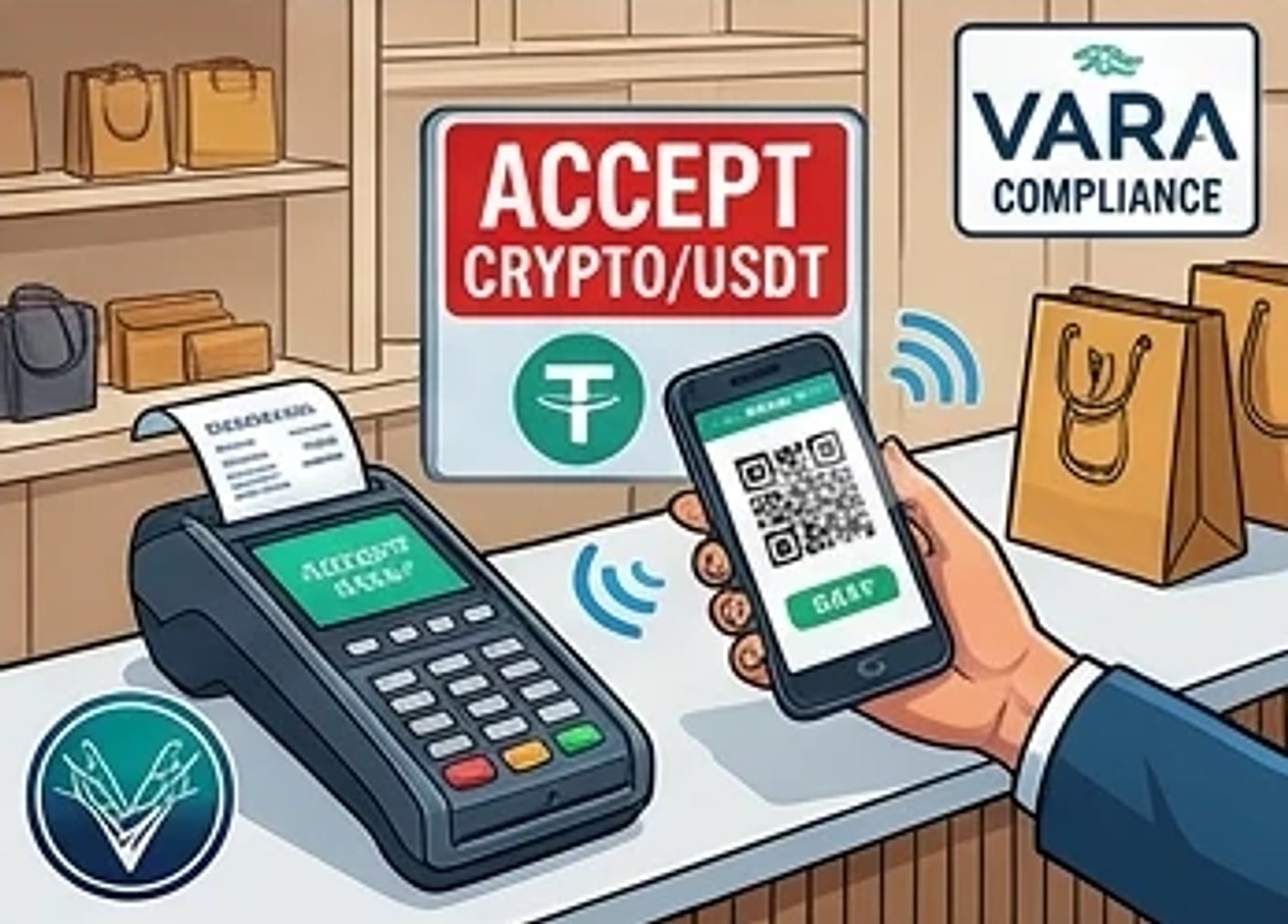
Foreign payment tokens UAE restrictions apply to merchants and payment providers. A shop that accepts USDT directly as payment from customers may be outside the permitted structure unless it uses a licensed provider that converts the token. Commentators advise businesses to use licensed payment service providers rather than accept tokens directly.
VARA and free zone regulators
VARA licenses virtual asset service providers in Dubai, outside the DIFC. VARA licensed USDT trading is available through exchanges and brokers that hold a VARA licence, and these firms must follow VARA’s rulebooks on custody, market conduct, AML and marketing. Check a firm’s licence on VARA’s register before you deal with it. Marketing of virtual assets in Dubai is also regulated.
| Activity | Regulator | Note |
|---|---|---|
| Trading and brokerage in Dubai | VARA | Licensed firms only |
| Payments onshore | Central Bank of the UAE | Payment token rules |
| DIFC activities | DFSA | Recognised tokens list |
| ADGM activities | FSRA | Fiat-referenced tokens framework |
ADGM’s Financial Services Regulatory Authority has a framework for fiat-referenced tokens and has recognised certain stablecoins for use by licensed firms, and the DFSA in DIFC has a regime for recognised crypto tokens. Reports say that some stablecoins, including USDT, have been recognised in these jurisdictions for specific uses. Recognition lists change, so consult the regulator’s current list.
The result is a layered system. A Dubai mainland user may trade USDT with a VARA-licensed firm. A DIFC firm may deal with a token only if it is recognised by the DFSA. A payment on the mainland must follow the Central Bank’s regime. Match your activity to the right regulator.
What it means in practice
For individuals, buying, holding and selling USDT through a licensed exchange is the lowest risk route. Avoid informal peer-to-peer dealers and unlicensed OTC desks, because enforcement and banking risk are higher. Keep records of source of funds, since banks and exchanges ask. For Indian expats, remember Indian tax and foreign exchange rules also apply to your holdings and transfers. In practical terms, is USDT legal in UAE for traders? Yes through licensed channels, subject to the limits above.
For businesses, USDT payments merchants UAE rules need a legal check. If you want to accept stablecoins, use a licensed payment service provider or exchange that settles in dirhams, and make sure your contracts, invoices and accounting reflect that. If you want to issue a stablecoin or run a payment service, you need a Central Bank licence, and VARA or free zone licences may also be relevant.
For all users, watch for scams. Fake exchanges, fake USDT and impersonation are common. Use official apps, check licences and never share keys. Follow regulator announcements and treat unofficial advice with caution.
Next steps and quick answers
Identify your activity, check the regulator, verify licences, keep records and review Indian rules if you are an Indian taxpayer. This is general information, not legal advice, and Halverton & Co. does not advise on UAE law. Before relying on any answer to is USDT legal in UAE, check the regulators’ current lists.
Related reading: stablecoins in India: USDT and RBI, USDT remittances from Dubai to India, the UAE Bitcoin ban claims, fact checked, how to check a VARA licence, paying contractors in India with USDC and tokenised gold in Dubai; also accepting crypto payments as a Dubai business and crypto leverage trading in Dubai and the LRS problem; also DFSA firm-led token assessment and crypto earn products in Dubai; also crypto debit cards in the UAE.
Quick answers
Is USDT legal in the UAE?
Holding and trading through licensed platforms is generally permitted, but the Central Bank’s payment token regime restricts using foreign stablecoins for payments onshore. Check current rules.
Can UAE merchants accept USDT?
Direct acceptance may be restricted. Commentators advise using licensed payment providers. Confirm with UAE counsel.
Does VARA allow USDT trading?
VARA-licensed firms can offer virtual assets within their licence conditions, which may include stablecoins. Check the firm’s licence and permitted activities.
Can I pay in USDT in a UAE shop?
Direct acceptance may be restricted onshore. Merchants are advised to use licensed providers. Confirm with UAE counsel.
Final word
Halverton & Co. is an Indian law firm advising NRIs, founders, investors and businesses in Dubai and across the UAE on Indian law, including virtual asset questions for Indian NRIs and businesses in the UAE, Indian tax and FEMA analysis of crypto holdings. We practise in Jharkhand, Maharashtra and before the Supreme Court of India, and work alongside UAE-licensed counsel, who advise on UAE law. Halverton & Co.: Where tech needs law! If you have a question about Indian law, write to us at office@halvertonandco.com, or get in touch.
This article reflects developments reported up to 31 October 2026. It is for general information only, is not legal advice, and does not create an advocate-client relationship. Halverton & Co. is an Indian law firm and does not advise on UAE law; UAE-law points should be confirmed with UAE-licensed counsel.
Sources
Related practice area
Crypto, Web3 & Digital Assets
Advice for virtual digital asset businesses on registration, reporting and structure.
View the practice areaComments
No account needed. Comments are reviewed before they appear, so yours will show here once approved. Please do not share confidential details or describe your own legal matter: replies are general discussion, not legal advice, and do not create an advocate-client relationship. For your own situation, write to office@halvertonandco.com.