Key takeaways
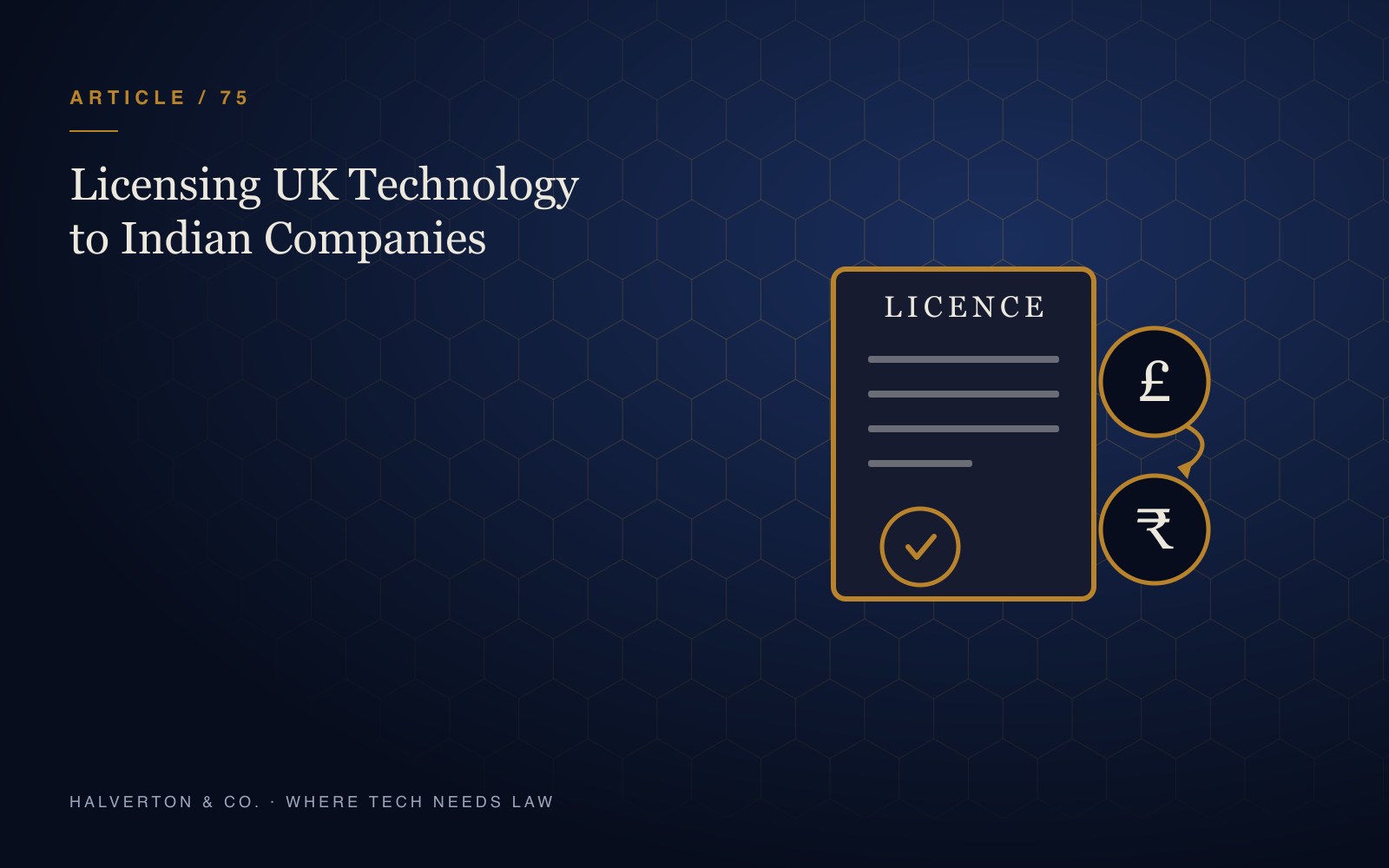
- Royalty and technical know-how payments are current account transactions under the automatic route, so the Indian licensee generally needs no RBI approval.
- The India-UK treaty rate for royalties and fees for technical services is generally cited at 15%, against a domestic rate commonly cited at 20%, and needs a UK tax residency certificate to claim.
- The Indian licensee usually pays GST under the reverse charge, and the agreement needs proper stamping to be admissible in an Indian court.
- Separate licence fees from service fees, because the treaty’s fees for technical services definition can reach consulting and support.
A UK technology company signs a licence with an Indian partner. It might be software, a patent portfolio, a brand or a bundle of know-how. The commercial terms are agreed quickly. Then the finance and legal teams on the Indian side start asking about foreign exchange approvals, withholding tax, forms and stamp duty, and the deal slows down.
These are normal questions with predictable answers, and most of the friction can be removed in advance. This guide explains how to structure a licence to an Indian company, how royalties are paid out of India under foreign exchange law, what withholding tax applies under the India-UK treaty and how to claim treaty rates, the indirect tax and stamp duty points, and how to allocate risk and resolve disputes. It’s written from the Indian-law perspective; UK tax and UK-law points should be confirmed with your UK advisers.
Structuring the licence
Start by being clear about what you are licensing. A software licence, a patent licence, a trade mark licence, a know-how and technical assistance agreement and a franchise are different things, and they are taxed differently in India. Decide whether the licence is exclusive or non-exclusive, what the territory is, whether the licensee can sublicense, who owns improvements and what happens to the licence if the Indian partner is acquired. Indian counterparties often ask for exclusivity for India, and you should balance that against minimum sales or royalty commitments.
The legal climate is favourable. The India-UK Comprehensive Economic and Trade Agreement entered into force on 15 July 2026, together with the Double Contribution Convention, and its intellectual property chapter is described by practitioners as India’s most comprehensive in any trade agreement, with a stated preference for voluntary licensing and technology transfer on mutually agreed terms (Bar & Bench; S.S. Rana). India has said its compulsory licensing powers under the Patents Act remain intact, so the chapter doesn’t remove that background risk for patents, particularly in sensitive sectors. For most commercial technology licences, the practical effect is a more settled framework and a working group to discuss implementation.
India’s competition law also touches IP licensing. Section 3(5) of the Competition Act, 2002 lets a rights holder impose reasonable conditions to protect its IP, which gives room for normal licence restrictions, but terms such as tying, resale price maintenance and broad exclusivity can still raise concerns, so keep restrictions tied to protecting the licensed rights.
FEMA: paying royalties out of India
Under India’s foreign exchange rules, remittances of royalty and technical know-how fees are current account transactions, and they are permitted under the automatic route: the Indian licensee pays through its authorised dealer bank without prior approval from the Reserve Bank of India or the government (Bar & Bench; Beacon Filing). Before the liberalisation in December 2009, the rules imposed caps linked to sales and exports, and a lump-sum limit of USD 2 million. Sources say those caps were removed. One source still mentions a lump-sum limit, so confirm the current position with the Indian bank or counsel before relying on it.
The bank will want documents. Expect to provide the licence agreement, the invoice, a tax residency certificate and the withholding tax details. The Indian licensee gives the bank a remittance declaration in Form 15CA and, where the payment is chargeable to tax, a chartered accountant’s certificate in Form 15CB. An agreement that is unclear about what is being paid for, or that bundles licence fees and services in a single figure, causes delay, because the bank and the accountant need to classify the payment.
Related-party licences, such as a UK parent licensing to an Indian subsidiary, are also subject to transfer pricing rules. The royalty must be at arm’s length, and the Indian tax authorities can challenge a rate that looks too high or too low, so keep a benchmarking study and a written agreement that predates the payments. Keep your invoices consistent with the agreement and the currency of payment, and bear in mind that a late or mis-described payment can complicate reconciliations and tax credits.
Indian withholding tax and the India-UK treaty
An Indian company paying royalties or fees for technical services to a UK company must deduct tax at source. The domestic rate is commonly cited at 20% before surcharge and cess, which one guide puts at an effective rate of about 21.84%. Under the India-UK tax treaty, the rate for royalties and fees for technical services is generally 15%, with 10% for royalties on the use of equipment, so a UK licensor that qualifies for treaty relief saves roughly six to seven percentage points (VJM Global; Beacon Filing). These figures come from secondary sources, and an earlier version of the treaty included a 20% rate for some fees, so confirm the current rate against the treaty text as amended in 2013.
To obtain the treaty rate, the UK licensor normally provides a tax residency certificate from HMRC, the tax declaration that Indian law requires (Form 10F under the old law, reportedly Form 41 under the Income-tax Act, 2025), and a statement that it is the beneficial owner of the income. The principal purpose test introduced through the multilateral instrument can also be raised in structures that appear designed to obtain treaty benefits. An Indian licensee that doesn’t receive the documents may withhold at the higher domestic rate, which is the usual cause of disputes.
| Item | Position | Who bears it |
|---|---|---|
| Withholding tax on royalties and fees for technical services | Treaty rate generally cited at 15% (10% for equipment) against a domestic rate commonly cited at 20%; needs a UK residency certificate | Negotiated: gross-up or net-of-tax clause |
| GST | Reverse charge on import of services; rate commonly stated as 18% | Indian licensee |
| Stamp duty | Varies by state; unstamped documents are not admissible until duty and penalty are paid | Usually the Indian party; agree in the contract |
| FEMA remittance | Current account transaction under the automatic route, with Forms 15CA and 15CB | Indian licensee through its bank |
Be precise about the type of payment. The India-UK treaty’s definition of fees for technical services is broader than the India-US equivalent and, according to some tribunal decisions, covers managerial and consultancy services whether or not they transfer technical knowledge (ITAT decisions on the India-UK treaty). If your agreement includes support or consulting alongside a licence, separate the fees and describe the services accurately. And address the commercial question of who bears the tax: a “net of tax” clause requires the Indian payer to gross up, which many Indian payers resist. Your UK advisers will advise on how the Indian tax withheld is credited against UK tax.
GST, stamp duty and other Indian costs
An Indian business that receives services from outside India generally pays Goods and Services Tax itself under the reverse charge mechanism, and royalties for licensing intellectual property from abroad fall into this category. The rate is commonly stated as 18%, which the Indian licensee may be able to claim as an input credit if it is making taxable supplies, so check the current rate and the licensee’s position. You, as the UK licensor, shouldn’t add Indian GST to your invoice, and you shouldn’t need an Indian GST registration for a straightforward licence.
Stamp duty is easy to overlook and can matter. An agreement signed in or brought into India has to be stamped under the stamp law of the relevant state, and the rates vary by state and by the type of document. An unstamped or under-stamped agreement is not admissible in evidence in an Indian court until the duty and a penalty are paid. The Supreme Court’s seven-judge decision in December 2023 held that an unstamped arbitration agreement is not void and the defect can be cured, but you should still stamp the agreement properly instead of relying on that. For an agreement signed abroad, the Indian stamp rules generally require stamping within a short period after it is first received in India.
Watch for permanent establishment risk. If your UK staff spend extended time in India supporting the licensee, or if your arrangement gives the Indian party authority to conclude contracts for you, India may treat you as having a taxable presence, which changes the tax analysis. Seconding staff to India has its own social security and tax consequences, and a UK company that wants to station people in India should plan that separately from the licence.
Risk allocation, disputes and quick answers
Use the contract to manage the main risks. Include audit rights over the licensee’s records and sales, an obligation to keep the licensed IP confidential, a clear IP indemnity from you and a limitation of liability, source code escrow if software is licensed, and termination rights on breach, insolvency or change of control. Say how royalties are converted and paid, and in which currency. For disputes, English law and arbitration seated in London or Singapore is common. India has notified the United Kingdom for the purposes of the New York Convention, so arbitration awards from a UK seat can be enforced in India, and judgments of UK superior courts can be executed under Section 44A of the Code of Civil Procedure. Interim relief to protect your IP, such as an injunction against unauthorised use, can be sought from Indian courts even where the contract provides for foreign arbitration. If withholding tax is applied wrongly, you can claim a refund by filing in India, and the treaty’s mutual agreement procedure is available for double taxation. A short pre-signing checklist, covering the tax documents, the payment classification, stamping and the bank’s requirements, will avoid most delays.
Related reading: the UK-India trade deal: a legal checklist for UK companies, selling SaaS to Indian customers from the UK, setting up an Indian subsidiary from the UK, protecting a UK trade mark in India, licensing US software in India: withholding tax and royalties, enforcing a UK judgment or arbitration award in India and seconding UK staff to India; also an intercompany IP licence from Dubai to an Indian subsidiary and exclusive and non-exclusive copyright licences between UK and Indian companies; also licensing a UK brand to Indian franchisees; also UK influencers working with Indian brands and licensing Indian music for UK content.
Quick answers
Do Indian companies need RBI approval to pay royalties to a UK licensor?
Generally no. Royalty and technical know-how payments are current account transactions allowed under the automatic route through an authorised dealer bank, subject to documentation and tax compliance.
What withholding tax applies to royalties paid to a UK company?
The lower of the domestic and treaty rate applies if you provide the documents. The treaty rate is generally cited as 15%, against a domestic rate commonly cited at 20%, so confirm the current figures.
Who pays GST on a UK technology licence?
The Indian licensee, generally through the reverse charge mechanism, so you should not add Indian GST to your invoice.
What documents will the Indian bank want for a royalty payment?
Typically the licence agreement, the invoice, a tax residency certificate and the withholding tax details, with a remittance declaration in Form 15CA and, where the payment is taxable, a chartered accountant’s certificate in Form 15CB.
Can a UK licensor claim a refund if too much tax is withheld?
Yes, by filing in India, and the treaty’s mutual agreement procedure is available for double taxation. The better approach is to settle the documents and classification before the first payment.
Final word
Halverton & Co. is an Indian law firm advising UK companies, founders, investors and law firms on Indian law, including technology licensing, FEMA and withholding tax documentation, stamp duty and disputes for UK businesses working with Indian counterparties. We practise in Jharkhand, Maharashtra and before the Supreme Court of India, and work alongside your UK solicitors, who advise on English law. Halverton & Co.: Where tech needs law! If you have a question about Indian law, write to us at office@halvertonandco.com, or get in touch.
This article reflects developments reported up to late October 2026. It is for general information only, is not legal advice, and does not create a solicitor-client relationship. Halverton & Co. is an Indian law firm, is not authorised or regulated by the Solicitors Regulation Authority, and does not advise on English law; UK-law points should be confirmed with UK advisers.
Sources
Related practice area
Startups & Venture
From incorporation to term sheet. The documents a company needs to be fundable.
View the practice areaComments
No account needed. Comments are reviewed before they appear, so yours will show here once approved. Please do not share confidential details or describe your own legal matter: replies are general discussion, not legal advice, and do not create an advocate-client relationship. For your own situation, write to office@halvertonandco.com.