Key takeaways
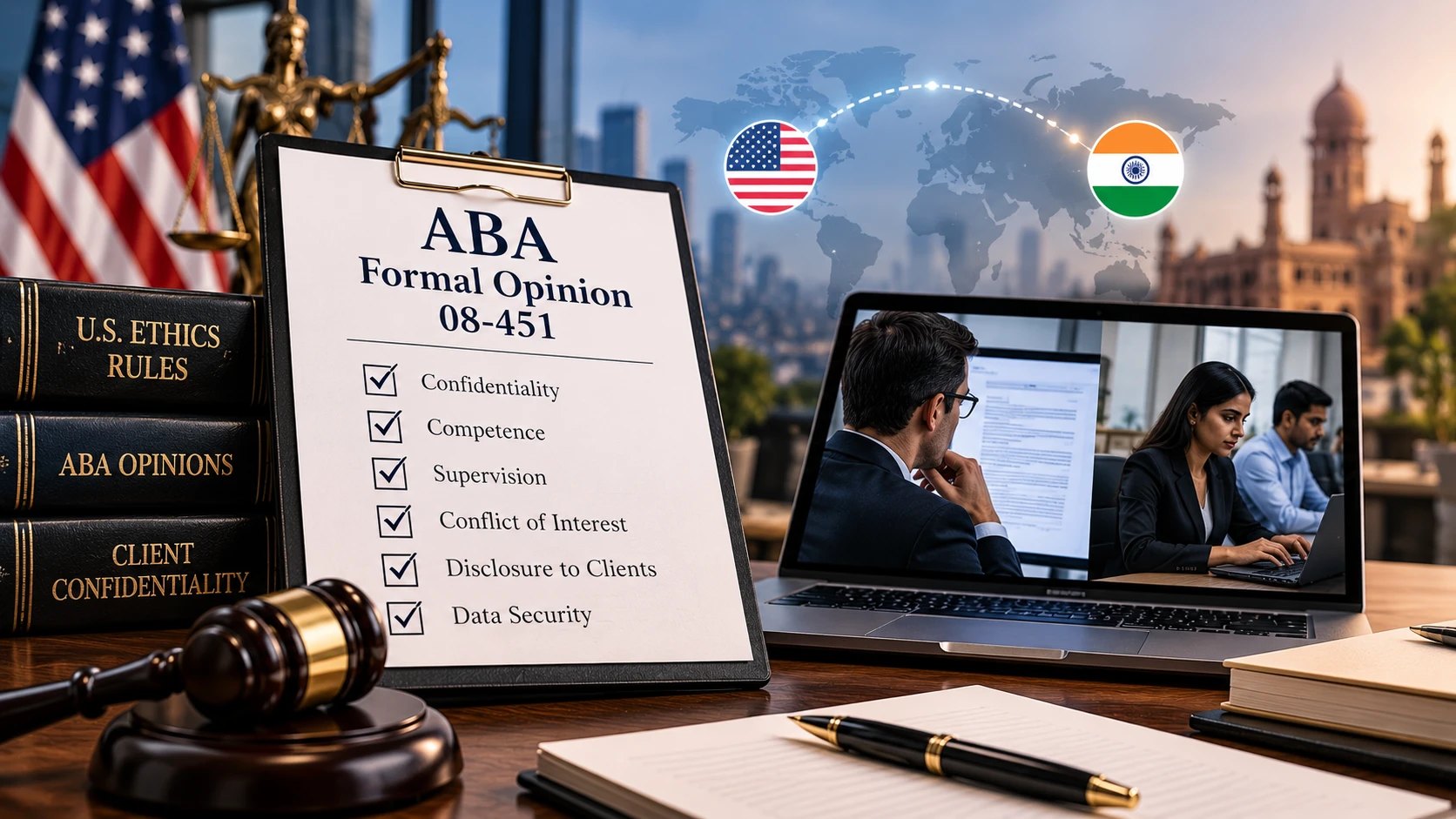
- ABA Formal Opinion 08-451 allows outsourcing with supervision and confidentiality safeguards and says consent may be needed in some cases.
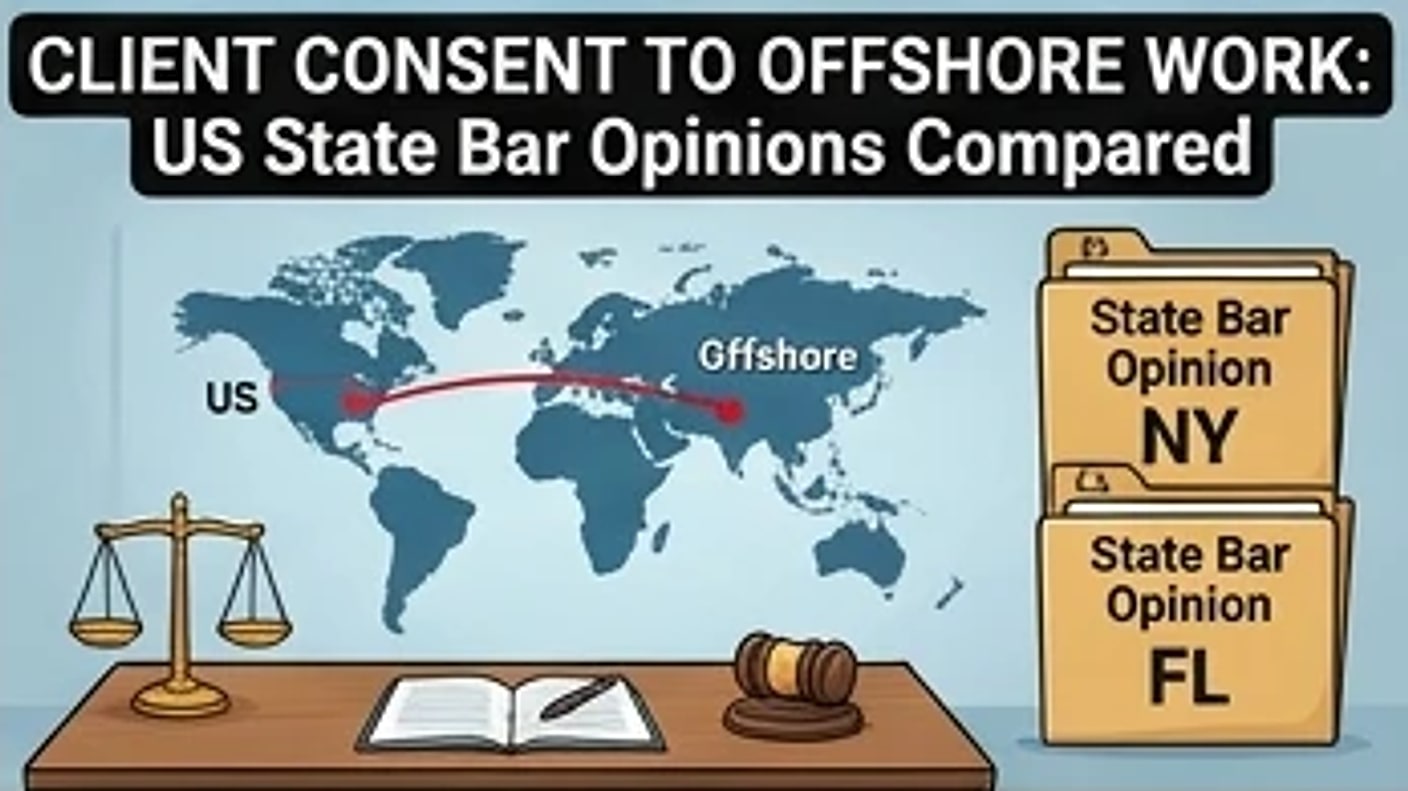
- NYC Bar 2006-3 and Florida 07-2 diverge in emphasis, but both point to disclosure and often consent for significant offshore work.
- Put consent language in the engagement letter and get specific consent for sensitive matters.
- Opinion summaries here come from secondary sources, so read the opinions and your own state’s rules.
Every US lawyer who sends work to an offshore team has to answer a simple question: do I need my client’s consent? The honest answer depends on the state and on the facts. The ABA’s guidance, New York City’s opinion and Florida’s opinion all allow outsourcing but take different approaches to consent. This guide compares them so that you can see the pattern in outsourcing legal work ethics.
We summarise the main opinions, explain when consent is likely to be required, compare disclosure with consent, and suggest a practical approach for firms with Indian support teams. The opinions are old but still relied on, and newer opinions address data security and AI. This is written by an Indian law firm for US readers. Always read the primary opinions and your own state’s current rules. This is the core of outsourcing legal work ethics for any firm that uses support teams outside the United States.
The baseline: ABA Opinion 08-451
ABA Formal Opinion 08-451, issued in 2008, concludes that lawyers may outsource legal and non-legal support services, including overseas, if they comply with the Model Rules. The key duties are competence under Rule 1.1, supervision under Rules 5.1 and 5.3, confidentiality under Rule 1.6, avoiding conflicts and billing properly. On consent, the opinion says that client consent may be needed where confidential information will be disclosed, depending on the circumstances. Outsourcing legal work ethics starts with the ABA’s model and then diverges state by state.
The ABA approach is not a bright line. It says that consent is not necessary in every case, for example where the work does not involve disclosure of confidential information or the vendor is akin to a regular support service, but it advises caution where the outsourcing is significant. ABA Formal Opinion 08-451 consent guidance therefore leaves room for state variation.
Billing is a related point. The opinion says that lawyers may charge the client for actual costs plus a reasonable allowance for overhead, but may not add an unexplained markup unless the client agrees. Keep this in view when you set up a service arrangement, because consent and billing disclosure often go hand in hand.
New York City and Florida compared
The New York City Bar’s Formal Opinion 2006-3 was among the first to address overseas outsourcing. It allows it, but warns about aiding unauthorised practice, requires supervision and competence and addresses confidentiality. On consent, secondary summaries say that the committee declined to require notice every time, but said advance informed consent is needed where non-lawyers play a significant role or where confidences must be shared. NYC Bar Formal Opinion 2006-3 is often cited for this middle position.
| Source | Approach to consent | Note |
|---|---|---|
| ABA Formal Opinion 08-451 | Consent may be needed where confidences are shared | Case-by-case |
| NYC Bar Formal Opinion 2006-3 | Advance informed consent in significant cases | Role of the non-lawyer |
| Florida Ethics Opinion 07-2 | Disclose if material, consent to disclose confidences | Materiality test |
| Other states | Mostly similar, some stricter | Check your own state |
Florida Ethics Opinion 07-2 takes a materiality approach. Summaries say that if a client would consider the outsourcing material to its decision to entrust the work to the firm, the firm must disclose it, and that prior consent to disclose confidential information is advisable under the confidentiality rule. Florida Ethics Opinion 07-2 also flags data security and breach issues in foreign jurisdictions.
The two approaches differ in emphasis. New York City focuses on the role of the non-lawyer and the sharing of confidences, while Florida focuses on materiality to the client. In practice both point to disclosure and often consent for substantive offshore work. A firm that follows the stricter of the two will usually be safe in most states, though local rules govern.
Other state opinions
Other states have addressed the issue. Virginia’s Legal Ethics Opinion 1850 deals with outsourcing and supervision and consent, and the North Carolina 2007 formal ethics opinion on outsourcing legal support services discusses similar duties. Ohio and other bars have also issued opinions, and some Illinois, Colorado and North Carolina materials extend the principles to temporary lawyers and technology vendors. The pattern is that states permit outsourcing with supervision and confidentiality safeguards.
On consent, the opinions vary. Some require consent where confidential information is shared with a vendor, some treat consent as prudent but not always required and some focus on disclosure if outsourcing is material. A state bar opinions comparison outsourcing shows that most converge on informed consent for significant offshore work involving confidential information, and on disclosure in the engagement letter as good practice. For outsourcing legal work ethics purposes, the safest reading is to treat significant offshore work as a disclosure event.
Newer guidance adds layers. Opinions on cloud services and AI tools stress reasonable efforts to protect information, vendor due diligence and sometimes client consent. California, for example, has issued practical guidance on generative AI, and other bars are following. Check for current opinions on technology vendors in your state, because they may apply to offshore teams that use such tools.
A practical approach
Build consent into engagement terms. State in the engagement letter that the firm may use outside and offshore support under supervision, describe the safeguards and obtain the client’s agreement. For sensitive matters, seek specific informed consent. Record the client’s response. This is the simplest way to meet client consent offshore legal outsourcing expectations in most states. Good outsourcing legal work ethics practice puts the consent language in the engagement letter before work starts.
Make the process real. Supervise the work, restrict access, use secure systems, run conflicts checks and use a written agreement with confidentiality and data security terms. Tell clients who asks, and avoid overstating the role of the offshore team. Review billing so that costs and overhead are described honestly. Keep logs that show review by a lawyer.
Keep up to date. Check your state bar’s opinions and rule changes each year, and the ABA’s guidance on technology and AI. If a client’s outside counsel guidelines or contract restrict outsourcing or require consent, follow them. When in doubt, ask your ethics counsel or the bar’s ethics hotline. A firm that keeps its outsourcing legal work ethics file current can answer a client or bar inquiry quickly.
Next steps and quick answers
Review your engagement letter, ask your vendor for security evidence, check your state’s opinions and document supervision. This is general information, not legal advice, and the summaries of opinions here come from secondary sources.
Related reading: ABA Opinion 08-451 and outsourcing legal work to India, offshore paralegal services for US law firms, offshore paralegal contracts: nine clauses, virtual paralegals in India: costs and ethics, privilege and offshore legal vendors and outsourced legal research for US law firms; also outsourcing trademark clearance searches to India and deposition summaries and medical chronologies from India.
Quick answers
Do I always need client consent to send legal work offshore?
Not always, but many opinions advise informed consent or disclosure where confidential information will be shared or the offshore role is significant. Check your own state’s opinion.
How do the NYC and Florida opinions differ on consent?
NYC Bar 2006-3 centres on the non-lawyer’s role and sharing of confidences, and advises advance informed consent in significant cases. Florida 07-2 uses a materiality test for disclosure and advises consent to disclose confidential information.
What does ABA Opinion 08-451 say about consent?
It allows outsourcing with supervision and confidentiality safeguards and says client consent may be needed where confidential information is disclosed, depending on the circumstances.
Is client consent always required to outsource legal work?
Not always, but many opinions advise it where confidential information is shared or the role is significant. Check your state.
Final word
Halverton & Co. is an Indian law firm advising US companies, founders, investors and law firms on Indian law, including legal outsourcing and support for US law firms, supervision and confidentiality frameworks and cross-border data protection. We practise in Jharkhand, Maharashtra and before the Supreme Court of India, and work alongside US counsel, who advise on US law. Halverton & Co.: Where tech needs law! If you have a question about Indian law, write to us at office@halvertonandco.com, or get in touch.
This article reflects developments reported up to 31 October 2026. It is for general information only, is not legal advice, and does not create an attorney-client relationship. Halverton & Co. is an Indian law firm and does not advise on US law; US-law points should be confirmed with US counsel.
Sources
Related practice area
Startups & Venture
From incorporation to term sheet. The documents a company needs to be fundable.
View the practice areaComments
No account needed. Comments are reviewed before they appear, so yours will show here once approved. Please do not share confidential details or describe your own legal matter: replies are general discussion, not legal advice, and do not create an advocate-client relationship. For your own situation, write to office@halvertonandco.com.