Key takeaways
- Disclosure to a third party can waive attorney-client privilege, but a vendor acting as the lawyer’s agent may fall within an exception.
- Work product protection is generally harder to waive than privilege.
- Engage the vendor through counsel, document the legal purpose and restrict access.
- Foreign-law points need Indian and US counsel because published commentary says little on foreign vendors.
Offshore legal vendor privilege is a worry for US firms and clients alike: if a vendor in India sees privileged documents, has privilege been waived? The general rule is that voluntary disclosure to a third party can waive the attorney-client privilege, but courts recognise exceptions where the third party acts as the lawyer’s agent to help provide legal advice. Work product protection is more forgiving. How you structure the engagement matters.
This guide explains the main principles, the Kovel line of cases, the difference between privilege and work product, the factors that courts examine, and a protocol for firms that use offshore vendors. It is written by an Indian law firm for US readers. It is general information, not legal advice. US counsel should advise on US privilege law, and published commentary says little about foreign vendors specifically. Offshore legal vendor privilege depends mostly on structure and purpose.
The basic rules
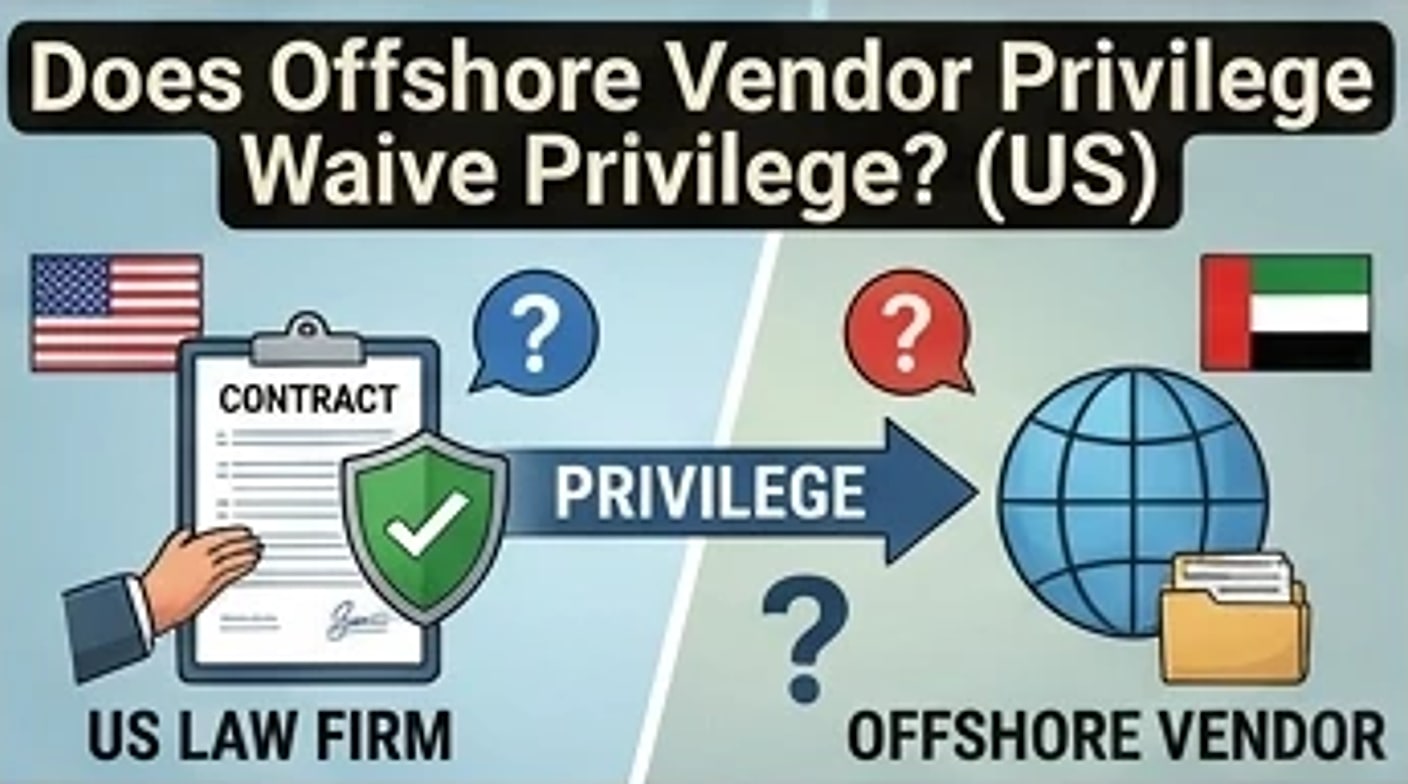
Attorney-client privilege protects confidential communications between lawyer and client made for the purpose of obtaining or giving legal advice. Disclosure to a third party who is outside the privilege generally waives it. Attorney-client privilege waiver third party issues arise because vendors, consultants and support staff are third parties unless they fall within an exception.
Courts consider whether the communication was confidential, whether the third party was necessary for the legal advice, who engaged and paid the third party and whether the purpose was legal or business. The more the vendor looks like an extension of the law firm, the stronger the argument that privilege survives. The more it looks like a business service, the weaker.
Federal Rule of Evidence 502 also helps with some waiver questions, including inadvertent disclosure and the scope of waiver in federal proceedings, and parties can agree protective orders. But 502 does not turn a purely business vendor into a privileged agent. State law varies, so check the forum. Offshore legal vendor privilege is rarely lost by sharing alone, but poor structure raises the risk.
Kovel and agents of the lawyer
United States v. Kovel, a 1961 decision of the Second Circuit, held that communications with an accountant hired by a law firm to help it understand a client’s financial information could be privileged, because the accountant acted as a translator for the lawyer. The Kovel doctrine offshore vendor arguments rely on the same logic: a vendor retained by counsel to help the lawyer give legal advice may be within the privilege.
The exception is narrow, according to commentary. It generally does not cover consultants hired by the client for business advice, and the vendor’s work must be in furtherance of legal advice. Practitioners recommend that the lawyer, not the client, engage the vendor, that the vendor bill the lawyer or firm, and that the engagement letter state the legal purpose and confidentiality.
Courts have also looked at security incident reports and other consultant work. In In re Capital One Consumer Data Security Breach Litigation, a federal court in Virginia in 2020 ordered production of a forensic report because it had business purposes and was not prepared in anticipation of litigation, even though counsel was involved. The In re Capital One privilege ruling is a caution that labels and counsel involvement are not enough.
Work product and waiver
The work product doctrine protects materials prepared in anticipation of litigation by or for a party or its representative. It does not require legal advice and is not waived by every disclosure. Commentary says many courts find waiver of work product only when the material is disclosed to an adversary or in a way that makes disclosure to an adversary likely. The work product doctrine offshore support teams rely on is therefore often stronger than privilege.
That does not make it safe to share freely. A vendor without confidentiality obligations or with poor security increases the chance of leakage. Disclosure to a vendor that also works for opponents creates risk. Choose vendors who commit to confidentiality, conflict checks and security, and keep their access limited.
Foreign factors add uncertainty. Documents stored in India may be reachable by Indian legal process, and Indian law on privilege protects communications with qualified legal advisers but may not extend to non-lawyer vendors in the same way as US doctrine. Published commentary says little on how US courts treat privilege claims involving foreign vendors, so treat the foreign dimension as an open risk and get US counsel’s view. Offshore legal vendor privilege is easier to defend when the engagement record is clear.
A protocol for offshore vendors
Build a privilege protocol. Engage the vendor through counsel, with a written agreement that states the vendor acts at the direction of counsel to assist in providing legal advice or in anticipation of litigation. Require confidentiality, non-use and non-disclosure, security controls, return or destruction of materials and notice of any legal demand for the documents. A privilege protocol legal outsourcing agreement should say these things clearly.
| Step | Action | Why |
|---|---|---|
| Engage through counsel | Lawyer retains the vendor | Agent of the lawyer |
| Document the purpose | Legal advice or litigation | Supports privilege or work product |
| Limit access | Need-to-know and secure platforms | Reduce leakage |
| Contract terms | Confidentiality, security, return and deletion | Show reasonable steps |
| Review | Test and update the protocol | Courts look at facts |
Limit access. Share only what the vendor needs, use secure platforms controlled by the firm, keep data in the firm’s environment where possible, mark materials as privileged and confidential, and keep logs. Train vendor staff on privilege and escalation. Separate privileged analysis from business work.
Document and disclose. Keep records of the engagement, tasks and supervision, and consider telling clients and obtaining consent. Include the vendor in your privilege log process when needed. Review the arrangement regularly, and revisit it whenever a dispute arises. Offshore legal vendor privilege protocols should be tested on a sample matter.
Next steps and quick answers
Review vendor contracts, route engagements through counsel, limit access, use secure systems and consult US counsel for sensitive matters. This is general information, not legal advice. Halverton & Co. is an Indian law firm and does not advise on US law. Revisit your offshore legal vendor privilege protocol after any court ruling in your circuit.
Related reading: ABA Opinion 08-451 and outsourcing legal work to India, offshore paralegal services for US law firms, offshore paralegal contracts: nine clauses, client consent for offshore legal work, AI hallucination sanctions for lawyers and choosing an offshore legal support partner; also deposition summaries and medical chronologies from India and outsourcing trademark clearance searches to India; also LEDES e-billing outsourcing.
Quick answers
Does sharing documents with an offshore vendor waive privilege?
Not necessarily. Disclosure to third parties can waive privilege, but a vendor acting as the lawyer’s agent under a Kovel-type arrangement may fall within it. Structure and purpose matter.
Is work product easier to protect than privilege?
Often yes, because many courts find waiver only if material goes to an adversary or likely reaches one.
What is the best way to reduce risk?
Engage vendors through counsel, document the legal purpose, restrict access and use secure systems with confidentiality terms.
Is work product easier to protect than privilege?
Often yes, because many courts find waiver only if material goes to an adversary or likely reaches one.
Final word
Halverton & Co. is an Indian law firm advising US companies, founders, investors and law firms on Indian law, including legal support and research for US law firms from India, with confidentiality, privilege and security protocols developed alongside US counsel. We practise in Jharkhand, Maharashtra and before the Supreme Court of India, and work alongside US counsel, who advise on US law. Halverton & Co.: Where tech needs law! If you have a question about Indian law, write to us at office@halvertonandco.com, or get in touch.
This article reflects developments reported up to 31 October 2026. It is for general information only, is not legal advice, and does not create an attorney-client relationship. Halverton & Co. is an Indian law firm and does not advise on US law; US-law points should be confirmed with US counsel.
Sources
Related practice area
Startups & Venture
From incorporation to term sheet. The documents a company needs to be fundable.
View the practice areaComments
No account needed. Comments are reviewed before they appear, so yours will show here once approved. Please do not share confidential details or describe your own legal matter: replies are general discussion, not legal advice, and do not create an advocate-client relationship. For your own situation, write to office@halvertonandco.com.