Key takeaways
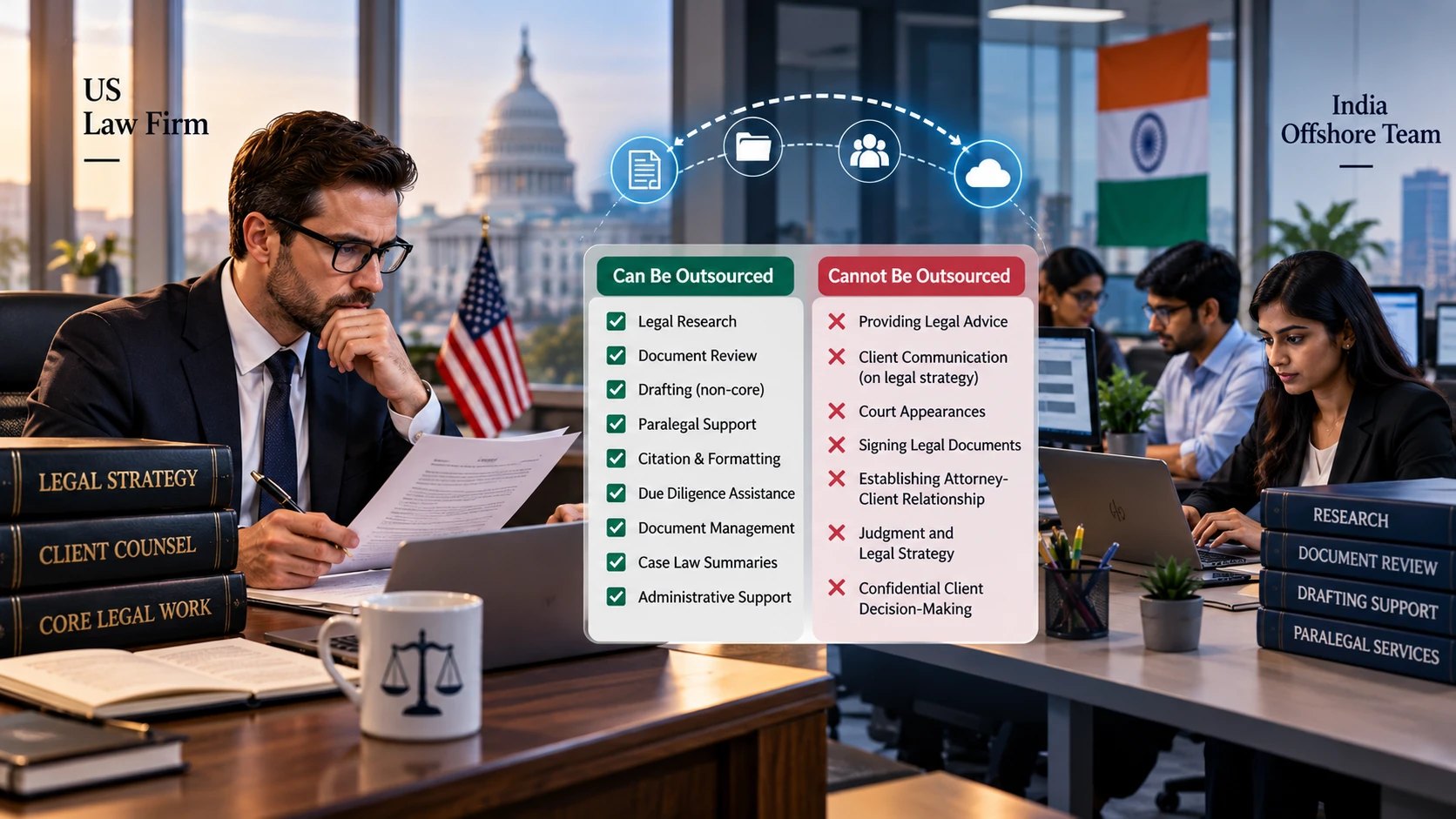
- ABA Formal Opinion 08-451 confirms that US lawyers may outsource legal and nonlegal support work, including to India.
- The lawyer remains responsible for competent representation under Model Rule 1.1 and must supervise the work.
- Sharing confidential information with an outside provider generally requires the client’s informed consent.
- Offshore contractors must not be held out as licensed US lawyers, and fees must remain reasonable.
Every managing partner who considers sending work offshore asks the same first question, and it isn’t about price. It’s “Are we allowed to do this?” The answer, for almost two decades, has been yes, with conditions. Those conditions come from one document every firm should know well: ABA Formal Opinion 08-451.
This guide turns ABA 08-451 into a practical compliance checklist for US law firms outsourcing legal work to India. It covers what the opinion says, the duties it imposes, how to structure an engagement with an offshore team, and the mistakes that create ethics risk. For the task-by-task view, see our guide to offshore paralegal services for US law firms.
What ABA Formal Opinion 08-451 actually says
The American Bar Association issued Formal Opinion No. 08-451, “Lawyer’s Obligations When Outsourcing Legal and Nonlegal Support Services”, on August 5, 2008, after several state and city bar associations had already approved offshore paralegal services subject to specific ethical safeguards. Its bottom line is short: a lawyer may outsource legal or nonlegal support services provided the lawyer remains ultimately responsible for rendering competent legal services to the client. You can read the underlying rules in the ABA Model Rules of Professional Conduct.
The opinion was openly positive about the trend. It described outsourcing as “a salutary one for our globalized economy” and noted that US firms were sending a growing amount of legal work offshore, especially to India. But it also made clear that ethics issues can arise unless the US lawyer maintains appropriate control over how the work is done.
In other words, ABA 08-451 doesn’t create a new set of rules for outsourcing. It applies the rules you already follow on competence, supervision, confidentiality, conflicts, fees and unauthorized practice to work done by people outside your office, including people in another country. Several state and city bars reached similar conclusions, including the New York City Bar and the Florida Bar, so the framework is well established. Always check your own state’s current opinions before you rely on a summary.
The core duties: competence, supervision and unauthorized practice
Competence comes first. The outsourcing lawyer can’t compromise the Rule 1.1 standard of “the legal knowledge, skill, thoroughness and preparation reasonably necessary for the representation”. In practice, that means you need to be able to evaluate the offshore team’s work, not just forward it to the client.
Supervision comes second. ABA 08-451 confirms that Model Rules 5.1 and 5.3, which require lawyers to ensure that work done by others under their supervision meets ethical standards, apply to work outsourced overseas. The opinion also suggests assessing the foreign provider’s education and disciplinary system and scrutinizing their work, perhaps treating foreign lawyers as nonlawyers for supervision purposes.
Unauthorized practice of law is the third duty. The outsourcing lawyer must avoid facilitating unauthorized practice under Model Rule 5.5(a). Offshore contractors must not be held out as licensed US lawyers and must work under a US-licensed attorney’s supervision. The offshore team prepares and researches. The US attorney reviews, decides and signs.
| Duty | Model Rule | What it means when work goes to India |
|---|---|---|
| Competence | Rule 1.1 | You must be able to evaluate the offshore work, not just forward it |
| Supervision | Rules 5.1 and 5.3 | A named US attorney supervises and reviews every deliverable |
| Unauthorized practice | Rule 5.5(a) | Offshore staff prepare and research; they are never held out as US lawyers |
Confidentiality, client consent, conflicts and billing
Confidentiality is where most firms focus, and rightly so. Written confidentiality agreements are “strongly advisable in outsourcing relationships”, according to the ABA opinion. Sharing Rule 1.6 information with an outside provider generally requires the client’s informed consent, and several state bars recommend obtaining it at the engagement letter stage.
Disclosure of the outsourcing itself may also be required. ABA 08-451 concludes that a lawyer may need to disclose the outsourcing relationship and obtain consent where the provider performs independent work without close supervision, and must not misrepresent the status of outside personnel. Many firms simply include an outsourcing clause in every engagement letter, which removes the question entirely.
Conflicts and billing round out the duties. State bar opinions building on ABA 08-451 list the obligations clearly: disclose the arrangement, maintain confidentiality through the outsourcing agreement, require conflict checks, avoid sharing fees with nonlawyers (for example, by using a fixed fee), avoid assisting unauthorized practice, and supervise the work. Bills for outsourced work must also be reasonable under Rule 1.5. You can’t mark up offshore costs as if they were associate hours without telling the client.
An ABA 08-451 compliance checklist for outsourcing legal work to India
Think of the checklist in three stages: before you engage a provider, at the client level, and during the work itself. Before engaging an offshore provider, confirm the team’s qualifications and experience, the professional rules that bind them at home, and their data security practices. Ask for references from other US firms. Sign a written services agreement covering confidentiality, data handling, conflict checks, the scope of work, turnaround times, return or destruction of documents, and governing law.
At the client level, update your engagement letter to disclose that support work may be performed by an offshore team, obtain informed consent to share confidential information, and explain how outsourced work is billed. Run a conflict check on the offshore provider for each matter, just as you would for a lateral hire.
During the work, give clear written instructions, keep the offshore team’s access limited to what each task needs, and review every deliverable before it goes to the client or a tribunal. Document your review. After the matter, confirm that documents have been returned or securely destroyed. A short file note recording each of these steps is the best evidence that your firm complied with ABA 08-451 if questions ever arise.
| Stage | Action |
|---|---|
| Before engaging a provider | Check qualifications, home-country rules and data security; get references; sign a written services agreement |
| At the client level | Update the engagement letter; obtain informed consent; explain billing; run a conflict check on the provider |
| During the work | Give written instructions; limit access; review and document every deliverable |
| After the matter | Confirm return or secure destruction of documents; write a short file note |
The same supervision logic applies to docketing and patent support; see our guides to trademark docketing outsourcing and patent paralegal outsourcing. For in-house teams, see our guide to contract review outsourcing. Data handling on the Indian side is covered in our guide to India’s DPDP Act for US SaaS companies and our DPDP Act compliance checklist.
Common mistakes, remedies and quick answers
The most common mistakes are predictable. Firms send confidential client files without consent or a written agreement. They let offshore work go out to clients unreviewed. They describe offshore staff as “our attorneys” on correspondence. Or they bill offshore hours at associate rates. Each one turns a legitimate arrangement into an ethics problem. If a mistake happens, the remedies follow ordinary professional responsibility practice: inform the client where required, correct the work, fix the billing, and tighten the process. A firm that discovers and fixes a problem promptly is in a far better position than one that ignores it.
Quick answers
Is it ethical for US law firms to outsource legal work to India?
Yes. ABA Formal Opinion 08-451 confirms that lawyers may outsource legal and nonlegal support services, provided they remain responsible for competent representation and meet their supervision, confidentiality, conflict, billing and unauthorized practice duties.
Do we need client consent to outsource?
Often, yes. Sharing confidential information with an outside provider generally requires the client’s informed consent, and disclosure may be required where the provider works without close supervision.
Can offshore staff be described as lawyers?
Not as US lawyers. Offshore contractors must not be held out as licensed US attorneys and should work under a US-licensed attorney’s supervision.
Related reading: choosing an offshore legal support partner and Indian AI teams and US client data; also what the SRA expects from UK law firms (the UK equivalent); also Indian patent prosecution for US firms; also hiring a virtual paralegal from India and outsourced legal research costs for US law firms.
Final word
Halverton & Co. is an Indian law firm. We do not provide US legal advice or represent clients before US courts or the USPTO, and nothing in this article is an offer of services. If you have a question about the Indian side of an offshore arrangement, such as Indian law, contracts or data protection, you can write to us at office@halvertonandco.com, or get in touch. Halverton & Co.: Where tech needs law!
This article reflects developments reported up to early October 2026. It is for general information only, is not legal advice, and does not create an attorney-client relationship. Halverton & Co. is an Indian law firm and does not advise on US law.
Related practice area
Startups & Venture
From incorporation to term sheet. The documents a company needs to be fundable.
View the practice areaComments
No account needed. Comments are reviewed before they appear, so yours will show here once approved. Please do not share confidential details or describe your own legal matter: replies are general discussion, not legal advice, and do not create an advocate-client relationship. For your own situation, write to office@halvertonandco.com.