Key takeaways
- A virtual paralegal in India works under a US lawyer’s supervision on research, drafting support, document review, docketing and file management.
- ABA Formal Opinion 08-451 allows outsourcing if you follow the Model Rules on competence, confidentiality, supervision, conflicts and billing.
- Offshore rates are often quoted at a fraction of US rates, but count supervision, security and rework in the real cost.
- Run a pilot, check security and keep your own lawyers responsible for the final work.
A virtual paralegal in India is a trained legal support professional who works remotely for a US law firm, usually on research, drafting support, document review, docketing and case management. US firms use a virtual paralegal India teams provide to handle overflow, extend working hours and lower costs, without hiring locally. The model works well when the firm supervises the work, protects client confidences and follows its ethics rules.
This guide explains what a virtual paralegal does, how the engagement works, what it costs, which ethics rules apply, what Indian law says, and how to choose a provider and protect client data. It is written by an Indian law firm for US readers. Ethics rules differ by state, so check your own bar’s rules and take advice from your state bar or ethics counsel.
What a virtual paralegal does
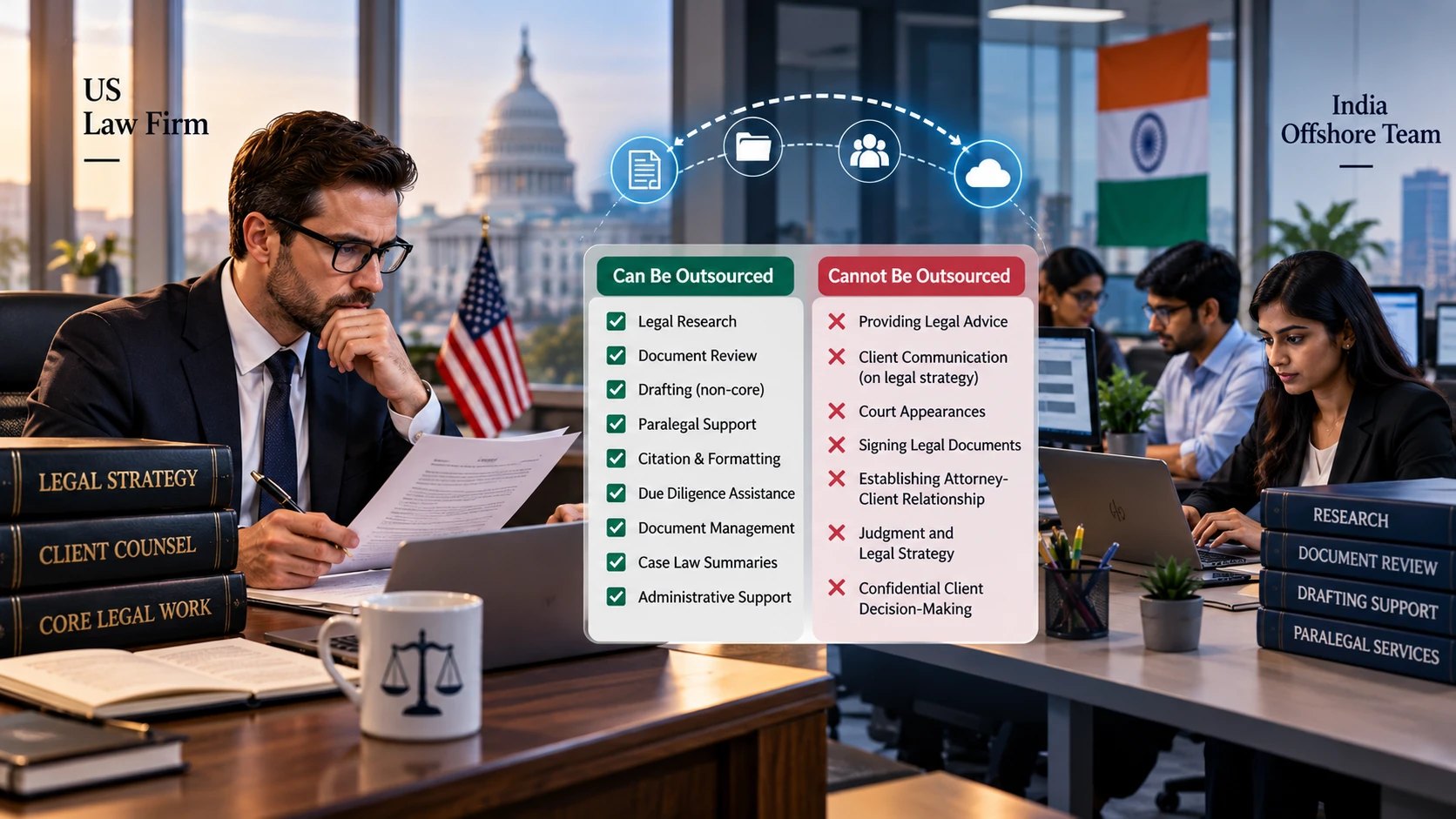
A virtual paralegal works under the supervision of a lawyer and does not give legal advice to clients or appear in court. Typical tasks include legal research and memo preparation, first drafts of pleadings, contracts and discovery responses, document review and summaries, chronology building, cite-checking, trade mark and patent docketing, and organising case files. The lawyer reviews and takes responsibility for the final work.
India has a large pool of law graduates and trained paralegals who are comfortable with English and common law. Time zones also help: work can be done overnight in the US, so that drafts are waiting each morning. For small and mid-sized firms, a virtual paralegal can be a flexible way to meet deadlines in busy periods without a permanent hire. A virtual paralegal India firms hire may also help with time zone coverage.
The model has limits. A virtual paralegal in India is not licensed to practise US law and cannot sign filings or advise clients. Work needing local knowledge, such as court rules or filing portals in a particular state, needs supervision by a US lawyer. Used for the right tasks, with clear instructions, the arrangement can be efficient. Used carelessly, it can create ethics and quality problems.
How the engagement works and what it costs
There are three common models. A firm can hire an individual freelancer or employee directly, use a staffing or outsourcing company that supplies and manages paralegals, or engage a law firm or legal process provider. A direct hire gives control but puts compliance, tax and management on you. A provider handles recruitment, infrastructure and security, but adds a margin and another party to supervise. The best model for a virtual paralegal India engagement depends on how much supervision you can give.
Costs vary with experience, task and model. Offshore paralegal rates are often quoted at a fraction of US rates, in a broad range of roughly US$10 to US$30 an hour for many tasks, against much higher rates for US paralegals, though these are only illustrative and depend on the provider and the work. Fixed fees, monthly retainers and per-task prices are also used. Ask for a written quote, and for details of what is included, such as software, supervision and quality review.
| Model | How it works | Trade-off |
|---|---|---|
| Direct hire | You hire an individual freelancer or employee | Most control, but you carry compliance and management |
| Staffing or outsourcing company | The company recruits, manages and secures the team | Adds a margin and another party to supervise |
| Law firm or legal process provider | Supplied as a service with quality review | Higher cost, more structure |
Count the full cost, not just the hourly rate. Include your own supervision time, training, security measures, software licences and the cost of correcting poor work. The saving comes from the difference between your rate and the offshore rate, less the overhead. A pilot project of a few weeks is a sensible way to test quality and fit before you commit. A good virtual paralegal India engagement is measured by quality and turnaround, not just price.
US ethics rules to follow
The American Bar Association’s Formal Opinion 08-451 says that lawyers may outsource legal and support services, including overseas, if they follow the Model Rules. The main duties are competence (Rule 1.1), confidentiality (Rule 1.6), and supervision of non-lawyer assistants (Rule 5.3). You must make sure that the person’s work is consistent with your professional obligations, and you remain responsible for the final product. State rules and opinions vary, so check them.
Confidentiality needs particular care. You should assess the provider’s security, check that confidentiality agreements bind the people who see client information, and consider whether client consent is needed. The ABA opinion says that you should consider the legal and ethical environment of the foreign country, including the protection of client confidences. Conflicts of interest must also be checked, as the provider may work for other firms.
Billing and unauthorised practice need attention. Under ABA guidance, you may charge for the actual cost of outsourced services plus a reasonable allowance for overhead, but not an unexplained markup, unless the client agrees. You must not let a non-lawyer practise law or share fees improperly under Rule 5.4 and 5.5. Write down your supervision process, review work before it goes to clients or courts, and keep the engagement letter and policies on file.
Indian law, security and quality
In India, only advocates enrolled under the Advocates Act, 1961 may practise law before Indian courts. A paralegal supporting a US law firm on US matters is not practising Indian law, but a provider that gives legal advice on Indian law to Indian clients must be an advocate or a law firm. Check the provider’s structure. Indian data protection law, the Digital Personal Data Protection Act, 2023, may apply to personal data processed in India, so ask how the provider complies. Check these points before you sign with a virtual paralegal India provider.
Security measures should be concrete: access through your own systems or a secure virtual desktop, multi-factor authentication, no local storage or downloads, encryption, role-based access, logging, background checks and a clean desk policy for staff. Ask for an information security policy, and for details on certifications such as ISO 27001, though a certificate is not enough by itself. Include a breach notification duty in the contract.
Quality comes from process. Give clear written instructions, templates and examples. Start with small tasks, review the output and give feedback. Set service levels for turnaround and accuracy. Keep one named supervisor on each side. A virtual paralegal India team that knows your style and standards becomes more valuable with time. If quality is poor, change the people or the model, not your standards.
Next steps and quick answers
Before you start, check your state bar’s rules, decide which tasks to delegate, run a conflicts and security review, sign a confidentiality and services agreement, and plan supervision. Begin with a pilot, measure the results and then expand. Tell clients where appropriate, and keep your engagement letters up to date. This is general information, not ethics advice, and your own bar’s guidance should be your first reference.
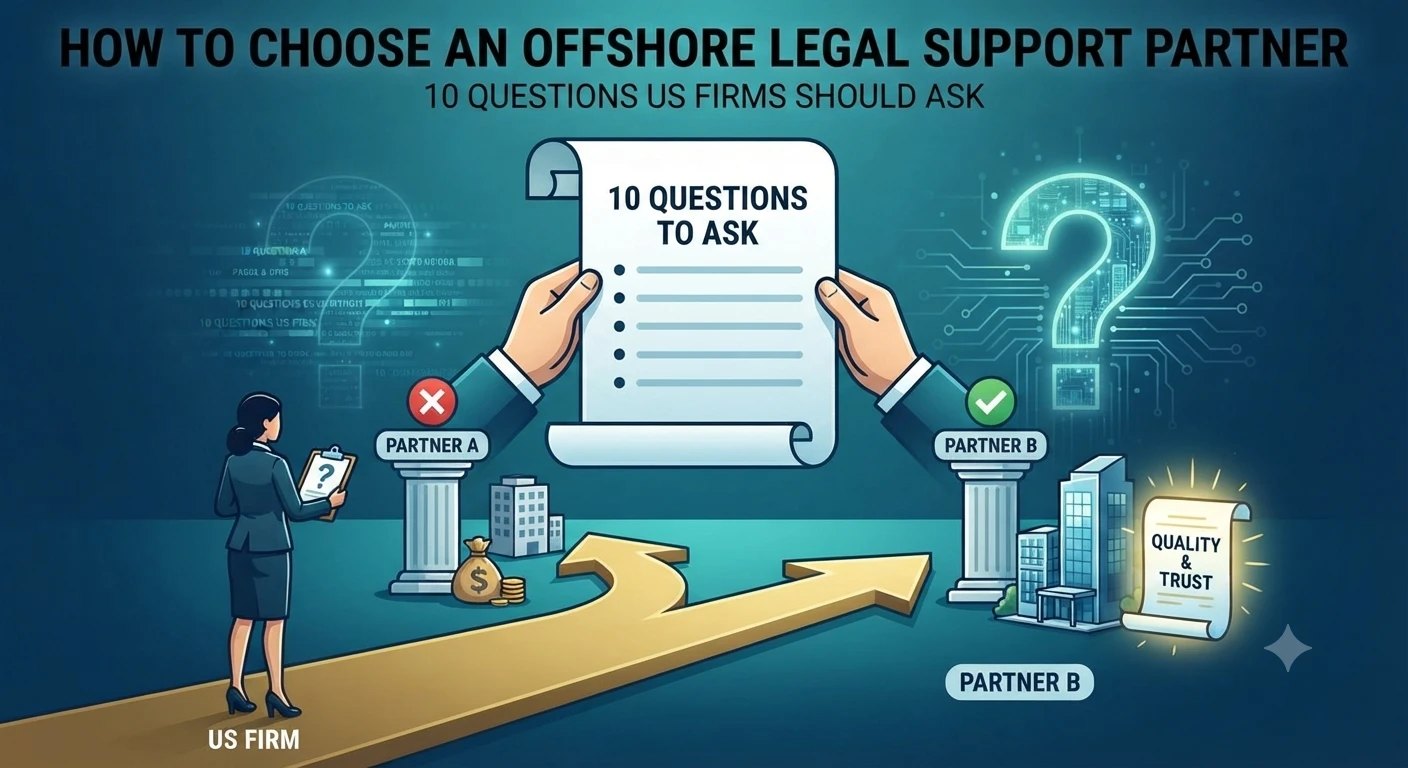
Related reading: offshore paralegal services for US law firms, ABA Formal Opinion 08-451 and outsourcing legal work to India, how to choose an offshore legal support partner, contract review outsourcing, trade mark docketing and USPTO deadlines, patent paralegal outsourcing in India and outsourced legal research: cost and when it is worth it; also outsourced contract management for US in-house teams; also offshore paralegal contracts: nine clauses and client consent for offshore legal work; also deposition summaries and medical chronologies from India and outsourcing trademark clearance searches to India.
Quick answers
Is it ethical to use a virtual paralegal in India?
Generally yes, if you follow the Model Rules: supervise the work, protect client confidences, check conflicts, bill properly and remain responsible for the result. ABA Formal Opinion 08-451 allows outsourcing, and state rules may add requirements.
How much does a virtual paralegal in India cost?
Rates are often quoted at a fraction of US rates, roughly US$10 to US$30 an hour for many tasks, but they vary by provider, skills and model. Get written quotes and count supervision and security costs.
Can a paralegal in India give legal advice to my clients?
No. A virtual paralegal supports you under your supervision and does not advise your clients or appear in court. Your lawyers remain responsible for the advice.
Can a virtual paralegal in India work on US litigation?
They can support your lawyers on tasks such as research, drafting support and document review under supervision. They cannot sign filings, appear in court or advise your clients.
Do I need client consent to outsource?
It depends on your state rules and the circumstances. ABA Formal Opinion 08-451 and state opinions guide this, and many firms disclose outsourcing in engagement letters.
Final word
Halverton & Co. is an Indian law firm advising US companies, founders, investors and law firms on Indian law, including legal support and outsourcing for US law firms, IP docketing and paralegal support, and cross-border compliance on confidentiality and data protection. We practise in Jharkhand, Maharashtra and before the Supreme Court of India, and work alongside US counsel, who advise on US law. Halverton & Co.: Where tech needs law! If you have a question about Indian law, write to us at office@halvertonandco.com, or get in touch.
This article reflects developments reported up to 31 October 2026. It is for general information only, is not legal advice, and does not create an attorney-client relationship. Halverton & Co. is an Indian law firm and does not advise on US law; US-law points should be confirmed with US counsel.
Sources
Related practice area
Startups & Venture
From incorporation to term sheet. The documents a company needs to be fundable.
View the practice areaComments
No account needed. Comments are reviewed before they appear, so yours will show here once approved. Please do not share confidential details or describe your own legal matter: replies are general discussion, not legal advice, and do not create an advocate-client relationship. For your own situation, write to office@halvertonandco.com.