Key takeaways
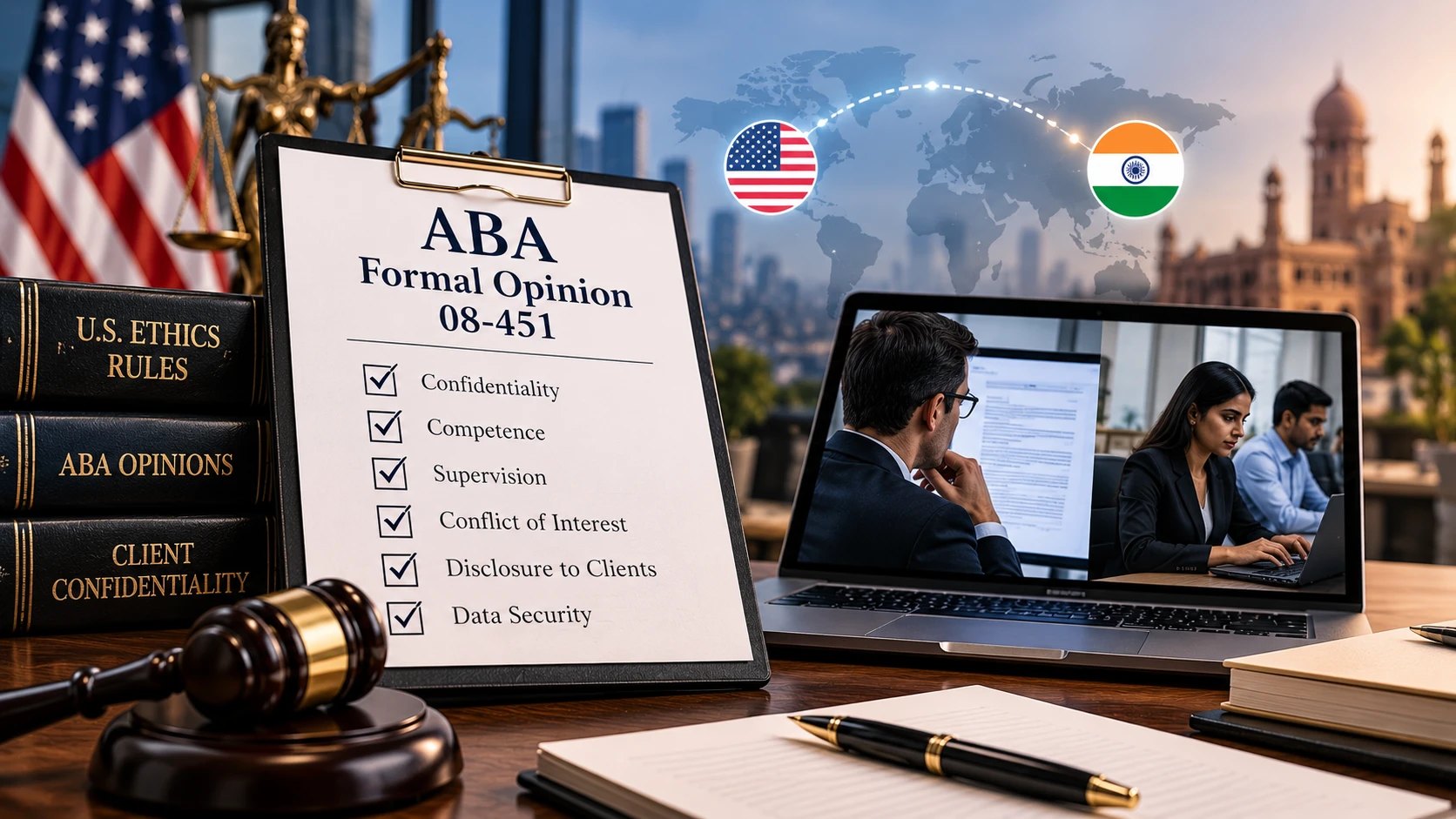
- US law firms can use offshore paralegal services under ABA Formal Opinion 08-451, with supervision, confidentiality and conflict checks.
- Research, document review, first drafts, deposition summaries, trademark searches and docketing suit offshore support.
- Legal advice, strategy, signing filings and appearances stay with US-licensed attorneys under Model Rule 5.5.
- Start with a pilot in one practice area with defined tasks and a fixed fee.
Small and mid-sized US law firms face a familiar squeeze. Clients push back on rates, associates are expensive and hard to keep, and a large share of the work on any matter is careful, detailed support work: research, document review, drafting first versions, organizing files. Offshore paralegal services exist to take that work off your attorneys’ desks.
But not everything can be outsourced, and the line matters. This guide explains which tasks US law firms can safely send to an offshore paralegal team in India, which tasks must stay with US-licensed attorneys, how supervision works in practice, and how to start without risk. The ethics framework is set out in our ABA 08-451 compliance checklist.
Why US law firms use offshore paralegal services
The outsourcing of legal and law-related services, often called legal process outsourcing, is a common practice in the legal services industry. The reasons are straightforward: lower cost for well-defined work, the ability to scale up for a big matter without hiring, and time-zone coverage that lets work progress overnight.
India is a natural partner for US firms. It has a large pool of English-speaking law graduates trained in a common-law system, familiar with precedent, statutory interpretation and legal drafting conventions similar to those in the US. The ABA itself noted in 2008 that US firms were sending a growing amount of legal work offshore, especially to India.
The ethical framework is settled. Under ABA Formal Opinion 08-451, outsourcing is permitted provided the lawyer remains ultimately responsible for competent legal services to the client. The real question for each firm isn’t whether offshore paralegal services are allowed, but which tasks to send.
What can be outsourced to an offshore paralegal team
The ABA’s 2008 analysis cited several common examples of outsourced tasks, and a well-trained, properly supervised paralegal can support many practice areas while maintaining high ethical standards. In practice, offshore paralegal services work best for tasks with clear instructions and a reviewable output.
Legal research and memo drafting are the most common: statutory and case law research, survey memos across states, and summaries of regulations. Document work follows close behind: first-level document review, privilege log preparation, deposition and transcript summaries, chronologies and exhibit indexes. Drafting support includes first drafts of routine contracts, NDAs, discovery requests and responses, and standard correspondence, all for attorney review.
Intellectual property support is a particular strength: trademark searches and clearance reports, docketing and deadline management, prior art searches and patent formalities, and portfolio audits; see our guides to trademark docketing and patent paralegal support. Corporate and transactional support includes due diligence reviews, contract abstraction, cap table and corporate records clean-ups, and compliance trackers; see contract review outsourcing. Each of these produces a work product your attorney can check, correct and adopt.
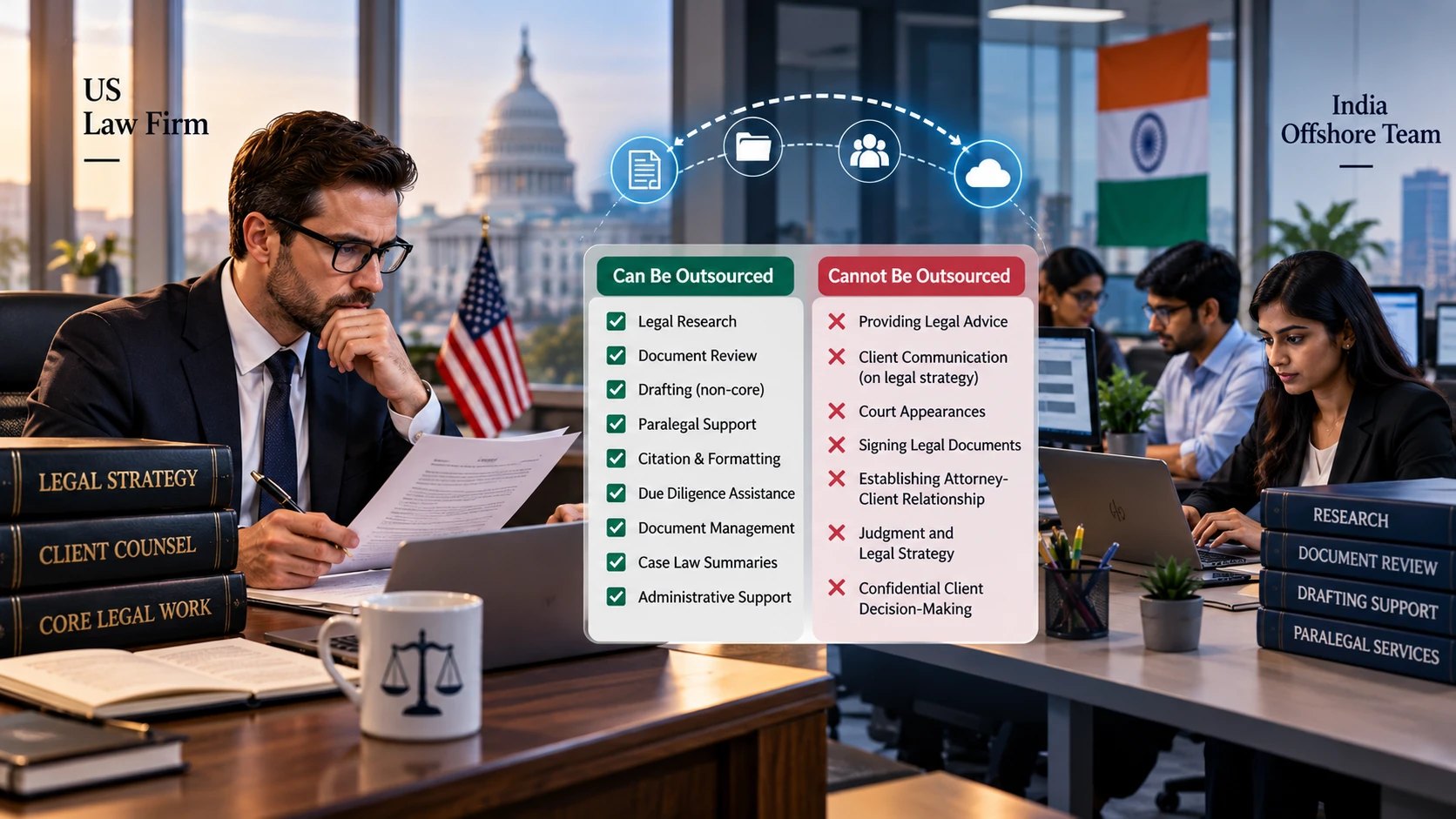
| Can be outsourced (attorney reviews) | Stays with US-licensed attorneys |
|---|---|
| Legal research and memo drafting | Legal advice to clients |
| First-level document review and privilege logs | Legal strategy and final privilege or responsiveness calls |
| First drafts of routine contracts, NDAs and discovery | Signing pleadings and filings |
| Trademark searches, docketing, prior art searches | Appearing in court or before agencies |
| Due diligence and contract abstraction | Negotiating on a client’s behalf |
What can’t be outsourced: unauthorized practice and attorney judgment
The boundary is set by Model Rule 5.5, which limits unauthorized practice of law. Foreign contractors must not be held out as licensed US lawyers and must work under the direct supervision of a US-licensed attorney. Done properly, the offshore contractor is performing support work, not practicing law.
That means certain things stay with your attorneys. Giving legal advice directly to clients, deciding legal strategy, signing pleadings or filings, appearing in court or before agencies, negotiating on a client’s behalf, and making final judgments on privilege or responsiveness all belong to licensed US lawyers. Before the USPTO, foreign-domiciled trademark applicants must be represented by a qualified US-licensed attorney, so offshore teams can prepare filings but not represent clients.
A useful test is simple: if the task requires someone to exercise independent legal judgment on behalf of a client, or to hold themselves out to a client, court or agency as the client’s lawyer, it stays in the US. If it produces a draft, a summary, a search or an analysis that a US attorney will review and adopt, it can be outsourced.
How supervision works in practice
A lawyer who outsources work to a paralegal or other nonlawyer, whether in the US or abroad, keeps the same ethical responsibilities as if they had done the work themselves. That includes assessing the paralegal’s education and relevant work experience before assigning work.
Good supervision is mostly good process. Assign a named supervising attorney for each matter. Give written instructions with the jurisdiction, the question, the format and the deadline. Hold a short call at the start of new types of work. Review every deliverable before it’s used, and give feedback so quality improves over time. Use secure shared workspaces rather than email attachments, limit access to what each task needs, and keep a record of who worked on what.
Communication habits matter as much as rules. Agree a single channel for questions, a daily or weekly check-in for active matters, and a clear way for offshore paralegals to flag uncertainty instead of guessing. Most quality problems with offshore paralegal services come from ambiguous instructions, not lack of skill, so the first few assignments are an investment in getting instructions right. Time zones help rather than hurt. Work sent at the end of the US day can be returned by the next morning, which is a real advantage on tight deadlines.
Starting with offshore paralegal services: risks, remedies and quick answers
Predictability is often what keeps firms using offshore support. Fixed-fee or monthly arrangements make budgets easier to manage than ad hoc contract staff, and they make it easier to quote flat fees to clients for routine work. A sensible way to start is a small pilot: one practice area, a defined set of tasks, a fixed fee and a review period of one to three months. Measure accuracy, turnaround and how much attorney time the work saves.
The main risks are confidentiality breaches, poor quality and unclear responsibility. The remedies are contractual: a written services agreement with confidentiality, data security, quality standards and termination rights, plus indemnities where appropriate. If something goes wrong, the supervising attorney’s review is the safety net, which is why it should never be skipped. On the Indian side, personal data in client files is also covered by India’s data protection law; see our guide to India’s DPDP Act for US SaaS companies.
Quick answers
Can US law firms legally use offshore paralegal services?
Yes, under ABA Formal Opinion 08-451, provided the lawyer supervises the work, protects confidentiality, checks conflicts and remains responsible to the client.
What tasks are best for offshore paralegals?
Legal research, document review, first drafts, deposition summaries, trademark searches, docketing, prior art searches and due diligence support.
What must stay with US attorneys?
Legal advice to clients, strategy, signing filings, court and agency appearances, and any work that holds someone out as the client’s lawyer.
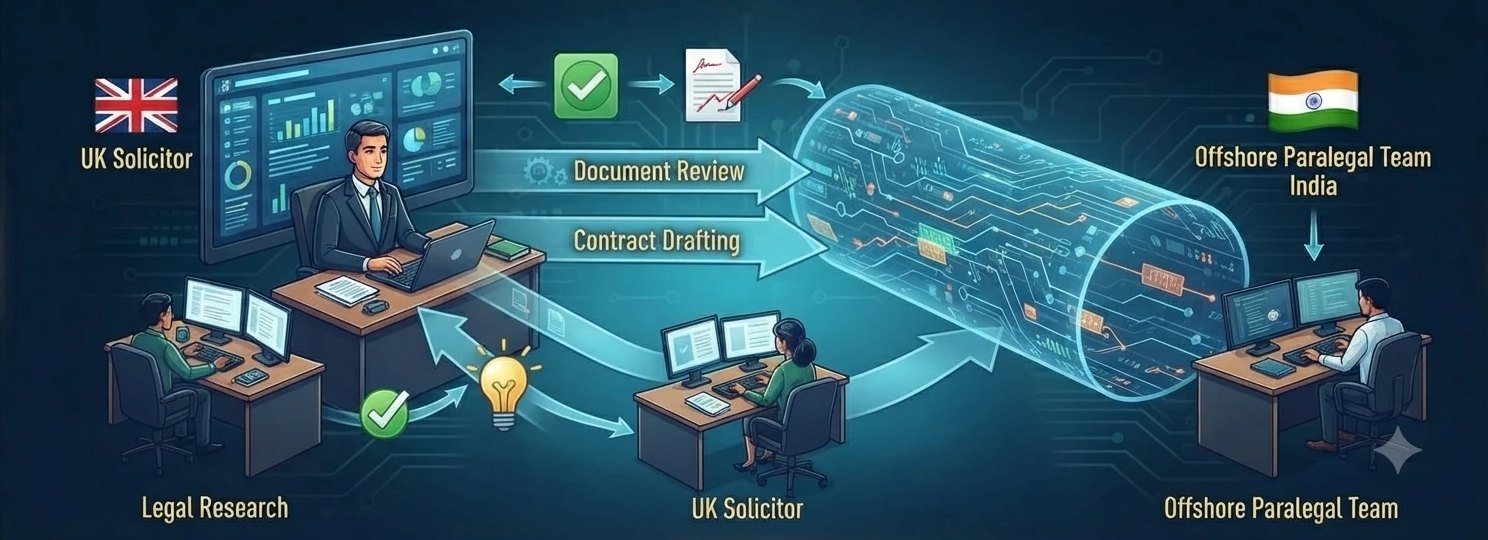
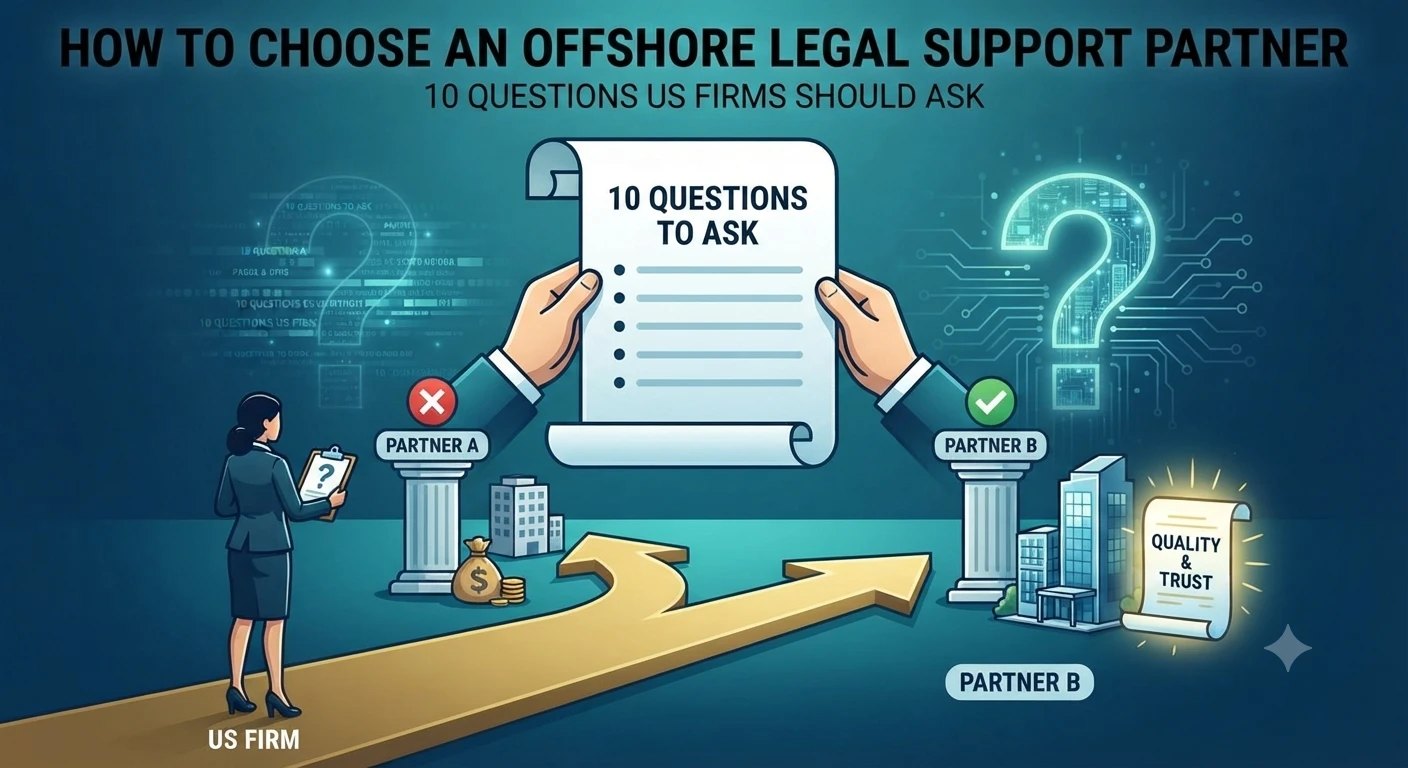
Related reading: choosing an offshore legal support partner; also paralegal support for solicitors (the UK equivalent); also hiring a virtual paralegal from India and outsourced legal research costs for US law firms.
Final word
Halverton & Co. is an Indian law firm. We do not provide US legal advice or represent clients before US courts or the USPTO, and nothing in this article is an offer of services. If you have a question about the Indian side of an offshore arrangement, such as Indian law, contracts or data protection, you can write to us at office@halvertonandco.com, or get in touch. Halverton & Co.: Where tech needs law!
This article reflects developments reported up to early October 2026. It is for general information only, is not legal advice, and does not create an attorney-client relationship. Halverton & Co. is an Indian law firm and does not advise on US law.
Related practice area
Startups & Venture
From incorporation to term sheet. The documents a company needs to be fundable.
View the practice areaComments
No account needed. Comments are reviewed before they appear, so yours will show here once approved. Please do not share confidential details or describe your own legal matter: replies are general discussion, not legal advice, and do not create an advocate-client relationship. For your own situation, write to office@halvertonandco.com.