Key takeaways
- Outsourced legal research is often quoted at a fraction of in-house cost, but supervision, rework and security add to the real figure.
- Common pricing models are hourly, fixed fee per memo and monthly retainer; offshore rates in the range of roughly US$15 to US$50 an hour are illustrative only.
- ABA Formal Opinion 08-451 allows outsourcing if you supervise, protect confidences, check conflicts and bill properly.
- Run a pilot and track the total cost per usable memo.
The outsourced legal research cost for a US law firm depends on the model, the complexity and the provider, and it is usually a fraction of what the same hours cost in-house. Offshore providers quote lower hourly or per-memo rates than US associates and paralegals, though the savings are real only when quality is high and supervision is built in. Readers who compare costs are often close to deciding, so this guide gives a practical way to compare options.
It explains pricing models, how to estimate the real cost, when outsourcing is worth it and when it is not, how to manage quality and risk, and the ethics rules to follow. Figures in this guide are illustrative, not quotes. It is written by an Indian law firm for US readers. Ethics rules vary by state, so check your own bar’s guidance.
What outsourced legal research is
Outsourced legal research means that a firm sends research tasks to an external provider, in the US or abroad, instead of doing them in-house. Typical tasks include researching a point of law for a motion, surveying cases and statutes, preparing a research memorandum, checking citations, tracking regulatory changes and summarising case law. The provider returns a written product that the firm’s lawyers review and adapt. The outsourced legal research cost depends on how well the task is defined.
Providers range from freelance researchers and small legal support firms to large legal process outsourcing companies and law firms. Many Indian providers work on US law with US legal databases supplied by the client or their own subscriptions. The work is done under the supervision of the client’s lawyers, and the provider does not advise the client’s clients directly.
Understanding the service helps in estimating costs. A short, clear research question has a different price from a complex multi-state survey. Be specific about the question, the jurisdictions, the sources to be used, the format and the deadline. Poorly defined tasks lead to extra hours and revisions, which add to the outsourced legal research cost without adding value.
Pricing models and typical costs
Three models are common. Hourly billing charges for the time spent, with rates that vary by the seniority of the researcher. Fixed-fee or per-memo pricing quotes a price for a defined task and gives certainty. Retainers or dedicated resource models charge a monthly fee for a set number of hours or a full-time researcher, which suits steady volume. Each has trade-offs between flexibility, predictability and control.
Typical figures are only a guide, and you should ask for written quotes. Offshore legal research is often quoted in a broad range of roughly US$15 to US$50 an hour depending on seniority and complexity, compared with much higher hourly costs for US associates, though a straight comparison ignores supervision time and review. A simple memo might be quoted at a few hundred dollars, and a complex one at more. Treat these as rough illustrations.
| Model | How it is priced | Best for |
|---|---|---|
| Hourly | Rate by seniority | Variable or exploratory work |
| Fixed fee or per memo | Quoted price for a defined task | Clear questions with a deadline |
| Retainer or dedicated researcher | Monthly fee for set hours or a full-time resource | Steady volume |
Add the hidden costs. Include your lawyer’s time to brief, review and revise the work, database fees, project management, security measures, onboarding time and the cost of rework if the quality is poor. Subtract the cost you would otherwise incur by using an associate or paralegal for the same work. The outsourced legal research cost that matters is the total cost per usable memo, not the headline rate.
When it is worth it
Outsourcing makes sense when the work is well defined, repeatable and not time-critical, when you have peaks that exceed capacity, or when a task needs more hours than your team can spare. Examples include background research on a new area of law, comparing statutes across states, preparing first-draft memos for review and large-volume citation checks. Time zone differences can help, because research can be ready the next morning. A clear task keeps the outsourced legal research cost predictable.
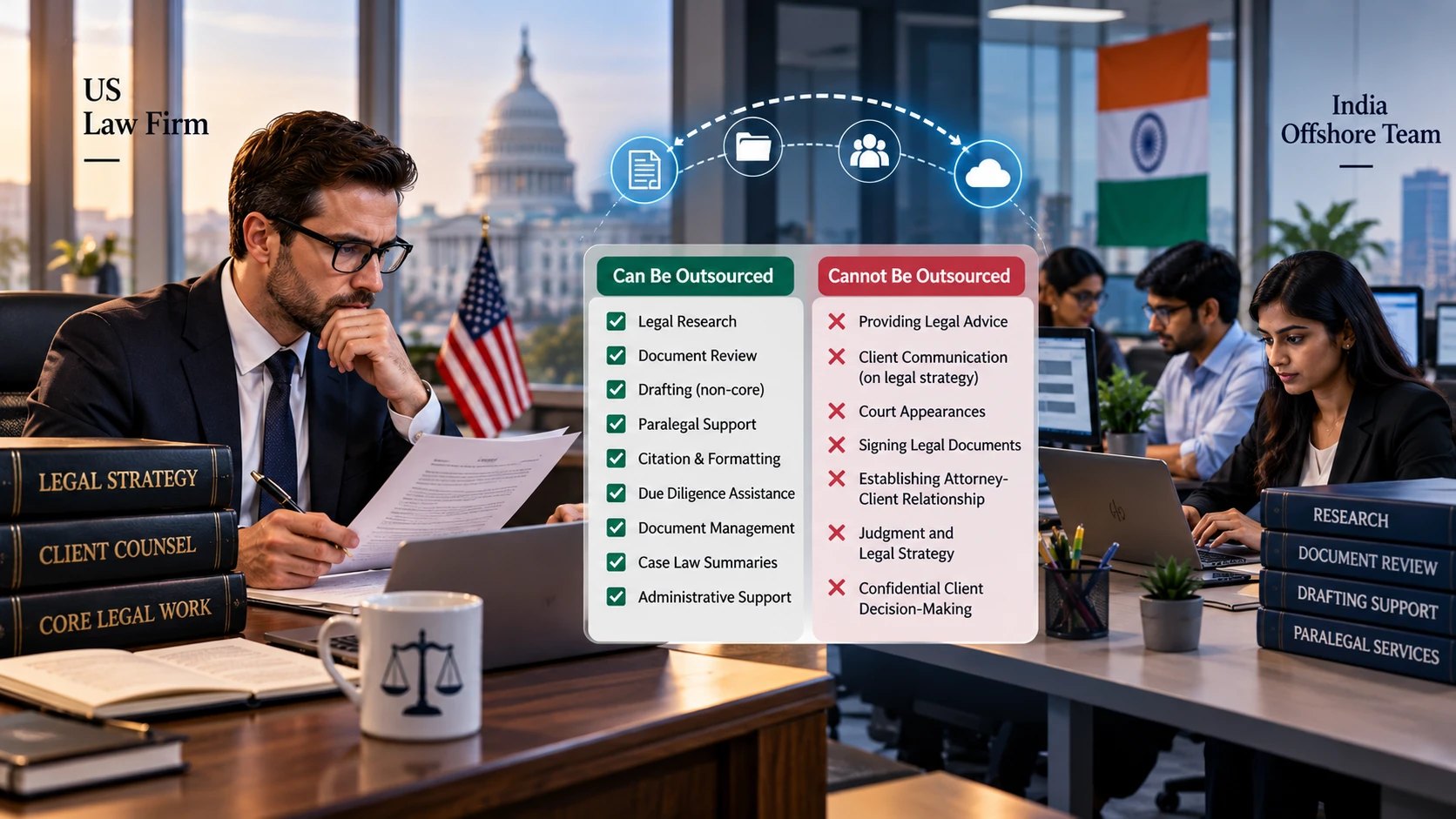
It makes less sense for work that depends on deep knowledge of the client or the court, such as strategic advice on a sensitive matter, or for urgent tasks that need constant back-and-forth. It also makes less sense if the matter is highly confidential and your security review cannot be satisfied, or if the research needs specialist knowledge that the provider does not have. Keep core judgment in-house.
Run a pilot. Send two or three typical tasks to a provider, and measure turnaround, accuracy, usefulness and the hours you spent on review. Compare the results with your internal cost. If the pilot works, expand step by step. If a provider’s work needs heavy rework, change the provider or the scope. A pilot turns an abstract cost comparison into evidence.
Quality, risk and ethics
Quality control is essential. Require that cases are checked against primary sources, that citations are verified and that the research states the question, the answer, the authorities and the limits or uncertainty. Beware of AI tools that can invent cases: ask the provider to disclose its use of AI and to verify every authority. The responsible lawyer must check the work before relying on it in any filing.
The ABA’s Formal Opinion 08-451 allows lawyers to outsource legal and non-legal support services, including abroad, if they comply with the Model Rules on competence, confidentiality and supervision of non-lawyers, and for billing and conflicts. You remain responsible for the work product. Check your state’s rules, consider whether client consent is needed and review the provider’s conflicts checks and security.
Protect confidentiality. Use confidentiality agreements, limit the information given, use secure systems and require breach notification. Ask how the provider stores data and whether it is processed in India under the Digital Personal Data Protection Act, 2023. Keep records of your supervision. A well-run arrangement can improve quality and lower cost. A careless one can create ethical and professional risk.
Next steps and quick answers
Define a few tasks you could outsource, get written quotes from two or three providers, run a pilot, track your own review time and calculate the cost per usable memo. Check your bar’s rules and put a written agreement in place. Review quarterly. This is general information, not ethics advice.
Related reading: offshore paralegal services for US law firms, ABA Formal Opinion 08-451 and outsourcing to India, how to choose an offshore legal support partner, contract review outsourcing, hiring a virtual paralegal from India, patent paralegal outsourcing in India and trade mark docketing and USPTO deadlines; also outsourced contract management for US in-house teams; also AI hallucination sanctions for lawyers; also deposition summaries and medical chronologies from India.
Quick answers
What is a typical outsourced legal research cost?
Offshore providers are often quoted in a broad range of roughly US$15 to US$50 an hour, or a fixed fee per memo, but costs vary with complexity and provider. Include your supervision and review time in the comparison.
Is outsourcing legal research ethical for US firms?
Generally yes, if you supervise the work, protect client confidences, check conflicts, bill appropriately and remain responsible for the result, as ABA Formal Opinion 08-451 explains. Check your state’s rules.
When is outsourced legal research worth it?
When tasks are well defined and repeatable, volume exceeds capacity or turnaround can be overnight. It is less suited to sensitive strategy work or urgent tasks needing close interaction.
Should I let the provider use AI tools for research?
Ask for disclosure of any AI use and require verification of every authority, because AI tools can invent cases. The responsible lawyer must check the work.
How do I compare providers?
Run a pilot with typical tasks and measure turnaround, accuracy and your own review time, then compare the cost per usable memo.
Final word
Halverton & Co. is an Indian law firm advising US companies, founders, investors and law firms on Indian law, including legal research and support for US law firms, outsourcing and offshore legal services, and India-related legal advice. We practise in Jharkhand, Maharashtra and before the Supreme Court of India, and work alongside US counsel, who advise on US law. Halverton & Co.: Where tech needs law! If you have a question about Indian law, write to us at office@halvertonandco.com, or get in touch.
This article reflects developments reported up to 31 October 2026. It is for general information only, is not legal advice, and does not create an attorney-client relationship. Halverton & Co. is an Indian law firm and does not advise on US law; US-law points should be confirmed with US counsel.
Sources
Related practice area
Startups & Venture
From incorporation to term sheet. The documents a company needs to be fundable.
View the practice areaComments
No account needed. Comments are reviewed before they appear, so yours will show here once approved. Please do not share confidential details or describe your own legal matter: replies are general discussion, not legal advice, and do not create an advocate-client relationship. For your own situation, write to office@halvertonandco.com.